How a club and a museum launched a community partnership
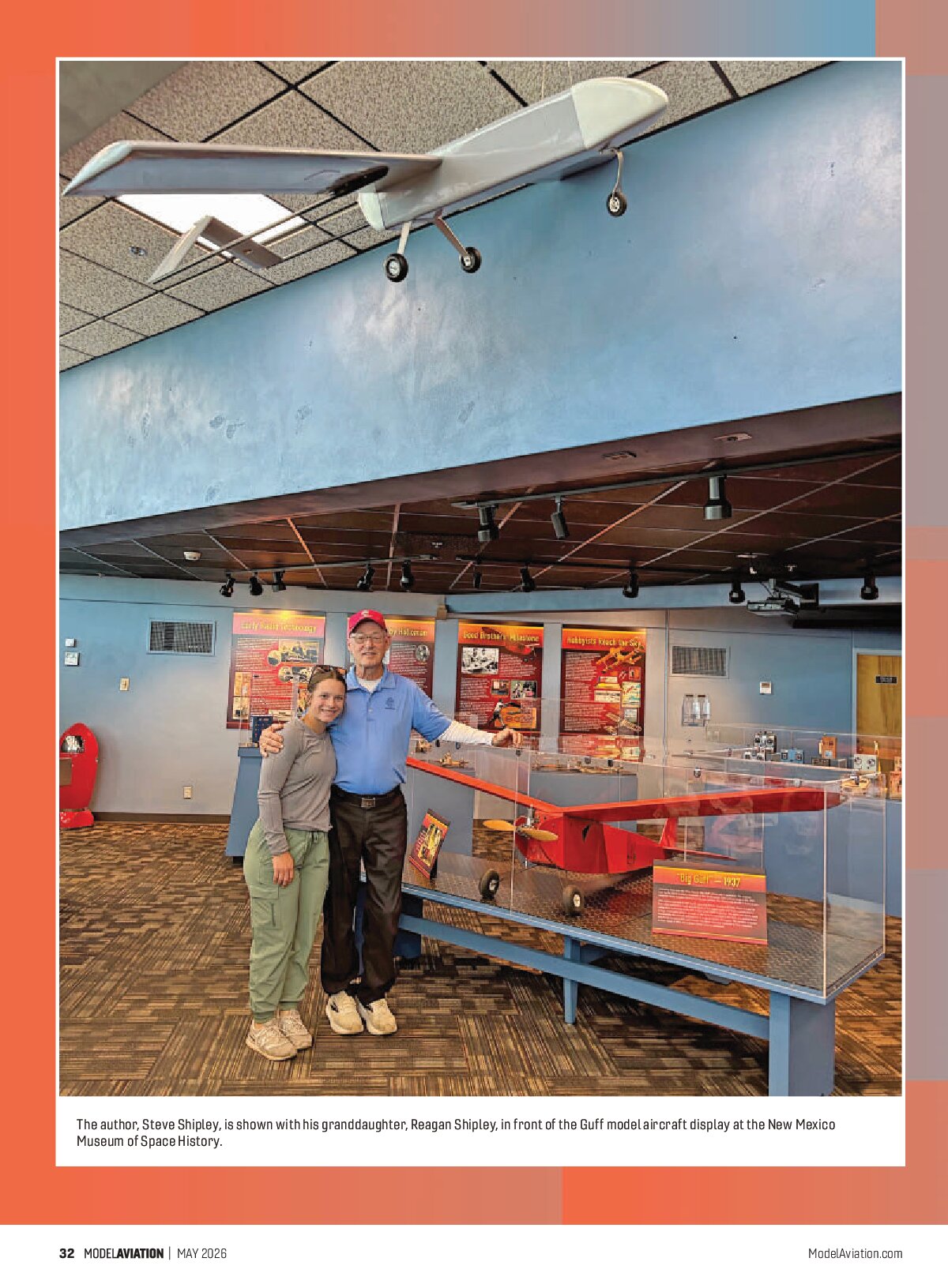
The author, Steve Shipley, is shown with his granddaughter, Reagan Shipley, in front of the Guff model aircraft display at the New Mexico Museum of Space History.
It started, as many meaningful things do, with a simple ask: “Would you be interested in an exhibit that features the history of RC?”
The Alamogordo RCers is a small but dedicated group of RC aviation enthusiasts in southern New Mexico. We have always been involved with our community and have long searched for ways to connect our passion for flight with the wider population. As a 30-member chartered AMA club that is tucked between the desert hills and the Sacramento Mountains, we needed to find an idea that was bigger than our modest size.
Our field sits on the outskirts of town, where the dry air and endless sky make for perfect flying conditions. During the weekends, we gather like every other club in the country. We fly nearly every kind of aircraft known to the modeling community. There is an unmistakable sense of camaraderie—from retired military fighter pilots and educators to active-duty officers and airmen from Holloman Air Force Base. We often have visitors, and we try to make them feel as welcome as any club member. Beyond our circle, however, few in Alamogordo really knew who the RCers were or what they represented. If our club was going to grow, we had to undertake a public relations attitude.
To begin our quest for community recognition, we joined the local chamber of commerce. The connections we have made have proven to be invaluable. We have been invited to attend and participate in the Holloman Air Force Base Open House, as well as the Legacy of Liberty Air Show. We were also asked to participate in the Big Bang STEM project, which is sponsored by the New Mexico Museum of Space History (NMMSH) in Alamogordo. We’ve held charity events and Toys for Tots drives and have volunteered for community service projects.
If you want your club to be recognized, it’s better if you dictate what you’re recognized for.
A Small Club With a Big Idea
The NMMSH is one of Alamogordo’s proudest institutions. A Smithsonian Affiliate museum, it sits high on a hill overlooking the Tularosa Basin. It celebrates the region’s role in space exploration—from the early rocket experiments of Robert Goddard to the nearby White Sands Missile Range. Thousands of visitors each year walk through its exhibits, marveling at the rockets, engines, capsules, and stories that define human ingenuity.
The museum is always seeking ways to expand its educational programming—especially in STEM outreach. The staff wanted more hands-on learning, something that could spark curiosity in students beyond the walls of the museum. When we reached out to suggest a partnership that could blend model aviation with space education, we had hoped for a small display somewhere in a corner of the museum.
“We immediately saw the alignment,” said Brianna Buller, the museum’s curator supervisor, along with Michael Shinaberry, the education director. “[The club is] about flight, engineering, and community. We’re about space, science, and education. It was a really good fit.”


From Conversation to Collaboration
At first, the collaboration was simple. The RCers club offered to set up an exhibit of model aircraft during one of the museum’s STEM projects. The museum, in turn, would provide space and publicity.
What started as a one-day event quickly took flight. The models—ranging from small electric airplanes to Scale replicas of historic aircraft—captured the imagination of young visitors. Kids crowded around the display tables, their faces showing their enthusiasm as club members explained how motors work, how radio signals control servos, and how aerodynamics govern lift and drag. One of the build-and-take gliders, provided by AMA and sponsored by District VIII Vice President Lawrence Harville, became one of the most sought-after prizes of the Big Bang event.
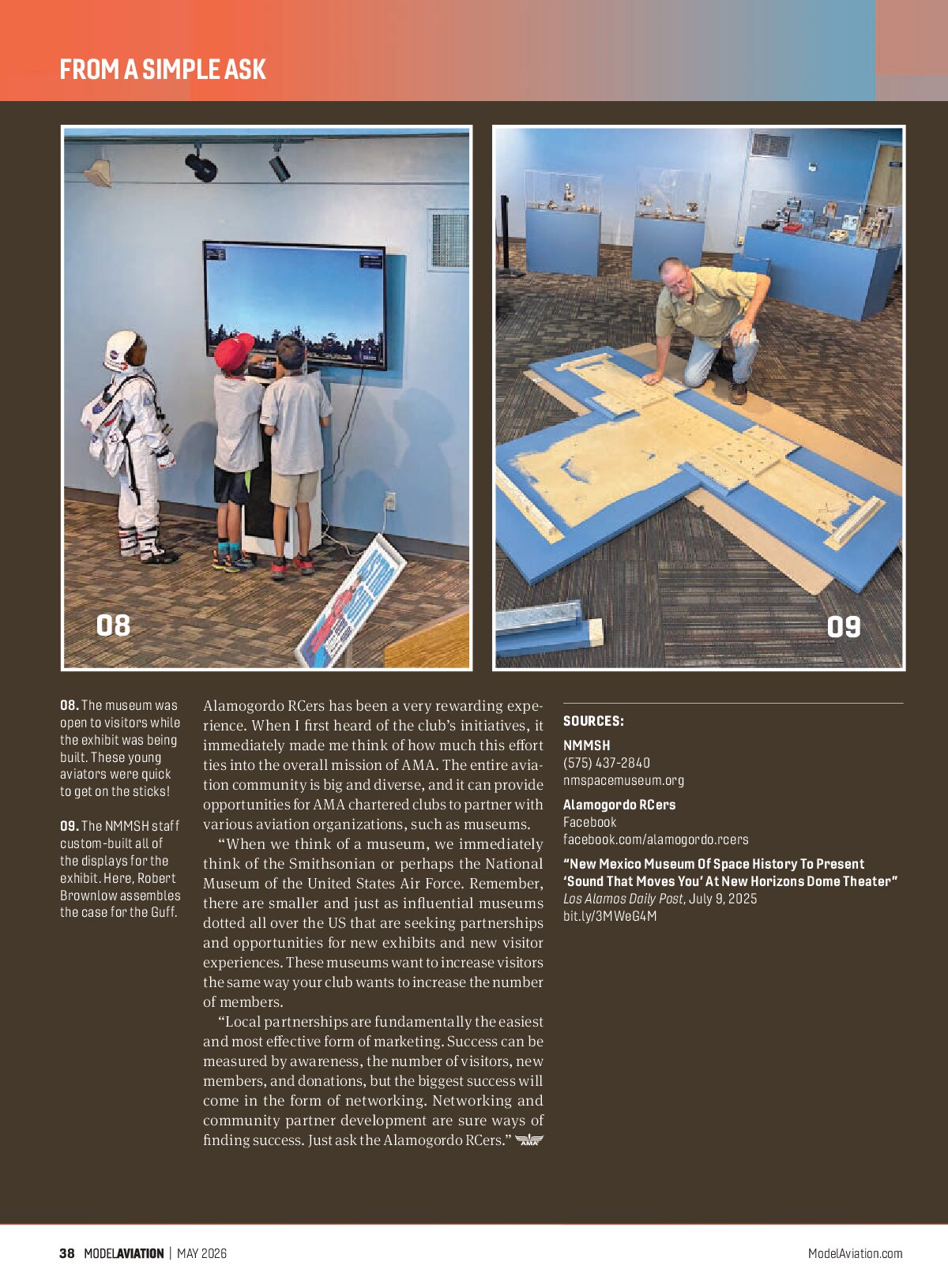
One volunteer, Roger Bryant, brought along his flight simulator, laptop, and large-screen TV to let children “fly” virtual airplanes. Another member, Gene Davis, demonstrated the difference between fixed-wing aircraft and quadcopters, explaining how drones are revolutionizing everything from photography to agriculture.
At the Big Bang STEM project, we were fortunate to have in our audience of participants the commander of the 49th Fighter Wing at Holloman Air Force Base, Col. John T. Ethridge; two state legislators, Sen. Jim Townsend and Rep. Jon Henry; Former U.S. Rep. Yvette Herrell; Alamogordo’s mayor, Sharon McDonald; and several city and county commissioners. It was a good event and the beginning of the relationship between the Alamogordo RCers and the NMMSH.

Building the Exhibit
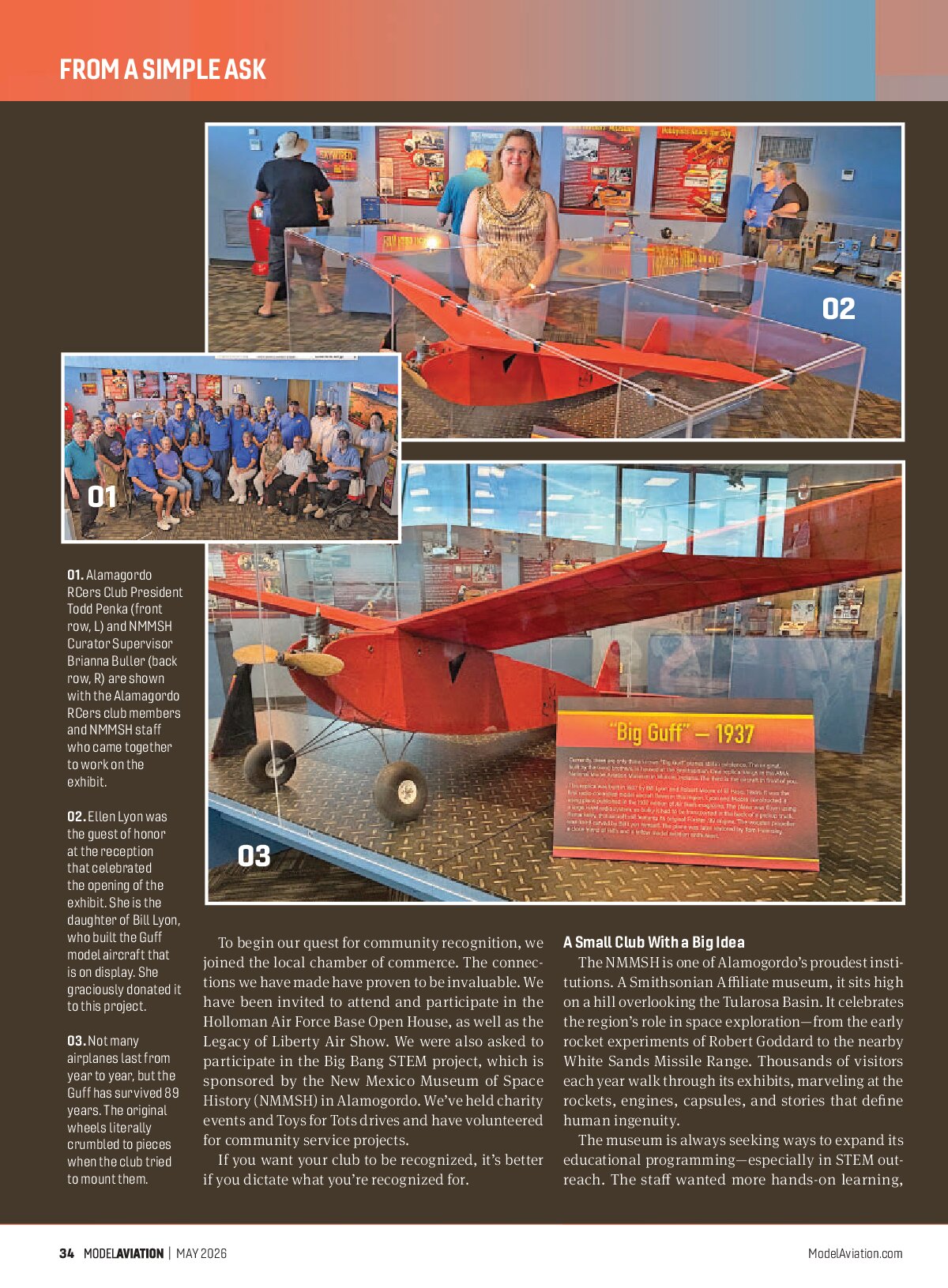
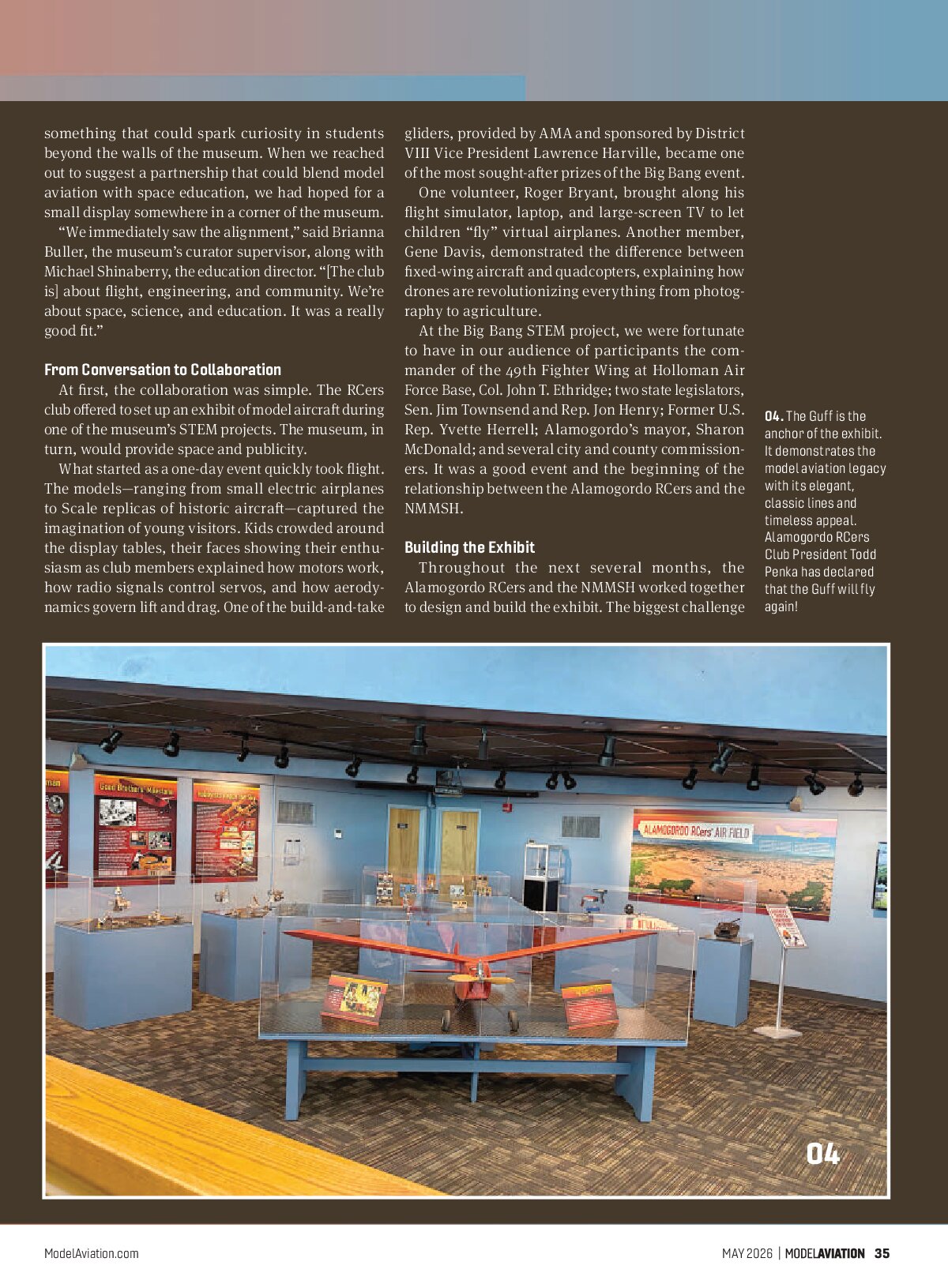
Throughout the next several months, the Alamogordo RCers and the NMMSH worked together to design and build the exhibit. The biggest challenge came from the museum’s lack of familiarity with RC. As the curator learned more about the club, our airplanes, and what we do, the exhibit grew from an idea to having a small display in a corner to encompassing the entire second floor of the museum!
For the RCers, many of whom are retired engineers, teachers, and veterans, it was a dream come true. “We’ve all spent years tinkering, building, flying—but sharing that with the broader community? That’s the real payoff,” said Club President Todd Penka. “You don’t need a big budget or a big club to make a difference—just people who care and a community willing to say yes.”
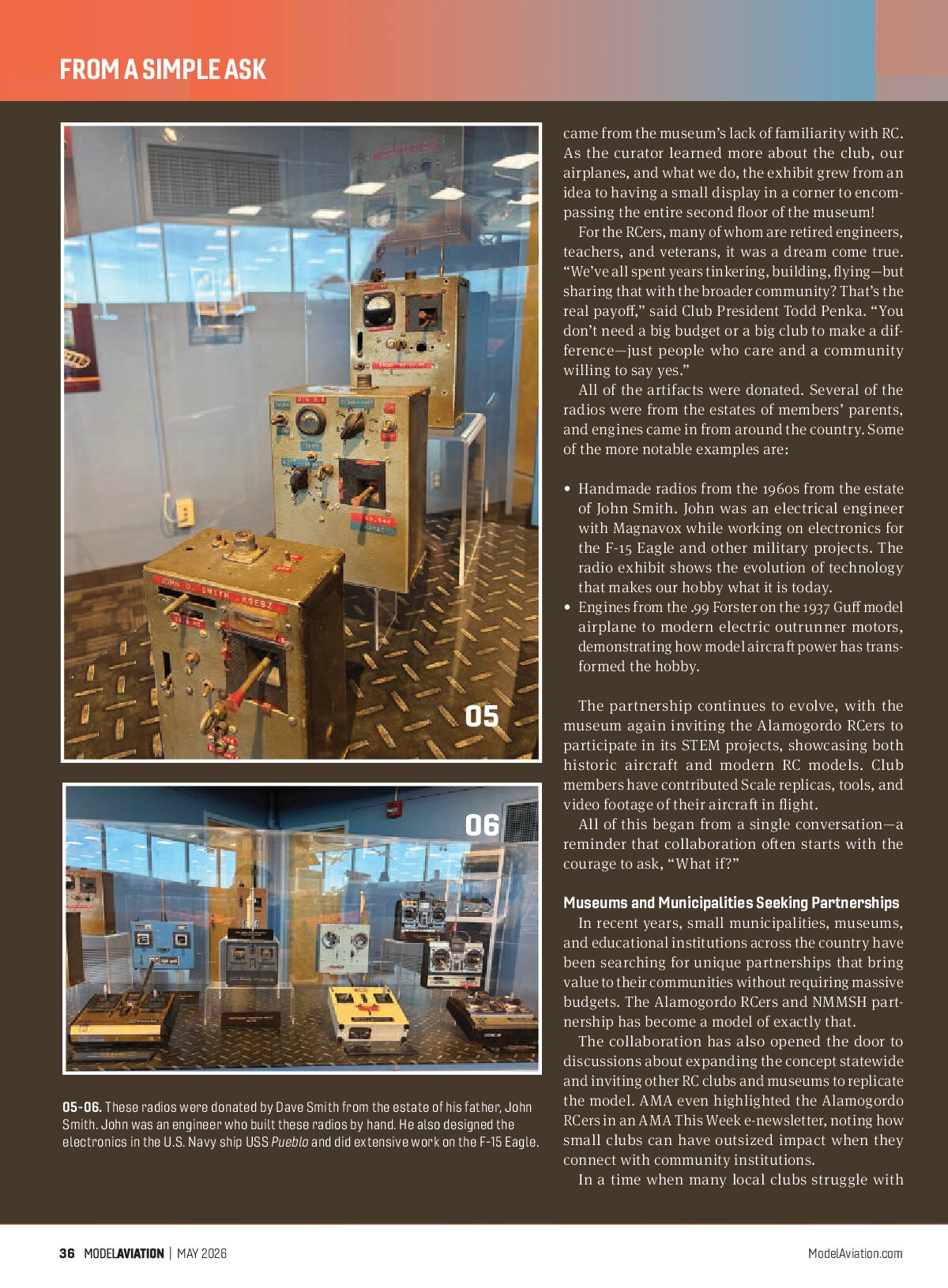
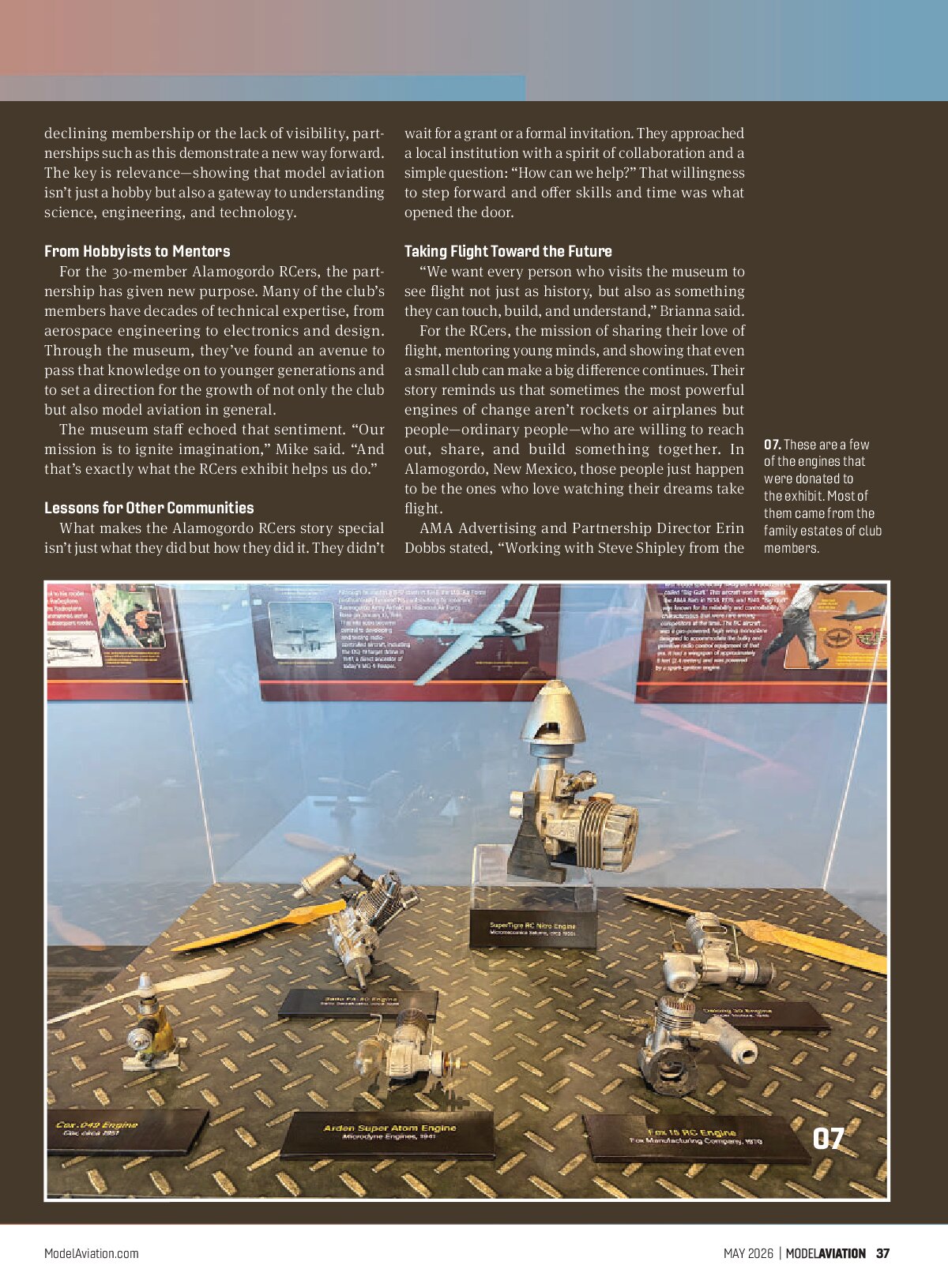
All of the artifacts were donated. Several of the radios were from the estates of members’ parents, and engines came in from around the country. Some of the more notable examples are:
- Handmade radios from the 1960s from the estate of John Smith. John was an electrical engineer with Magnavox while working on electronics for the F-15 Eagle and other military projects. The radio exhibit shows the evolution of technology that makes our hobby what it is today.
- Engines from the .99 Forster on the 1937 Guff model airplane to modern electric outrunner motors, demonstrating how model aircraft power has transformed the hobby.


The partnership continues to evolve, with the museum again inviting the Alamogordo RCers to participate in its STEM projects, showcasing both historic aircraft and modern RC models. Club members have contributed Scale replicas, tools, and video footage of their aircraft in flight.
All of this began from a single conversation—a reminder that collaboration often starts with the courage to ask, “What if?”
Museums and Municipalities Seeking Partnerships
In recent years, small municipalities, museums, and educational institutions across the country have been searching for unique partnerships that bring value to their communities without requiring massive budgets. The Alamogordo RCers and NMMSH partnership has become a model of exactly that.
The collaboration has also opened the door to discussions about expanding the concept statewide and inviting other RC clubs and museums to replicate the model. AMA even highlighted the Alamogordo RCers in an AMA This Week e-newsletter, noting how small clubs can have outsized impact when they connect with community institutions.
In a time when many local clubs struggle with declining membership or the lack of visibility, partnerships such as this demonstrate a new way forward. The key is relevance—showing that model aviation isn’t just a hobby but also a gateway to understanding science, engineering, and technology.
From Hobbyists to Mentors
For the 30-member Alamogordo RCers, the partnership has given new purpose. Many of the club’s members have decades of technical expertise, from aerospace engineering to electronics and design. Through the museum, they’ve found an avenue to pass that knowledge on to younger generations and to set a direction for the growth of not only the club but also model aviation in general.
The museum staff echoed that sentiment. “Our mission is to ignite imagination,” Mike said. “And that’s exactly what the RCers exhibit helps us do.”
Lessons for Other Communities
What makes the Alamogordo RCers story special isn’t just what they did but how they did it. They didn’t wait for a grant or a formal invitation. They approached a local institution with a spirit of collaboration and a simple question: “How can we help?” That willingness to step forward and offer skills and time was what opened the door.

Taking Flight Toward the Future
“We want every person who visits the museum to see flight not just as history, but also as something they can touch, build, and understand,” Brianna said.
For the RCers, the mission of sharing their love of flight, mentoring young minds, and showing that even a small club can make a big difference continues. Their story reminds us that sometimes the most powerful engines of change aren’t rockets or airplanes but people—ordinary people—who are willing to reach out, share, and build something together. In Alamogordo, New Mexico, those people just happen to be the ones who love watching their dreams take flight.
AMA Advertising and Partnership Director Erin Dobbs stated, “Working with Steve Shipley from the Alamogordo RCers has been a very rewarding experience. When I first heard of the club’s initiatives, it immediately made me think of how much this effort ties into the overall mission of AMA. The entire aviation community is big and diverse, and it can provide opportunities for AMA chartered clubs to partner with various aviation organizations, such as museums.
“When we think of a museum, we immediately think of the Smithsonian or perhaps the National Museum of the United States Air Force. Remember, there are smaller and just as influential museums dotted all over the US that are seeking partnerships and opportunities for new exhibits and new visitor experiences. These museums want to increase visitors the same way your club wants to increase the number of members.
“Local partnerships are fundamentally the easiest and most effective form of marketing. Success can be measured by awareness, the number of visitors, new members, and donations, but the biggest success will come in the form of networking. Networking and community partner development are sure ways of finding success. Just ask the Alamogordo RCers.”


SOURCES
- NMMSH
(575) 437-2840 - nmspacemuseum.org
- Alamogordo RCers
Facebook - facebook.com/alamogordo.rcers
- “New Mexico Museum Of Space History To Present ‘Sound That Moves You’ At New Horizons Dome Theater”
Los Alamos Daily Post, July 9, 2025 - bit.ly/3MWeG4M