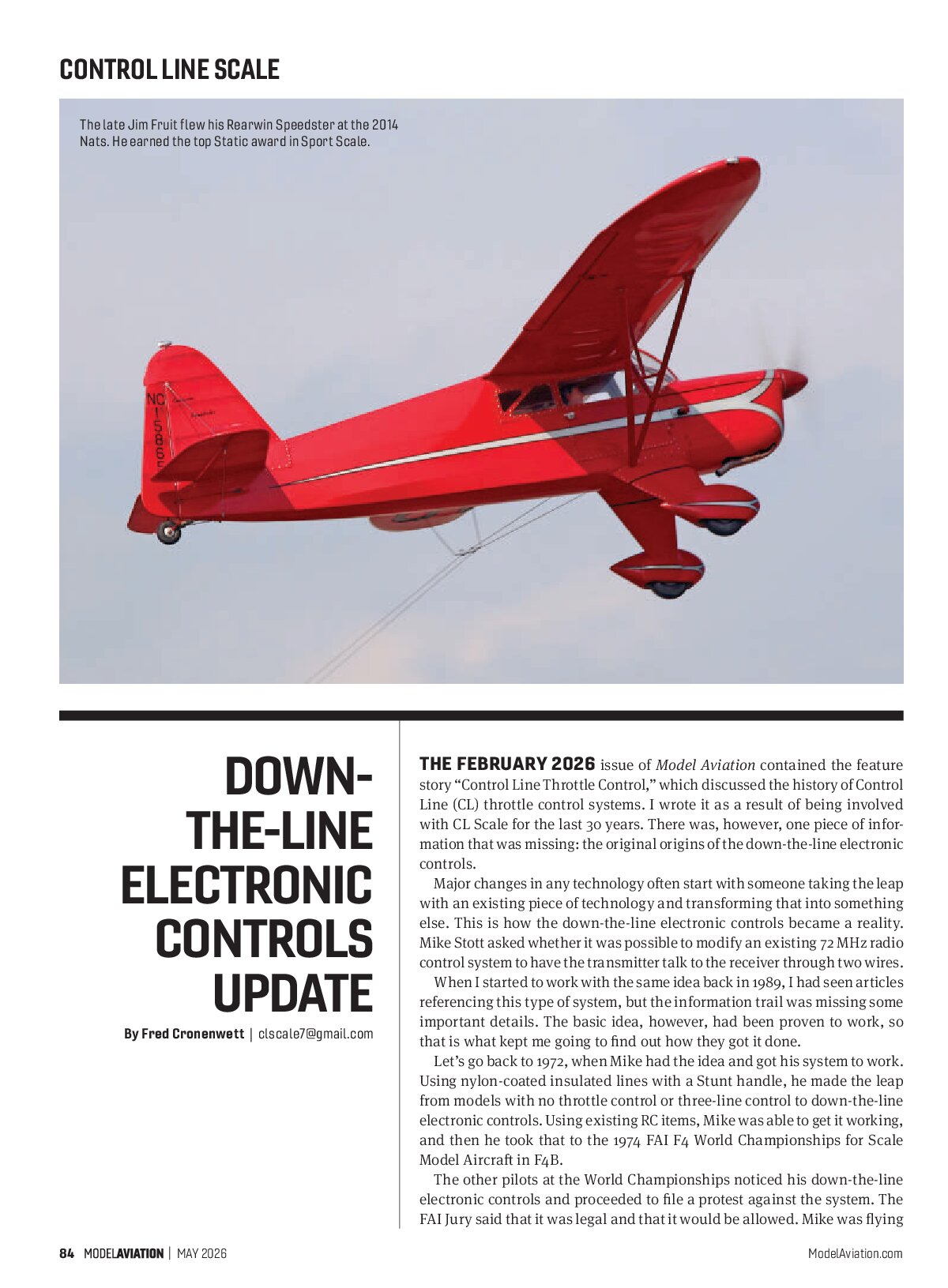
The late Jim Fruit flew his Rearwin Speedster at the 2014 Nats. He earned the top Static award in Sport Scale.
Down-the-Line Electronic Controls Update
By Fred Cronenwett | clscale7@gmail.com
The February 2026 issue of Model Aviation contained the feature story “Control Line Throttle Control,” which discussed the history of Control Line (CL) throttle control systems. I wrote it as a result of being involved with CL Scale for the last 30 years. There was, however, one piece of information that was missing: the original origins of the down-the-line electronic controls.
Major changes in any technology often start with someone taking the leap with an existing piece of technology and transforming that into something else. This is how the down-the-line electronic controls became a reality. Mike Stott asked whether it was possible to modify an existing 72 MHz radio control system to have the transmitter talk to the receiver through two wires.
When I started to work with the same idea back in 1989, I had seen articles referencing this type of system, but the information trail was missing some important details. The basic idea, however, had been proven to work, so that is what kept me going to find out how they got it done.
Let’s go back to 1972, when Mike had the idea and got his system to work. Using nylon-coated insulated lines with a Stunt handle, he made the leap from models with no throttle control or three-line control to down-the-line electronic controls. Using existing RC items, Mike was able to get it working, and then he took that to the 1974 FAI F4 World Championships for Scale Model Aircraft in F4B.
The other pilots at the World Championships noticed his down-the-line electronic controls and proceeded to file a protest against the system. The FAI Jury said that it was legal and that it would be allowed. Mike was flying with the late Mike Gretz at the time that he developed the system.
The Bill Young handle, Clancy Arnold’s electronics, and any of the permanently converted 72 MHz RC transmitters and receivers, were all doing the same basic thing. I converted my Ace three-channel radio with the help of Ace RC. Other pilots told me that it had been done before; however, I didn’t know when and how it had been done in the past, or by whom.
Mike Stott wrote the rules for the Sport Scale event, and he was the first “CL Scale” columnist for Model Aviation. Mike Gretz was the next “CL Scale” columnist. Both of them wrote information about the system in their columns.
The technology that Mike Stott developed in 1972 basically never changed until CL Scale adopted 2.4 GHz controls in 2013. The use of 2.4 GHz radio control was another leap in technology for CL Scale. Grant Hiestand wrote that rules proposal, which was approved. The 2.4 GHz system has since transformed the hobby for CL Scale. We use all sorts of products that were designed for RC use.
Fun Scale Rules Updated
The Fun Scale rules have changed for static judging. You will receive either zero or 10 points. Before, the judges could give partial scores for the color and markings, depending upon how closely you copied the pictures that you had in your documentation.
A pilot typically enters an ARF into Fun Scale that might or might not match a full-scale aircraft. The rules are now written so that if the outline, color, and markings resemble the subject aircraft or a similar aircraft of the era, you will receive 10 points.
In the past, we have seen one- or two-point differences between the static points in Fun Scale. When the flight scores came in really close, those one or two points made a difference. This will also speed up the static judging time for Fun Scale because the model will be able to be judged very quickly.
There are still the same 100 flight points and 10 static points, so the majority of the points are the flight score. Practice your flight options and remember to fly the model like the full-scale aircraft would be flown.
100th Anniversary of the Nats!
The CL Scale events at the 2026 AMA Nats will take place on July 9-12 in Muncie, Indiana, at the International Aeromodeling Center. Because Team USA for F4B will be traveling to England for the FAI F4 World Championships during that time, I have been asked to be the Nats CL Scale event director.
The static judging will take place at the Site 6 CL Scale flying circles so that we can put in round one after the static judging is complete on Friday, July 10. The weather could be an issue, so we need to take advantage of the flying time on Friday, Saturday, and Sunday.
You can save yourself a lot of time by printing out the judging forms, which are a part of the CL Scale rules on the AMA website; the link can be found in “Sources.” You will need two static judging forms and two flight judging forms per flight. If you plan on flying all four rounds, you will need eight flight judging forms.
There are four mandatory flight maneuvers that are judged: takeoff, 10 level laps, realism, and landing. To get the maximum amount of realism points, the key is to fly the model like the full-scale aircraft would be flown. When you put in practice flights, you can figure out the best way to do touch-and-go landings.
There are several options that are judged throughout the entire flight, so you don’t have to perform them on dedicated laps. Flaps, throttle control, and retractable landing gear will be judged from start to finish. With flaps, remember to use them during takeoff, the touch-and-go, and then land in the proper manner. If you fly with retractable landing gear, retract the gear right after takeoff then extend it on final approach into the landing pattern.
Options fall into two groups: mechanical (flaps and retractable landing gear) and flight options. The flight options include the touch-and-go, an overshoot, a 45° flight, and others that are listed in the CL Scale rules. An overshoot can be difficult to do correctly, so read the CL Scale rules for a description of how it should be done. Remember to perform the options in front of the judges. You also have to call out when you are going to perform an option.
Contest Calendar
The Northwest Regionals will get the 2026 contest season started Memorial Day weekend in Roseburg, Oregon. Check the online AMA Event Calendar, as well as the “Sanctioned Event Calendar” in Model Aviation, to find the dates for other events.
The AMA Nats will be flown in July. Check the National Association of Scale Aeromodelers (NASA) website to determine when and where the CL portion of the NASA Scale Classic will be held in 2026.
- Northwest Regionals: May 22-24; Roseburg, Oregon
- Brodak Fly-In: June 15-19; Carmichaels, Pennsylvania
- AMA CL Scale Nats: July 9-12; Muncie, Indiana
- Midwest Regional C/L Championships: September 5-6; Aurora, Illinois
- Broken Arrow CL Stunt & Scale Contest: September 19-20; Buder Park, Valley Park, Missouri
- NASA Scale Classic (CL only): TBD
Land softly!

SOURCES
- NASA
- nasascale.org
- Flying Lines
News of Northwest Control-Line Model Aviation - flyinglines.org
- AMA Rulebook 2026-2027 Control Line Scale
- modelaircraft.org/sites/default/files/events/rule-books/2026/Control_Line_Scale_2026-2027.pdf
AMA Event Calendar
modelaircraft.org/event-calendar - Brodak Manufacturing & Distributing Company, Inc.
(724) 966-2726 - brodak.com