F2A WORLD CHAMPIONSHIPS
A SUMMARY OF THIS YEAR'S
FIERCE CL SPEED COMPETITION
By Fred Cronenwett
clscale7@gmail.com
Photos courtesy of the author

F2A Control Line (CL) Speed has only one purpose, and that is to fly as fast as possible on a .15-size engine without any nitromethane in the fuel. People ask why the models only have a left wing and no right-wing panel. The models are not flown for sport or at fun-flys because their design and layout for competition are serious investments.
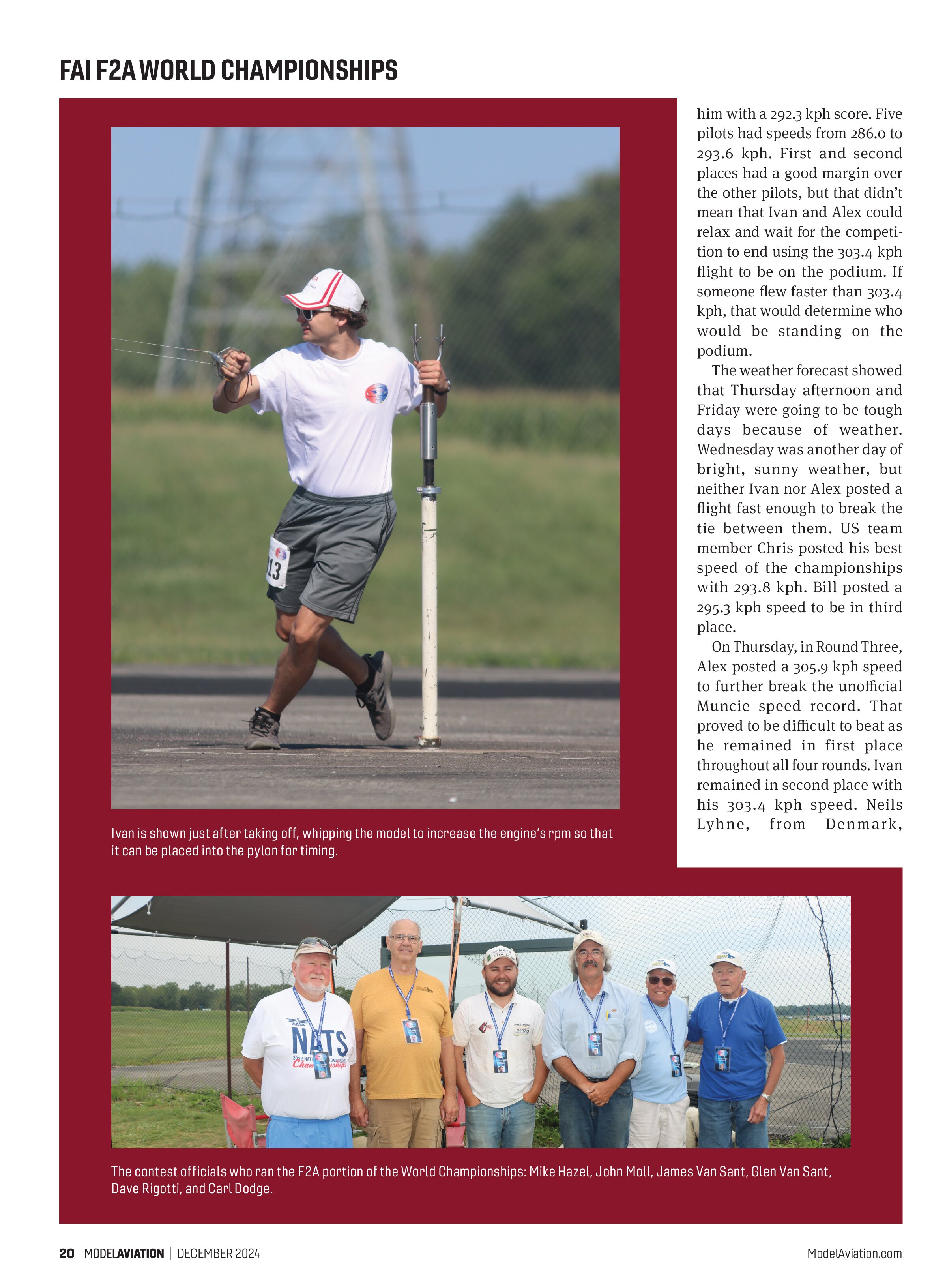
The model has metal skids on the bottom on which to land, and the dolly that is used for takeoff drops away quickly after it is airborne. At first, the model is flying slowly because the rpm on the engine has not yet peaked. The model has a tuned pipe, so it is whipped to get the rpm to peak. If the settings are right, the pilot will put the handle into the pylon, and then the timing starts for nine laps. The pylon keeps the model in a perfect circle during the timed portion of the flight.
If the engine settings are not right, the pilot can shut down the flight, land, and restart, but they only have a limited amount of time to make any needle-valve changes, restart, and get flying again. If they don’t get a flight in, they can do so again after everyone else has flown.
The typical humidity levels in Muncie, Indiana, where the event took place, create a challenging environment to get an F2A model to fly fast. The altitude also reduces the amount of oxygen in the air compared with flying sites that are closer to sea level. The fastest speed flown in Muncie before the 2024 F2 World Championships was 303.2 kph. That changed after this year’s championships were completed.
There were four rounds flown, and they started on Tuesday, August 13. Monday, the day before, held the official processing and the opening ceremonies. The F2 World Championships included F2A (CL Speed), F2B (CL Aerobatics), F2C (CL Racing), and F2D (CL Combat). We could hear the Combat matches going on from the Speed circle. When a motor sound came to a sudden stop with a thud, we could tell that there had been a kill or midair.
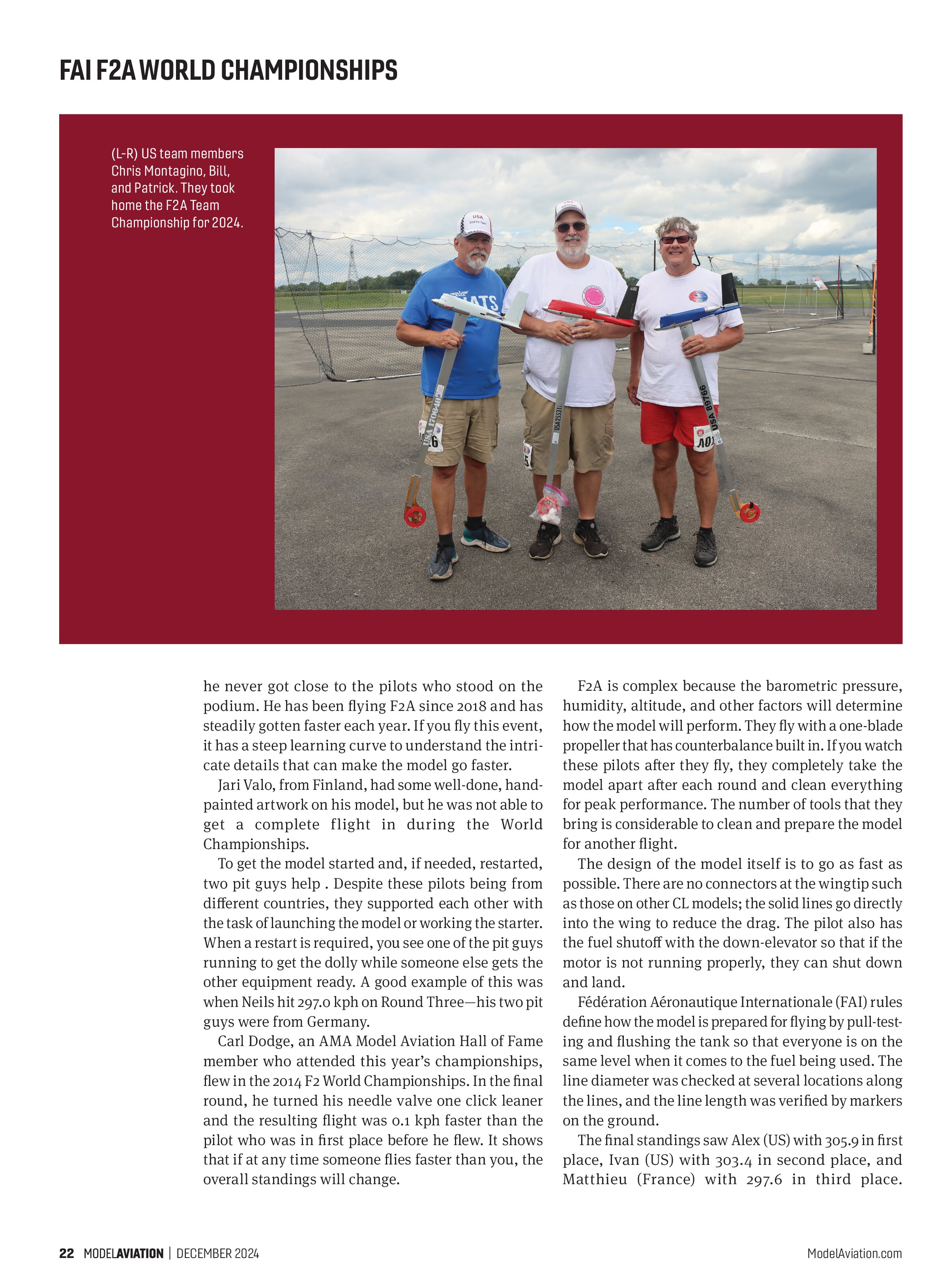
With pilots from the US, France, Germany, Denmark, Cuba, Finland, Brazil, Austria, and Canada in F2A, each pilot was given a certain amount of time to put in an official flight. The F2A champion from the 2022 World Championships could come back. That meant that Alex Valishev, who took first place in 2022, could return to defend his title as the F2A World Champion. His son, Ivan Valishev, was the 2022 Junior F2A World Champion, so he also returned. The US had a total of five pilots, but only Chris Montagino, Bill Hughes, and Patrick Hempel’s flight scores would be used for the team score. In 2022, the US took home the F2A Team trophy.
With sunny weather, Round One flight scores were used to determine the flight order for Round Two. Five pilots did not get a complete flight in; however, Ivan and Alex were tied with a speed of 303.4 kph. The next question was, “who is going to fly faster in Rounds Two, Three, and Four?” They both broke the unofficial fastest speed flown in Muncie. Now the fastest speed flown in Muncie is 303.4 kph.
Team USA was looking great at this point because Bill had flown a 293.6 kph, with Patrick right behind

FAI F2A WORLD CHAMPIONSHIPS

him with a 292.3 kph score. Five pilots had speeds from 286.0 to 293.6 kph. First and second places had a good margin over the other pilots, but that didn’t mean that Ivan and Alex could relax and wait for the competition to end using the 303.4 kph flight to be on the podium. If someone flew faster than 303.4 kph, that would determine who would be standing on the podium.
The weather forecast showed that Thursday afternoon and Friday were going to be tough days because of weather. Wednesday was another day of bright, sunny weather, but neither Ivan nor Alex posted a flight fast enough to break the tie between them. US team member Chris posted his best speed of the championships with 293.8 kph. Bill posted a 295.3 kph speed to be in third place.
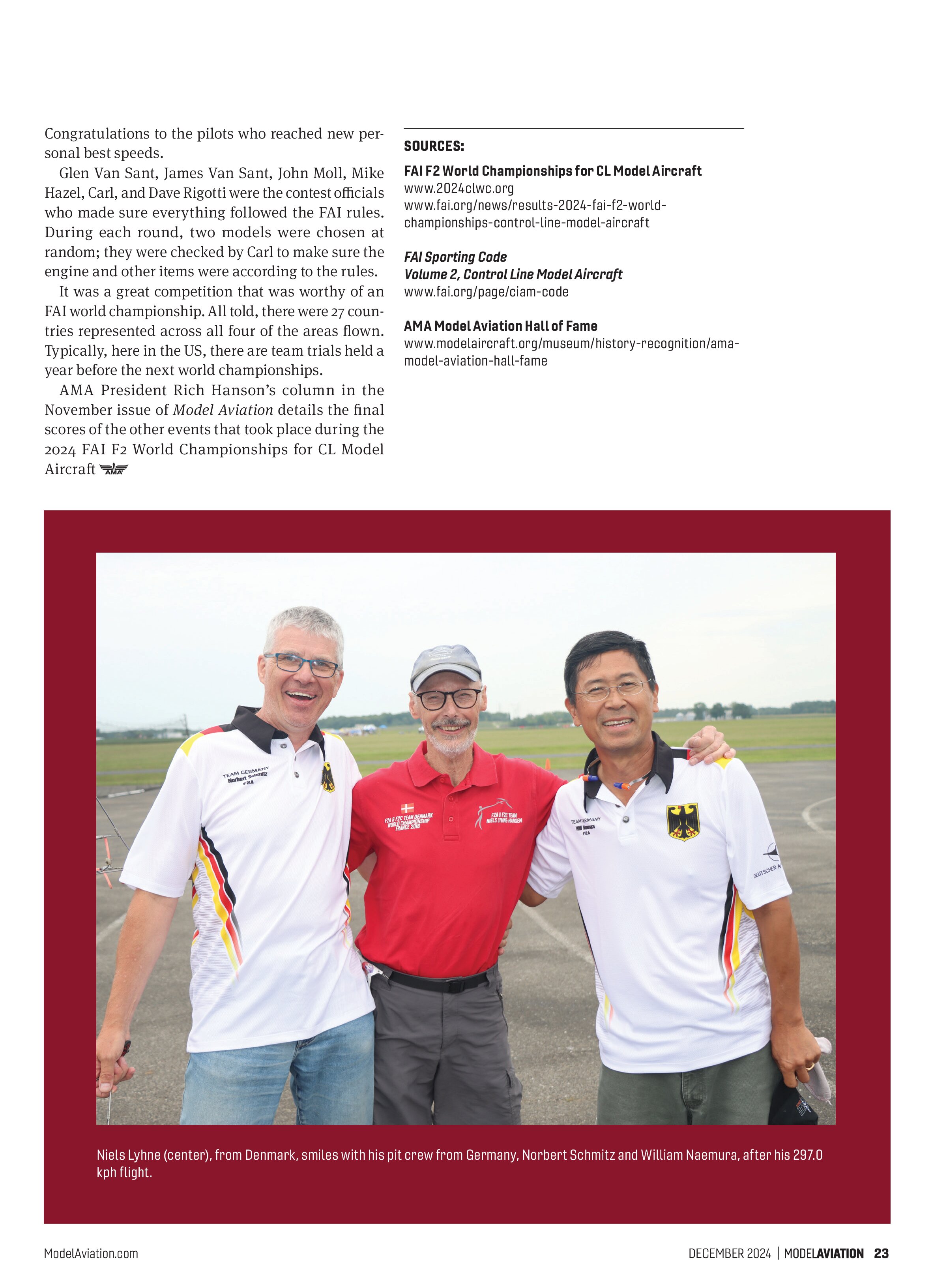
On Thursday, in Round Three, Alex posted a 305.9 kph speed to further break the unofficial Muncie speed record. That proved to be difficult to beat as he remained in first place throughout all four rounds. Ivan remained in second place with his 303.4 kph speed. Neils Lyhne, from Denmark,

surprised everyone with a 297.0 kph speed, which moved him from seventh place to third place. He was very excited, but he couldn’t relax because if anyone scored a flight faster than that, the standings would change once again. There were flight speeds from 297.0 down to 290.4 kph a total of 14 times between seven pilots after Round Three was complete.
Matthieu Perret, of France, posted a 297.6 kph flight, which moved him into third place in Round Four. No other pilot posted any flights that would challenge Matthieu, Ivan, or Alex.
There were several personal best flights during the World Championships, including Yury Schedenkov, of Canada, who posted a 249.8 kph flight in Round One, and then made an even better flight at 268.8 kph in Round Four. He got faster every round, but


Mathieu Perret, of France, posted a 297.6 kph flight, which moved him into third place in Round Four. No other pilot posted any flights that would challenge Matthieu, Ivan, or Alex.
There were several personal best flights during the World Championships, including Yury Schedenkov, of Canada, who posted a 249.8 kph flight in Round One, and then made an even better flight at 268.8 kph in Round Four. He got faster every round, but


he never got close to the pilots who stood on the podium. He has been flying F2A since 2018 and has steadily gotten faster each year. If you fly this event, it has a steep learning curve to understand the intricate details that can make the model go faster.
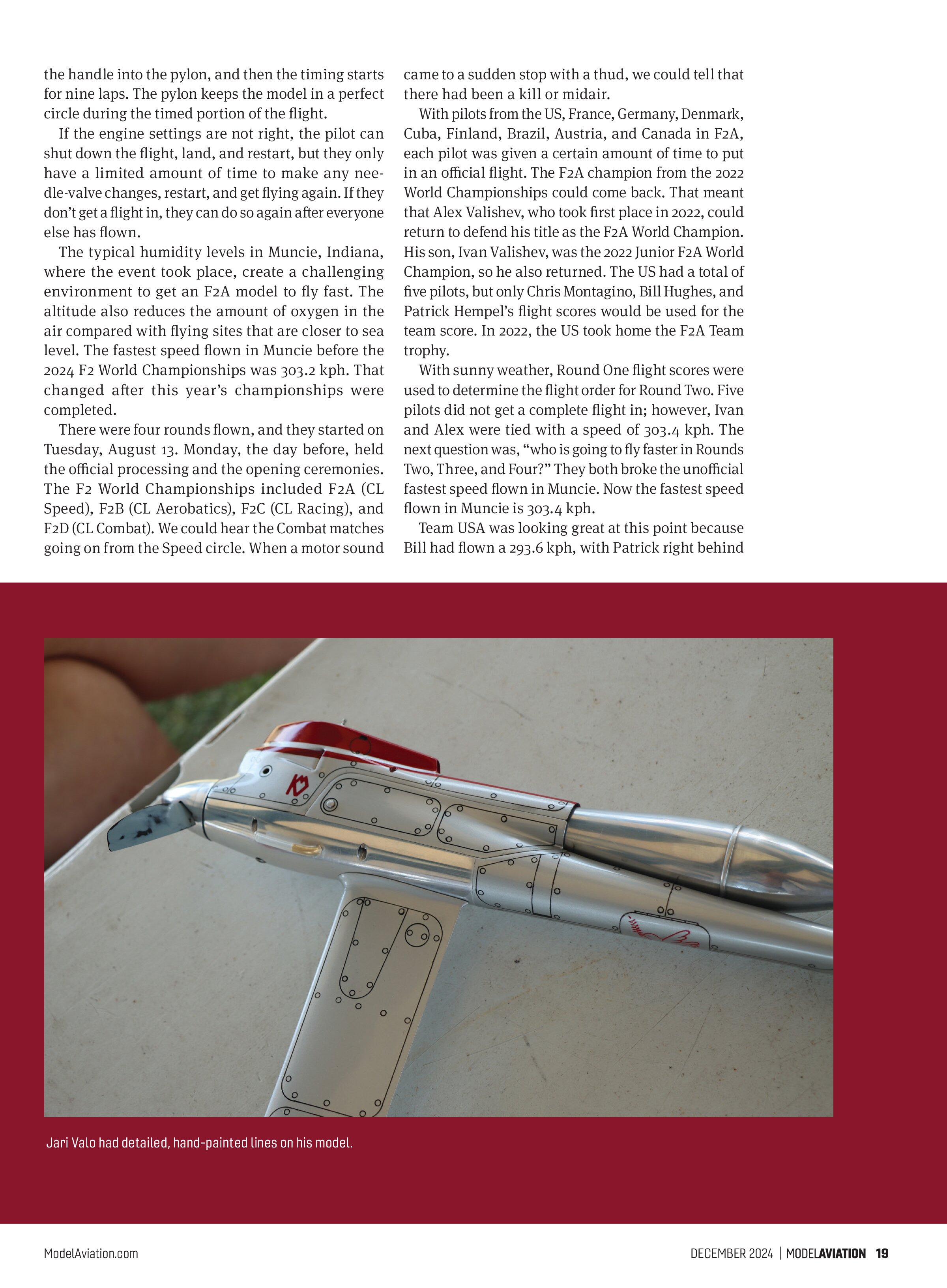
Jari Valo, from Finland, had some well-done, hand-painted artwork on his model, but he was not able to get a complete flight in during the World Championships.
To get the model started and, if needed, restarted, two pit guys help. Despite these pilots being from different countries, they supported each other with the task of launching the model or working the starter. When a restart is required, you see one of the pit guys running to get the dolly while someone else gets the other equipment ready. A good example of this was when Neils hit 297.0 kph on Round Three—his two pit guys were from Germany.
Carl Dodge, an AMA Model Aviation Hall of Fame member who attended this year’s championships, flew in the 2014 F2 World Championships. In the final round, he turned his needle valve one click leaner and the resulting flight was 0.1 kph faster than the pilot who was in first place before he flew. It shows that if at any time someone flies faster than you, the overall standings will change.
F2A is complex because the barometric pressure, humidity, altitude, and other factors will determine how the model will perform. They fly with a one-blade propeller that has counterbalance built in. If you watch these pilots after they fly, they completely take the model apart after each round and clean everything for peak performance. The number of tools that they bring is considerable to clean and prepare the model for another flight.
The design of the model itself is to go as fast as possible. There are no connectors at the wingtip such as those on other CL models; the solid lines go directly into the wing to reduce the drag. The pilot also has the fuel shutoff with the down-elevator so that if the motor is not running properly, they can shut down and land.
Fédération Aéronautique Internationale (FAI) rules define how the model is prepared for flying by pull-testing and flushing the tank so that everyone is on the same level when it comes to the fuel being used. The line diameter was checked at several locations along the lines, and the line length was verified by markers on the ground.
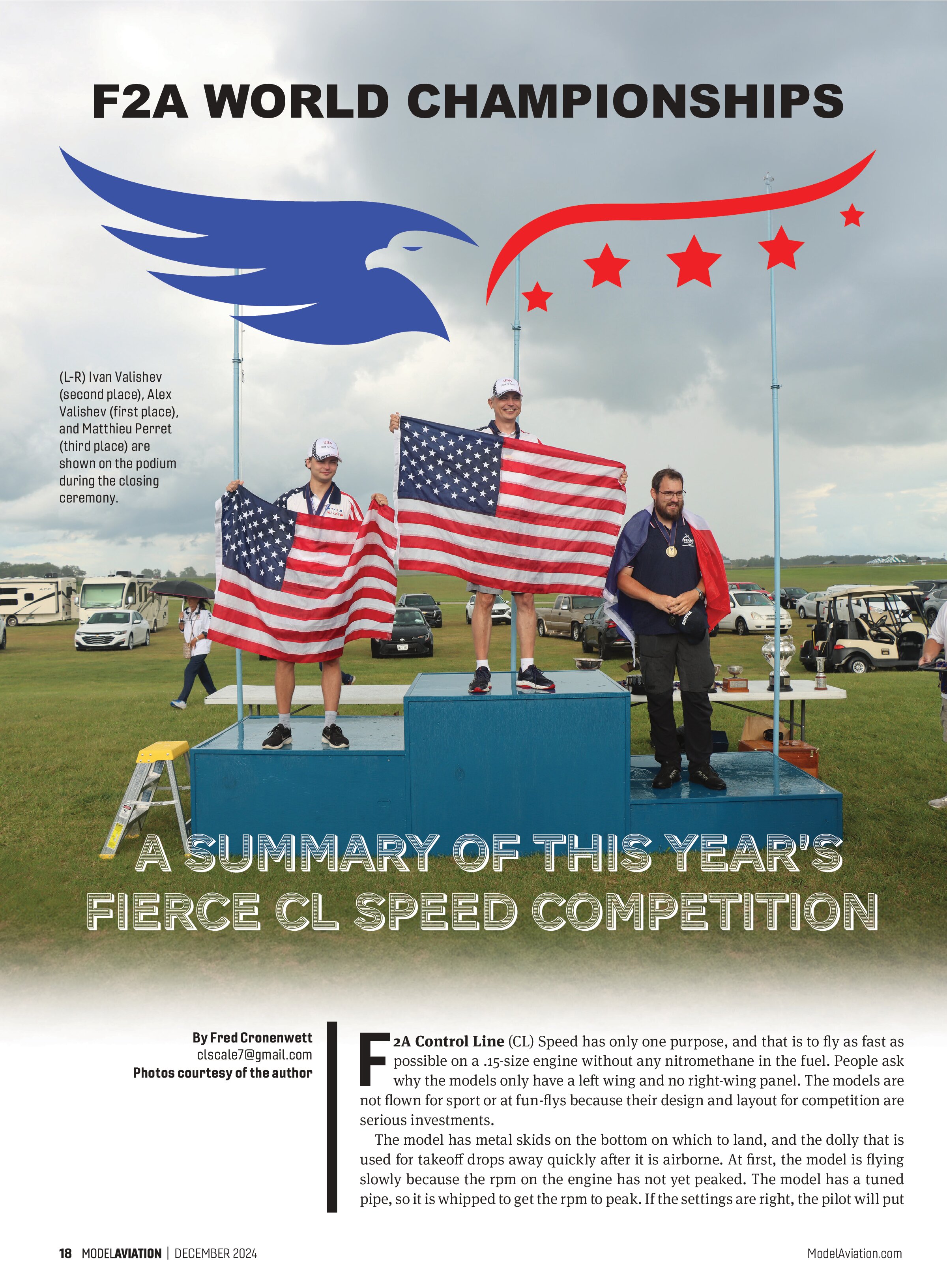
The final standings saw Alex (US) with 305.9 in first place, Ivan (US) with 303.4 in second place, and Matthieu (France) with 297.6 in third place.
Congratulations to the pilots who reached new personal best speeds.
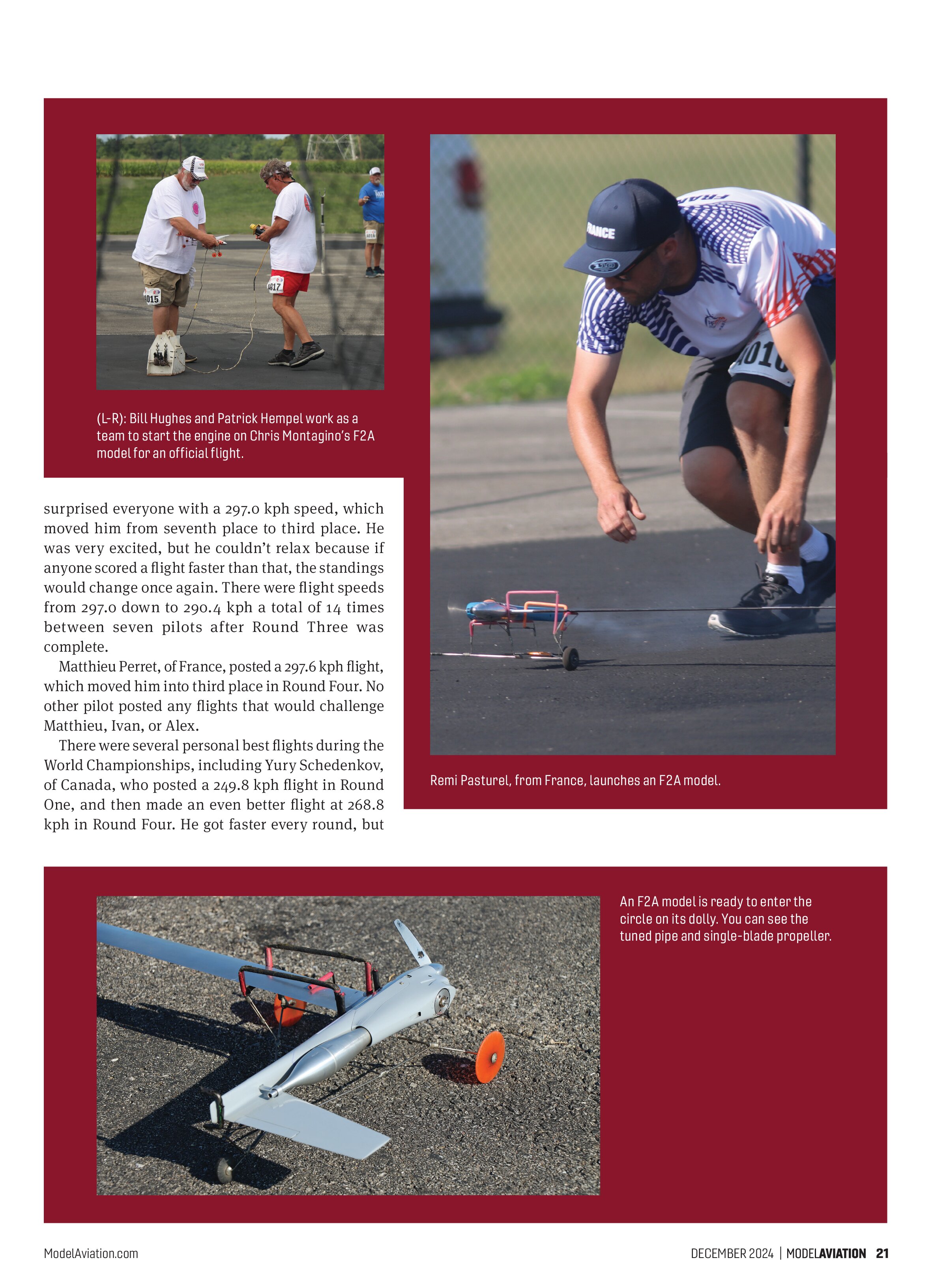
Glen Van Sant, James Van Sant, John Moll, Mike Hazel, Carl, and Dave Rigotti were the contest officials who made sure everything followed the FAI rules. During each round, two models were chosen at random; they were checked by Carl to make sure the engine and other items were according to the rules.
It was a great competition that was worthy of an FAI world championship. All told, there were 27 countries represented across all four of the areas flown. Typically, here in the US, there are team trials held a year before the next world championships.
AMA President Rich Hanson’s column in the November issue of Model Aviation details the final scores of the other events that took place during the 2024 FAI F2 World Championships for CL Model Aircraft
SOURCES:
FAI F2 World Championships for CL Model Aircraft
www.2024clwc.org
www.fai.org/news/results-2024-fai-f2-world-championships-control-line-model-aircraft
FAI Sporting Code
Volume 2, Control Line Model Aircraft
www.fai.org/page/ciam-code
AMA Model Aviation Hall of Fame
www.modelaircraft.org/museum/history-recognition/ama-model-aviation-hall-fame