CONTROL LINE SCALE

SIZING FOR
ELECTRIC
POWER
By Fred Cronenwett | clscale7@gmail.com
THE DIFFICULT THING with electric motors is that you can’t just look at the motor and know what size of propeller, battery, or ESC to use and how much power they have. You need to see the specification sheet about the motor. That will tell you what size of battery the motor was designed to use and how many amps it will pull. Some electric motors are designed to spin small propellers, while others turn larger propellers.
I start with the weight of the model and what size of propeller will fit it. Electric motor power is measured in watts, which is the battery voltage multiplied by the amps. The larger the battery you pick (voltage), the more power you will have. LiPo batteries come in different sizes, which is determined by the series (S) cells. You will find 1S and 2S up to 6S, which determines the voltage of the battery.
I use the rule of 125 to 150 watts per pound to determine how much total power I will need for the model. If the model weighs 10 pounds, you will need a motor with 1,250 to 1,500 watts of power. The propeller you choose will make a big difference with how much power the motor produces.
It’s not uncommon for electric motor companies to have several variations of the motor with different Kv values. One example is the Power 60 from E-Flite that has 400 Kv and 470 Kv versions. They both turn the same size of propeller, but one has 50% more power than the other. The higher power version requires an 85-amp ESC, while the other version requires a 65-amp ESC. Both motors have the same physical dimensions and use the same battery.
After you have found a brushless motor that has the power you need and turns a propeller that fits the model, you need to decide where to put the battery and the ESC. You want the battery to be located somewhere in the model so that you can easily remove and replace it at the flying site after the model is assembled and ready to fly. The location of the LiPo battery can also be used to establish the center of gravity of the model.
If you are flying a model with two or more motors, take the overall weight of the model and divide it by the number of motors. Using the 10-pound example with two motors, the overall power of 1,500 watts will not change. The combined power from the two motors has to add up to the overall power that is required. Two 750-watt motors would work for this example.
Before you start building, decide how many batteries you are going to use and where you will place them. The nominal voltage of a charged 4S battery is the same regardless of the mAh rating. If you need more flight time, increase the mAh rating on your LiPo battery.
If you need a 6S battery, you can put two 3S batteries in a series, which will have the same combined voltage of a 6S battery. If you need more of an mAh rating to increase your flight time, you can put two batteries in parallel.
You should also consider using an arming plug in the circuit for the electric motor, which allows the circuit to be dead until the arming plug is installed. It completes the circuit to feed power from the battery to the ESC.
The ESC will have a nominal number of amps that it can handle without failing. You do not want to pair a 40-amp ESC with a motor that is going to pull 65 amps from the battery.


SNJ Electric Conversion
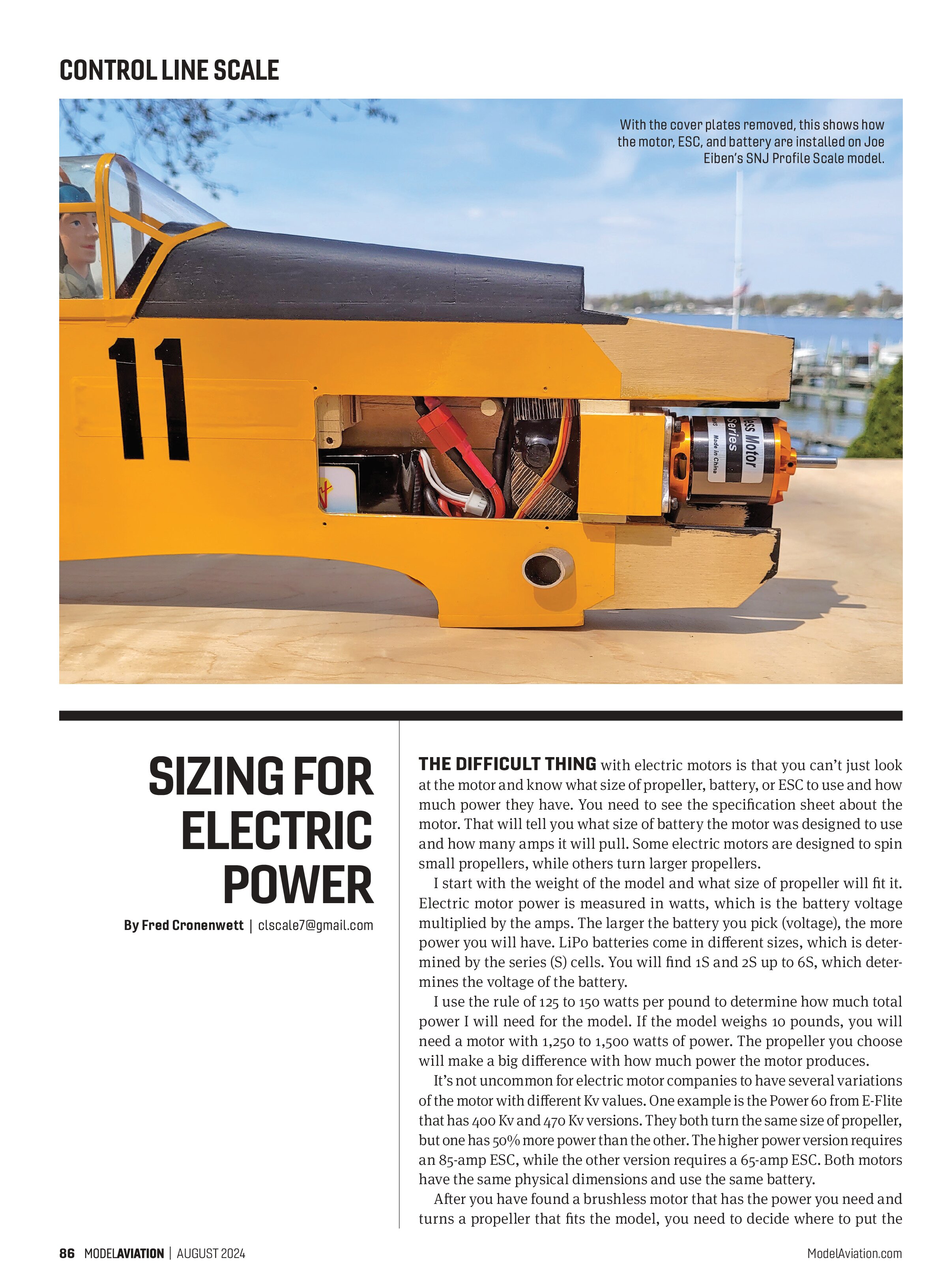
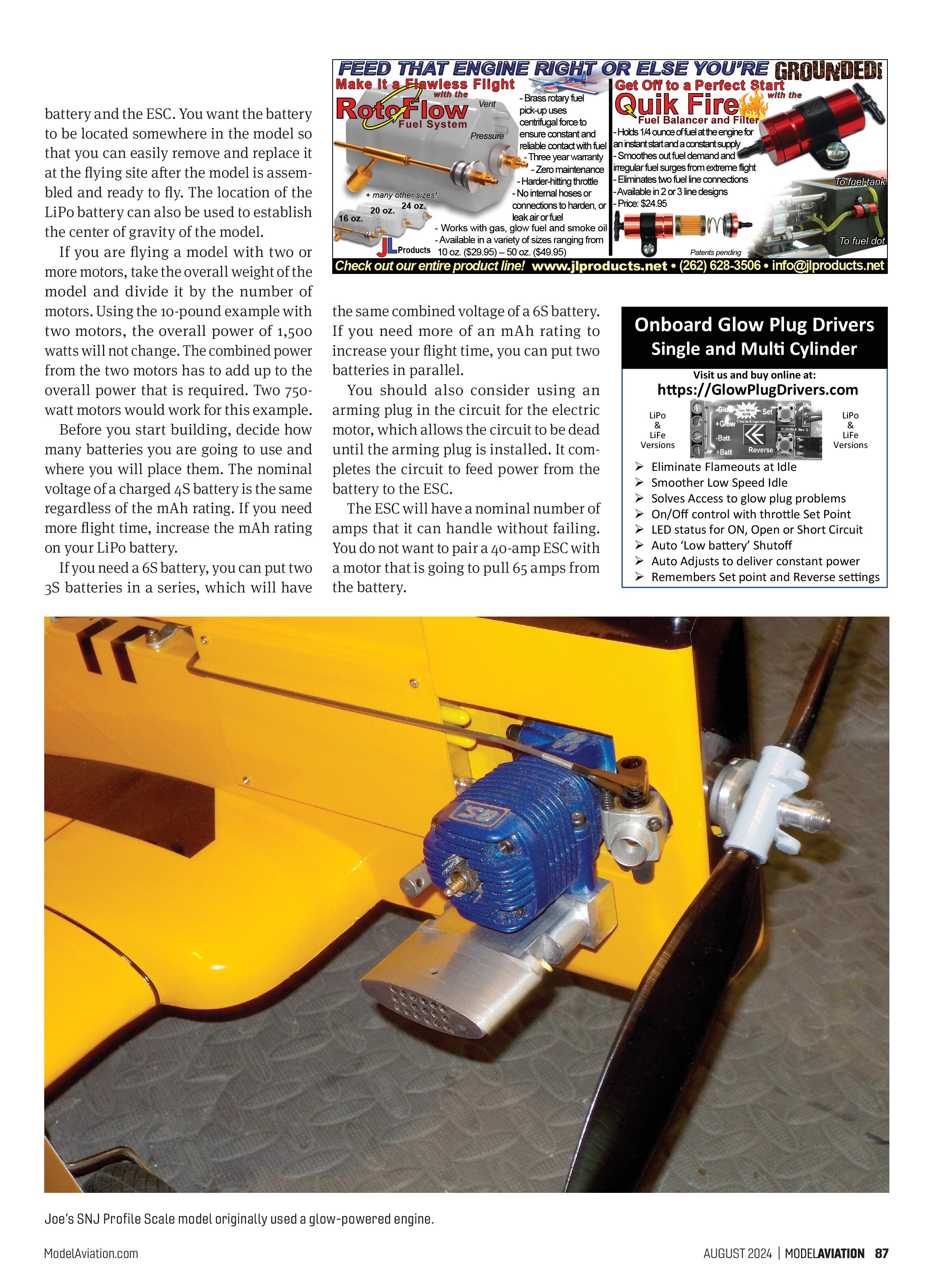
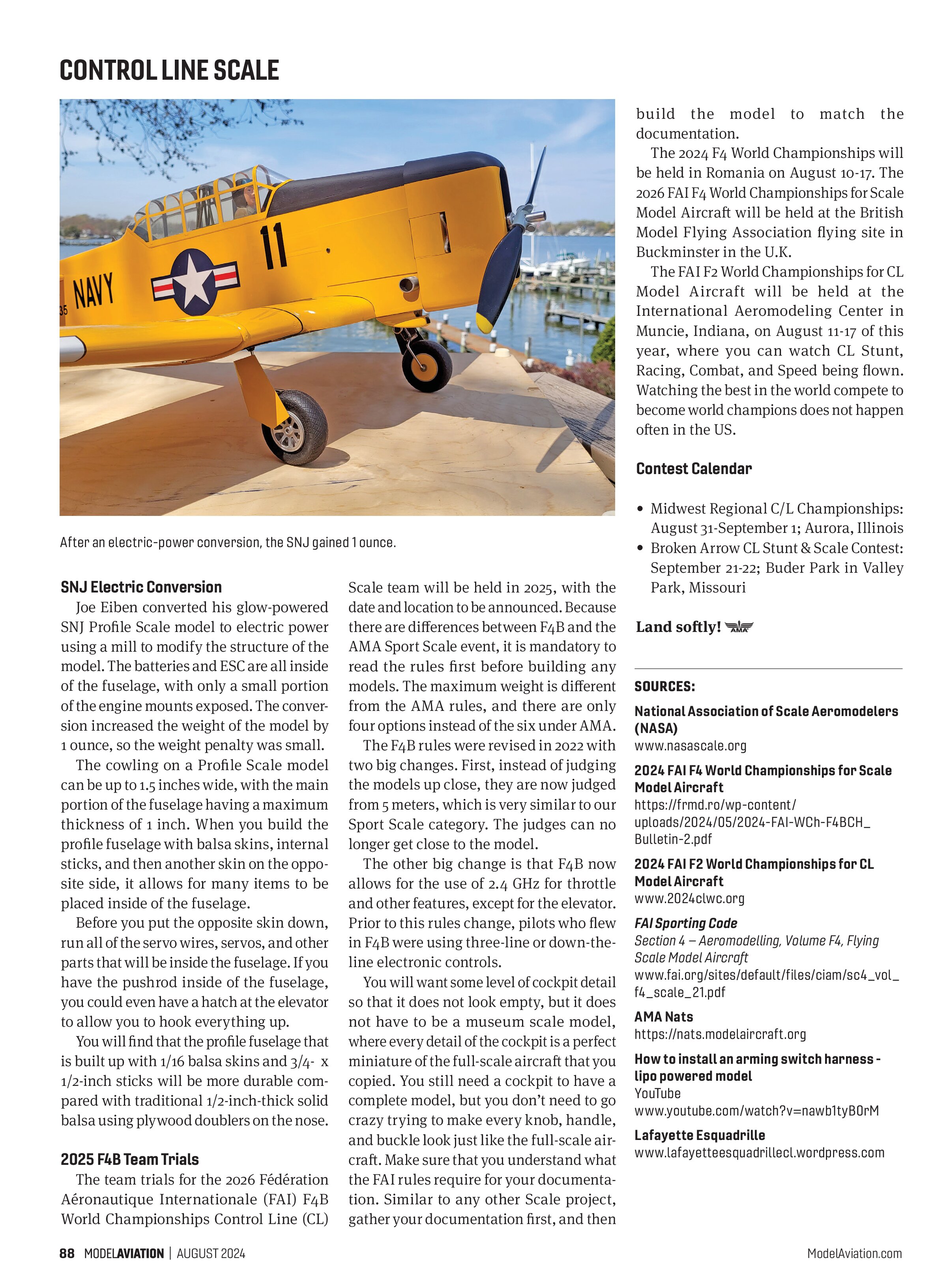
Joe Eiben converted his glow-powered SNJ Profile Scale model to electric power using a mill to modify the structure of the model. The batteries and ESC are all inside of the fuselage, with only a small portion of the engine mounts exposed. The conversion increased the weight of the model by 1 ounce, so the weight penalty was small.
The cowling on a Profile Scale model can be up to 1.5 inches wide, with the main portion of the fuselage having a maximum thickness of 1 inch. When you build the profile fuselage with balsa skins, internal sticks, and then another skin on the opposite side, it allows for many items to be placed inside of the fuselage.
Before you put the opposite skin down, run all of the servo wires, servos, and other parts that will be inside the fuselage. If you have the pushrod inside of the fuselage, you could even have a hatch at the elevator to allow you to hook everything up.
You will find that the profile fuselage that is built up with 1/16 balsa skins and 3/4- x 1/2-inch sticks will be more durable compared with traditional 1/2-inch-thick solid balsa using plywood doublers on the nose.
2025 F4B Team Trials
The team trials for the 2026 Fédération Aéronautique Internationale (FAI) F4B World Championships Control Line (CL) Scale team will be held in 2025, with the date and location to be announced. Because there are differences between F4B and the AMA Sport Scale event, it is mandatory to read the rules first before building any models. The maximum weight is different from the AMA rules, and there are only four options instead of the six under AMA.
The F4B rules were revised in 2022 with two big changes. First, instead of judging the models up close, they are now judged from 5 meters, which is very similar to our Sport Scale category. The judges can no longer get close to the model.
The other big change is that F4B now allows for the use of 2.4 GHz for throttle and other features, except for the elevator. Prior to this rules change, pilots who flew in F4B were using three-line or down-the-line electronic controls.
You will want some level of cockpit detail so that it does not look empty, but it does not have to be a museum scale model, where every detail of the cockpit is a perfect miniature of the full-scale aircraft that you copied. You still need a cockpit to have a complete model, but you don’t need to go crazy trying to make every knob, handle, and buckle look just like the full-scale aircraft. Make sure that you understand what the FAI rules require for your documentation. Similar to any other Scale project, gather your documentation first, and then build the model to match the documentation.
The 2024 F4 World Championships will be held in Romania on August 10-17. The 2026 FAI F4 World Championships for Scale Model Aircraft will be held at the British Model Flying Association flying site in Buckminster in the U.K.
The FAI F2 World Championships for CL Model Aircraft will be held at the International Aeromodeling Center in Muncie, Indiana, on August 11-17 of this year, where you can watch CL Stunt, Racing, Combat, and Speed being flown. Watching the best in the world compete to become world champions does not happen often in the US.
Contest Calendar
- Midwest Regional C/L Championships: August 31-September 1; Aurora, Illinois
- Broken Arrow CL Stunt & Scale Contest: September 21-22; Buder Park in Valley Park, Missouri
Land softly!
SOURCES:
National Association of Scale Aeromodelers (NASA)
www.nasascal e.org
2024 FAI F4 World Championships for Scale Model Aircraft
https://fmd.ru/wp-content/uploads/2024/05/2024-FAI-WCh-F4BCH_Bulletin-2.pdf
2024 FAI F2 World Championships for CL Model Aircraft
www.2024clwc.org
FAI Sporting Code
Section 4 – Aeromodelling, Volume F4, Flying Scale Model Aircraft
www.fai.org/sites/default/files/ciam/sc4_vol_f4_scale_21.pdf
AMA Nats
https://nats.modelaircraft.org
How to install an arming switch harness - lipo powered model
YouTube
www.youtube.com/watch?v=nawb1tyB0rM
Lafayette Esquadrille
www.lafayetteesquadrillecl.wordpress.com