BETTER WAYS
TO BUILD
LIGHTER
By Joe Daly | stunt38060@gmail.com

I HAVE BEEN EXTREMELY fortunate to share this hobby with my sons. A couple of years ago, I met Mike Alimov, who is enjoying the same delight with his two sons, Luca and Gabe. Mike is a proud father who enjoys spending time with his boys and learning to fly, build, and compete! In this article, you will hear from him, as well as the Precision Aerobatics Model Pilots Association’s (PAMPA) new president, Mark Weiss.
Because there continues to be a shortage of contest-grade balsa wood, we have all been looking for better ways to build lightweight and rigid airplanes. At the end of last season, I saw Mike and Gabe with a new airplane that they had built. It was composite and could be dismantled. In talking with Mike, he shared how they accomplished it. I thought it was another good method for building. He wrote the following:
With both of my boys actively flying Control Line (CL) Aerobatics (Stunt) and constantly needing new airplanes, I started looking for ways to help them build faster, better, and cheaper. We decided to plunge into composites.
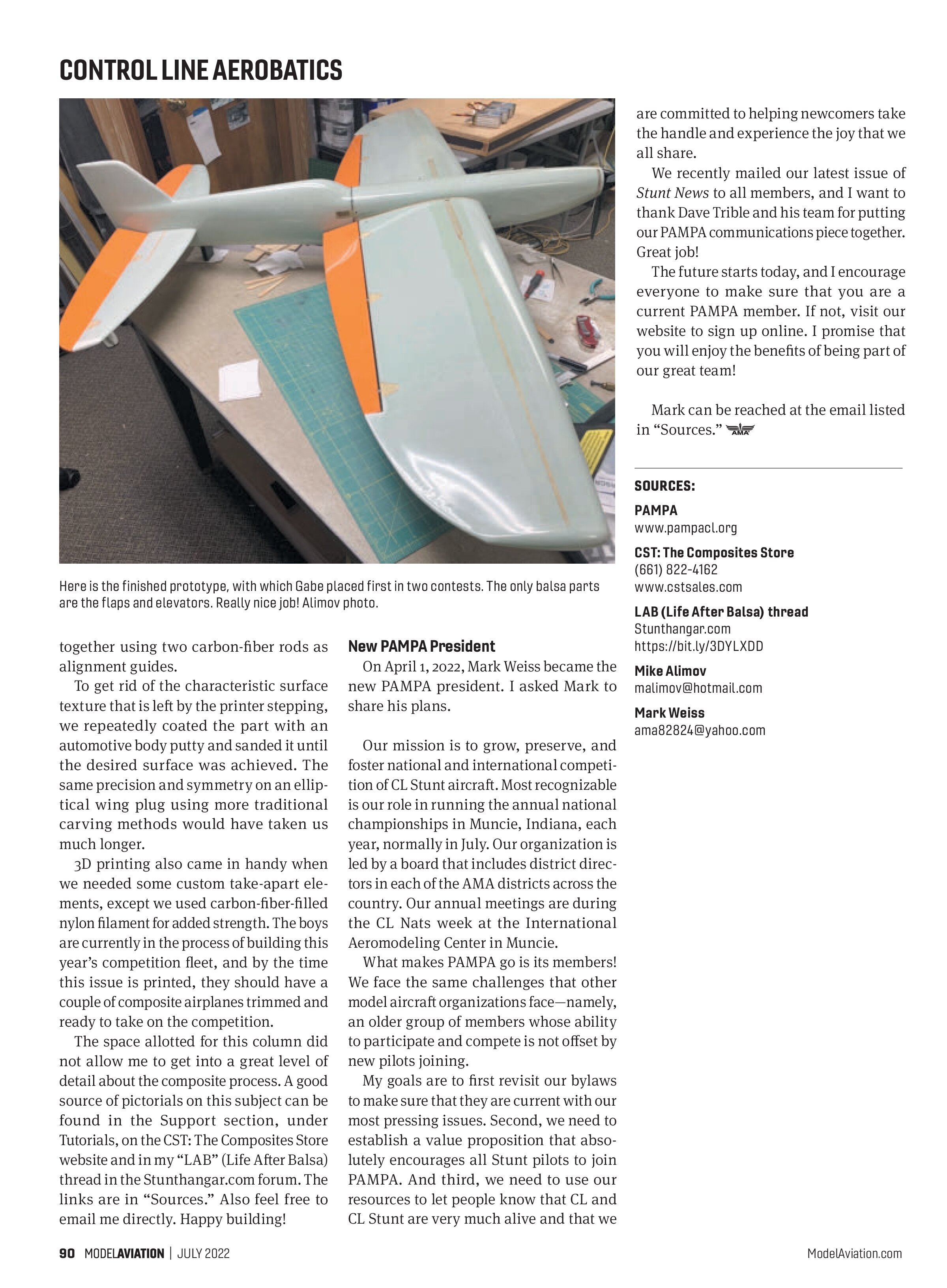
This turned out to be a worthwhile undertaking. Using a preproduction prototype, my son, Gabe, won Advanced at two contests, posting scores of more than 550. The airplane turned out to be easy to build and trim, and the weight came to a respectable 62 ounces at 660 sq. in. of wing area with a typical electric powertrain.
The composite methodology is opposite of traditional balsa construction. Instead of building the structure from the inside out and finishing the surface with some sort of covering, the composite layup starts with putting the outermost layer of epoxy-saturated fabric into the mold, and then continuing inward. This takes some change in the mindset because the early steps are the most critical. On the other hand, after the part is pulled out of the mold, the builder is rewarded with a nearly paint-ready surface, greatly shortening the overall build time.
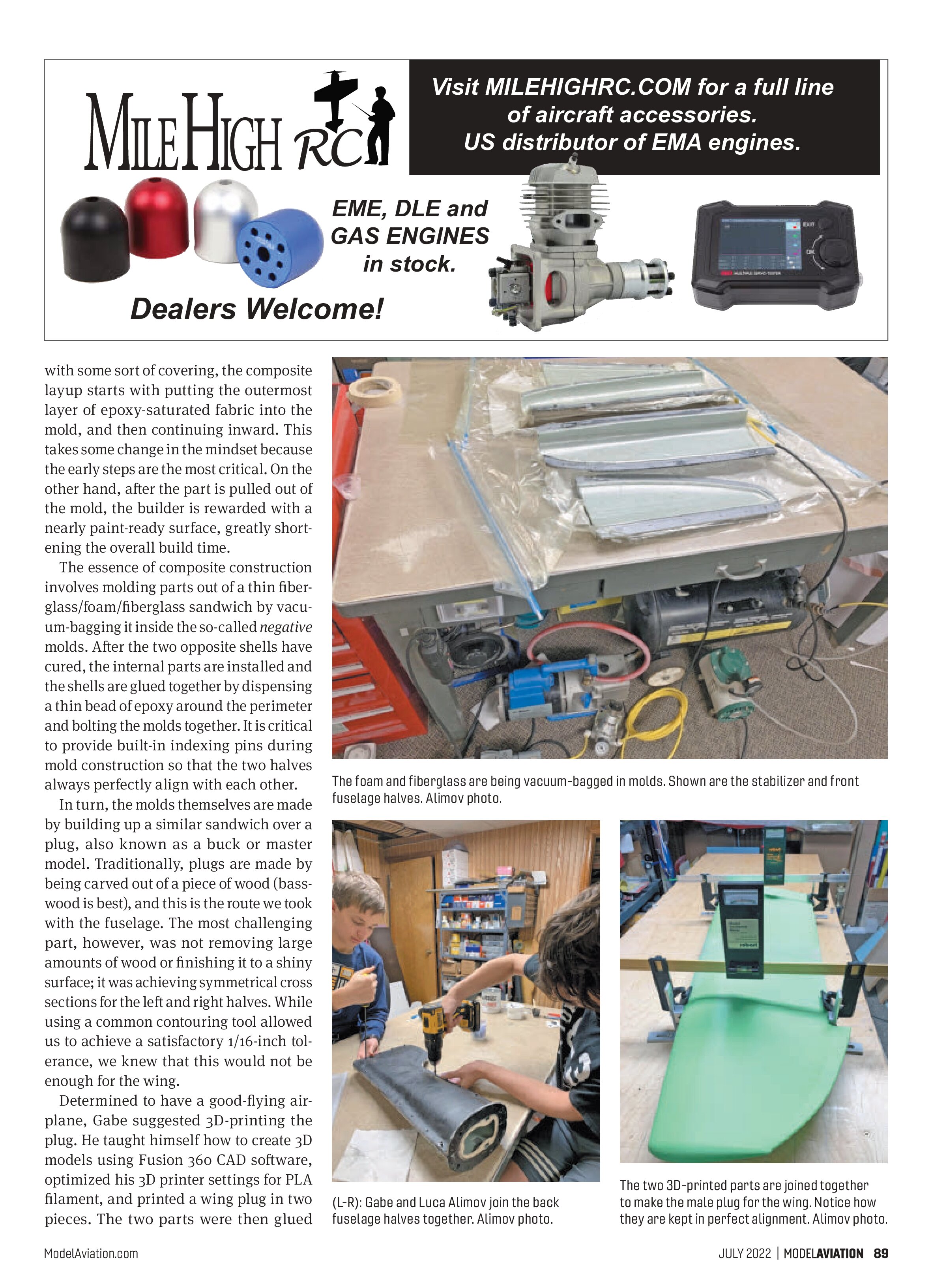
The essence of composite construction involves molding parts out of a thin fiberglass/foam/fiberglass sandwich by vacuum-bagging it inside the so-called negative molds. After the two opposite shells have cured, the internal parts are installed and the shells are glued together by dispensing a thin bead of epoxy around the perimeter and bolting the molds together. It is critical to provide built-in indexing pins during mold construction so that the two halves always perfectly align with each other.

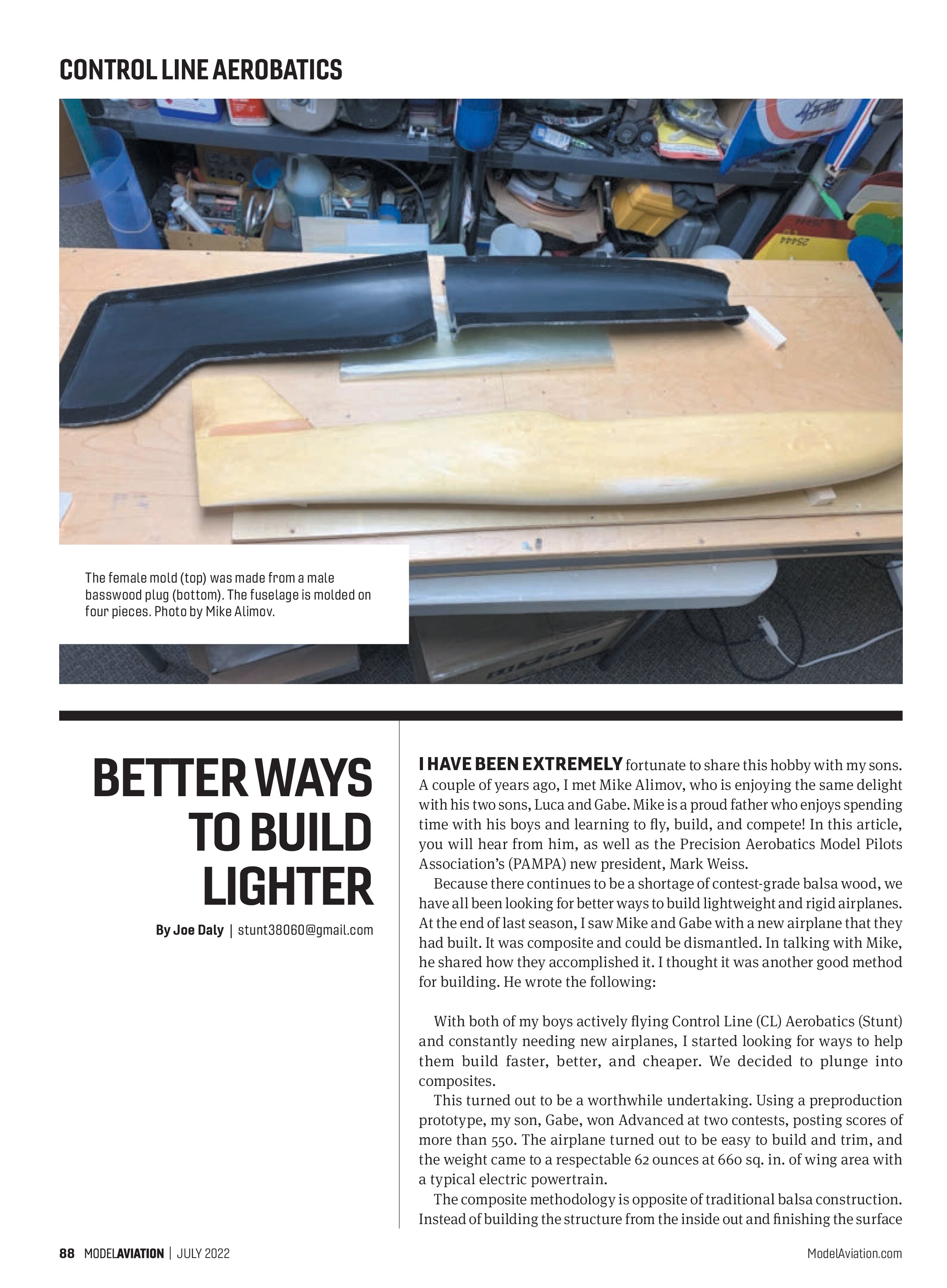
In turn, the molds themselves are made by building up a similar sandwich over a plug, also known as a buck or master model. Traditionally, plugs are made by being carved out of a piece of wood (basswood is best), and this is the route we took with the fuselage. The most challenging part, however, was not removing large amounts of wood or finishing it to a shiny surface; it was achieving symmetrical cross sections for the left and right halves. While using a common contouring tool allowed us to achieve a satisfactory 1/16-inch tolerance, we knew that this would not be enough for the wing.
Determined to have a good-flying airplane, Gabe suggested 3D-printing the plug. He taught himself how to create 3D models using Fusion 360 CAD software, optimized his 3D printer settings for PLA filament, and printed a wing plug in two pieces. The two parts were then glued


together using two carbon-fiber rods as alignment guides.
To get rid of the characteristic surface texture that is left by the printer stepping, we repeatedly coated the part with an automotive body putty and sanded it until the desired surface was achieved. The same precision and symmetry on an elliptical wing plug using more traditional carving methods would have taken us much longer.
3D printing also came in handy when we needed some custom take-apart elements, except we used carbon-fiber-filled nylon filament for added strength. The boys are currently in the process of building this year’s competition fleet, and by the time this issue is printed, they should have a couple of composite airplanes trimmed and ready to take on the competition.
The space allotted for this column did not allow me to get into a great level of detail about the composite process. A good source of pictorials on this subject can be found in the Support section, under Tutorials, on the CST: The Composites Store website and in my “LAB” (Life After Balsa) thread in the Stunthangar.com forum. The links are in “Sources.” Also feel free to email me directly. Happy building!
New PAMPA President
On April 1, 2022, Mark Weiss became the new PAMPA president. I asked Mark to share his plans.
Our mission is to grow, preserve, and foster national and international competition of CL Stunt aircraft. Most recognizable is our role in running the annual national championships in Muncie, Indiana, each year, normally in July. Our organization is led by a board that includes district directors in each of the AMA districts across the country. Our annual meetings are during the CL Nats week at the International Aeromodeling Center in Muncie.
What makes PAMPA go is its members! We face the same challenges that other model aircraft organizations face—namely, an older group of members whose ability to participate and compete is not offset by new pilots joining.
My goals are to first revisit our bylaws to make sure that they are current with our most pressing issues. Second, we need to establish a value proposition that absolutely encourages all Stunt pilots to join PAMPA. And third, we need to use our resources to let people know that CL and CL Stunt are very much alive and that we are committed to helping newcomers take the handle and experience the joy that we all share.
We recently mailed our latest issue of Stunt News to all members, and I want to thank Dave Trible and his team for putting our PAMPA communications piece together. Great job!
The future starts today, and I encourage everyone to make sure that you are a current PAMPA member. If not, visit our website to sign up online. I promise that you will enjoy the benefits of being part of our great team!
Mark can be reached at the email listed in “Sources.”
SOURCES:
PAMPA
www.pampacl.org
CST: The Composites Store
(661) 822-4162
www.cstsales.com
LAB (Life After Balsa) thread
Stunthangar.com
https://bit.ly/3DYLXDD
Mike Alimov
malimov@hotmail.com
Mark Weiss
ama82824@yahoo.com