CONTROL LINE SCALE
CL SCALE F4B
COMPETITION
By Fred Cronenwett | clscale@aol.com

AT THE 2021 Control Line (CL) Scale Nats, it was announced that there is an effort to get CL Scale F4B going again at the FAI Scale World Championships. This has not been confirmed or approved yet, so at this point, it is not part of the competition. If it is approved, the goal is to have it as part of the 2024 event. The team trials would be held in 2023.
F4B is the international CL Scale competition. The last time F4B was flown at the world championships was in 2010. The event was held during the even years and the team trials were held during the odd years. The team members for the 2010 F4B competition were selected during the 2009 team trials.
The 2010 FAI rules say that a single-engine model can weigh as much as 13.2 pounds and a model with two or more engines can weigh 15.4 pounds. The AMA rules allow a 20-pound model to be flown. The F4B rules also introduce complexity factors for the paint scheme, the configuration of the subject aircraft, and flying options. If you choose the wrong subject aircraft, the complexity factors might not be in your favor, regardless of how well the model was built.
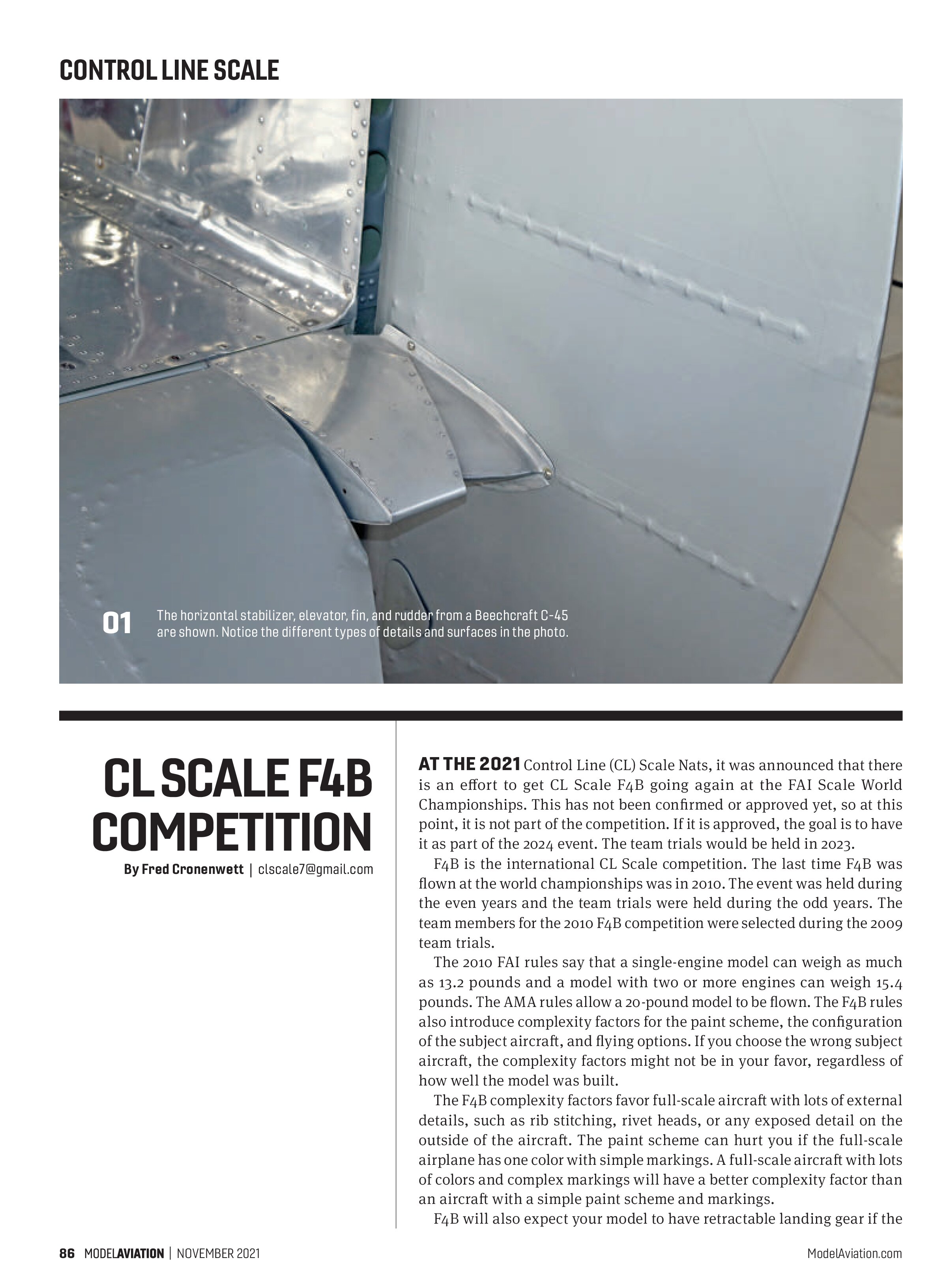
The F4B complexity factors favor full-scale aircraft with lots of external details, such as rib stitching, rivet heads, or any exposed detail on the outside of the aircraft. The paint scheme can hurt you if the full-scale airplane has one color with simple markings. A full-scale aircraft with lots of colors and complex markings will have a better complexity factor than an aircraft with a simple paint scheme and markings.
F4B will also expect your model to have retractable landing gear if the full-scale aircraft featured it. If there is something on the full-scale airplane that moves during flight, that item should also move in the same manner on the model. The judges will even check that you have the flap hinges in the correct location and the right type of flaps.
In F4B, it’s critical that you do the documentation first. After that is complete, you build the model to match the documentation for that particular full-scale aircraft. Your first job is to assemble the documentation package. Choose your three-view and get color information and photographs of the full-scale aircraft you are modeling.
When the documentation is complete, you can build the model. This rule applies to any CL Scale event. Your scores will increase when you assemble the documentation first then build the model.
The only event that comes close to the level of F4B in AMA competition is Authentic Scale because the model is evaluated up close by the judges. Team, Profile, and Sport Scale are judged from 15 feet. Authentic Scale and F4B are judged at close range.
The judges cannot touch the model, but they can look into the wheel wells and into the cockpit. A fully detailed cockpit is expected with F4B, and your documentation must have photographs of it. It must include the floor, rudder pedals, and everything that the full-scale pilot would see and touch. Authentic Scale also judges the cockpit.
A limited number of CL contests even offer Authentic Scale, such as the AMA Nats and perhaps the National Association of Scale Aeromodelers (NASA) Classic.

Looking at Photo 01, a properly done Beechcraft C-45 model would earn many points. Notice that there are metal surfaces with different types of fasteners and sizes, as well as a fabric-covered elevator and a rudder with rib stitching.
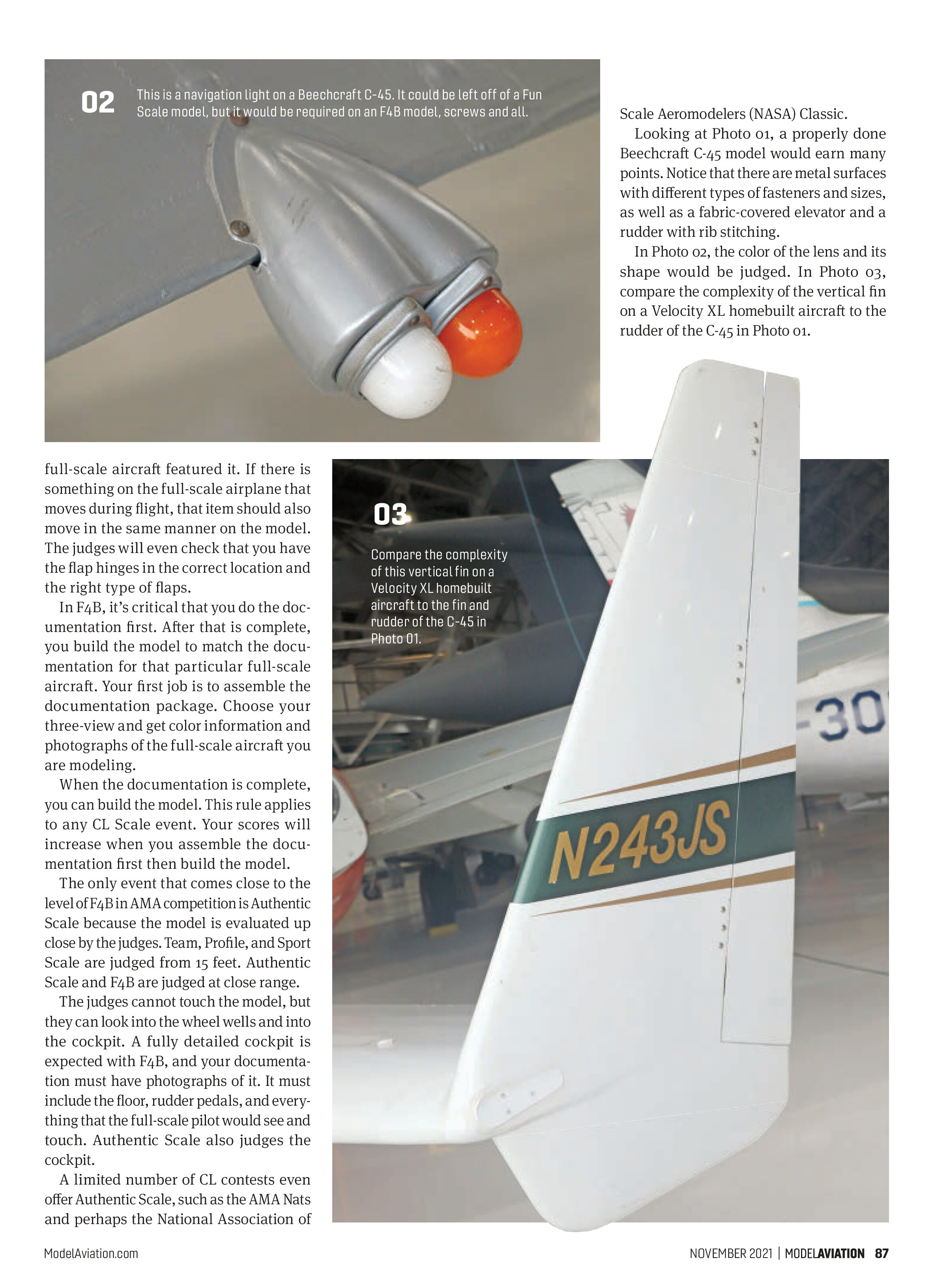
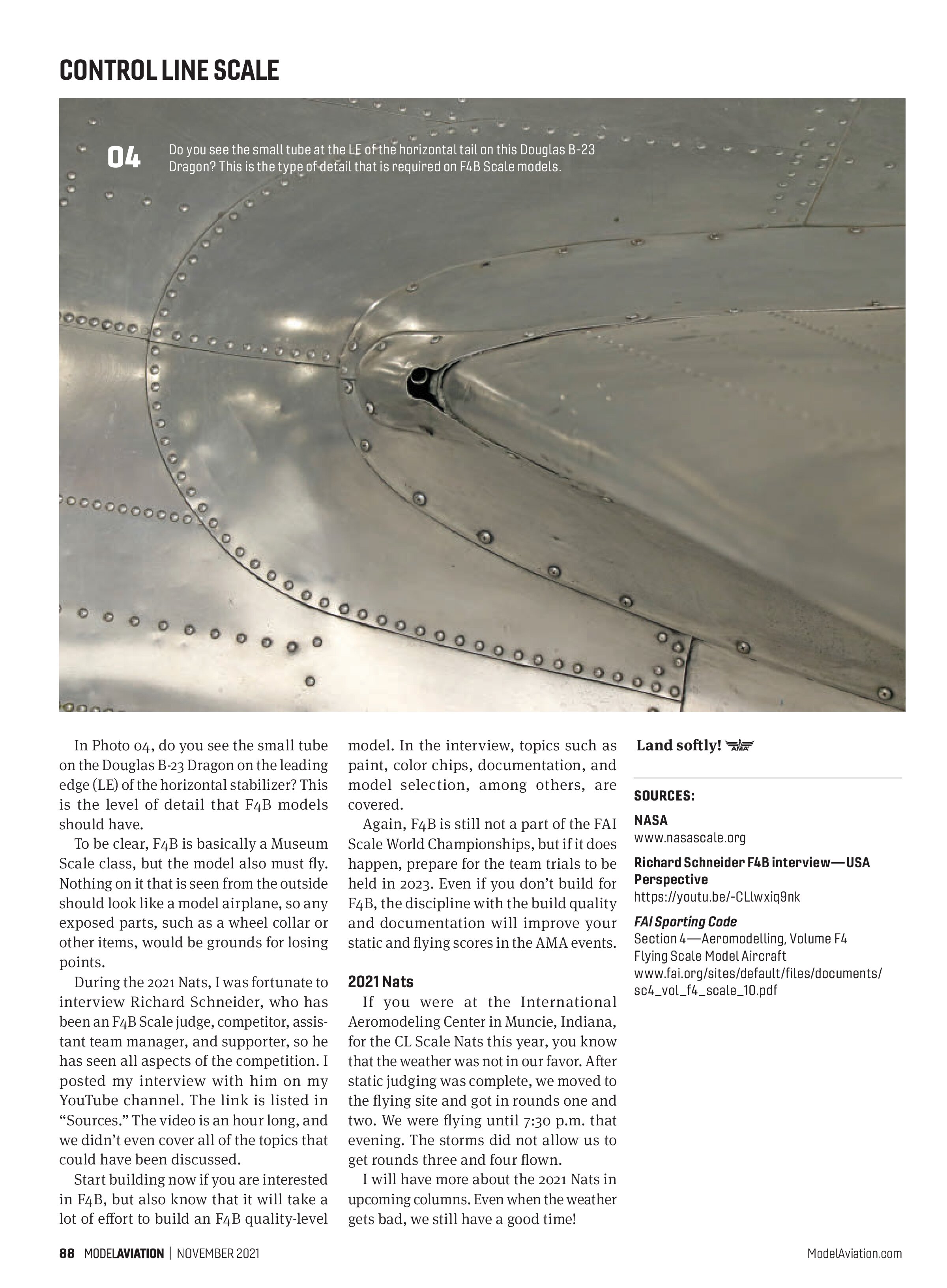
In Photo 02, the color of the lens and its shape would be judged. In Photo 03, compare the complexity of the vertical fin on a Velocity XL homebuilt aircraft to the rudder of the C-45 in Photo 01.


In Photo 04, do you see the small tube on the Douglas B-23 Dragon on the leading edge (LE) of the horizontal stabilizer? This is the level of detail that F4B models should have.
To be clear, F4B is basically a Museum Scale class, but the model also must fly. Nothing on it that is seen from the outside should look like a model airplane, so any exposed parts, such as a wheel collar or other items, would be grounds for losing points.
During the 2021 Nats, I was fortunate to interview Richard Schneider, who has been an F4B Scale judge, competitor, assistant team manager, and supporter, so he has seen all aspects of the competition. I posted my interview with him on my YouTube channel. The link is listed in “Sources.” The video is an hour long, and we didn’t even cover all of the topics that could have been discussed.
Start building now if you are interested in F4B, but also know that it will take a lot of effort to build an F4B quality-level model. In the interview, topics such as paint, color chips, documentation, and model selection, among others, are covered.
Again, F4B is still not a part of the FAI Scale World Championships, but if it does happen, prepare for the team trials to be held in 2023. Even if you don’t build for F4B, the discipline with the build quality and documentation will improve your static and flying scores in the AMA events.
2021 Nats
If you were at the International Aeromodeling Center in Muncie, Indiana, for the CL Scale Nats this year, you know that the weather was not in our favor. After static judging was complete, we moved to the flying site and got in rounds one and two. We were flying until 7:30 p.m. that evening. The storms did not allow us to get rounds three and four flown.
I will have more about the 2021 Nats in upcoming columns. Even when the weather gets bad, we still have a good time!
SOURCES:
Richard Schneider F4B interview—USA Perspective
https://youtu.be/-CLwlxqi9nk
FAI Sporting Code
Section 4—Aeromodelling, Volume F4
Flying Scale Model Aircraft
www.fai.org/sites/default/files/documents/sc4_vol_f4_scale_10.pdf