CONTROL LINE SCALE
JOE EIBEN AND HIS AMERICAN JET MODEL
By Fred Cronenwett | clscale7@gmail.com

IN THIS COLUMN, I will look at three different models, new and old. What I like about Control Line (CL) Scale is that you can build a model of a full-scale aircraft. This is a personal decision. Some modelers build civilian aircraft and some build military aircraft. Some models fly fast and some fly slow. You can build biplanes from World War I, a propeller-driven fighter from World War II, and then a modern aircraft.
You never know what you will see when you arrive at the Nats or your local CL Scale contest. Multiengine models continue to draw more attention than single-engine aircraft. Setting up a glow-powered, multiengine aircraft has its challenges, but it is worth it when you hear two or more engines running together.
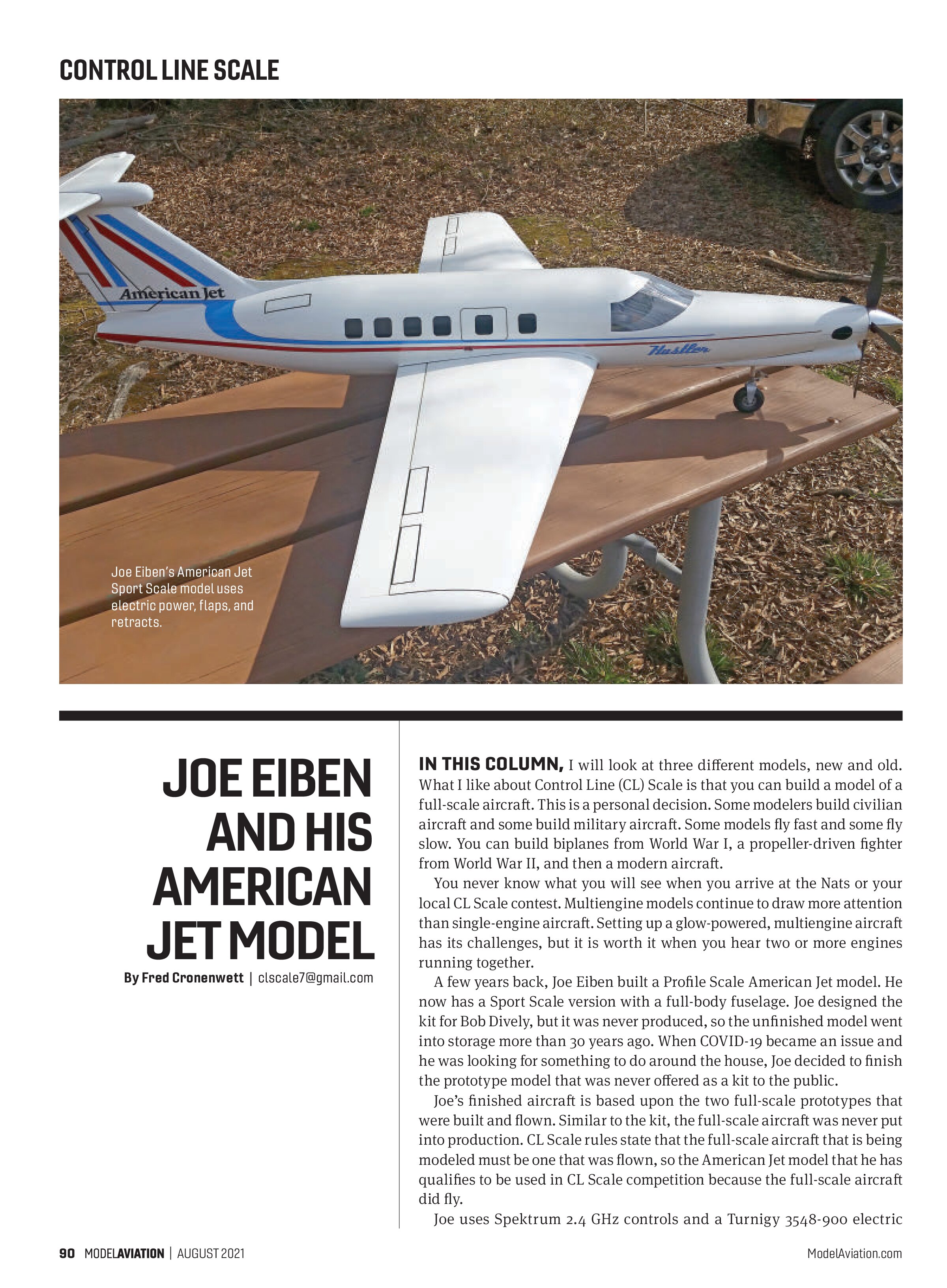
A few years back, Joe Eiben built a Profile Scale American Jet model. He now has a Sport Scale version with a full-body fuselage. Joe designed the kit for Bob Dively, but it was never produced, so the unfinished model went into storage more than 30 years ago. When COVID-19 became an issue and he was looking for something to do around the house, Joe decided to finish the prototype model that was never offered as a kit to the public.
Joe’s finished aircraft is based upon the two full-scale prototypes that were built and flown. Similar to the kit, the full-scale aircraft was never put into production. CL Scale rules state that the full-scale aircraft that is being modeled must be one that was flown, so the American Jet model that he has qualifies to be used in CL Scale competition because the full-scale aircraft did fly.
Joe uses Spektrum 2.4 GHz controls and a Turnigy 3548-900 electric motor. The model has a 54-inch wingspan. With a 55-amp ESC, flaps, and retracts, this airplane has many choices when it comes to deciding what to use as an optional maneuver for a CL Scale competition flight. The shape of the nose on this aircraft makes electric power a good choice because the motors can fit into a small cowling, unlike the traditional glow-powered engine.
The wing and horizontal stabilizer are covered with MonoKote and the fuselage is painted with Rust-Oleum Ultra. If this model were glow-powered, you would have to put on a fuelproof clear coat, but because it is electric, this choice of paint is not a problem. The markings came from Callie Graphics.
Colin Grantley-Blake’s P-51 Mustang
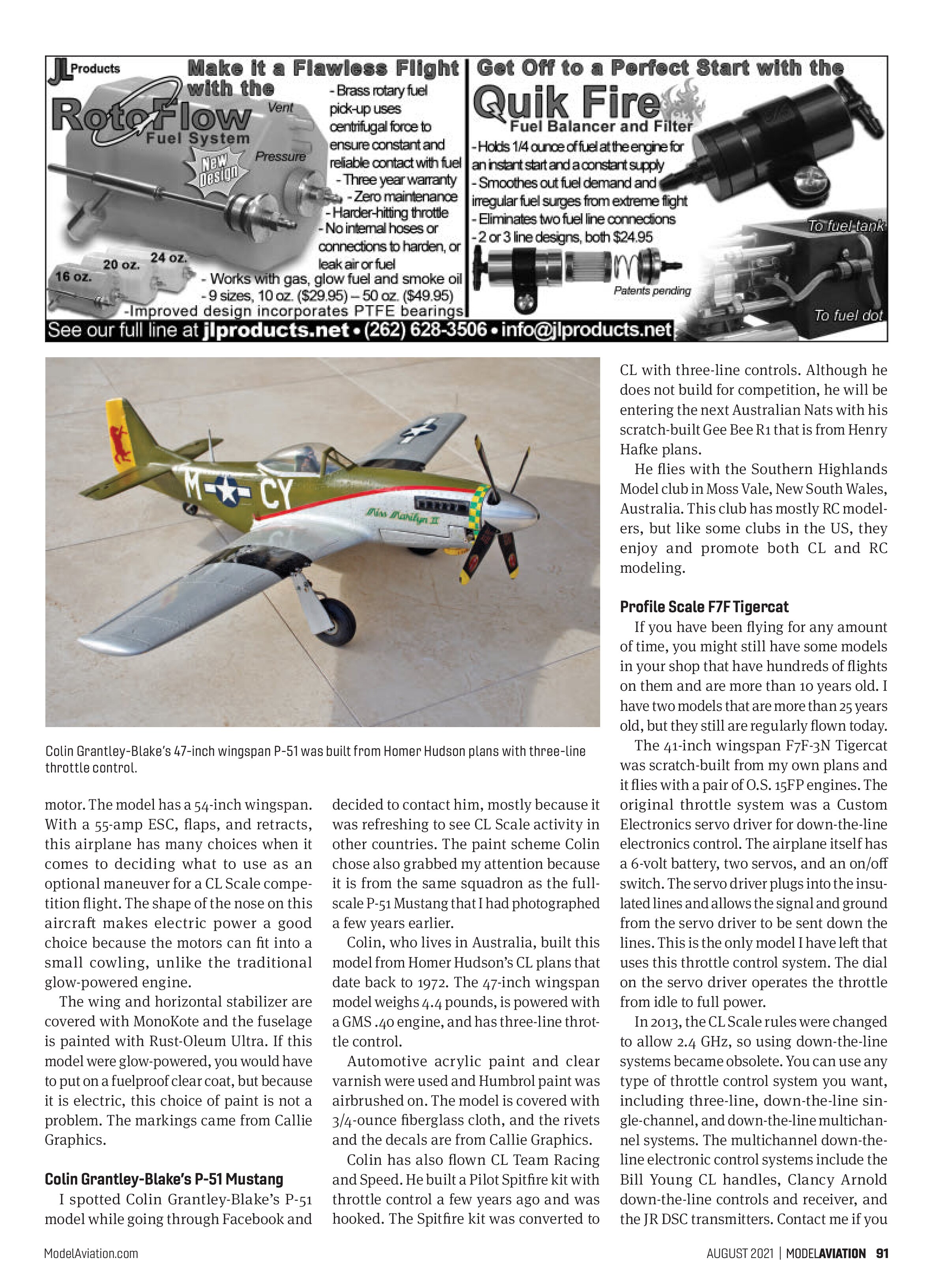
I spotted Colin Grantley-Blake’s P-51 model while going through Facebook and decided to contact him, mostly because it was refreshing to see CL Scale activity in other countries. The paint scheme Colin chose also grabbed my attention because it is from the same squadron as the full-scale P-51 Mustang that I had photographed a few years earlier.
Colin, who lives in Australia, built this model from Homer Hudson’s CL plans that date back to 1972. The 47-inch wingspan model weighs 4.4 pounds, is powered with a GMS .40 engine, and has three-line throttle control.
Automotive acrylic paint and clear varnish were used and Humbrol paint was airbrushed on. The model is covered with 3/4-ounce fiberglass cloth, and the rivets and the decals are from Callie Graphics.
Colin has also flown CL Team Racing and Speed. He built a Pilot Spitfire kit with throttle control a few years ago and was hooked. The Spitfire kit was converted to CL with three-line controls. Although he does not build for competition, he will be entering the next Australian Nats with his scratch-built Gee Bee R1 that is from Henry Hafke plans.
He flies with the Southern Highlands Model club in Moss Vale, New South Wales, Australia. This club has mostly RC modelers, but like some clubs in the US, they enjoy and promote both CL and RC modeling.

Profile Scale F7F Tigercat
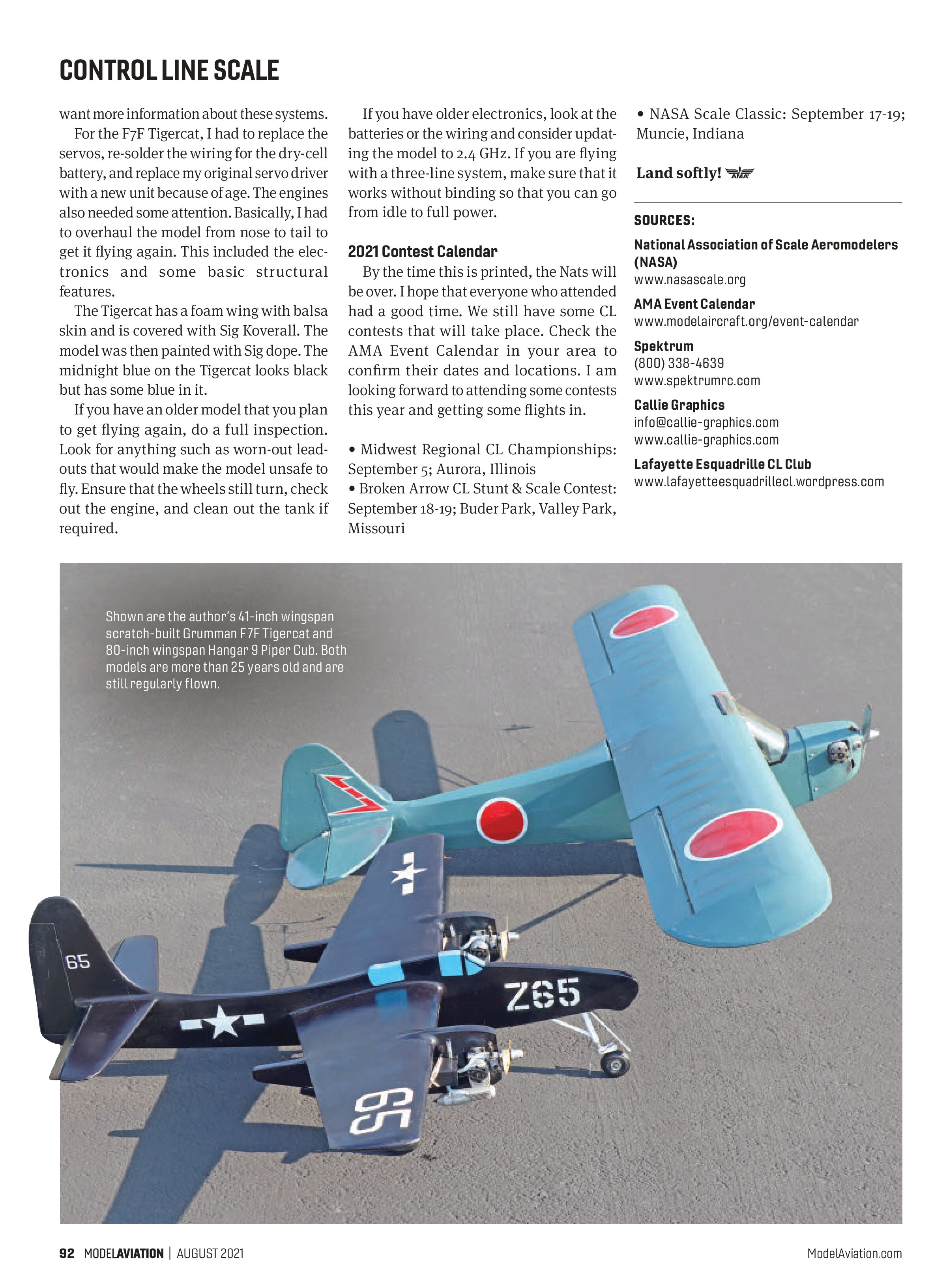
If you have been flying for any amount of time, you might still have some models in your shop that have hundreds of flights on them and are more than 10 years old. I have two models that are more than 25 years old, but they still are regularly flown today.
The 41-inch wingspan F7F-3N Tigercat was scratch-built from my own plans and it flies with a pair of O.S. 15FP engines. The original throttle system was a Custom Electronics servo driver for down-the-line electronics control. The airplane itself has a 6-volt battery, two servos, and an on/off switch. The servo driver plugs into the insulated lines and allows the signal and ground from the servo driver to be sent down the lines. This is the only model I have left that uses this throttle control system. The dial on the servo driver operates the throttle from idle to full power.
In 2013, the CL Scale rules were changed to allow 2.4 GHz, so using down-the-line systems became obsolete. You can use any type of throttle control system you want, including three-line, down-the-line single-channel, and down-the-line multichannel systems. The multichannel down-the-line electronic control systems include the Bill Young CL handles, Clancy Arnold down-the-line controls and receiver, and the JR DSC transmitters. Contact me if you
want more information about these systems.
For the F7F Tigercat, I had to replace the servos, re-solder the wiring for the dry-cell battery, and replace my original servo driver with a new unit because of age. The engines also needed some attention. Basically, I had to overhaul the model from nose to tail to get it flying again. This included the electronics and some basic structural features.
The Tigercat has a foam wing with balsa skin and is covered with Sig Koverall. The model was then painted with Sig dope. The midnight blue on the Tigercat looks black but has some blue in it.
If you have an older model that you plan to get flying again, do a full inspection. Look for anything such as worn-out lead-outs that would make the model unsafe to fly. Ensure that the wheels still turn, check out the engine, and clean out the tank if required.
If you have older electronics, look at the batteries or the wiring and consider updating the model to 2.4 GHz. If you are flying with a three-line system, make sure that it works without binding so that you can go from idle to full power.
2021 Contest Calendar
By the time this is printed, the Nats will be over. I hope that everyone who attended had a good time. We still have some CL contests that will take place. Check the AMA Event Calendar in your area to confirm their dates and locations. I am looking forward to attending some contests this year and getting some flights in.
- Midwest Regional CL Championships: September 5; Aurora, Illinois
- Broken Arrow CL Stunt & Scale Contest: September 18-19; B uder Park, Valley Park, Missouri
- NASA Scale Classic: September 17-19; Muncie, Indiana
SOURCES:
National Association of Scale Aeromodelers (NASA)
www.nasascale.org
AMA Event Calendar
www.modelaircraft.org/event-calendar
Spektrum
(800) 338-4639
www.spektrumrc.com
Callie Graphics
info@callie-graphics.com
www.callie-graphics.com
Lafayette Esquadrille CL Club
www.lafayetteesquadrillecl.wordpress.com