RETRACTABLE
LANDING GEAR,
PART TWO
By Fred Cronenwett | clscale@aol.com

PART ONE about retractable landing gear was in the August 2020 issue of Model Aviation and showed the differences between a variety of full-scale aircraft. The complexity of a full-scale airplane will affect the complexity of a Control Line (CL) Scale model project. This is especially true of retractable landing gear (retracts).
The Grumman F8F Bearcat, Cessna UC-78 Bobcat, Grumman F4F Wildcat, and the Grumman HU-16 Albatross have complex landing gear that would be difficult to duplicate at the scales in which we typically build.
If you decide to build a North American AT-6 Texan or a Boeing B-17 Flying Fortress, these aircraft have relatively simple landing gear that can be duplicated on a model airplane. Some full-scale aircraft have landing gear doors and some do not. This will be something that you need to consider for some categories if you plan to enter or fly the model in Scale competition.
If the full-scale aircraft has landing gear doors, static Scale judges will expect to see landing gear doors on your model. The outline of the doors should match the outline on the full-scale airplane to get the maximum number of static points.
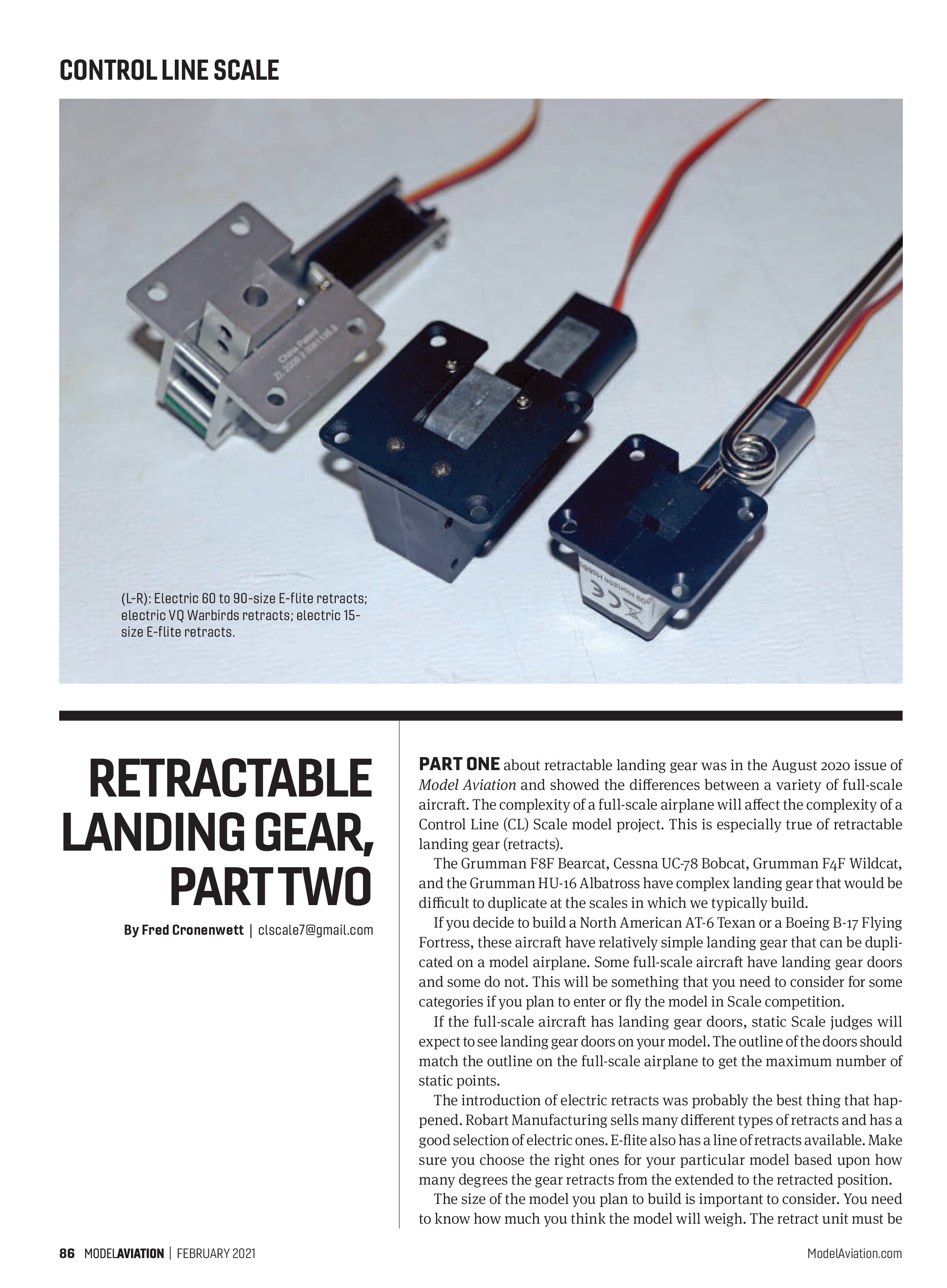
The introduction of electric retracts was probably the best thing that happened. Robart Manufacturing sells many different types of retracts and has a good selection of electric ones. E-flite also has a line of retracts available. Make sure you choose the right ones for your particular model based upon how many degrees the gear retracts from the extended to the retracted position.
The size of the model you plan to build is important to consider. You need to know how much you think the model will weigh. The retract unit must be able to handle the weight of the aircraft. If you are not sure how much it will weigh, get a larger retract unit than what you think you’ll require. A larger unit will have an easier time retracting the gear during flight because of the weight of the wheels.
The interface between the landing gear strut and the retract unit also varies. Some retracts have a circular clamp that allows for infinite adjustment of the strut rotation. Other retracts have setscrews that go into the wire strut to keep it from turning.
Landing Gear Doors
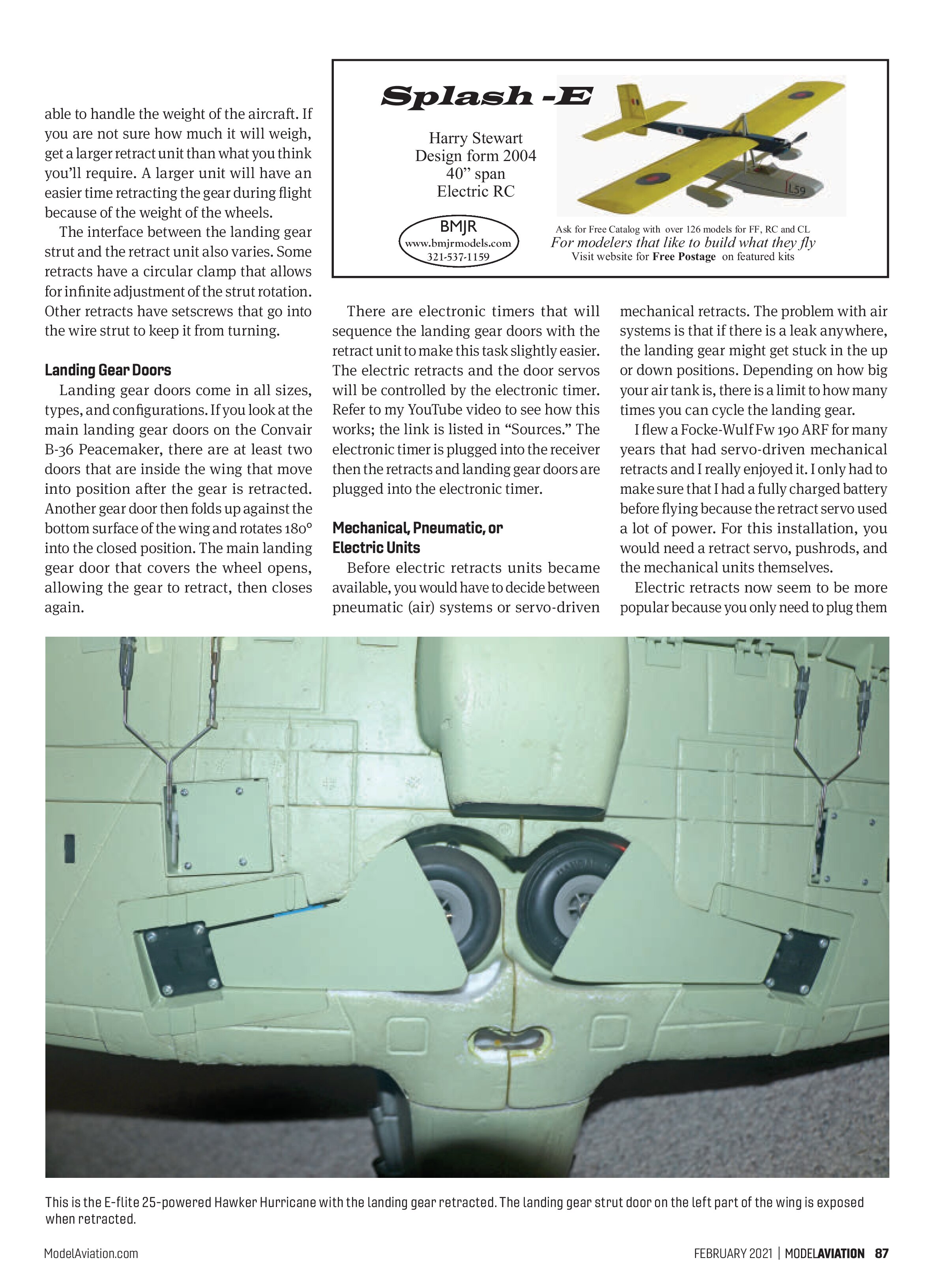
Landing gear doors come in all sizes, types, and configurations. If you look at the main landing gear doors on the Convair B-36 Peacemaker, there are at least two doors that are inside the wing that move into position after the gear is retracted. Another gear door then folds up against the bottom surface of the wing and rotates 180º into the closed position. The main landing gear door that covers the wheel opens, allowing the gear to retract, then closes again.
There are electronic timers that will sequence the landing gear doors with the retract unit to make this task slightly easier. The electric retracts and the door servos will be controlled by the electronic timer. Refer to my YouTube video to see how this works; the link is listed in “Sources.” The electronic timer is plugged into the receiver then the retracts and landing gear doors are plugged into the electronic timer.
Mechanical, Pneumatic, or
Electric Units
Before electric retracts units became available, you would have to decide between pneumatic (air) systems or servo-driven mechanical retracts. The problem with air systems is that if there is a leak anywhere, the landing gear might get stuck in the up or down positions. Depending on how big your air tank is, there is a limit to how many times you can cycle the landing gear.
I flew a Focke-Wulf Fw 190 ARF for many years that had servo-driven mechanical retracts and I really enjoyed it. I only had to make sure that I had a fully charged battery before flying because the retract servo used a lot of power. For this installation, you would need a retract servo, pushrods, and the mechanical units themselves.
Electric retracts now seem to be more popular because you only need to plug them

into the receiver for them to work. Move the toggle switch on your transmitter and the landing gear goes up and down. The servo and pushrod that move mechanical retracts are no longer required when you use electric retracts.
Even when we were flying “down-the-line” electronic controls, we could operate the servo-driven retracts. The entire system was made wireless by 2.4 GHz, but the electric retracts or servos plug into the receiver the same way that they did before.
Retracts are easy if everything is working properly while at the flying field, but you have to check and maintain the system before flying, and installation is more difficult than fixed landing gear. Before you fly, cycle the landing gear several times to make sure that the batteries are charged and that the gear is functioning correctly.
Just know that building an aircraft with retractable landing gear will be more

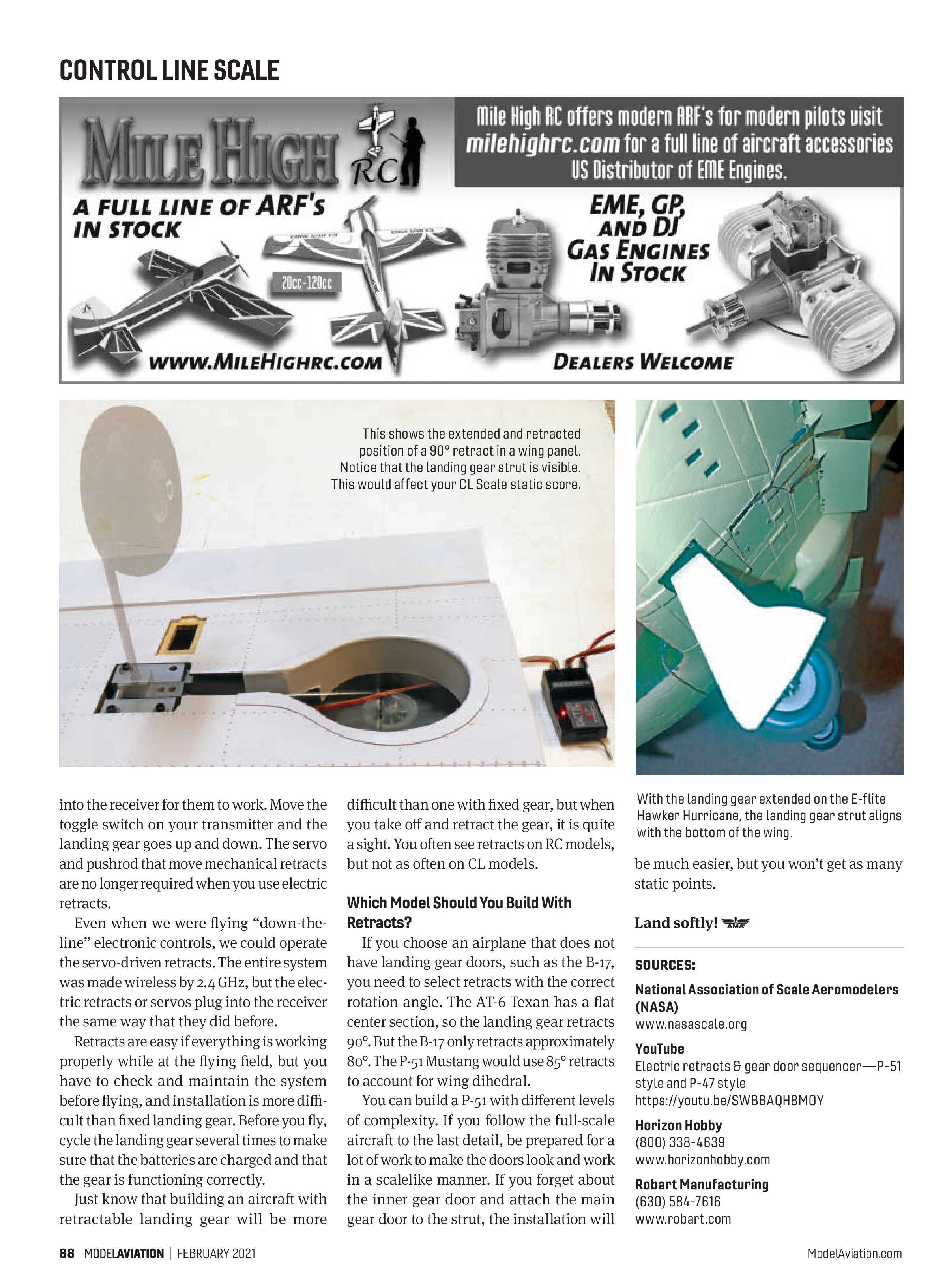
With the landing gear extended on the E-flite Hawker Hurricane, the landing gear strut aligns with the bottom of the wing.
difficult than one with fixed gear, but when you take off and retract the gear, it is quite a sight. You often see retracts on RC models, but not as often on CL models.
Which Model Should You Build With Retracts?
If you choose an airplane that does not have landing gear doors, such as the B-17, you need to select retracts with the correct rotation angle. The AT-6 Texan has a flat center section, so the landing gear retracts 90°. But the B-17 only retracts approximately 80°. The P-51 Mustang would use 85° retracts to account for wing dihedral.
You can build a P-51 with different levels of complexity. If you follow the full-scale aircraft to the last detail, be prepared for a lot of work to make the doors look and work in a scalelike manner. If you forget about the inner gear door and attach the main gear door to the strut, the installation will
be much easier, but you won’t get as many static points.
Land softly!
SOURCES:
National Association of Scale Aeromodelers (NASA)
www.nasascale.org
YouTube
Electric retracts & gear door sequencer—P-51 style and P-47 style
https://youtu.be/SWBBAQH8M0Y
Horizon Hobby
(800) 338-4639
www.horizonhobby.com
Robart Manufacturing
(630) 584-7616
www.robart.com