How to prepare for the Nats
by Fred Cronenwett
clscale7@gmail.com
One of the things I like best about Control Line (CL) competitions is that you see things that you might have never thought of or even considered doing. I have picked up innovative ideas or learned new things at every contest I have attended.
If you have flown in a CL Aerobatics contest, you know that everyone flies the same maneuvers in the same order. The score sheets in CL Scale list six blank options. This means that you have to choose what options you want to do, and in what order. If you only list five options and leave one blank, you will receive zero points for the sixth option.
Options are lumped into two categories: mechanical and flying. The flying options include a touch-and-go, missed approach, high flight, taxi, inside loop, Lazy Eight, wingover, or other aerobatic maneuvers.
Mechanical options are easier to do at the flying field, but require more building time to make them work correctly. These options include retractable landing gear, flaps, a bomb or tank drop, rotating turrets, torpedo drop, parachute drop, crop dusting, or other scale operations that are unique to the aircraft being modeled. Remember that throttle control and multiengine also count as options and can be used (see my February 2017 column).
There is a long list on the score sheet of what can be called out, based upon the airplane you have built. Retractable landing gear and touch-and-gos count as two options and are typically listed on two lines of the score sheet.
Score Sheets
There are currently two versions of the score sheet available. The AMA rules have a set attached to the 2017-2018 CL Scale rules; the National Association of Scale Aeromodelers (NASA) website has another set of score sheets that add up to the same number of points, but are laid out differently for the judges. Ask the contest director (CD) which form he or she will use so you can fill it out before arriving at the contest.
Practice Flying at Your Local Flying Site
When you go to your local flying field and something does not work, it is usually not a big deal, but during a contest it can be a problem, especially if you have driven a long way to get there. There have been cases where items have been left at home or something does not work properly. These things can sometimes be difficult to fix on the road.
Pull-test your lines and do a safety inspection of the aircraft. Just because the model was okay the last time you flew it does not mean that it doesn’t need some attention.
Several days before a contest, I go to my local flying field and run through the same things I would do at a contest.
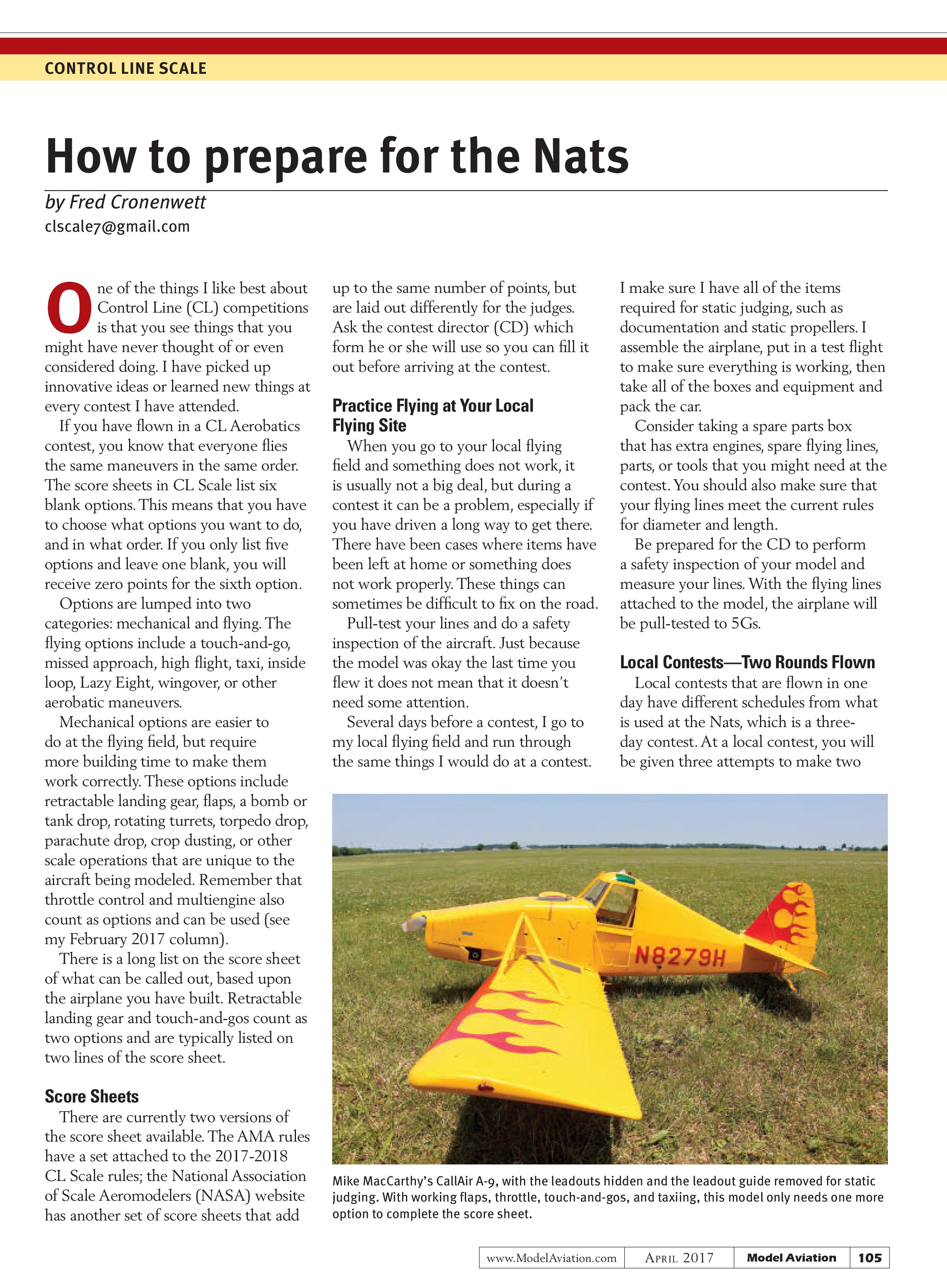
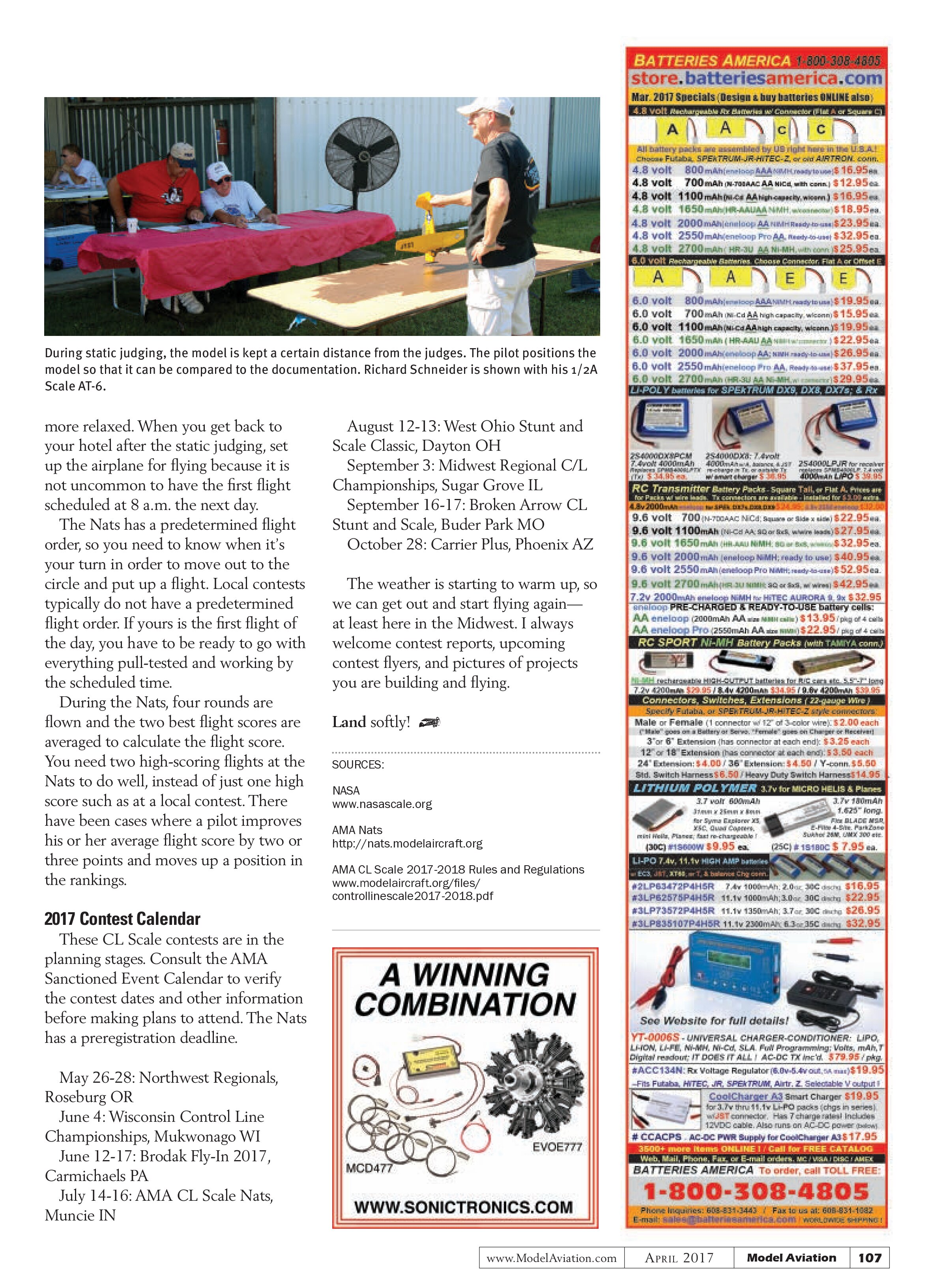
I make sure I have all of the items required for static judging, such as documentation and static propellers. I assemble the airplane, put in a test flight to make sure everything is working, then take all of the boxes and equipment and pack the car.
Consider taking a spare parts box that has extra engines, spare flying lines, parts, or tools that you might need at the contest. You should also make sure that your flying lines meet the current rules for diameter and length.
Be prepared for the CD to perform a safety inspection of your model and measure your lines. With the flying lines attached to the model, the airplane will be pull-tested to 5Gs.
Local Contests—Two Rounds Flown
Local contests that are flown in one day have different schedules from what is used at the Nats, which is a three-day contest. At a local contest, you will be given three attempts to make two


more relaxed. When you get back to your hotel after the static judging, set up the airplane for flying because it is not uncommon to have the first flight scheduled at 8 a.m. the next day.
The Nats has a predetermined flight order, so you need to know when it’s your turn in order to move out to the circle and put up a flight. Local contests typically do not have a predetermined flight order. If yours is the first flight of the day, you have to be ready to go with everything pull-tested and working by the scheduled time.
During the Nats, four rounds are flown and the two best flight scores are averaged to calculate the flight score. You need two high-scoring flights at the Nats to do well, instead of just one high score such as at a local contest. There have been cases where a pilot improves his or her average flight score by two or three points and moves up a position in the rankings.
2017 Contest Calendar
These CL Scale contests are in the planning stages. Consult the AMA Sanctioned Event Calendar to verify the contest dates and other information before making plans to attend. The Nats has a preregistration deadline.
May 26-28: Northwest Regionals, Roseburg OR
June 4: Wisconsin Control Line Championships, Mukwonago WI
June 12-17: Brodak Fly-In 2017, Carmichaels PA
July 14-16: AMA CL Scale Nats, Muncie IN
August 12-13: West Ohio Stunt and Scale Classic, Dayton OH
September 3: Midwest Regional C/L Championships, Sugar Grove IL
September 16-17: Broken Arrow CL Stunt and Scale, Buder Park MO
October 28: Carrier Plus, Phoenix AZ
The weather is starting to warm up, so we can get out and start flying again—at least here in the Midwest. I always welcome contest reports, upcoming contest flyers, and pictures of projects you are building and flying.
Land softly!
SOURCES:
AMA Nats
http://nats.modelaircraft.org
AMA CL Scale 2017-2018 Rules and Regulations
www.modelaircraft.org/files/
controllinescale2017-2018.pdf