Rules changes for 2017–2018
by Fred Cronenwett
clscale7@gmail.com

Thirteen rules proposals have been approved and will be incorporated into the 2017-2018 Control Line Scale rule book. Most of the proposals cleaned up and clarified the wording about how some items are to be judged and scored. There are several, though, that are worth pointing out and explaining.
Proposal 17-01
How flight points are added for ½A Scale was corrected and the wording was clarified. How to add the flight scores for a contest that has two flight rounds, compared with the four rounds flown at the Nats, was confusing. If you are hosting a ½A Scale event, make sure to reread how the flight points are calculated for the total score.
Proposal 17-14
There will be a 1.5-point deduction to the realism score if your model does not have working flaps or retractable landing gear if the full-scale aircraft had such items. This rule change was written this way to clarify to the judges and standardize how much the realism deduction should be if the model does not have retractable landing gear or flaps when the full-scale aircraft did. This does not apply to Fun or Profile Scale categories.
Proposals 17-02 and 17-13
Flaps and retractable landing gear are no longer considered independent functions and will be judged throughout the entire flight. Previously, you would call out the flaps or the retractable landing gear as an independent function by lowering them for one lap during the flight.
Now you can operate the flaps during takeoff, touch-and-gos, and landing, and they will be judged throughout the entire flight. If the flaps were partially lowered on the full-scale aircraft for takeoff, you should do the same thing to get the full points for this option.
You will still list retractable landing gear as two options and flaps as one option on the score sheet, but you don’t have to perform the option during one lap as an independent feature by demonstrating it and calling it out to the judges.
CL Scale models have generally not taken advantage of the technology for retractable landing gear and flaps until recently. Electronic controls were first introduced in 1975, but did not become mainstream until the 2000s. This technology has allowed the use of servos and other electronics.
The reason for mentioning this is that the electric retracts and servos need to plug into a receiver to work properly. Now that we are using 2.4 GHz radio control for CL Scale, we can easily take advantage of this technology for flaps and retractable landing gear.
If you take advantage of the 2.4 GHz control, the flaps are easy to integrate into the model (see my April 2016 column). Retractable landing gear is more difficult to install, but it plugs directly into the receiver if you use electric retracts.
Throttle Control as a Flight Option
Every CL Scale model is different, and each pilot must choose six options during the flight portion. Options fall into two categories: flying and mechanical. Flying options such as a missed approach, 45°, touch-and-go, and taxi, among others, can be flown by any model, assuming the full-scale aircraft was capable of performing that maneuver.
Mechanical options, such as a canopy, flaps, retractable landing gear, bomb drop, carrier hook, dive brakes, open/close air scoop, and other unique mechanical options are easier to achieve during the flying portion, but are more difficult to set up. Most of the work with the mechanical options takes place while you build the model.
Don’t forget to include throttle control as an option when you fill out the flight score sheet. If you don’t have throttle control on your model, you will lose realism points, so throttle control is almost expected if you want to be in the winner’s circle.
Remember that you can install a 2.4 GHz throttle control module on practically any model. The module only needs to contain a receiver, battery, on/off switch, and a servo. A great example is the module that Dan McEntee put on his Scale model (see my June 2016 column).
Another overlooked option is employing multiple engines. If you have two or more engines or motors, you can claim the multiengine as an option. This would be judged throughout the entire flight.
Joe Eiben’s Fun Scale SBD Dauntless
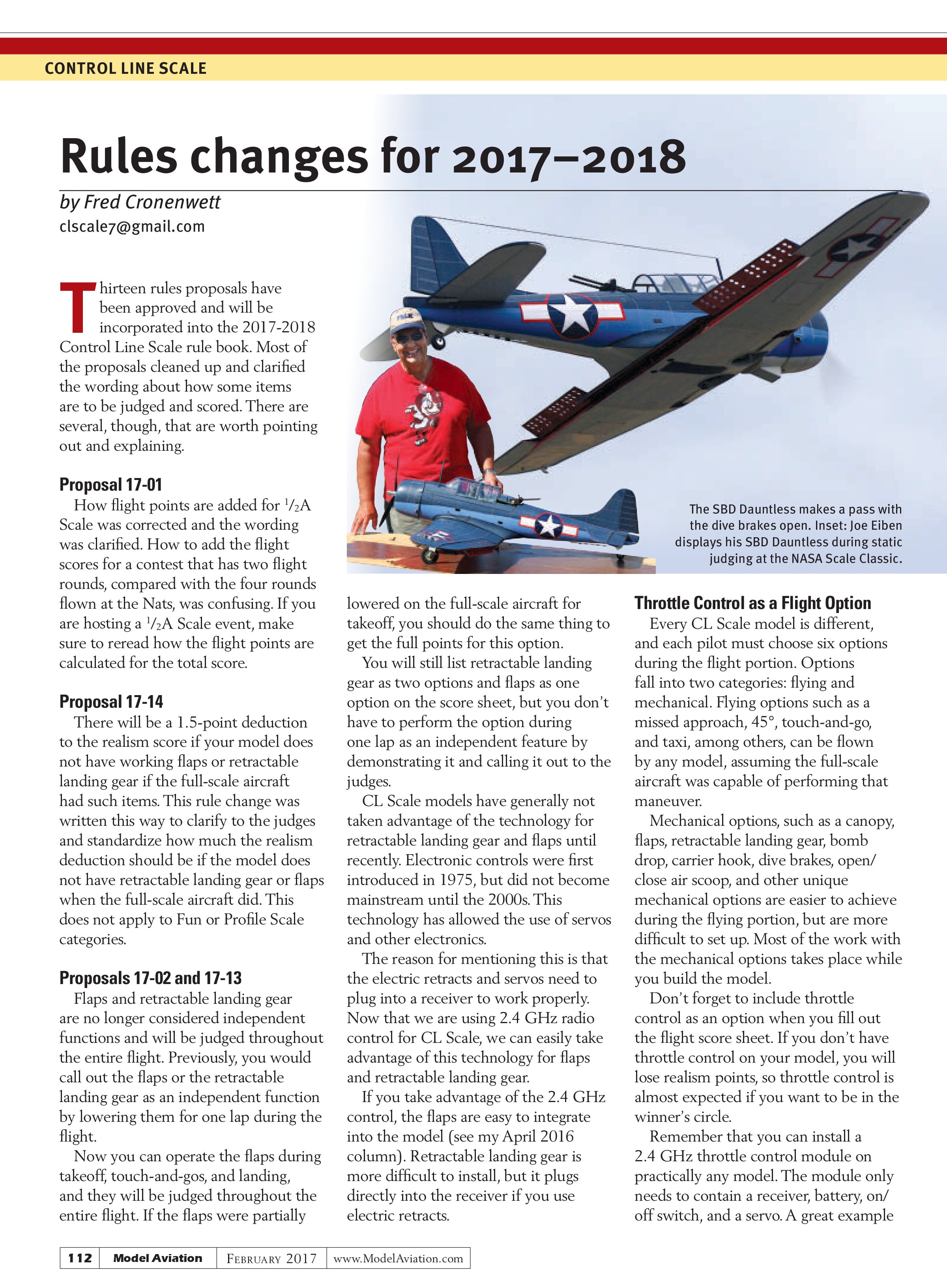
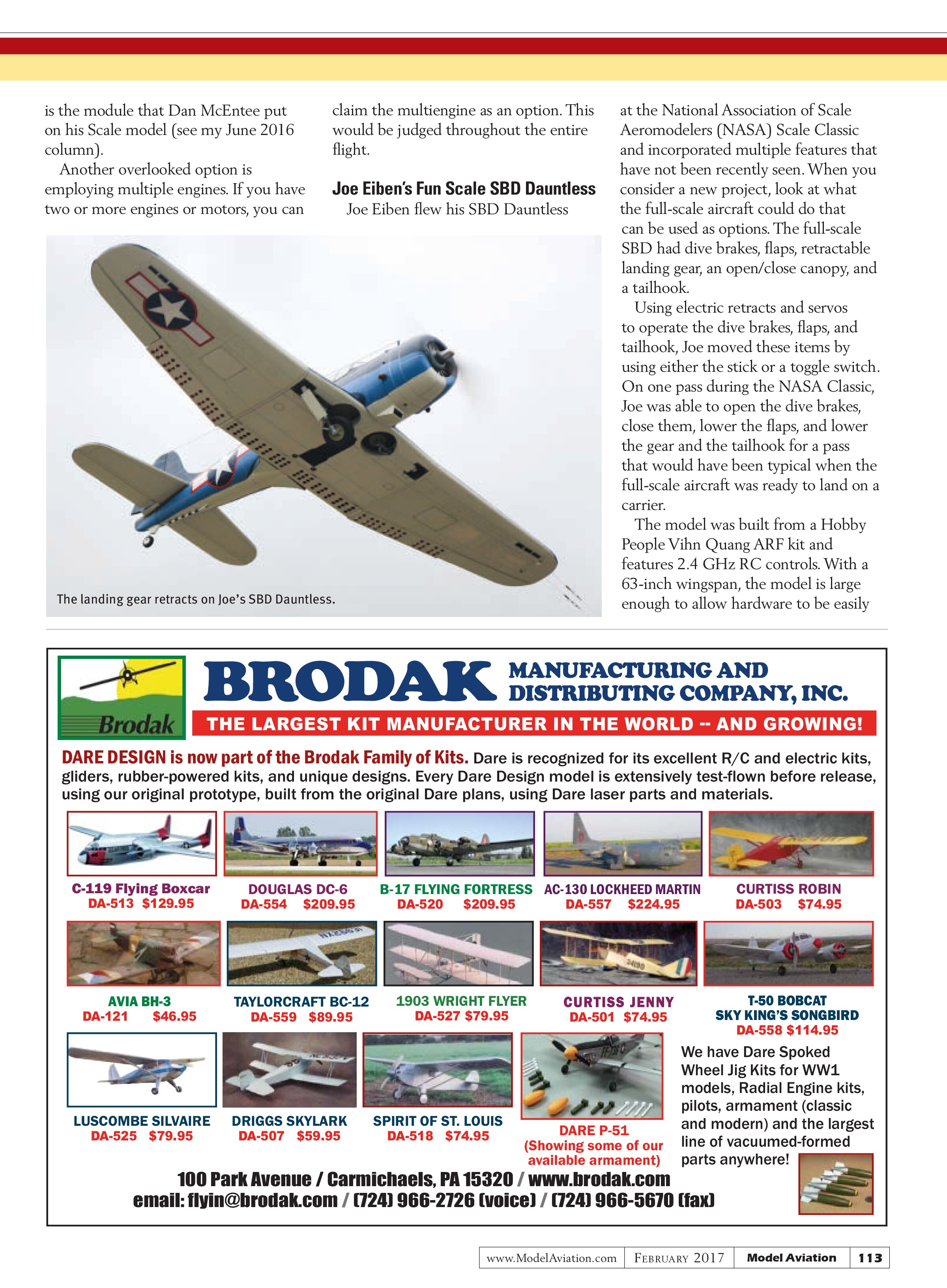
Joe Eiben flew his SBD Dauntless

at the National Association of Scale Aeromodelers (NASA) Scale Classic and incorporated multiple features that have not been recently seen. When you consider a new project, look at what the full-scale aircraft could do that can be used as options. The full-scale SBD had dive brakes, flaps, retractable landing gear, an open/close canopy, and a tailhook.
Using electric retracts and servos to operate the dive brakes, flaps, and tailhook, Joe moved these items by using either the stick or a toggle switch. On one pass during the NASA Classic, Joe was able to open the dive brakes, close them, lower the flaps, and lower the gear and the tailhook for a pass that would have been typical when the full-scale aircraft was ready to land on a carrier.
The model was built from a Hobby People Vinh Quang ARF kit and features 2.4 GHz RC controls. With a 63-inch wingspan, the model is large enough to allow hardware to be easily
installed, but not so big that you would need a good-size car to transport the model. The Hobby People G-46 electric motor is paired with a 4,000 mAh 4S LiPo battery and a 60-amp ESC.
NASA Scale Classic
The NASA Scale Classic was held in Waynesburg, Pennsylvania, on September 23-25, 2016. The event was successful and the weather was warm with almost no wind. On Sunday, the windsock was limp on the flag pole at the Green County Regional Airport where the contest was held.
The location of the 2018 NASA Scale Classic will be announced in January on the NASA website. There has been some confusion about how to qualify for an invitation for the Sport and Profile Scale entries; this will be revised for next year’s contest.
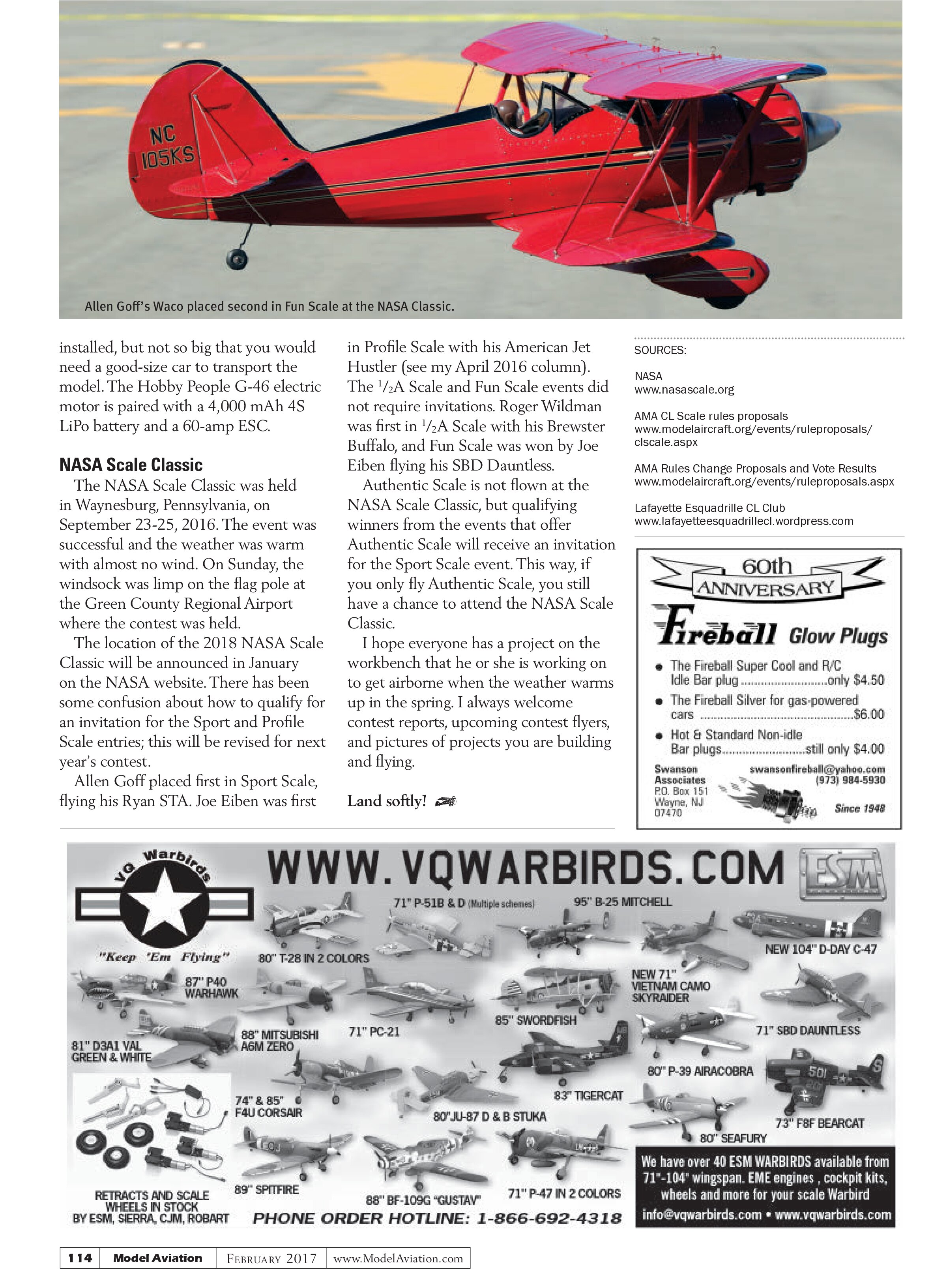
Allen Goff placed first in Sport Scale, flying his Ryan STA. Joe Eiben was first in Profile Scale with his American Jet Hustler (see my April 2016 column). The ½A Scale and Fun Scale events did not require invitations. Roger Wildman was first in ½A Scale with his Brewster Buffalo, and Fun Scale was won by Joe Eiben flying his SBD Dauntless.
Authentic Scale is not flown at the NASA Scale Classic, but qualifying winners from the events that offer Authentic Scale will receive an invitation for the Sport Scale event. This way, if you only fly Authentic Scale, you still have a chance to attend the NASA Scale Classic.
I hope everyone has a project on the workbench that he or she is working on to get airborne when the weather warms up in the spring. I always welcome contest reports, upcoming contest flyers, and pictures of projects you are building and flying.
Land softly!
SOURCES:
AMA CL Scale rules proposals
www.modelaircraft.org/events/ruleproposals/clscale.aspx
AMA Rules Change Proposals and Vote Results
www.modelaircraft.org/events/ruleproposals.aspx
Lafayette Esquadrille CL Club
www.lafayetteesquadrillecl.wordpress.com