Dan McEntee’s Air Tractor
by Fred Cronenwett
clscale7@gmail.com
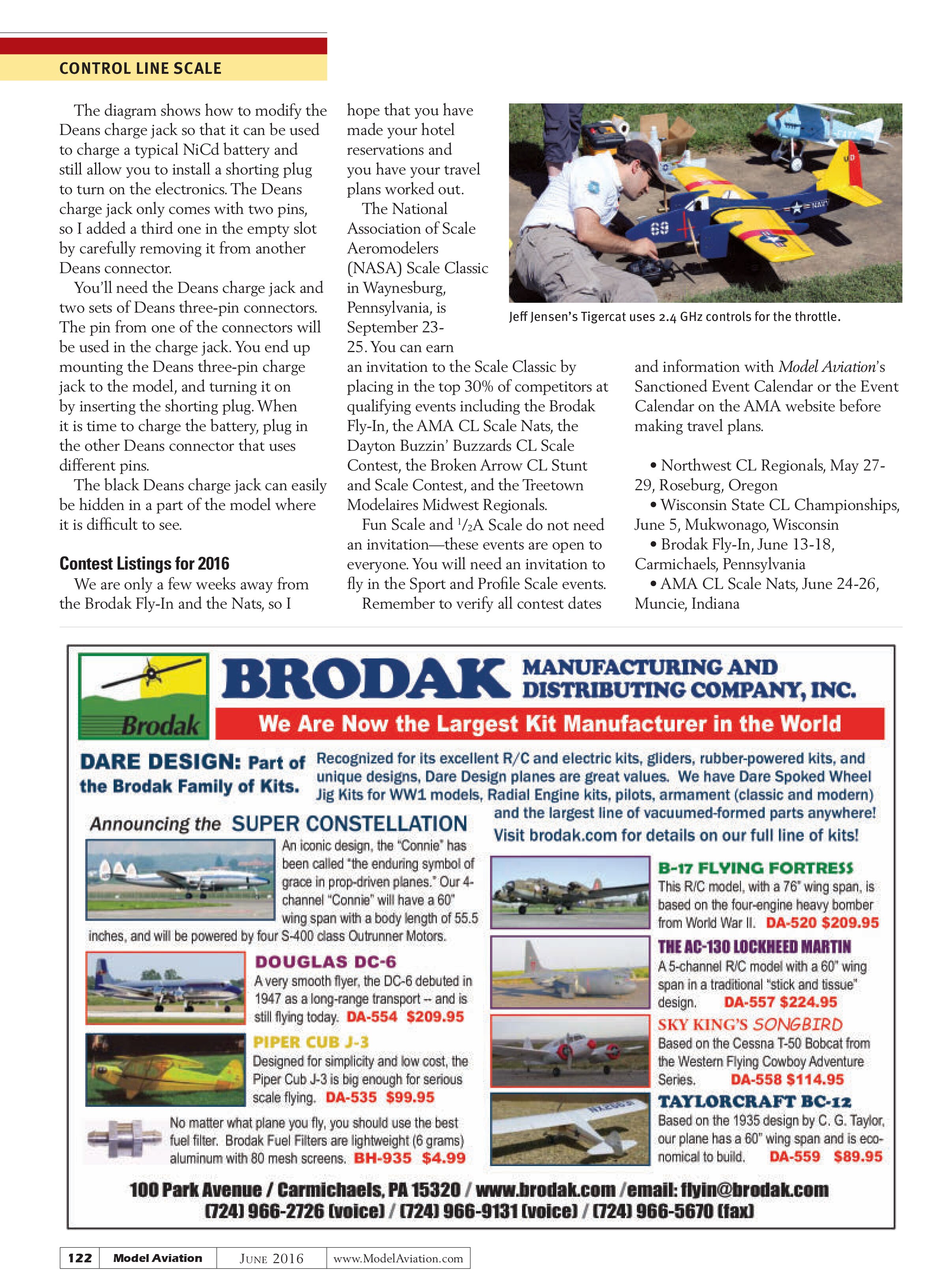
Dan McEntee’s model of an Air Tractor AT-301 attracts much attention because of its bright paint scheme. There is a full-scale Air Tractor painted in this color scheme in Texas. When Dan entered the model in the 2015 St. Louis Broken Arrow Control Line (CL) Stunt and Scale Contest, he used pictures that he found during an Internet image search as documentation.
Using a set of Cessna 188 AGwagon plans drawn by Larry Kruse, Dan modified a Twister wing and now has a unique Profile Scale model. The Twister wing was modified by putting in some dihedral and adding bays so that the wing matched the outlines of the three-view drawing.
The wingtips were also changed to correspond with the three-view. Always remember to verify the outlines on the plans to make sure they match the outlines of the three-view that you show to the judges and modify your plans to avoid any discrepancies.
Dan primary flies CL Precision Aerobatics (Stunt), and he wanted a model that could fly in Stunt and in CL Scale events. In CL Stunt, throttle control is not permitted; in CL Scale, throttle control is expected.
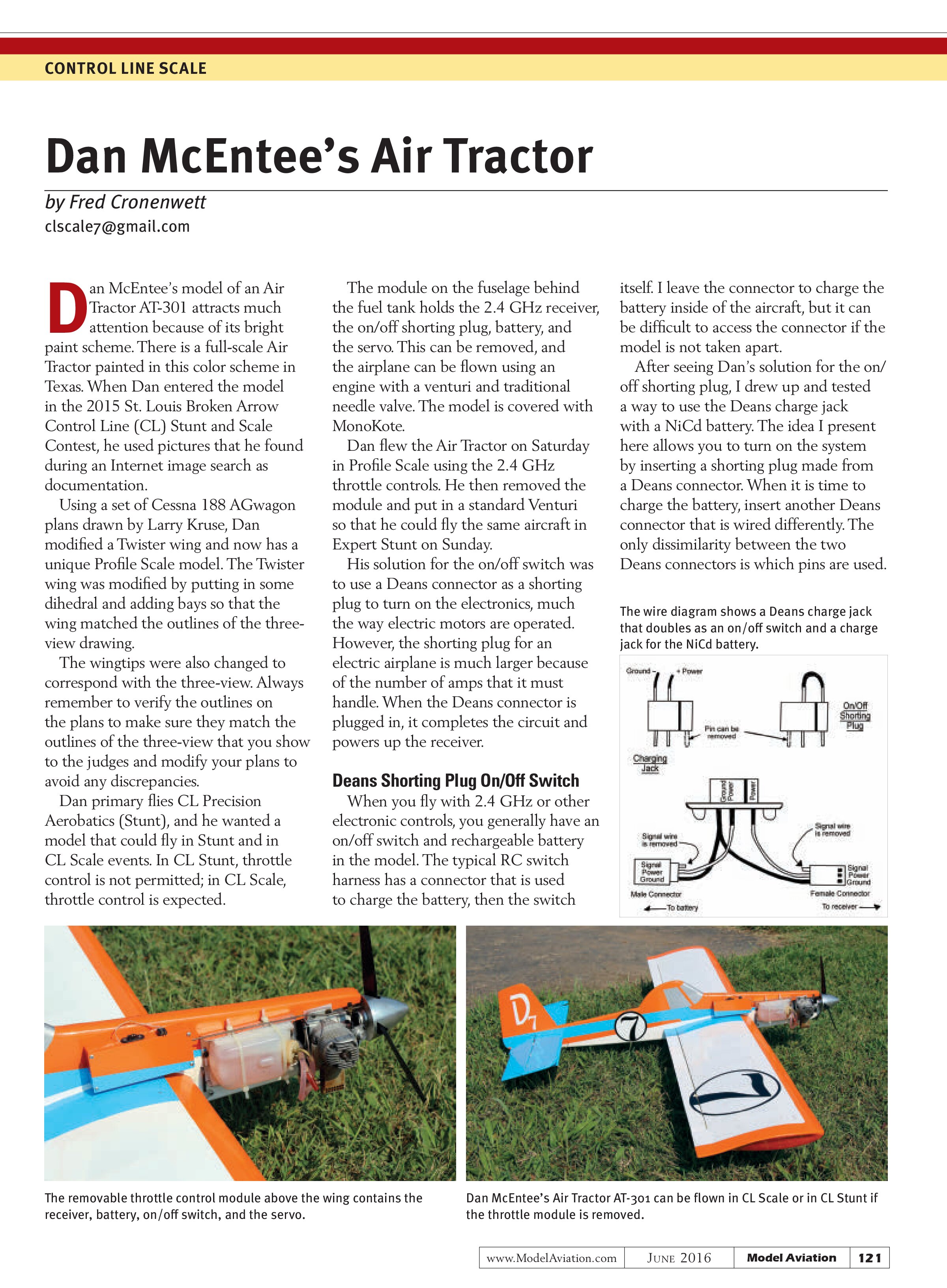
The module on the fuselage behind the fuel tank holds the 2.4 GHz receiver, the on/off shorting plug, battery, and the servo. This can be removed, and the airplane can be flown using an engine with a venturi and traditional needle valve. The model is covered with MonoKote.
Dan flew the Air Tractor on Saturday in Profile Scale using the 2.4 GHz throttle controls. He then removed the module and put in a standard Venturi so that he could fly the same aircraft in Expert Stunt on Sunday.
His solution for the on/off switch was to use a Deans connector as a shorting plug to turn on the electronics, much the way electric motors are operated. However, the shorting plug for an electric airplane is much larger because of the number of amps that it must handle. When the Deans connector is plugged in, it completes the circuit and powers up the receiver.
Deans Shorting Plug On/Off Switch
When you fly with 2.4 GHz or other electronic controls, you generally have an on/off switch and rechargeable battery in the model. The typical RC switch harness has a connector that is used to charge the battery, then the switch itself. I leave the connector to charge the battery inside of the aircraft, but it can be difficult to access the connector if the model is not taken apart.
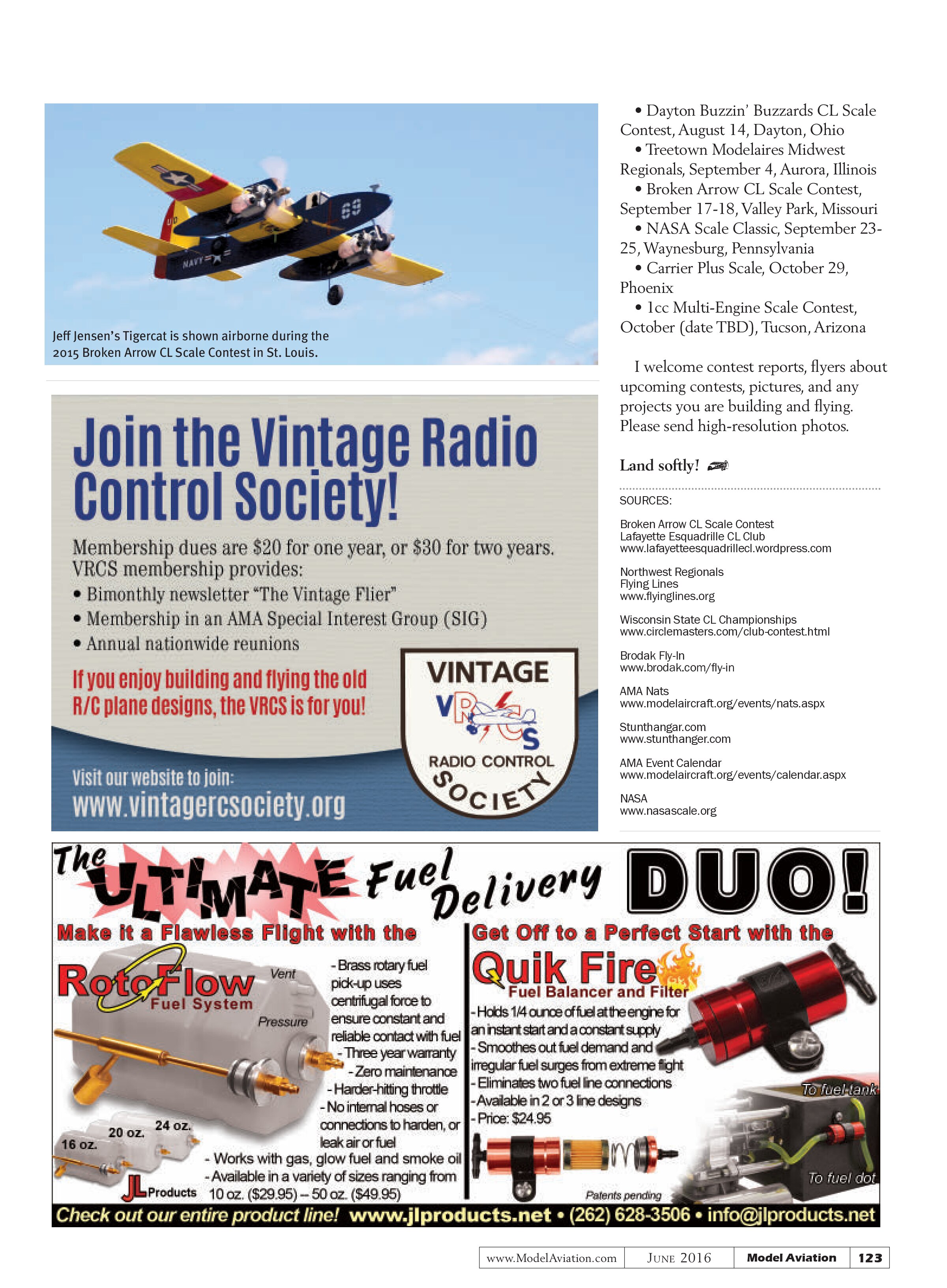
After seeing Dan’s solution for the on/off shorting plug, I drew up and tested a way to use the Deans charge jack with a NiCd battery. The idea I present here allows you to turn on the system by inserting a shorting plug made from a Deans connector. When it is time to charge the battery, insert another Deans connector that is wired differently. The only dissimilarity between the two Deans connectors is which pins are used.

The removable throttle control module above the wing contains the receiver, battery, on/off switch, and the servo.


The diagram shows how to modify the Deans charge jack so that it can be used to charge a typical NiCd battery and still allow you to install a shorting plug to turn on the electronics. The Deans charge jack only comes with two pins, so I added a third one in the empty slot by carefully removing it from another Deans connector.
You’ll need the Deans charge jack and two sets of Deans three-pin connectors. The pin from one of the connectors will be used in the charge jack. You end up mounting the Deans three-pin charge jack to the model, and turning it on by inserting the shorting plug. When it is time to charge the battery, plug in the other Deans connector that uses different pins.
The black Deans charge jack can easily be hidden in a part of the model where it is difficult to see.
Contest Listings for 2016
We are only a few weeks away from the Brodak Fly-In and the Nats, so I hope that you have made your hotel reservations and you have your travel plans worked out. The National Association of Scale Aeromodelers (NASA) Scale Classic in Waynesburg, Pennsylvania, is September 23-25. You can earn an invitation to the Scale Classic by placing in the top 30% of competitors at qualifying events including the Brodak Fly-In, the AMA CL Scale Nats, the Dayton Buzzin’ Buzzards CL Scale Contest, the Broken Arrow CL Stunt and Scale Contest, and the Treetown Modelaires Midwest Regionals.
Fun Scale and ½A Scale do not need an invitation—these events are open to everyone. You will need an invitation to fly in the Sport and Profile Scale events.
Remember to verify all contest dates and information with Model Aviation’s Sanctioned Event Calendar or the Event Calendar on the AMA website before making travel plans.
• Northwest CL Regionals, May 27-29, Roseburg, Oregon
• Wisconsin State CL Championships, June 5, Mukwonago, Wisconsin
• Brodak Fly-In, June 13-18, Carmichaels, Pennsylvania
• AMA CL Scale Nats, June 24-26, Muncie, Indiana

• Dayton Buzzin’ Buzzards CL Scale Contest, August 14, Dayton, Ohio
• Treetown Modelaires Midwest Regionals, September 4, Aurora, Illinois
• Broken Arrow CL Scale Contest, September 17-18, Valley Park, Missouri
• NASA Scale Classic, September 23-25, Waynesburg, Pennsylvania
• Carrier Plus Scale, October 29, Phoenix
• 1cc Multi-Engine Scale Contest, October (date TBD), Tucson, Arizona

I welcome contest reports, flyers about upcoming contests, pictures, and any projects you are building and flying. Please send high-resolution photos.
Land softly!
SOURCES:
Broken Arrow CL Scale Contest
Lafayette Escuadrille CL Club
www.lafayetteescuadrillecl.wordpress.com
Northwest Regionals
Flying Lines
www.flyinglines.org
Wisconsin State CL Championships
www.circlemasters.com/club-contest.html
Brodak Fly-In
www.brodak.com/fly-in
AMA Nats
www.modelaircraft.org/events/nats.aspx
Stunthangar.com
www.stunthangar.com
AMA Event Calendar
www.modelaircraft.org/events/calendar.aspx
NASA
www.nasascal e.org