Flaps and reducing servo speed
by Fred Cronenwett
clscale7@gmail.com
Flaps can be listed as one of the six options available to you during the flight portion of Control Line (CL) competition. With 2.4 GHz or down-the-line electronic controls, we can easily hook up a servo to move the flaps from the up position to the landing position.
Determine how far the flaps are lowered on a full-scale aircraft so that when you build the model, it can simulate the full-scale airplane. Some aircraft will lower the flap partway for takeoff and then all the way for landing. The P-51 Mustang can be lowered up to 50° and flaps are typically only used for landing.
If the flaps are on a toggle switch on the transmitter or handle, they will quickly move to the down position. The nose of the model will pitch up when the flaps are lowered, and the more they are lowered, the greater the effect.
You basically need to feed in down-trim to keep the model flying level when the flaps are lowered. When you raise the flaps, the opposite happens—the nose will want to drop, which means you will need to feed in up-trim to keep the airplane flying level.
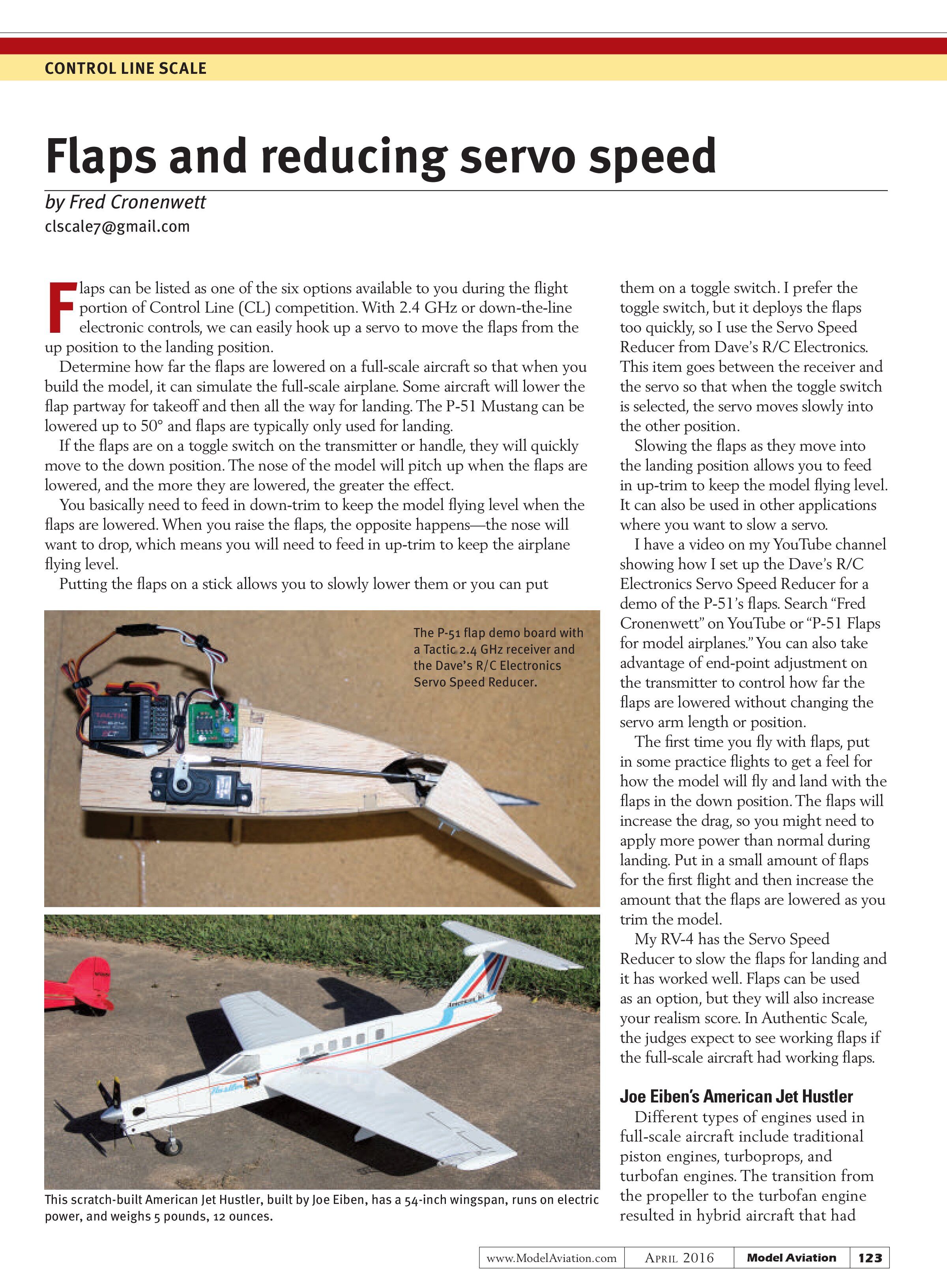
Putting the flaps on a stick allows you to slowly lower them or you can put them on a toggle switch. I prefer the toggle switch, but it deploys the flaps too quickly, so I use the Servo Speed Reducer from Dave’s R/C Electronics. This item goes between the receiver and the servo so that when the toggle switch is selected, the servo moves slowly into the other position.

Slowing the flaps as they move into the landing position allows you to feed in up-trim to keep the model flying level. It can also be used in other applications where you want to slow a servo.
I have a video on my YouTube channel showing how I set up the Dave’s R/C Electronics Servo Speed Reducer for a demo of the P-51’s flaps. Search “Fred Cronenwett” on YouTube or “P-51 Flaps for model airplanes.” You can also take advantage of end-point adjustment on the transmitter to control how far the flaps are lowered without changing the servo arm length or position.
The first time you fly with flaps, put in some practice flights to get a feel for how the model will fly and land with the flaps in the down position. The flaps will increase the drag, so you might need to apply more power than normal during landing. Put in a small amount of flaps for the first flight and then increase the amount that the flaps are lowered as you trim the model.
My RV-4 has the Servo Speed Reducer to slow the flaps for landing and it has worked well. Flaps can be used as an option, but they will also increase your realism score. In Authentic Scale, the judges expect to see working flaps if the full-scale aircraft had working flaps.

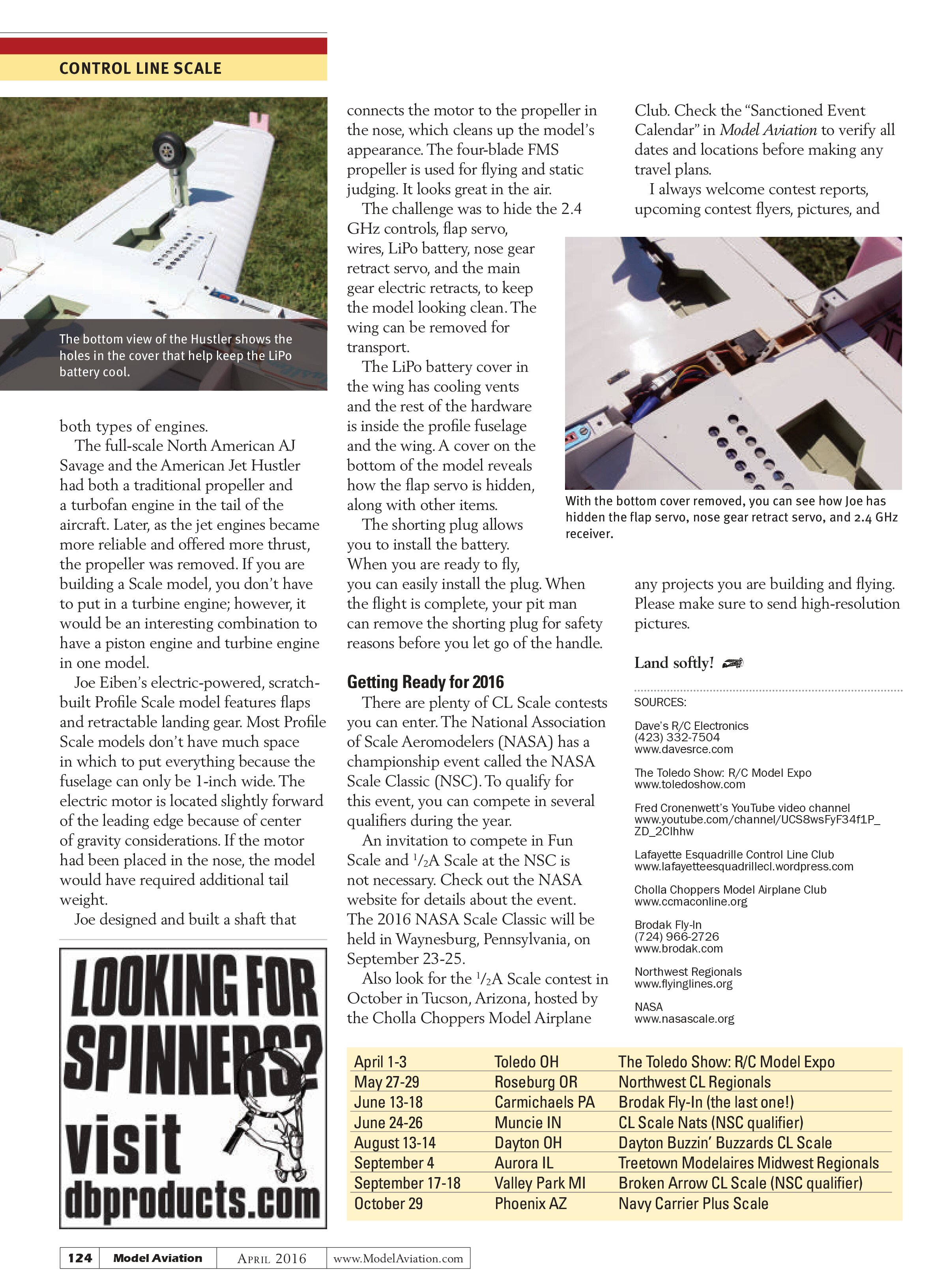
This scratch-built American Jet Hustler, built by Joe Eiben, has a 54-inch wingspan, runs on electric power, and weighs 5 pounds, 12 ounces.
Joe Eiben’s American Jet Hustler
Different types of engines used in full-scale aircraft include traditional piston engines, turboprops, and turbofan engines. The transition from the propeller to the turbofan engine resulted in hybrid aircraft that had

both types of engines.
The full-scale North American AJ Savage and the American Jet Hustler had both a traditional propeller and a turbofan engine in the tail of the aircraft. Later, as the jet engines became more reliable and offered more thrust, the propeller was removed. If you are building a Scale model, you don’t have to put in a turbine engine; however, it would be an interesting combination to have a piston engine and turbine engine in one model.
Joe Eiben’s electric-powered, scratch-built Profile Scale model features flaps and retractable landing gear. Most Profile Scale models don’t have much space in which to put everything because the fuselage can only be 1-inch wide. The electric motor is located slightly forward of the leading edge because of center of gravity considerations. If the motor had been placed in the nose, the model would have required additional tail weight.
Joe designed and built a shaft that connects the motor to the propeller in the nose, which cleans up the model’s appearance. The four-blade FMS propeller is used for flying and static judging. It looks great in the air.
The challenge was to hide the 2.4 GHz controls, flap servo, wires, LiPo battery, nose gear retract servo, and the main gear electric retracts, to keep the model looking clean. The wing can be removed for transport.
The LiPo battery cover in the wing has cooling vents and the rest of the hardware is inside the profile fuselage and the wing. A cover on the bottom of the model reveals how the flap servo is hidden, along with other items.
The shorting plug allows you to install the battery. When you are ready to fly, you can easily install the plug. When the flight is complete, your pit man can remove the shorting plug for safety reasons before you let go of the handle.
Getting Ready for 2016
There are plenty of CL Scale contests you can enter. The National Association of Scale Aeromodelers (NASA) has a championship event called the NASA Scale Classic (NSC). To qualify for this event, you can compete in several qualifiers during the year.
An invitation to compete in Fun Scale and ½A Scale at the NSC is not necessary. Check out the NASA website for details about the event. The 2016 NASA Scale Classic will be held in Waynesburg, Pennsylvania, on September 23-25.
Also look for the ½A Scale contest in October in Tucson, Arizona, hosted by the Cholla Choppers Model Airplane Club. Check the “Sanctioned Event Calendar” in Model Aviation to verify all dates and locations before making any travel plans.
I always welcome contest reports, upcoming contest flyers, pictures, and any projects you are building and flying. Please make sure to send high-resolution pictures.
Land softly!

April 1-3 — Toledo OH — The Toledo Show: R/C Model Expo
May 27-29 — Roseburg OR — Northwest CL Regionals
June 13-18 — Carmichaels PA — Brodak Fly-In (the last one!)
June 24-26 — Muncie IN — CL Scale Nats (NSC qualifier)
August 13-14 — Dayton OH — Dayton Buzzin’ Buzzards CL Scale
September 4 — Aurora IL — Treetown Modelaires Midwest Regionals
September 17-18 — Valley Park MI — Broken Arrow CL Scale (NSC qualifier)
October 29 — Phoenix AZ — Navy Carrier Plus Scale
SOURCES:
Dave’s R/C Electronics
(423) 332-7504
www.davesrce.com
The Toledo Show: R/C Model Expo
www.toledoshow.com
Fred Cronenwett’s YouTube video channel
www.youtube.com/channel/UCS8wsFyF34f1P_ZD_2Clhhw
Lafayette Esquadrille Control Line Club
www.lafayetteesquadrillecl.wordpress.com
Cholla Choppers Model Airplane Club
www.cmaconline.org
Brodak Fly-In
(724) 966-2726
www.brodak.com
Northwest Regionals
www.flyinglines.org