

Last contests for 2015
by Fred Cronenwett
clscale7@gmail.com
The 1cc Multi-Engine Control Line (CL) Scale Contest will be held October 10-11, 2015, in Tucson, Arizona. This ½A event has some great stuff and club rules will be used. There are two divisions of ½A Scale, one using throttle control.
The Central Arizona CL Club will host its contest on October 24-25, 2015, in Phoenix featuring Fun, Profile, Sport, Authentic, and ½A Scale using the Tucson rules. Consider checking out these contests if you can travel to Tucson or Phoenix.
Building for 2016
We had a great flying season throughout the summer months, but now that winter is coming, it is time to get that new CL Scale project out and start building. The weather was challenging in some parts of the country in 2015, so I hope everyone had a chance to fly.
If you plan to build for competition, think about what events you want to enter. This will determine how much detail you will need to add. Make sure you start with a good three-view representation and assemble your documentation. The model will need to match the documentation if you plan to enter a contest. Modify the plans or kit to match the three-view before you build.
The final Brodak Fly-In will be held in June 2016, so now is the time to plan ahead to attend the event in Carmichaels, Pennsylvania. This large fly-in is popular and it will be sad to see it fade away.
Northwest Regionals
One of the events that ranks high on my list of great contests is the Northwest Regionals, held Memorial Day weekend in Roseburg, Oregon. Hosted by the Northwest Regionals Management Association, the contest has been held in several locations.
Next year, the venue will remain in Roseburg. Although not a typical club, this group of modelers is led by John Thompson and Mike Hazel, who run the contest with help from the Eugene Prop Spinners and the Umpqua Valley Modelers.
The 2015 contest was held at the Roseburg Regional Airport with the support of the City of Roseburg, which allows the models to be flown at the airport. Special thanks goes to the airport’s manager, Patricia Loegering, who allows the club to use the ramp and grass area to fly CL Scale, Aerobatics, Racing, Combat, Carrier, and Speed. With 69 entries this year, the 2015 Northwest Regionals event was well attended and worth considering putting on your list of events to attend next year.
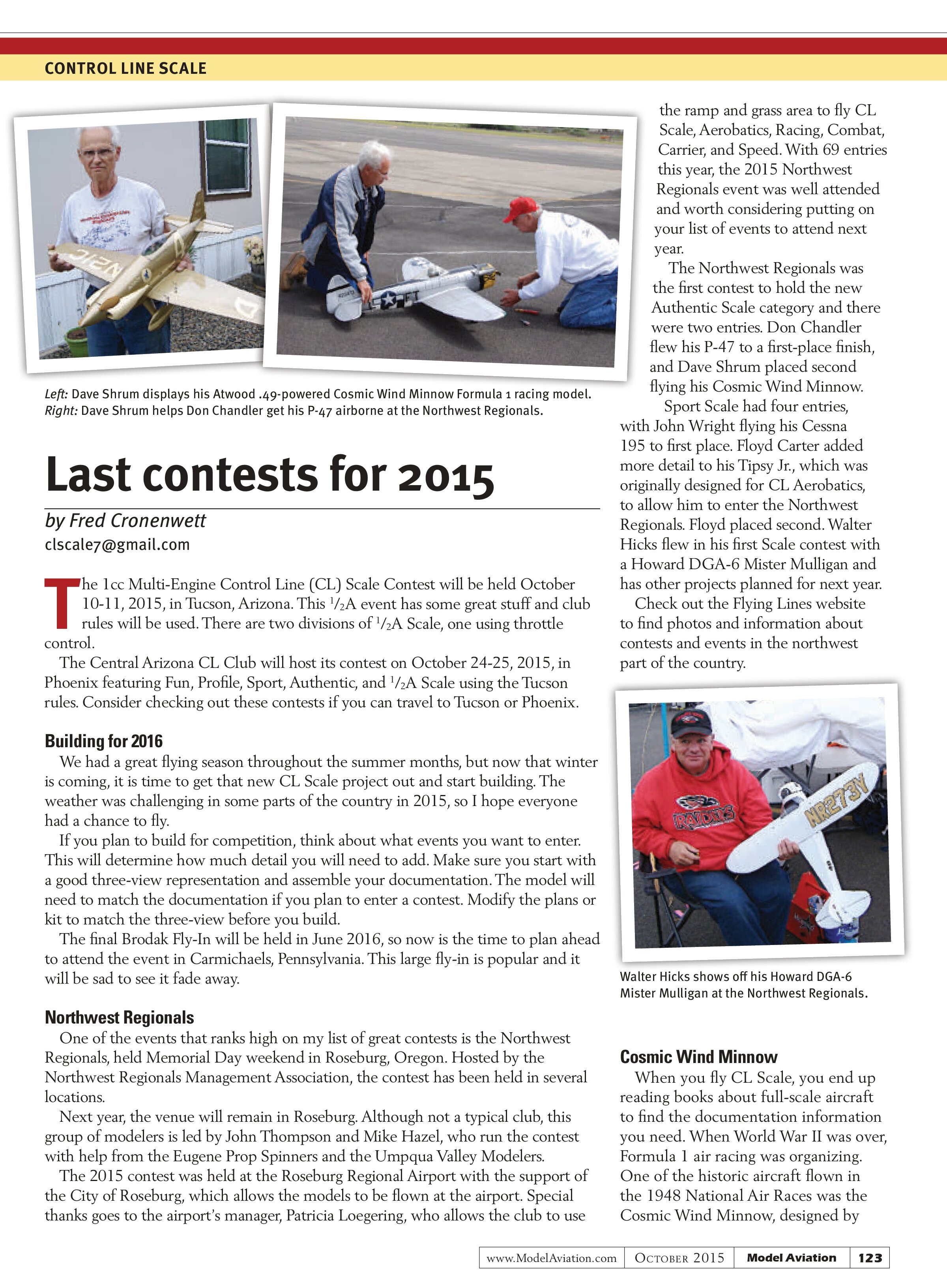
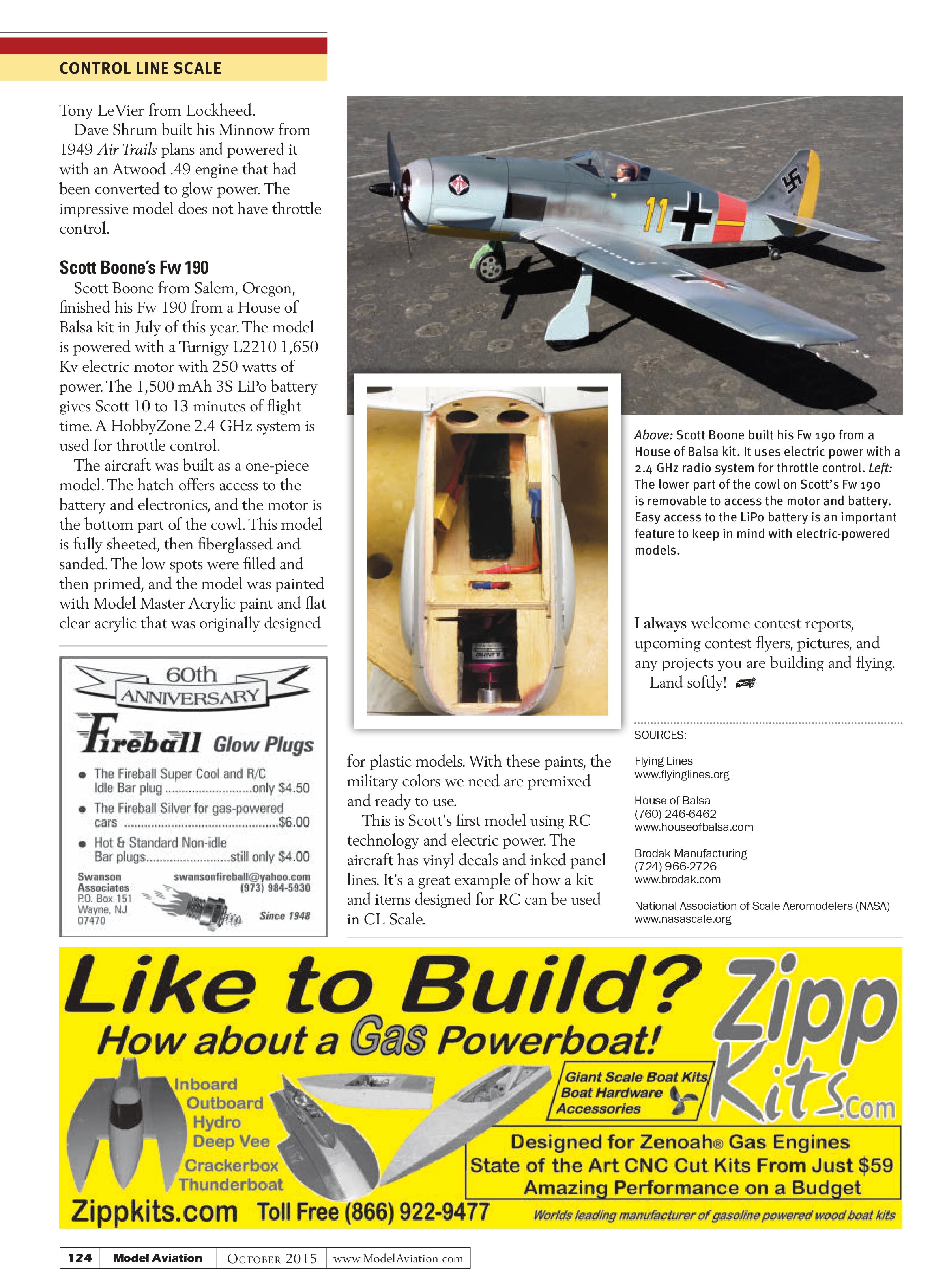
The Northwest Regionals was the first contest to hold the new Authentic Scale category and there were two entries. Don Chandler flew his P-47 to a first-place finish, and Dave Shrum placed second flying his Cosmic Wind Minnow.
Sport Scale had four entries, with John Wright flying his Cessna 195 to first place. Floyd Carter added more detail to his Tipsy Jr., which was originally designed for CL Aerobatics, to allow him to enter the Northwest Regionals. Floyd placed second. Walter Hicks flew in his first Scale contest with a Howard DGA-6 Mister Mulligan and has other projects planned for next year.
Check out the Flying Lines website to find photos and information about contests and events in the northwest part of the country.

Cosmic Wind Minnow
When you fly CL Scale, you end up reading books about full-scale aircraft to find the documentation information you need. When World War II was over, Formula 1 air racing was organizing. One of the historic aircraft flown in the 1948 National Air Races was the Cosmic Wind Minnow, designed by
Tony LeVier from Lockheed. Dave Shrum built his Minnow from 1949 Air Trails plans and powered it with an Atwood .49 engine that had been converted to glow power. The impressive model does not have throttle control.
Scott Boone’s Fw 190
Scott Boone from Salem, Oregon, finished his Fw 190 from a House of Balsa kit in July of this year. The model is powered with a Turnigy L2210 1,650 Kv electric motor with 250 watts of power. The 1,500 mAh 3S LiPo battery gives Scott 10 to 13 minutes of flight time. A HobbyZone 2.4 GHz system is used for throttle control.
The aircraft was built as a one-piece model. The hatch offers access to the battery and electronics, and the motor is the bottom part of the cowl. This model is fully sheeted, then fiberglassed and sanded. The low spots were filled and then primed, and the model was painted with Model Master Acrylic paint and flat clear acrylic that was originally designed

for plastic models. With these paints, the military colors we need are premixed and ready to use.
This is Scott’s first model using RC technology and electric power. The aircraft has vinyl decals and inked panel lines. It’s a great example of how a kit and items designed for RC can be used in CL Scale.

I always welcome contest reports, upcoming contest flyers, pictures, and any projects you are building and flying. Land softly!
SOURCES:
Flying Lines
www.flyinglines.org
House of Balsa
(760) 246-6462
www.houseofbalsa.com
Brodak Manufacturing
(724) 966-2726
www.brodak.com
National Association of Scale Aeromodelers (NASA)
www.nasascale.org