SMALL-FIELD FLYING

WHAT GOES
AROUND
FLIES
AROUND
By Pat Tritle | patscustommodels@gmail.com
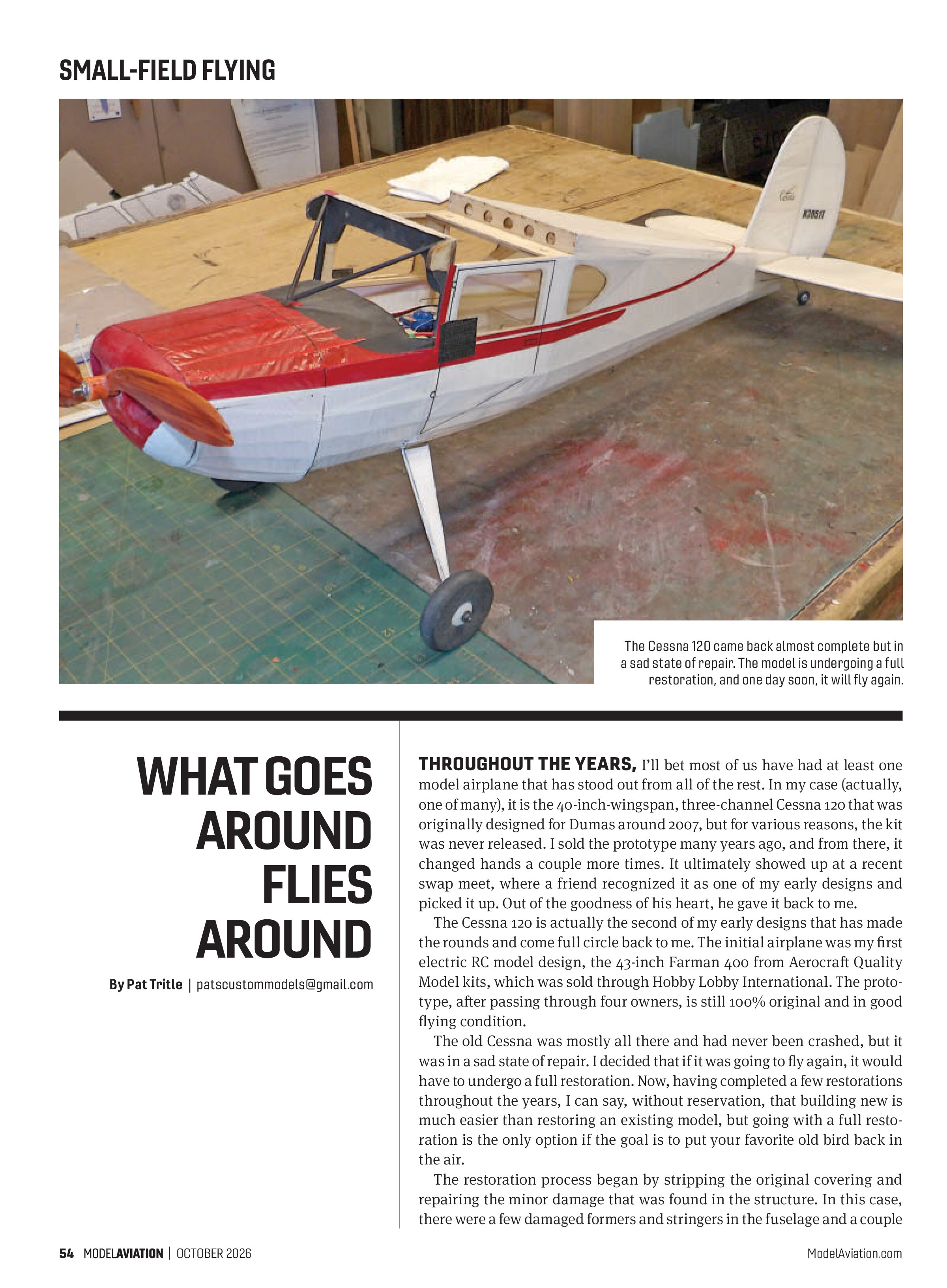
THROUGHOUT THE YEARS, I’ll bet most of us have had at least one model airplane that has stood out from all of the rest. In my case (actually, one of many), it is the 40-inch-wingspan, three-channel Cessna 120 that was originally designed for Dumas around 2007, but for various reasons, the kit was never released. I sold the prototype many years ago, and from there, it changed hands a couple more times. It ultimately showed up at a recent swap meet, where a friend recognized it as one of my early designs and picked it up. Out of the goodness of his heart, he gave it back to me.
The Cessna 120 is actually the second of my early designs that has made the rounds and come full circle back to me. The initial airplane was my first electric RC model design, the 43-inch Farman 400 from Aerocraft Quality Model kits, which was sold through Hobby Lobby International. The prototype, after passing through four owners, is still 100% original and in good flying condition.
The old Cessna was mostly all there and had never been crashed, but it was in a sad state of repair. I decided that if it was going to fly again, it would have to undergo a full restoration. Now, having completed a few restorations throughout the years, I can say, without reservation, that building new is much easier than restoring an existing model, but going with a full restoration is the only option if the goal is to put your favorite old bird back in the air.
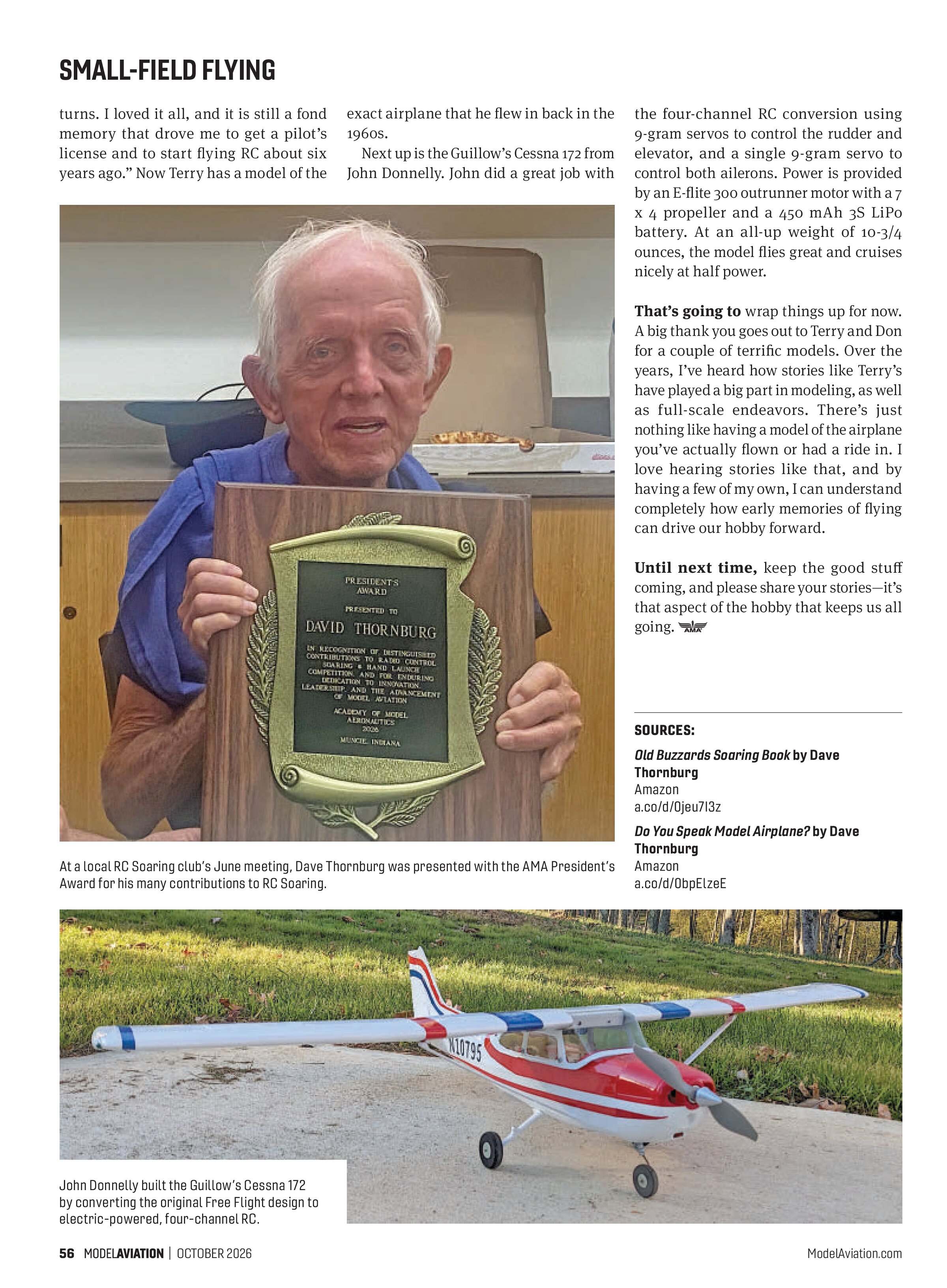
The restoration process began by stripping the original covering and repairing the minor damage that was found in the structure. In this case, there were a few damaged formers and stringers in the fuselage and a couple of broken ribs in the wing. Once the covering was removed, the airframe was sanded to remove the residue from the original MicroLite covering. That in itself was a tedious task that took several hours to complete. Once the airframe had been stripped, cleaned up, and repaired, it was ready for new covering.
I decided to go with period-correct Airspan rather than the original MicroLite. At this point, the covering was progressing nicely. After considering several color schemes, I decided to go back to the original red and white to keep with the restoration theme. Once it’s all completed and ready to go, I’ll follow up with a photo or two of the finished model.
Giving Credit Where Credit Is Due
In April’s column, I had mentioned flying with Dave Thornburg. In June of this year, our local RC Soaring club presented Dave with a well-deserved AMA President’s Award for his many contributions to the hobby of RC Soaring. Without Dave’s efforts and sailplane designs, Soaring might not be what it is today.
Dave is also the author of two great books, Old Buzzard’s Soaring Book and Do You Speak Model Airplane? Both are excellent reads, and much can be learned from them. They are still available through Amazon and other sources. Well done and well deserved, Dave.
I also have a couple of terrific contributions from readers this time around. My first offering is from the Land Down Under. Terry Gold sent over a photo from Australia of his 60-inch-wingspan Luscombe 8C that

was built from the Dare/Brodak kit. The best part of this project is the story behind the model.
At the approximate tender age of 8, Terry got his first airplane ride in a family friend’s full-scale Luscombe. In Terry’s words, “He [the pilot] was a mild-mannered pharmacist, but years later, I found out that he had been a P-47 pilot in World War II. My introduction flight included a loop and a Hammerhead turn where he stopped the engine, and then he cranked it in flight into a dive and some very steep

turns. I loved it all, and it is still a fond memory that drove me to get a pilot’s license and to start flying RC about six years ago.” Now Terry has a model of the

exact airplane that he flew in back in the 1960s.
Next up is the Guillow’s Cessna 172 from John Donnelly. John did a great job with

the four-channel RC conversion using 9-gram servos to control the rudder and elevator, and a single 9-gram servo to control both ailerons. Power is provided by an E-flite 300 outrunner motor with a 7 x 4 propeller and a 450 mAh 3S LiPo battery. At an all-up weight of 10-3/4 ounces, the model flies great and cruises nicely at half power.
That’s going to wrap things up for now. A big thank you goes out to Terry and Don for a couple of terrific models. Over the years, I’ve heard how stories like Terry’s have played a big part in modeling, as well as full-scale endeavors. There’s just nothing like having a model of the airplane you’ve actually flown or had a ride in. I love hearing stories like that, and by having a few of my own, I can understand completely how early memories of flying can drive our hobby forward.
Until next time, keep the good stuff coming, and please share your stories—it’s that aspect of the hobby that keeps us all going.
SOURCES:
Old Buzzards Soaring Book by Dave Thornburg
Amazon
a.co/d/Ujeu7I3z
Do You Speak Model Airplane? by Dave Thornburg
Amazon
a.co/d/ObpElzeE