RC SCALE AEROBATICS

SELECTING
COMPONENTS
AND MANAGING
SPARE PARTS
By John Glezellis | jglezellis@gmail.com
IN MY LAST column, I examined a few items that a pilot can implement within their daily routine to ensure that they are prepared to the maximum extent possible for a given competition.
Having flown competitively since 1995, and International Miniature Aerobatic Club (IMAC) competition since the late 1990s, I have experienced many different types of failures at both the local flying field and at numerous events held in the US and abroad. Interestingly, certain elements of preparation for an event begin while a competition airplane is still on the building bench and when items are being procured, sometimes even before the aircraft arrives!
This month, I will continue along the lines of preparation and will review a few practices that you can follow, either during the assembly of an ARF aircraft or during the construction of a kit. With this knowledge, the expectation is that a competitor will be able to quickly address and resolve a potential issue and then return their attention to perfecting that next competition flight.
Without further delay, let’s begin!
Overcoming a Failure
While a failure can occur at any point, it doesn’t always have to be something that is either structural or electrical. For example, let’s assume that a pilot experiences an engine failure during a practice flight the day before an event. During a spin, they had an idle setting for the throttle that was too low and caused the engine to quit. The aircraft was unable to make it back to the runway and landed in a rough area, damaging the landing gear,
not at the mounting location to the fuselage but, rather, at the axle. Not having a spare axle (which is an inexpensive item) can easily result in a pilot being unable to use that model during a competition. Don’t let this happen to you!

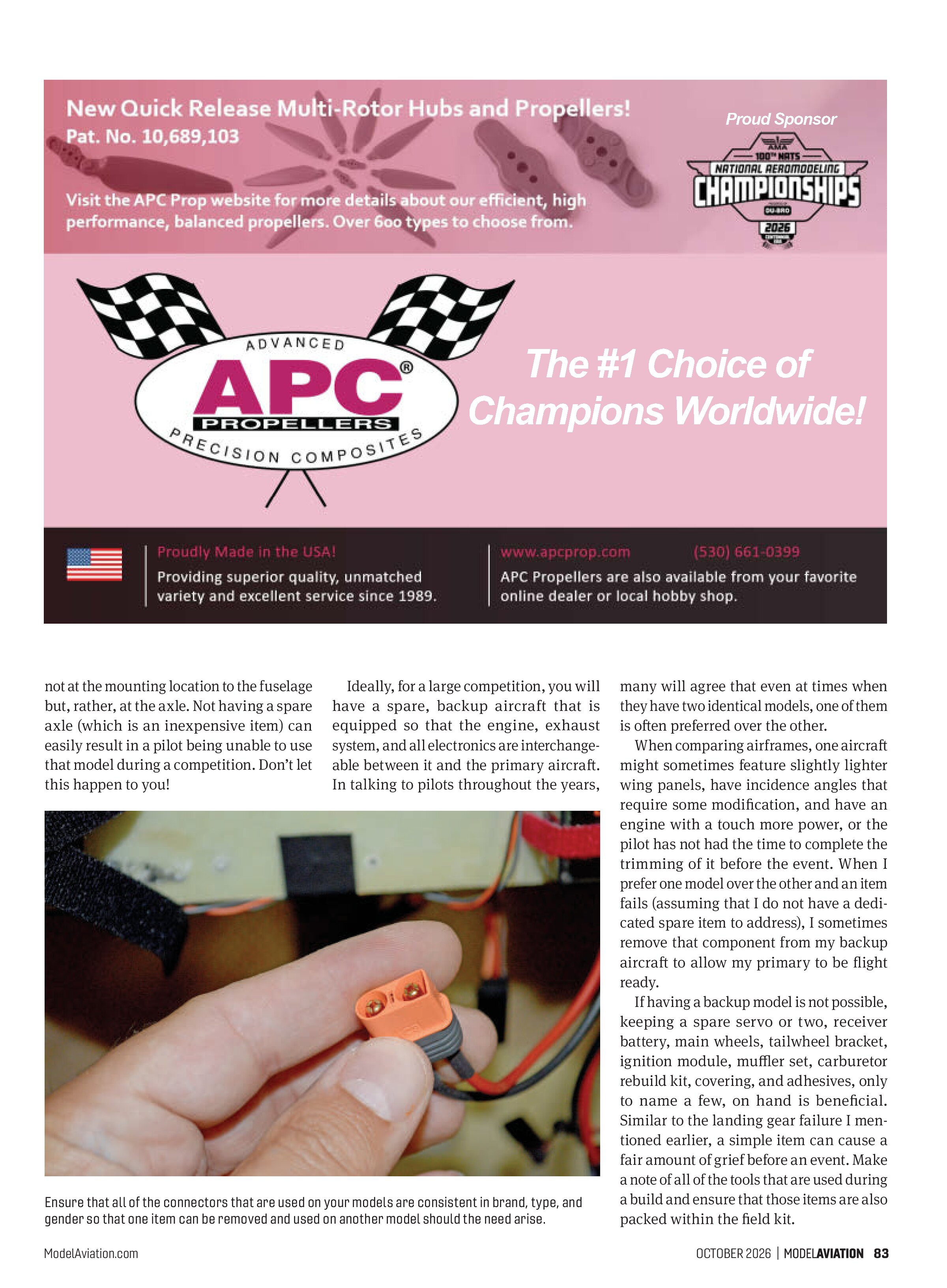
Ideally, for a large competition, you will have a spare, backup aircraft that is equipped so that the engine, exhaust system, and all electronics are interchangeable between it and the primary aircraft. In talking to pilots throughout the years,
many will agree that even at times when they have two identical models, one of them is often preferred over the other.
When comparing airframes, one aircraft might sometimes feature slightly lighter wing panels, have incidence angles that require some modification, and have an engine with a touch more power, or the pilot has not had the time to complete the trimming of it before the event. When I prefer one model over the other and an item fails (assuming that I do not have a dedicated spare item to address), I sometimes remove that component from my backup aircraft to allow my primary to be flight ready.
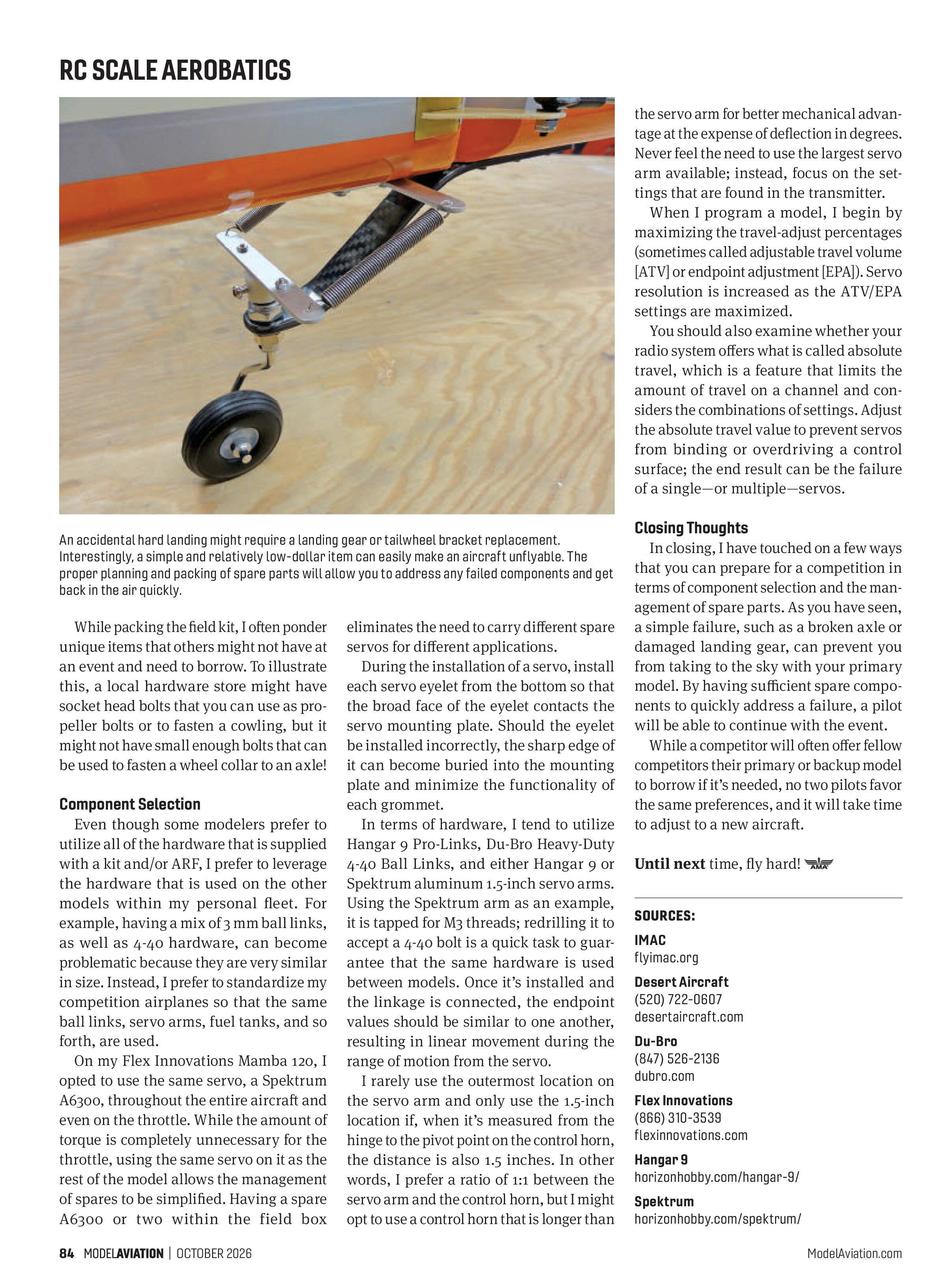
If having a backup model is not possible, keeping a spare servo or two, receiver battery, main wheels, tailwheel bracket, ignition module, muffler set, carburetor rebuild kit, covering, and adhesives, only to name a few, on hand is beneficial. Similar to the landing gear failure I mentioned earlier, a simple item can cause a fair amount of grief before an event. Make a note of all of the tools that are used during a build and ensure that those items are also packed within the field kit.

the servo arm for better mechanical advantage at the expense of deflection in degrees. Never feel the need to use the largest servo arm available; instead, focus on the settings that are found in the transmitter.
When I program a model, I begin by maximizing the travel-adjust percentages (sometimes called adjustable travel volume [ATV] or endpoint adjustment [EPA]). Servo resolution is increased as the ATV/EPA settings are maximized.
You should also examine whether your radio system offers what is called absolute travel, which is a feature that limits the amount of travel on a channel and considers the combinations of settings. Adjust the absolute travel value to prevent servos from binding or overdriving a control surface; the end result can be the failure of a single—or multiple—servos.
An accidental hard landing might require a landing gear or tailwheel bracket replacement. Interestingly, a simple and relatively low-dollar item can easily make an aircraft unflyable. The proper planning and packing of spare parts will allow you to address any failed components and get back in the air quickly.
While packing the field kit, I often ponder unique items that others might not have at an event and need to borrow. To illustrate this, a local hardware store might have socket head bolts that you can use as propeller bolts or to fasten a cowling, but it might not have small enough bolts that can be used to fasten a wheel collar to an axle!
Component Selection
Even though some modelers prefer to utilize all of the hardware that is supplied with a kit and/or ARF, I prefer to leverage the hardware that is used on the other models within my personal fleet. For example, having a mix of 3 mm ball links, as well as 4-40 hardware, can become problematic because they are very similar in size. Instead, I prefer to standardize my competition airplanes so that the same ball links, servo arms, fuel tanks, and so forth, are used.
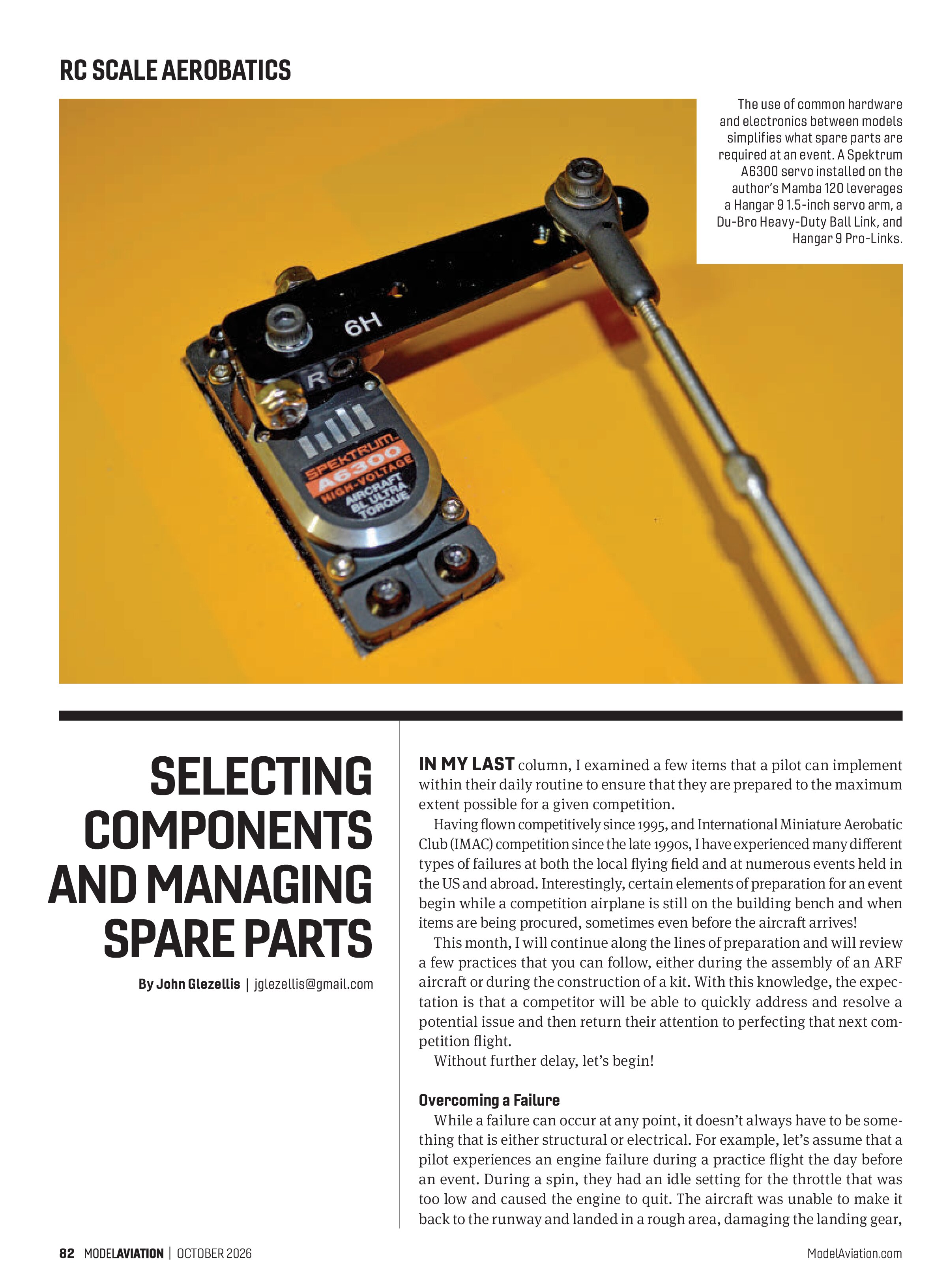
On my Flex Innovations Mamba 120, I opted to use the same servo, a Spektrum A6300, throughout the entire aircraft and even on the throttle. While the amount of torque is completely unnecessary for the throttle, using the same servo on it as the rest of the model allows the management of spares to be simplified. Having a spare A6300 or two within the field box eliminates the need to carry different spare servos for different applications.
During the installation of a servo, install each servo eyelet from the bottom so that the broad face of the eyelet contacts the servo mounting plate. Should the eyelet be installed incorrectly, the sharp edge of it can become buried into the mounting plate and minimize the functionality of each grommet.
In terms of hardware, I tend to utilize Hangar 9 Pro-Links, Du-Bro Heavy-Duty 4-40 Ball Links, and either Hangar 9 or Spektrum aluminum 1.5-inch servo arms. Using the Spektrum arm as an example, it is tapped for M3 threads; redrilling it to accept a 4-40 bolt is a quick task to guarantee that the same hardware is used between models. Once it’s installed and the linkage is connected, the endpoint values should be similar to one another, resulting in linear movement during the range of motion from the servo.
I rarely use the outermost location on the servo arm and only use the 1.5-inch location if, when it’s measured from the hinge to the pivot point on the control horn, the distance is also 1.5 inches. In other words, I prefer a ratio of 1:1 between the servo arm and the control horn, but I might opt to use a control horn that is longer than the servo arm for better mechanical advantage at the expense of deflection in degrees.
Closing Thoughts
In closing, I have touched on a few ways that you can prepare for a competition in terms of component selection and the management of spare parts. As you have seen, a simple failure, such as a broken axle or damaged landing gear, can prevent you from taking to the sky with your primary model. By having sufficient spare components to quickly address a failure, a pilot will be able to continue with the event.
While a competitor will often offer fellow competitors their primary or backup model to borrow if it’s needed, no two pilots favor the same preferences, and it will take time to adjust to a new aircraft.
Until next time, fly hard!
SOURCES:
IMAC
flyimac.org
Desert Aircraft
(520) 722-0607
desertaircraft.com
Du-Bro
(847) 526-2136
dub ro.com
Flex Innovations
(866) 310-3539
flexinnovations.com
Hangar 9
horizonhobby.com/hangar-9/
Spektrum
horizonhobby.com/spektrum/