RC HELICOPTERS
THE STORY
OF THETA
SERVOS
By James Wang | heloeditor@gmail.com

THROUGHOUT THE past few years, Theta Servos has become one of the fastest-growing names in the high-performance RC helicopter market. First adopted by elite competition pilots, the brand has quickly earned a reputation for exceptional speed, precision, and reliability.
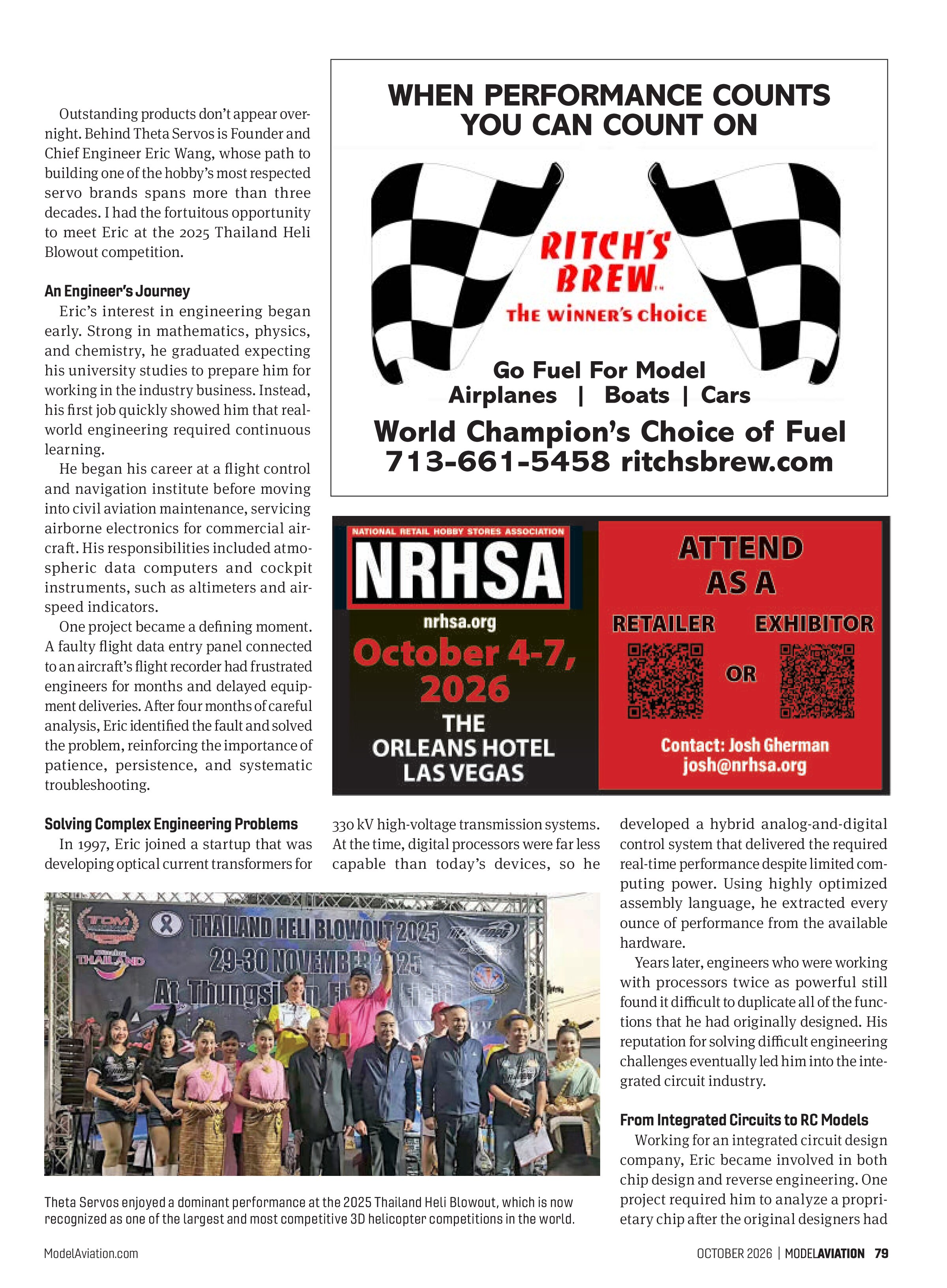
Today, Theta’s servos are trusted by many of the world’s top pilots, including 3D Masters Champions Kenny Ko and Duncan Bossion, as well as many of the leading competitors at the 2025 Thailand Heli Blowout in Bangkok, Thailand, which is now regarded as one of the world’s premier 3D helicopter competitions. Other pilots who fly Theta Servos include Rhys Wyatt, Carl-Henning Siebert, Chawarin Kongthong, Sakkarin CD Kongthong, Barel Atanlov, and Jae Hong Lee.
I began flying Theta Servos earlier this year, installing the high-voltage servos in my 700-size helicopters and the low-profile Razor series in my Goblin RAW 580. After more than six months of regular flying, they continue to perform flawlessly. The centering remains precise, the movement is exceptionally smooth, and there has not been a noticeable loss of performance.
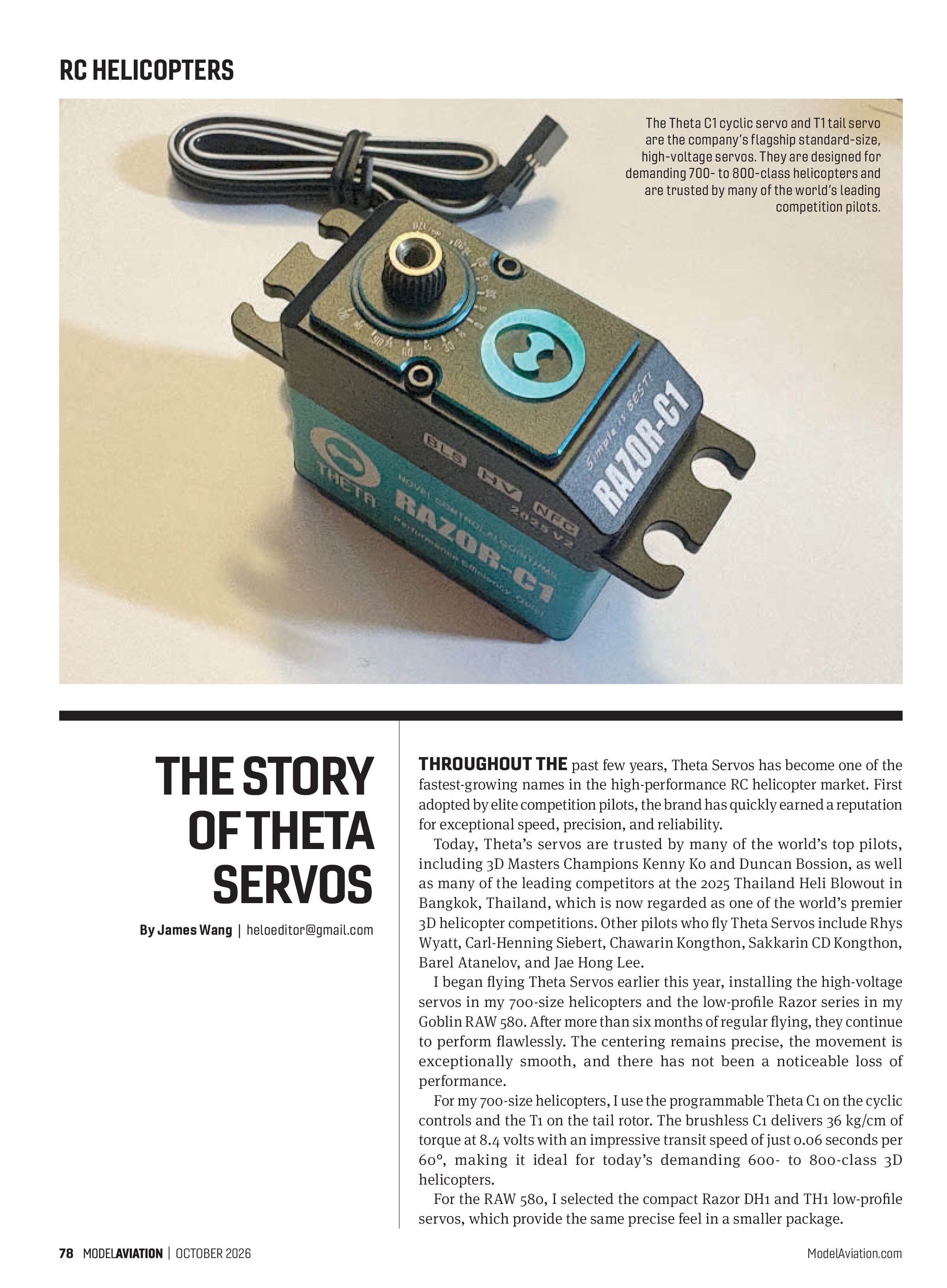
For my 700-size helicopters, I use the programmable Theta C1 on the cyclic controls and the T1 on the tail rotor. The brushless C1 delivers 36 kg/cm of torque at 8.4 volts with an impressive transit speed of just 0.06 seconds per 60°, making it ideal for today’s demanding 600- to 800-class 3D helicopters.
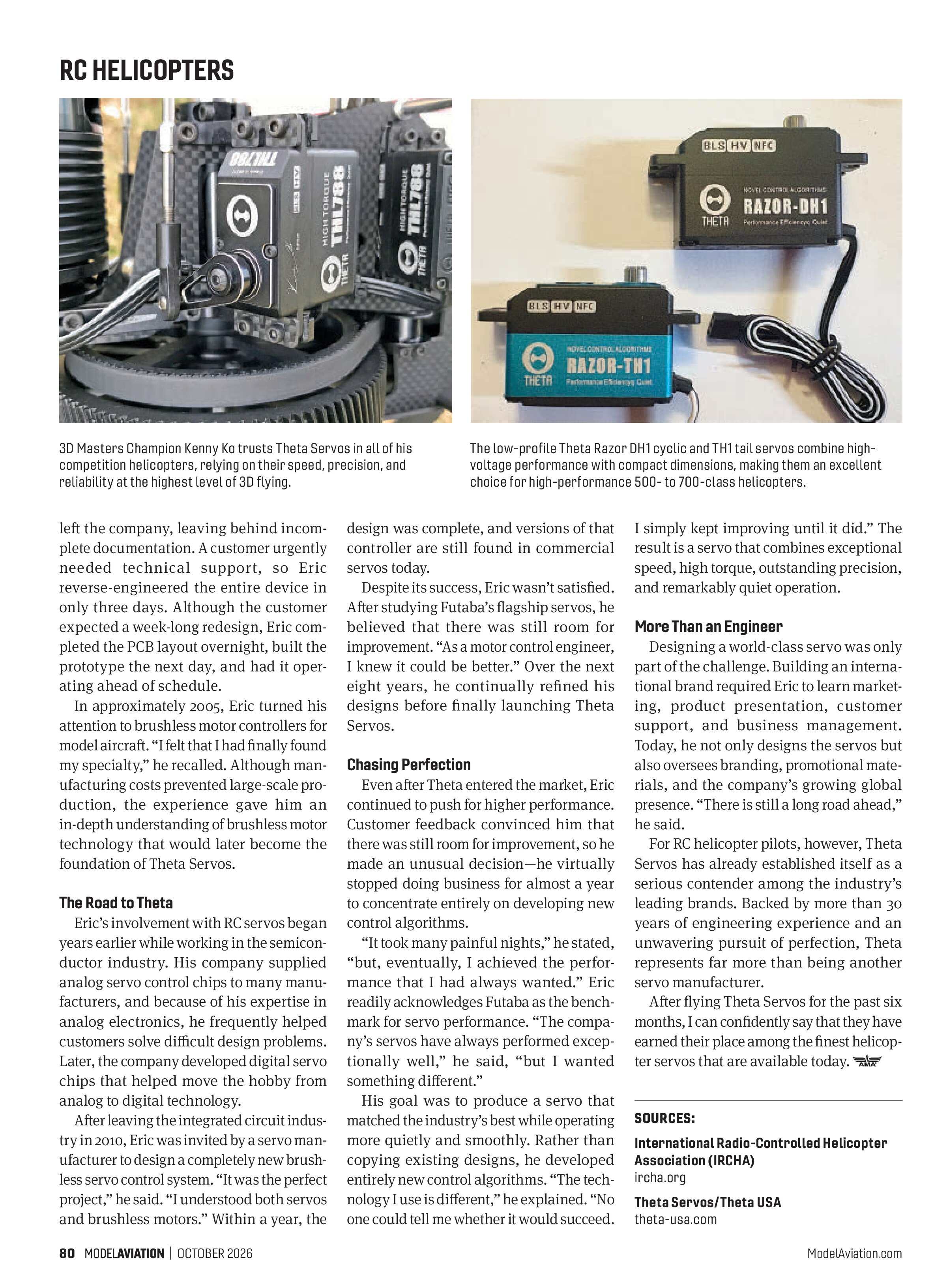
For the RAW 580, I selected the compact Razor DH1 and TH1 low-profile servos, which provide the same precise feel in a smaller package.
Outstanding products don’t appear overnight. Behind Theta Servos is Founder and Chief Engineer Eric Wang, whose path to building one of the hobby’s most respected servo brands spans more than three decades. I had the fortuitous opportunity to meet Eric at the 2025 Thailand Heli Blowout competition.
An Engineer’s Journey
Eric’s interest in engineering began early. Strong in mathematics, physics, and chemistry, he graduated expecting his university studies to prepare him for working in the industry business. Instead, his first job quickly showed him that real-world engineering required continuous learning.
He began his career at a flight control and navigation institute before moving into civil aviation maintenance, servicing airborne electronics for commercial aircraft. His responsibilities included atmospheric data computers and cockpit instruments, such as altimeters and airspeed indicators.
One project became a defining moment. A faulty flight data entry panel connected to an aircraft’s flight recorder had frustrated engineers for months and delayed equipment deliveries. After four months of careful analysis, Eric identified the fault and solved the problem, reinforcing the importance of patience, persistence, and systematic troubleshooting.
Solving Complex Engineering Problems
In 1997, Eric joined a startup that was developing optical current transformers for 330 kV high-voltage transmission systems. At the time, digital processors were far less capable than today’s devices, so he developed a hybrid analog-and-digital control system that delivered the required real-time performance despite limited computing power. Using highly optimized assembly language, he extracted every ounce of performance from the available hardware.
Years later, engineers who were working with processors twice as powerful still found it difficult to duplicate all of the functions that he had originally designed. His reputation for solving difficult engineering challenges eventually led him into the integrated circuit industry.
From Integrated Circuits to RC Models
Working for an integrated circuit design company, Eric became involved in both chip design and reverse engineering. One project required him to analyze a proprietary chip after the original designers had


left the company, leaving behind incomplete documentation. A customer urgently needed technical support, so Eric reverse-engineered the entire device in only three days. Although the customer expected a week-long redesign, Eric completed the PCB layout overnight, built the prototype the next day, and had it operating ahead of schedule.
In approximately 2005, Eric turned his attention to brushless motor controllers for model aircraft. “I felt that I had finally found my specialty,” he recalled. Although manufacturing costs prevented large-scale production, the experience gave him an in-depth understanding of brushless motor technology that would later become the foundation of Theta Servos.
The Road to Theta
Eric’s involvement with RC servos began years earlier while working in the semiconductor industry. His company supplied analog servo control chips to many manufacturers, and because of his expertise in analog electronics, he frequently helped customers solve difficult design problems. Later, the company developed digital servo chips that helped move the hobby from analog to digital technology.
After leaving the integrated circuit industry in 2010, Eric was invited by a servo manufacturer to design a completely new brushless servo control system. “It was the perfect project,” he said. “I understood both servos and brushless motors.” Within a year, the design was complete, and versions of that controller are still found in commercial servos today.
Despite its success, Eric wasn’t satisfied. After studying Futaba’s flagship servos, he believed that there was still room for improvement. “As a motor control engineer, I knew it could be better.” Over the next eight years, he continually refined his designs before finally launching Theta Servos.
Chasing Perfection
Even after Theta entered the market, Eric continued to push for higher performance. Customer feedback convinced him that there was still room for improvement, so he made an unusual decision—he virtually stopped doing business for almost a year to concentrate entirely on developing new control algorithms.
“It took many painful nights,” he stated, “but, eventually, I achieved the performance that I had always wanted.” Eric readily acknowledges Futaba as the benchmark for servo performance. “The company’s servos have always performed exceptionally well,” he said, “but I wanted something different.”
His goal was to produce a servo that matched the industry’s best while operating more quietly and smoothly. Rather than copying existing designs, he developed entirely new control algorithms. “The technology I use is different,” he explained. “No one could tell me whether it would succeed. I simply kept improving until it did.” The result is a servo that combines exceptional speed, high torque, outstanding precision, and remarkably quiet operation.
More Than an Engineer
Designing a world-class servo was only part of the challenge. Building an international brand required Eric to learn marketing, product presentation, customer support, and business management. Today, he not only designs the servos but also oversees branding, promotional materials, and the company’s growing global presence. “There is still a long road ahead,” he said.
For RC helicopter pilots, however, Theta Servos has already established itself as a serious contender among the industry’s leading brands. Backed by more than 30 years of engineering experience and an unwavering pursuit of perfection, Theta represents far more than being another servo manufacturer.
After flying Theta Servos for the past six months, I can confidently say that they have earned their place among the finest helicopter servos that are available today.
SOURCES:
International Radio-Controlled Helicopter Association (IRCHA)
ircha.org
Theta Servos/Theta USA
theta-usa.com