OLD-TIMERS
THE PLANET OF FLIGHT
By Bob Angel | samrcflier@verizon.net

THE ANNUAL BUILD edition of Model Aviation is one to which I haven’t usually contributed a lot because I feel that we Old-Timers (OT) address the subject in our activities year-round. This time, however, I’ll try to focus on the issue’s theme after some comments about where the model hobby appears to be heading.
Not only does pure Free Flight (FF) require large open space, but even our OT RC-assisted FF sometimes needs fields with a bit more overflight area than other branches of the RC hobby. That’s because our flight duration competition requires us to cover more ground as we follow thermals that are moving downwind.
As population relentlessly spreads over our limited-size planet, competition for the remaining space decreases its availability while increasing its cost. By requiring a smaller “footprint,” conventional RC flying can retain more flying sites for its higher participation rate. I assume that we won’t be flying many models on other planets within most of our lifetimes.
Most of today’s modelers are assemblers and fliers who were attracted to the hobby by seeing experienced pilots enjoy apparently effortless flying, usually at an RC site. After a newcomer gets “hooked,” however, reality sometimes kicks in when some discover the necessary maintenance and repair time, which wasn’t readily apparent when they were casually visiting the flying field. Our need for instant gratification results in both a high recruitment and turnover rate among conventional RC fliers.
With fewer numbers, OT fliers can seldom afford our own dedicated flying sites. The space that remains open for free use has declined drastically throughout the last century. Fortunately, our activities are sometimes interesting enough that a few modern RC sites tolerate us, even if it’s on a more limited schedule between the “back and forth” flights of the more numerous conventional fliers.
Fewer jobs today require hands-on work, but many people still find a need to get involved with something that requires patient construction skills at home, plus open-air activities and companionship with like-minded sportsmen. Still, I get a spooky feeling for the fortunes of both modeling and humanity in general when I look at aerial photos of Hong Kong, Paris, New York City, London, etc., and I can’t help but to compare all of us to dinosaurs. The change comes slowly, and each generation adapts somehow, at least until that future day when the last open acre is finally sold for a specific commercial use.
Four Decades of Construction Wisdom
Society of Antique Modelers (SAM) newsletters from the past 26 years are a source from which I have mined my own past SAM Chapter 26 newsletters for a lot of the construction hints and “kinks.” The rumor is totally false that our first few issues were written in Sanskrit on papyrus. Still, our publication does go back a few years to at least October 1984, which was labeled as Issue 7.
I have been the editor from about that time until now, so I’ve produced 401 issues at a rate of 10 pages per issue. That amounts to more than 4,000 pages, or the equivalent of 10 novels!

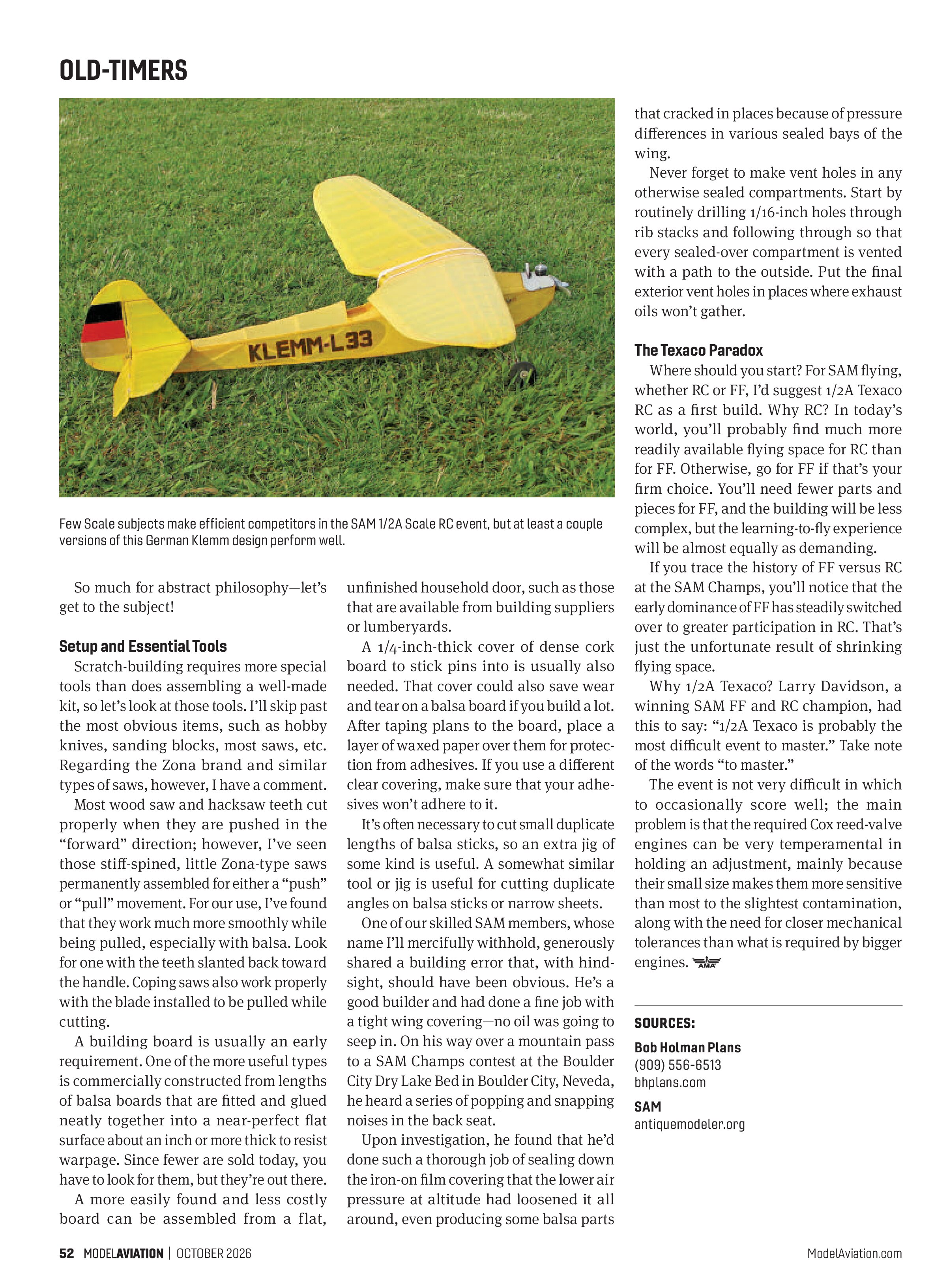
Few Scale subjects make efficient competitors in the SAM 1/2A Scale RC event, but at least a couple versions of this German Klemm design perform well.

So much for abstract philosophy—let’s get to the subject!
Setup and Essential Tools
Scratch-building requires more special tools than does assembling a well-made kit, so let’s look at those tools. I’ll skip past the most obvious items, such as hobby knives, sanding blocks, most saws, etc. Regarding the Zona brand and similar types of saws, however, I have a comment.
Most wood saw and hacksaw teeth cut properly when they are pushed in the “forward” direction; however, I’ve seen those stiff-spined, little Zona-type saws permanently assembled for either a “push” or “pull” movement. For our use, I’ve found that they work much more smoothly while being pulled, especially with balsa. Look for one with the teeth slanted back toward the handle. Coping saws also work properly with the blade installed to be pulled while cutting.
A building board is usually an early requirement. One of the more useful types is commercially constructed from lengths of balsa boards that are fitted and glued neatly together into a near-perfect flat surface about an inch or more thick to resist warpage. Since fewer are sold today, you have to look for them, but they’re out there.
A more easily found and less costly board can be assembled from a flat, unfinished household door, such as those that are available from building suppliers or lumberyards.
A 1/4-inch-thick cover of dense cork board to stick pins into is usually also needed. That cover could also save wear and tear on a balsa board if you build a lot. After taping plans to the board, place a layer of waxed paper over them for protection from adhesives. If you use a different clear covering, make sure that your adhesives won’t adhere to it.
It’s often necessary to cut small duplicate lengths of balsa sticks, so an extra jig of some kind is useful. A somewhat similar tool or jig is useful for cutting duplicate angles on balsa sticks or narrow sheets.
One of our skilled SAM members, whose name I’ll mercifully withhold, generously shared a building error that, with hindsight, should have been obvious. He’s a good builder and had done a fine job with a tight wing covering—no oil was going to seep in. On his way over a mountain pass to a SAM Champs contest at the Boulder City Dry Lake Bed in Boulder City, Nevada, he heard a series of popping and snapping noises in the back seat.
Upon investigation, he found that he’d done such a thorough job of sealing down the iron-on film covering that the lower air pressure at altitude had loosened it all around, even producing some balsa parts that cracked in places because of pressure differences in various sealed bays of the wing.
Never forget to make vent holes in any otherwise sealed compartments. Start by routinely drilling 1/16-inch holes through rib stacks and following through so that every sealed-over compartment is vented with a path to the outside. Put the final exterior vent holes in places where exhaust oils won’t gather.
The Texaco Paradox
Where should you start? For SAM flying, whether RC or FF, I’d suggest 1/2A Texaco RC as a first build. Why RC? In today’s world, you’ll probably find much more readily available flying space for RC than for FF. Otherwise, go for FF if that’s your firm choice. You’ll need fewer parts and pieces for FF, and the building will be less complex, but the learning-to-fly experience will be almost equally as demanding.
If you trace the history of FF versus RC at the SAM Champs, you’ll notice that the early dominance of FF has steadily switched over to greater participation in RC. That’s just the unfortunate result of shrinking flying space.
Why 1/2A Texaco? Larry Davidson, a winning SAM FF and RC champion, had this to say: “1/2A Texaco is probably the most difficult event to master.” Take note of the words “to master.”
The event is not very difficult in which to occasionally score well; the main problem is that the required Cox reed-valve engines can be very temperamental in holding an adjustment, mainly because their small size makes them more sensitive than most to the slightest contamination, along with the need for closer mechanical tolerances than what is required by bigger engines.
SOURCES:
Bob Holman Plans
(909) 556-6513
bhplans.com
SAM
antiquemodeler.org