FOCAL POINT
Interested in sharing your handiwork? Visit ModelAviation.com for submission guidelines.
The S-Pou! (Flying Flea)
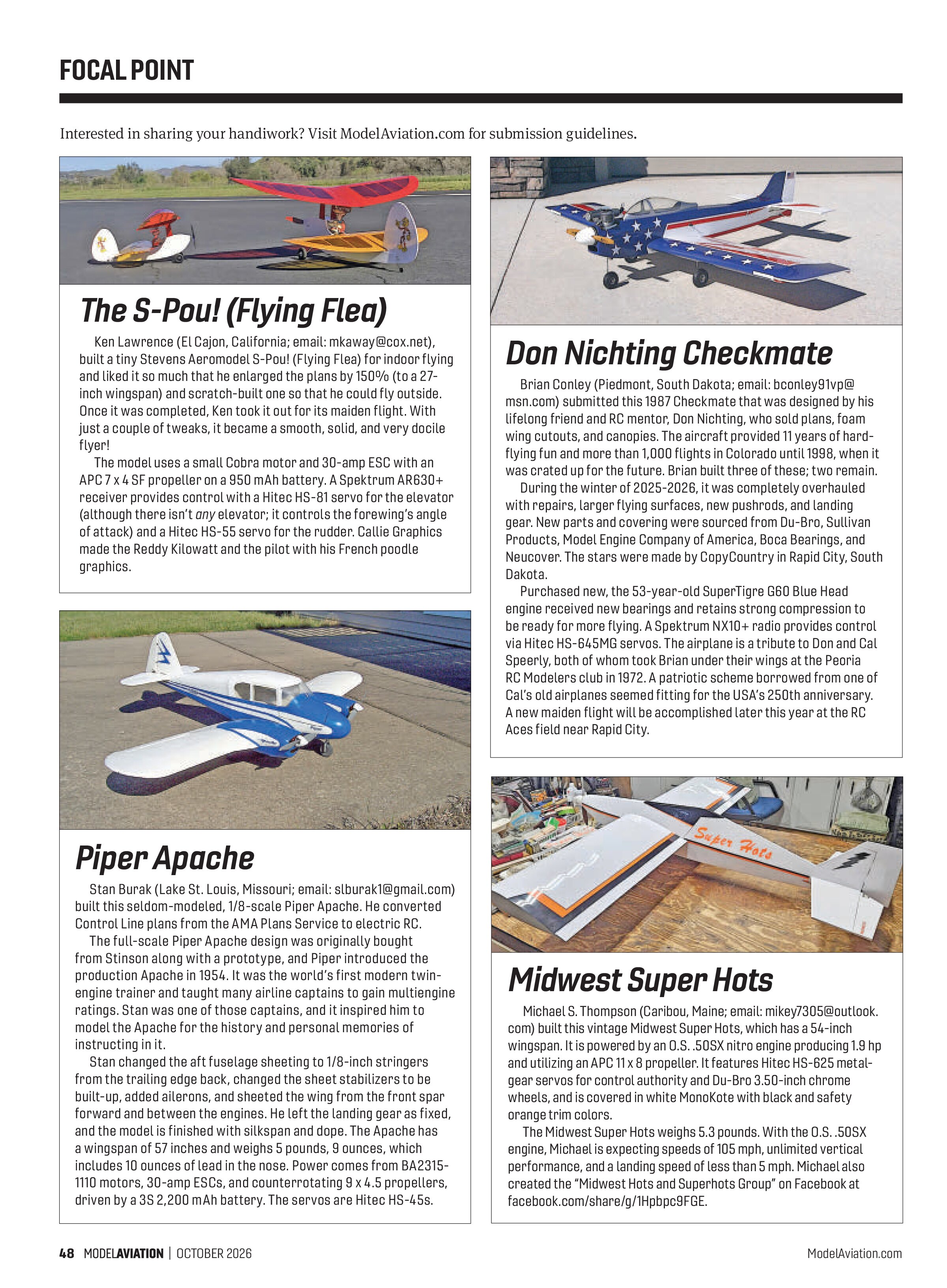
Ken Lawrence (El Cajon, California; email: mkaway@cox.net), built a tiny Stevens Aeromodel S-Pou! (Flying Flea) for indoor flying and liked it so much that he enlarged the plans by 150% (to a 27-inch wingspan) and scratch-built one so that he could fly outside. Once it was completed, Ken took it out for its maiden flight. With just a couple of tweaks, it became a smooth, solid, and very docile flyer!
The model uses a small Cobra motor and 30-amp ESC with an APC 7 x 4 SF propeller on a 950 mAh battery. A Spektrum AR630+ receiver provides control with a Hitec HS-81 servo for the elevator (although there isn’t any elevator; it controls the forewing’s angle of attack) and a Hitec HS-55 servo for the rudder. Callie Graphics made the Reddy Kilowatt and the pilot with his French poodle graphics.

Piper Apache
Stan Burak (Lake St. Louis, Missouri; email: slburak1@gmail.com) built this seldom-modeled, 1/8-scale Piper Apache. He converted Control Line plans from the AMA Plans Service to electric RC.
The full-scale Piper Apache design was originally bought from Stinson along with a prototype, and Piper introduced the production Apache in 1954. It was the world’s first modern twin-engine trainer and taught many airline captains to gain multiengine ratings. Stan was one of those captains, and it inspired him to model the Apache for the history and personal memories of instructing in it.
Stan changed the aft fuselage sheeting to 1/8-inch stringers from the trailing edge back, changed the sheet stabilizers to be built-up, added ailerons, and sheeted the wing from the front span forward and between the engines. He left the landing gear as fixed, and the model is finished with silkspan and dope. The Apache has a wingspan of 57 inches and weighs 5 pounds, 9 ounces, which includes 10 ounces of lead in the nose. Power comes from B A2315-1110 motors, 30-amp ESCs, and counterrotating 9 x 4.5 propellers, driven by a 3S 2,200 mAh battery. The servos are Hitec HS-45s.

Don Nighting Checkmate
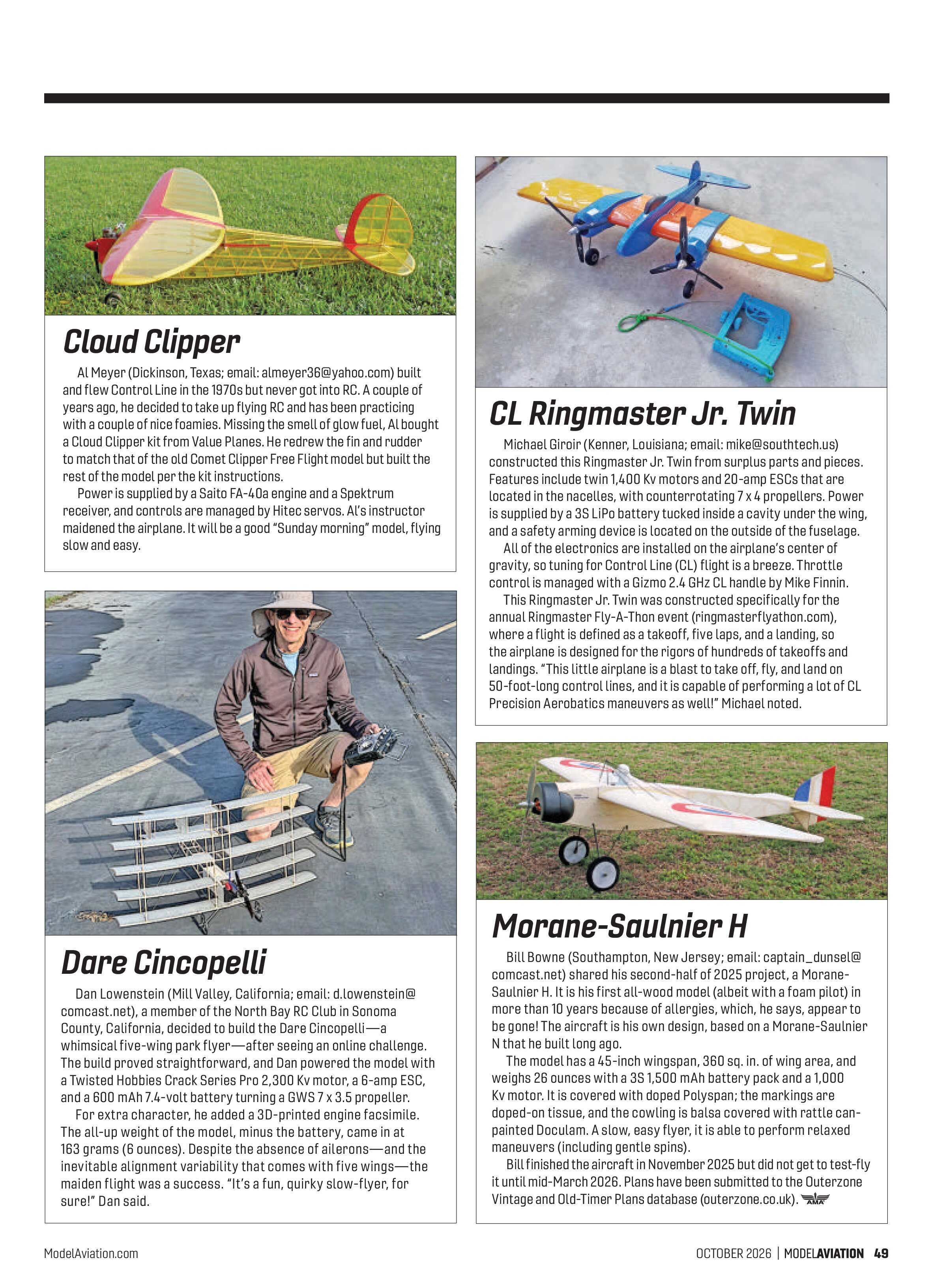
Brian Conley (Piedmont, South Dakota; email: bconley91vp@msn.com) submitted this 1987 Checkmate that was designed by his lifelong friend and RC mentor, Don Nighting, who sold plans, foam wing cutouts, and canopies. The aircraft provided 11 years of hard-flying fun and more than 1,000 flights in Colorado until 1998, when it was crated up for the future. Brian built three of these; two remain.
During the winter of 2025-2026, it was completely overhauled with repairs, larger flying surfaces, new pushrods, and landing gear. New parts and covering were sourced from Du-Bro, Sullivan Products, Model Engine Company of America, Boca Bearings, and Neucover. The stars were made by CopyCountry in Rapid City, South Dakota.
Purchased new, the 53-year-old SuperTigre G60 Blue Head engine received new bearings and retains strong compression to be ready for more flying. A Spektrum NX10+ radio provides control via Hitec HS-645MG servos. The airplane is a tribute to Don and Cal Speerly, both of whom took Brian under their wings at the Peoria RC Modelers club in 1972. A patriotic scheme borrowed from one of Cal’s old airplanes seemed fitting for the USA’s 250th anniversary. A new maiden flight will be accomplished later this year at the RC Aces field near Rapid City.

Midwest Super Hots
Michael S. Thompson (Caribou, Maine; email: mikey7305@outlook.com) built this vintage Midwest Super Hots, which has a 54-inch wingspan. It is powered by an O.S. .50SX nitro engine producing 1.9 hp and utilizing an APC 11 x 8 propeller. It features Hitec HS-625 metal-gear servos for control authority and Du-Bro 3.50-inch chrome wheels, and is covered in white MonoKote with black and safety orange trim colors.
The Midwest Super Hots weighs 5.3 pounds. With the O.S. .50SX engine, Michael is expecting speeds of 105 mph, unlimited vertical performance, and a landing speed of less than 5 mph. Michael also created the “Midwest Hots and Superhots Group” on Facebook at facebook.com/share/g/1Hppbc9FGE.

Cloud Clipper
Al Meyer (Dickinson, Texas; email: almeyer36@yahoo.com) built and flew Control Line in the 1970s but never got into RC. A couple of years ago, he decided to take up flying RC and has been practicing with a couple of nice foamies. Missing the smell of glow fuel, Al bought a Cloud Clipper kit from Value Planes. He redrew the fin and rudder to match that of the old Comet Clipper Free Flight model but built the rest of the model per the kit instructions.
Power is supplied by a Saito FA-40a engine and a Spektrum receiver, and controls are managed by Hitec servos. Al’s instructor maidened the airplane. It will be a good “Sunday morning” model, flying slow and easy.

Dare Cincopelli
Dan Lowenstein (Mill Valley, California; email: d.lowenstein@comcast.net), a member of the North Bay RC Club in Sonoma County, California, decided to build the Dare Cincopelli—a whimsical five-wing park flyer—after seeing an online challenge. The build proved straightforward, and Dan powered the model with a Twisted Hobbies Crack Series Pro 2,300 Kv motor, a 6-amp ESC, and a 600 mAh 7.4-volt battery turning a GWS 7 x 3.5 propeller.
For extra character, he added a 3D-printed engine facsimile. The all-up weight of the model, minus the battery, came in at 163 grams (6 ounces). Despite the absence of ailerons—and the inevitable alignment variability that comes with five wings—the maiden flight was a success. “It’s a fun, quirky slow-flyer, for sure!” Dan said.

CL Ringmaster Jr. Twin
Michael Giroir (Kenner, Louisiana; email: mike@southtech.us) constructed this Ringmaster Jr. Twin from surplus parts and pieces. Features include twin 1,400 Kv motors and 20-amp ESCs that are located in the nacelles, with counterrotating 7 x 4 propellers. Power is supplied by a 3S LiPo battery tucked inside a cavity under the wing, and a safety arming device is located on the outside of the fuselage.
All of the electronics are installed on the airplane’s center of gravity, so tuning for Control Line (CL) flight is a breeze. Throttle control is managed with a Gizmo 2.4 GHz CL handle by Mike Finnin.
This Ringmaster Jr. Twin was constructed specifically for the annual Ringmaster Fly-A-Thon event (ringmasterflyathon.com), where a flight is defined as a takeoff, five laps, and a landing, so the airplane is designed for the rigors of hundreds of takeoffs and landings. “This little airplane is a blast to take off, fly, and land on 50-foot-long control lines, and it is capable of performing a lot of CL Precision Aerobatics maneuvers as well!” Michael noted.

Morane-Saulnier H
Bill Bowne (Southampton, New Jersey; email: captain_dunsel@comcast.net) shared his second-half of 2025 project, a Morane-Saulnier H. It is his first all-wood model (albeit with a foam pilot) in more than 10 years because of allergies, which, he says, appear to be gone! The aircraft is his own design, based on a Morane-Saulnier N that he built long ago.
The model has a 45-inch wingspan, 360 sq. in. of wing area, and weighs 26 ounces with a 3S 1,500 mAh battery pack and a 1,000 Kv motor. It is covered with doped Polyspan; the markings are doped-on tissue, and the cowling is balsa covered with rattle can-painted Doculam. A slow, easy flyer, it is able to perform relaxed maneuvers (including gentle spins).
Bill finished the aircraft in November 2025 but did not get to test-fly it until mid-March 2026. Plans have been submitted to the Outerzone Vintage and Old-Timer Plans database (outerzone.co.uk).