MASTERING THE HAMMERHEAD, PART 2
By Dave Scott | 1usrcfs@gmail.com

AS A REVIEW of part one of my column that appeared in the August issue, I discussed how to establish a perfectly executed vertical upline for a Hammerhead, which leads to talking about the pivot.
The Pivot
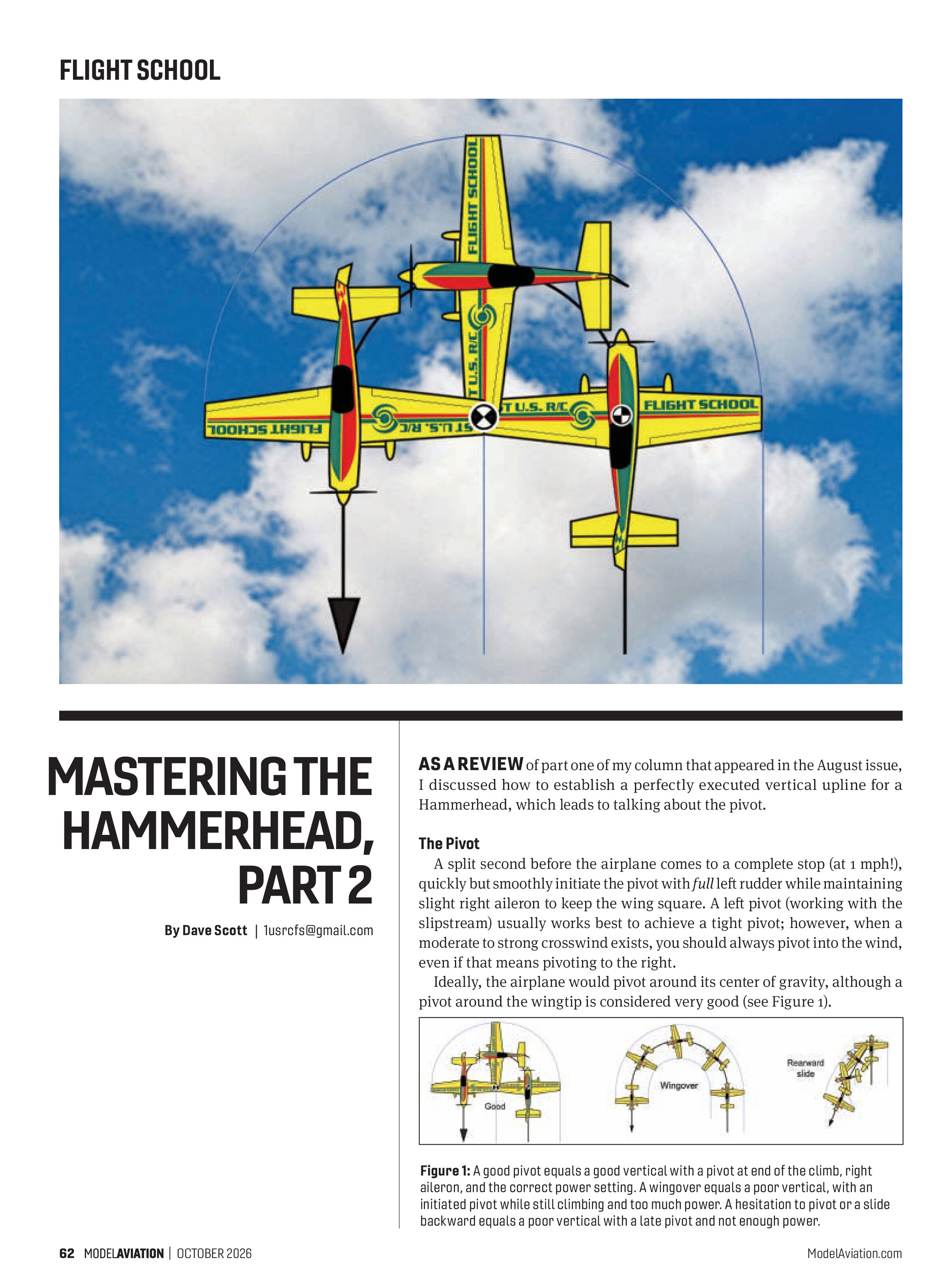
A split second before the airplane comes to a complete stop (at 1 mph!), quickly but smoothly initiate the pivot with full left rudder while maintaining slight right aileron to keep the wing square. A left pivot (working with the slipstream) usually works best to achieve a tight pivot; however, when a moderate to strong crosswind exists, you should always pivot into the wind, even if that means pivoting to the right.
Ideally, the airplane would pivot around its center of gravity, although a pivot around the wingtip is considered very good (see Figure 1).

To achieve this, you must find the right balance of power and timing. Remember, any sideways component to the upline will cause the airplane to either hesitate to pivot or to perform a type of wingover with the pivot displaced several wingspans. Assuming a good vertical line is flown, a wingover is usually the result of initiating the pivot too early while the airplane is still climbing, and/or too much power.
If the pilot times the pivot correctly (at 1 mph!) and still experiences a wingover, power along the upline will have to be reduced further but not to idle. Note that reducing the power to idle will take away the ability to consistently control the pivot. On the other hand, if a good vertical line is flown but the airplane is hesitant to pivot or slides backward, the pilot has waited too long to initiate the pivot and the power setting is too low, which can be corrected by better timing and leaving more power on.
Note that other forces at work during the pivot might cause the airplane to tuck (pitch) toward the canopy or landing gear. If this occurs, rather than trying to correct it right away, watch and learn what the characteristics are for your airplane so that you know for certain whether to add a push or pull to future pivots.
The key point in all of this is to maintain a little power during the upline/pivot to maintain control authority throughout. This helps you perform a successful pivot every time, and leaving some power on ensures that you’ll still be able to salvage a decent pivot even when you encounter turbulence or get a little sloppy keeping the upline.
The Downline
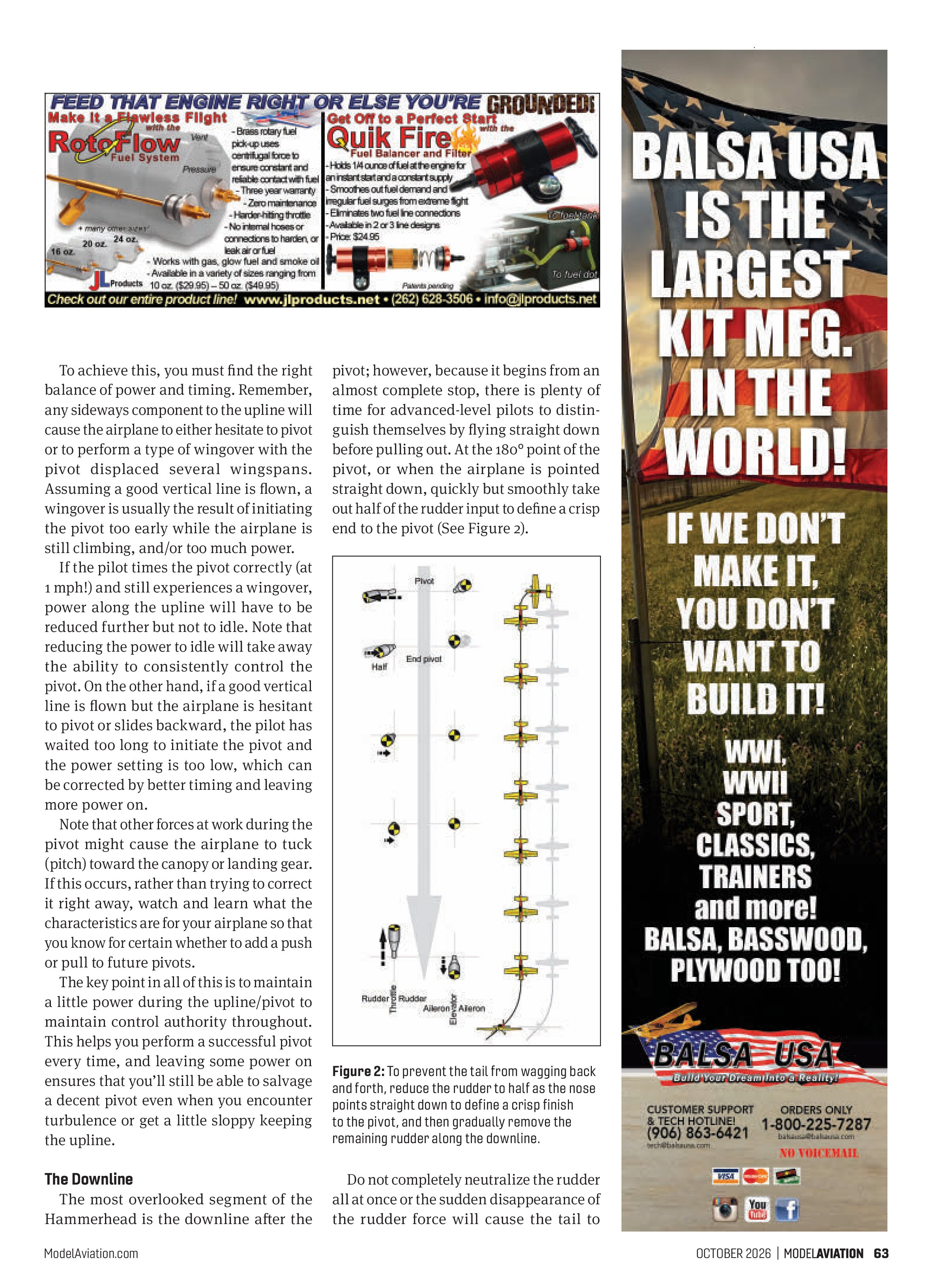
The most overlooked segment of the Hammerhead is the downline after the pivot; however, because it begins from an almost complete stop, there is plenty of time for advanced-level pilots to distinguish themselves by flying straight down before pulling out. At the 180° point of the pivot, or when the airplane is pointed straight down, quickly but smoothly take out half of the rudder input to define a crisp end to the pivot (See Figure 2).

Do not completely neutralize the rudder all at once or the sudden disappearance of the rudder force will cause the tail to

pendulum and the airplane to deviate from vertical. Once the downline has been established, gradually take out the remaining rudder. Any other controls that were a part of keeping the pivot square should be removed as soon as the pivot is completed. From there, flying perfectly straight down requires no particular skill other than the initiative to do it.
The most common fault on the downline is a tendency to “cheat the pull;” that is, pilots tend to unconsciously apply a little up-elevator pressure when the airplane is headed toward the ground in anticipation of pulling out, or they neglect to use forward elevator pressure to push the nose straight down when that is what it takes.
Because the downline began with almost no airspeed, idling the engine is optional. If you add rolls to the downline, this is when it becomes important to idle the engine to buy a little more time coming down. Finally, pull out and smoothly advance the throttle to the position that is appropriate for the next maneuver as you return the airplane to level flight.
Let’s Review
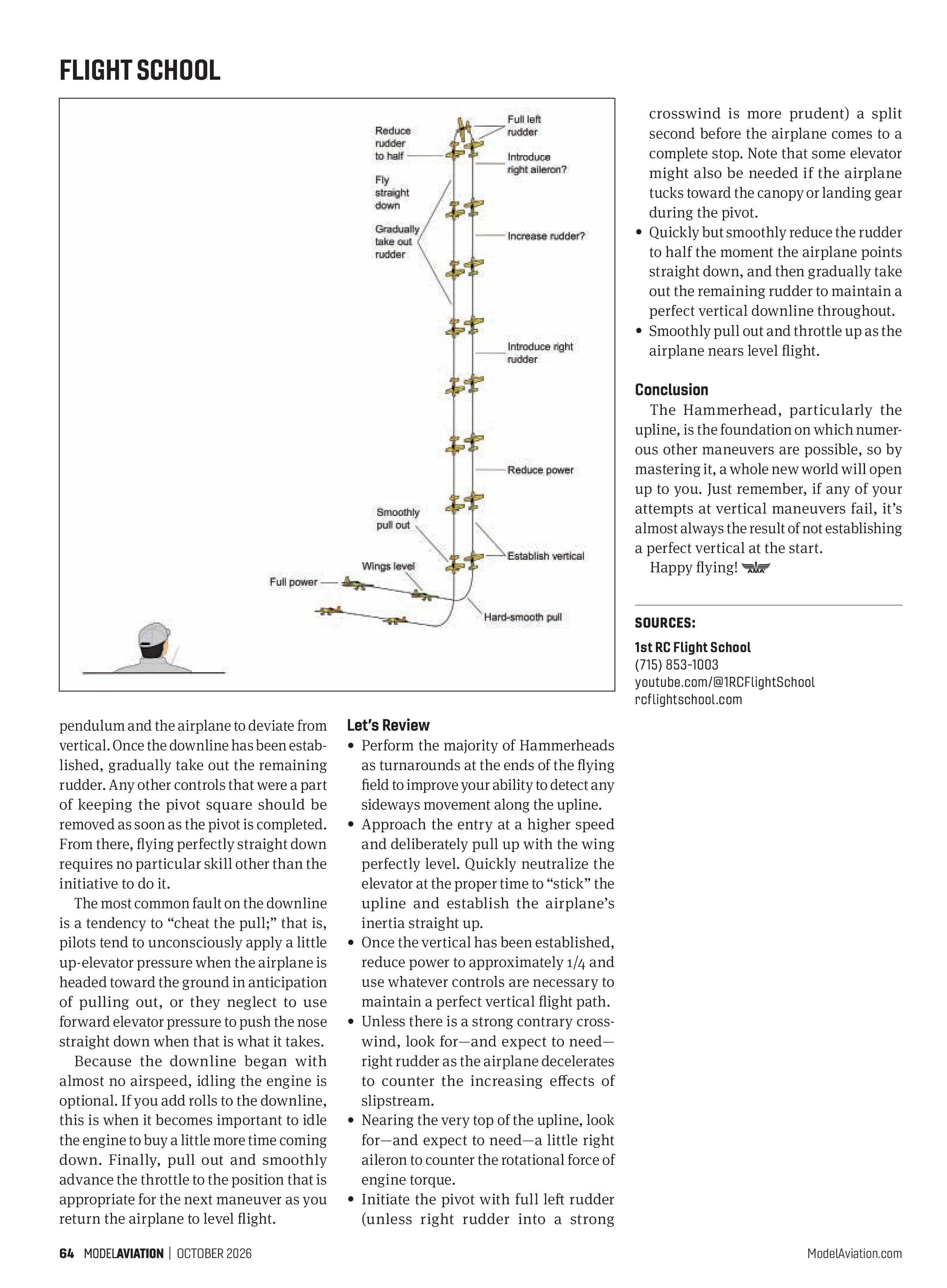
- Perform the majority of Hammerheads as turnarounds at the ends of the flying field to improve your ability to detect any sideways movement along the upline.
- Approach the entry at a higher speed and deliberately pull up with the wing perfectly level. Quickly neutralize the elevator at the proper time to “stick” the upline and establish the airplane’s inertia straight up.
- Once the vertical has been established, reduce power to approximately ¼ and use whatever controls are necessary to maintain a perfect vertical flight path.
- Unless there is a strong contrary crosswind, look for—and expect to need—right rudder as the airplane decelerates to counter the increasing effects of slipstream.
- Nearing the very top of the upline, look for—and expect to need—a little right aileron to counter the rotational force of engine torque.
- Initiate the pivot with full left rudder (unless right rudder into a strong crosswind is more prudent) a split second before the airplane comes to a complete stop. Note that some elevator might also be needed if the airplane tucks toward the canopy or landing gear during the pivot.
- Quickly but smoothly reduce the rudder to half the moment the airplane points straight down, and then gradually take out the remaining rudder to maintain a perfect vertical downline throughout.
- Smoothly pull out and throttle up as the airplane nears level flight.
Conclusion
The Hammerhead, particularly the upline, is the foundation on which numerous other maneuvers are possible, so by mastering it, a whole new world will open up to you. Just remember, if any of your attempts at vertical maneuvers fail, it’s almost always the result of not establishing a perfect vertical at the start. Happy flying!
SOURCES:
1st RC Flight School
(715) 853-1003
youtube.com/@1RCFlightSchool
rcflightschool.com