THE MOMENT OF TRUTH
By Dave Gee | safetycolumn@cs.com
I’VE NOTICED the incident reports that are sent by RC pilots often have to do with the moment of truth when the control system is first turned on. Assembling the aircraft and running preflight checks are usually routine. If there’s going to be any excitement, it happens when that main switch gets flipped and sends power to the electronic system. It’s a critical moment, and pilots are sometimes not prepared for what happens.
Experienced modelers make sure that they are ready for all outcomes when they power on an aircraft. Gas airplanes can be exciting enough, but electric-powered airplanes really have the possibility of trouble during the startup. Something completely beyond our knowledge or control could happen, and the propeller might be waiting to unexpectedly spin at full throttle.
Make sure that your airplane or helicopter is secured because stories of a runaway propeller or rotor blade are far too common. Airplanes have made exciting surprise flights across the workshop or pit area just because some setting was wrong or a throttle lever got bumped. It’s much better to tell your pit assistant, “Thanks, pal! If you hadn’t been holding the tail, that could have been bad news!”
Many fliers use the same transmitter for multiple models. Even with the smart systems that are now available, it’s worthwhile to double-check the settings and make sure that the throttle is off when you want it off.
Full-scale pilots use a written preflight checklist, and we should consider doing the same for any moderately-complex RC model. Even my rubber-powered Free Flight models get a once-over before launch. My checklist is often written on the nose. “Right-turn pattern!” or “Wind pushers backward” save me from embarrassment over and over. I learned these tricks the hard way, of course.
Wrench It or Be Wretched
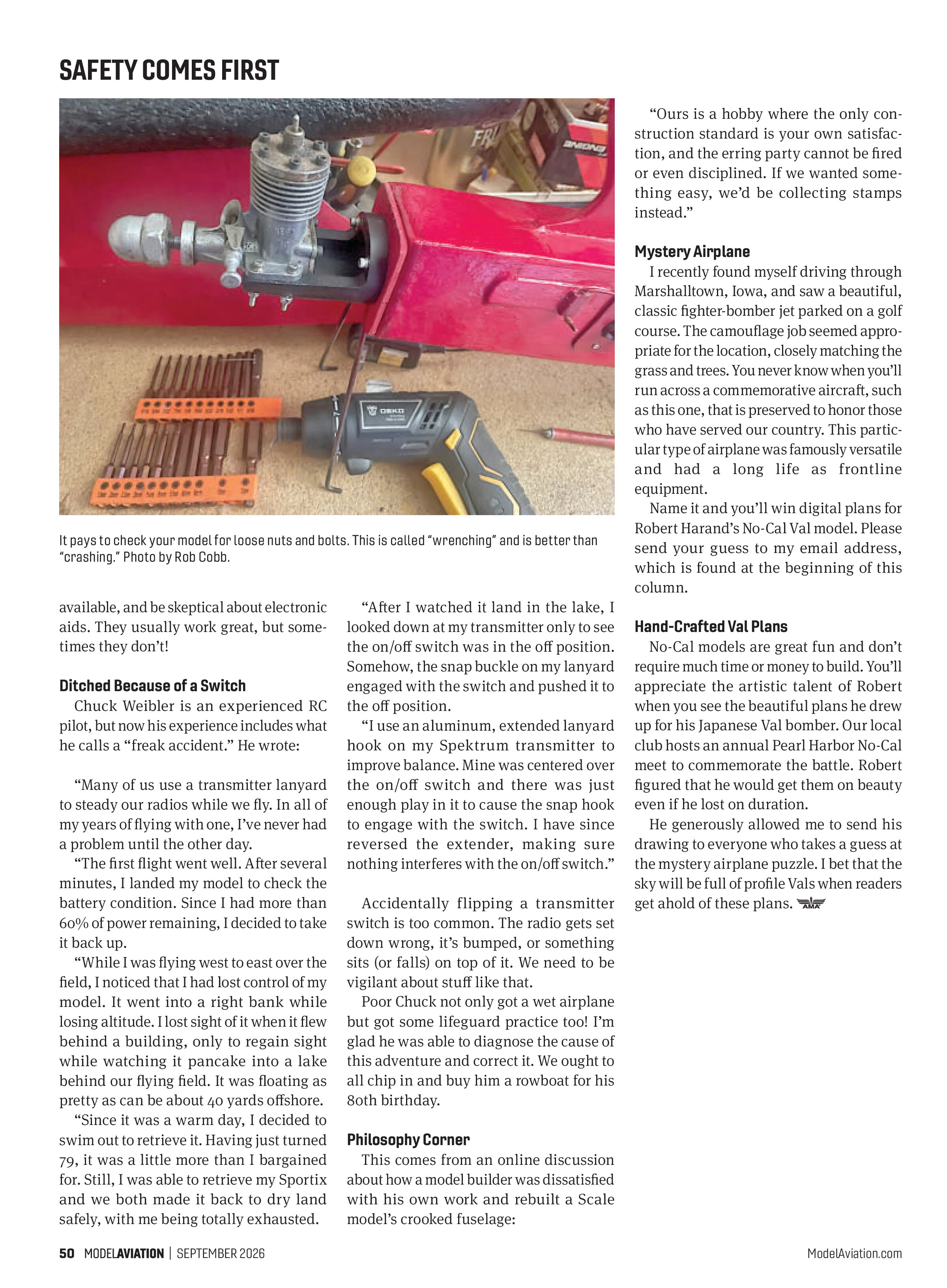
Another preflight procedure that some pilots learn the hard way is to occasionally “wrench” the model. I used to think that a wrench was what New Yorkers called a Wild West cattle farm, but it turns out to be a tool that we should use on all of the nuts and bolts on our aircraft. These have a way of coming loose at inconvenient times, so going over the model and verifying that they are all tight is called “wrenching” the airplane.
Hot rodders famously do it and so should we. Oh, sure, our models don’t have as many bolts as cars, but cars seldom fall out of the sky like our aircraft could do if proper precautions are not taken. Gas-engine mounts handle a lot of vibration, and electric motors run so smoothly that we can be lulled into complacency. A model’s control linkages can develop troubles that give no symptoms in advance of a crisis. Check them all and prevent problems!
From Safe to Not-So-Safe and Back
Tom Chytil sent in an account of a rather harrowing flight with his T-33.

“I was using a Spektrum AR620 receiver and a Vector stabilization module. The system could be switched in or out of SAFE mode using a switch on the Spektrum DX6 transmitter. I normally fly with SAFE mode on and flip it to off when I want to do a loop or roll, and then I immediately switch back to SAFE mode to continue the flight. On this occasion, I was too slow while entering a loop and the model stalled at the top, flipping into a downward spin. I switched back into SAFE mode and took my hands off of the sticks.
“The model continued to spin, and I knew it was going to crash; however, it suddenly and unexpectedly righted itself at a very low level and zoomed along at about waist height. Of course, I could not know or control which direction the model would take on recovery. The uncontrolled spin could have been dangerous enough to any humans nearby, but the low-level recovery was even worse! It just goes to show that the unexpected can happen suddenly and quickly.”
I know it’s not unusual for pilots to change these settings during a flight, but Tom’s story reinforces the point that you shouldn’t absolutely depend on such gadgetry. There’s no substitute for proper training and skill in controlling our models. Don’t fly over people, make sure you have a safe forced-landing area

available, and be skeptical about electronic aids. They usually work great, but sometimes they don’t!
Ditched Because of a Switch
Chuck Weibler is an experienced RC pilot, but now his experience includes what he calls a “freak accident.” He wrote:
“Many of us use a transmitter lanyard to steady our radios while we fly. In all of my years of flying with one, I’ve never had a problem until the other day.
“The first flight went well. After several minutes, I landed my model to check the battery condition. Since I had more than 60% of power remaining, I decided to take it back up.
“While I was flying west to east over the field, I noticed that I had lost control of my model. It went into a right bank while losing altitude. I lost sight of it when it flew behind a building, only to regain sight while watching it pancake into a lake behind our flying field. It was floating as pretty as can be about 40 yards offshore.
“Since it was a warm day, I decided to swim out to retrieve it. Having just turned 79, it was a little more than I bargained for. Still, I was able to retrieve my Sportix and we both made it back to dry land safely, with me being totally exhausted.
“After I watched it land in the lake, I looked down at my transmitter only to see the on/off switch was in the off position. Somehow, the snap buckle on my lanyard engaged with the switch and pushed it to the off position.
“I use an aluminum, extended lanyard hook on my Spektrum transmitter to improve balance. Mine was centered over the on/off switch and there was just enough play in it to cause the snap hook to engage with the switch. I have since reversed the extender, making sure nothing interferes with the on/off switch.”
Accidentally flipping a transmitter switch is too common. The radio gets set down wrong, it’s bumped, or something sits (or falls) on top of it. We need to be vigilant about stuff like that.
Poor Chuck not only got a wet airplane but got some lifeguard practice too! I’m glad he was able to diagnose the cause of this adventure and correct it. We ought to all chip in and buy him a rowboat for his 80th birthday.
Philosophy Corner
This comes from an online discussion about how a model builder was dissatisfied with his own work and rebuilt a Scale model’s crooked fuselage:
“Ours is a hobby where the only construction standard is your own satisfaction, and the erring party cannot be fired or even disciplined. If we wanted something easy, we’d be collecting stamps instead.”
Mystery Airplane
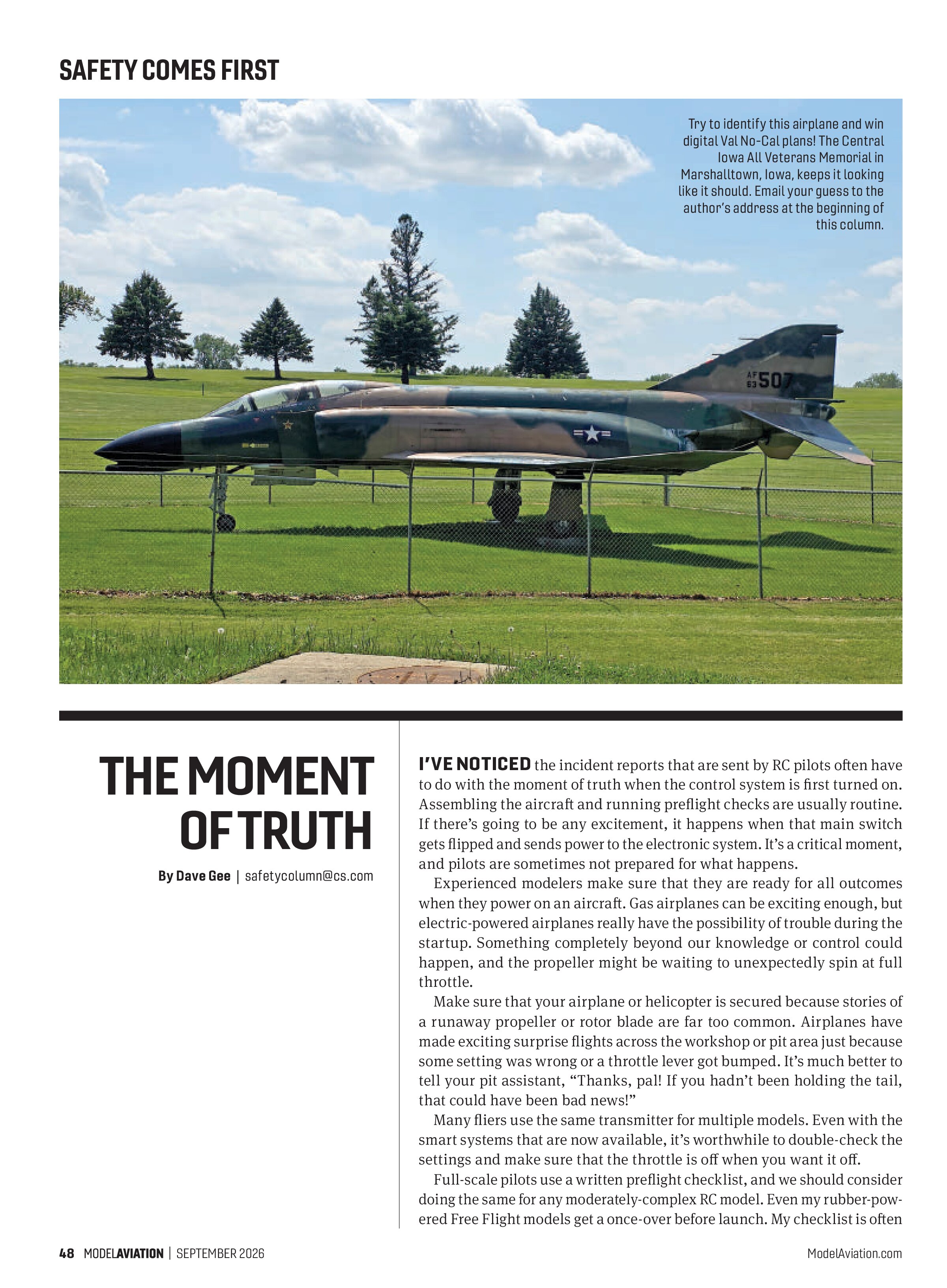
I recently found myself driving through Marshalltown, Iowa, and saw a beautiful, classic fighter-bomber jet parked on a golf course. The camouflage job seemed appropriate for the location, closely matching the grass and trees. You never know when you’ll run across a commemorative aircraft, such as this one, that is preserved to honor those who have served our country. This particular type of airplane was famously versatile and had a long life as frontline equipment.
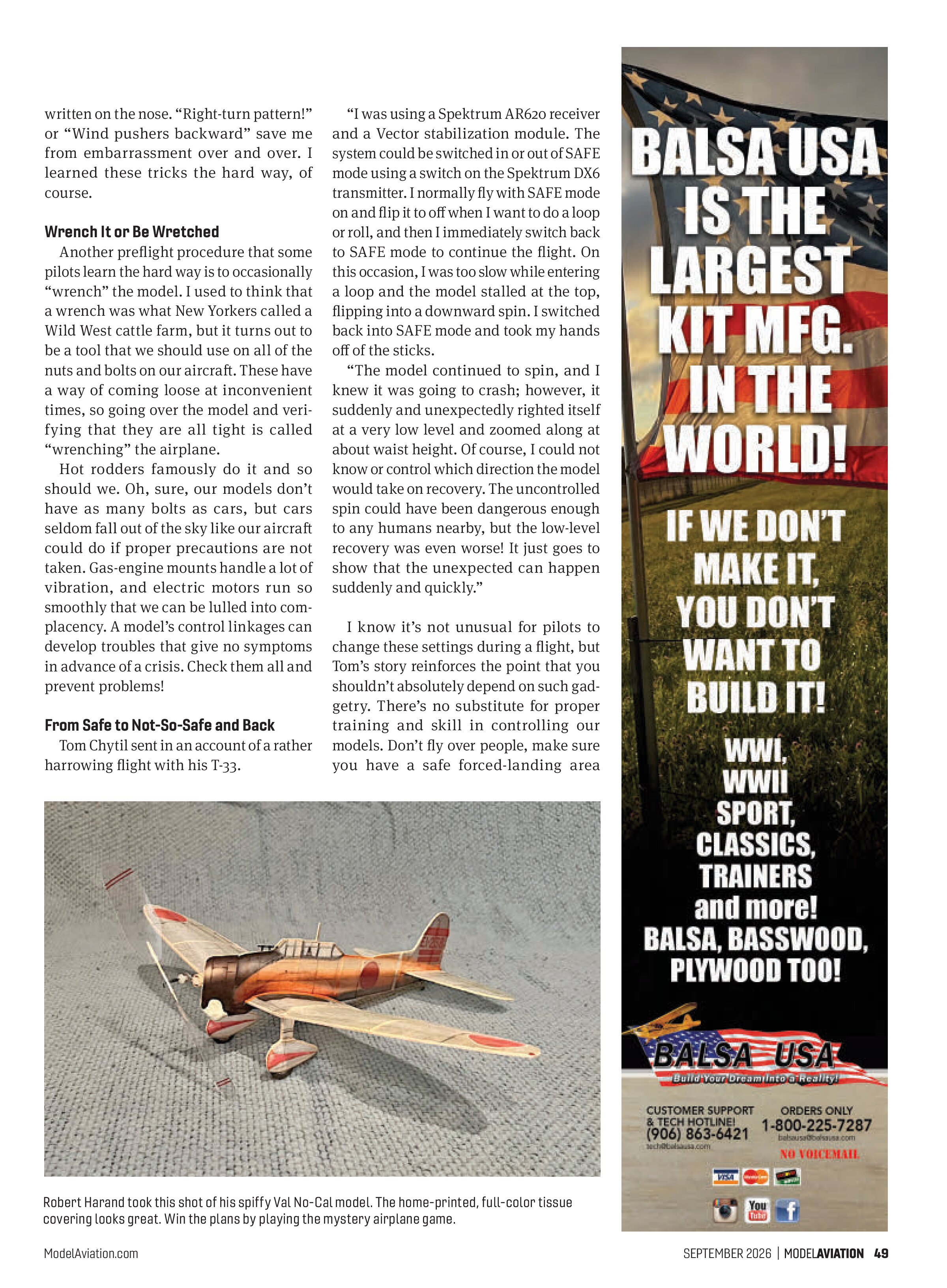
Name it and you’ll win digital plans for Robert Harand’s No-Cal Val model. Please send your guess to my email address, which is found at the beginning of this column.
Hand-Crafted Val Plans
No-Cal models are great fun and don’t require much time or money to build. You’ll appreciate the artistic talent of Robert when you see the beautiful plans he drew up for his Japanese Val bomber. Our local club hosts an annual Pearl Harbor No-Cal meet to commemorate the battle. Robert figured that he would get them on beauty even if he lost on duration.
He generously allowed me to send his drawing to everyone who takes a guess at the mystery airplane puzzle. I bet that the sky will be full of profile Vals when readers get ahold of these plans.