WILL A NEW
COMPETITION
SAILPLANE
HELP YOU
WIN?
By Gordon Buckland | gordon@gatorf3b.com
THE ANSWER TO the question of whether a new competition sailplane will help you win is “maybe.” If you can pilot that model at 100% efficiency, and if you know how to find lift and keep it flying in lift, it will surely help—but how much impact will owning that latest and greatest model have on your flight scores?
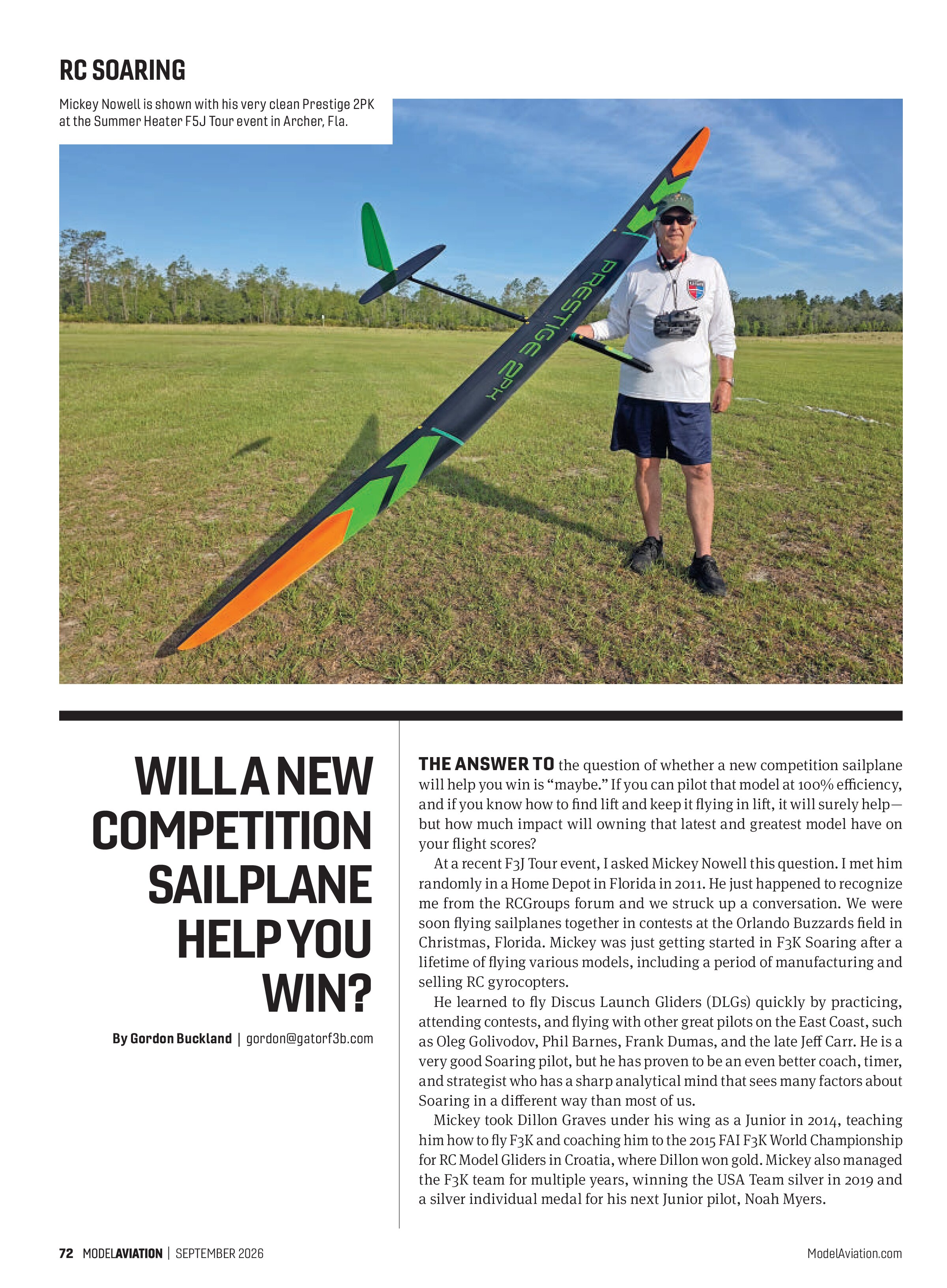
At a recent F3J Tour event, I asked Mickey Nowell this question. I met him randomly in a Home Depot in Florida in 2011. He just happened to recognize me from the RCGroups forum and we struck up a conversation. We were soon flying sailplanes together in contests at the Orlando Buzzards field in Christmas, Florida. Mickey was just getting started in F3K Soaring after a lifetime of flying various models, including a period of manufacturing and selling RC gyrocopters.
He learned to fly Discus Launch Gliders (DLGs) quickly by practicing, attending contests, and flying with other great pilots on the East Coast, such as Oleg Golivodov, Phil Barnes, Frank Dumas, and the late Jeff Carr. He is a very good Soaring pilot, but he has proven to be an even better coach, timer, and strategist who has a sharp analytical mind that sees many factors about Soaring in a different way than most of us.
Mickey took Dillon Graves under his wing as a Junior in 2014, teaching him how to fly F3K and coaching him to the 2015 FAI F3K World Championship for RC Model Gliders in Croatia, where Dillon won gold. Mickey also managed the F3K team for multiple years, winning the USA Team silver in 2019 and a silver individual medal for his next Junior pilot, Noah Myers.
With these major FAI Soaring accomplishments under his belt and multiple world championships as the F3K team manager, Mickey is very experienced and well qualified as a source of RC Soaring knowledge and inspiration.
GORDON BUCKLAND: What are five things you would recommend to readers to help them become better competition pilots?
MICKEY NOWELL: The number-one skill you need to be successful is to maintain a coordinated turn at any radius that you pick. To train the Juniors, I would say, “Give me a two-wingspan turn. Now give me a five-wingspan turn, and then give me a 10-wingspan turn, etc.” In the beginning, they couldn’t do it. They were used to cranking and banking and couldn’t fly different radius turns on command.
The key is that you really want to fly the biggest circle you can for the lift that’s available. Often, especially with DLG, you start out low with a high bank angle, and you slowly relax the bank angle and increase the turn diameters as you go up, with the thermal developing and growing in size. You have to be able to infinitely adjust your turn radius as you go up—very few people can fly multiple radius turns. That’s just a discipline you must go out and learn to do.
Number two is to learn to use the rudder and fly a coordinated turn. If you are using rudder mixed into the ailerons, you will need to add rudder into the turn regularly to avoid a slipping turn because your opposite aileron inputs (to counteract up-elevator tightening the turn) will be adding rudder, which causes the model to slip.
Number three is that you have to be able to recognize when your model is climbing and when it’s not climbing. It is always telling you whether it is happy or not. Complacency in a thermal leads to losing the thermal. Being able to recognize quickly that the model is no longer climbing and immediately opening up to reacquire the lift is extremely important.
Number four is that you need to learn what climb rate you must have to continue to go downwind in a thermal with the model that you have. This skill comes with practice. Choosing the right ballast is important, but knowing when to leave a thermal before reaching the point of no return is essential.
Number five would be to know how to get back from downwind in the cleanest possible configuration. Your model must be trimmed for the best lift-to-drag ratio speed or faster to come home with minimal height loss. Learning how much to ballast comes into play here as well.
This is if I had to pick five skills just off the top of my head, but you still have to talk about strategy. In F3K specifically, we have the 1-, 2-, 3-, and 4-minute tasks. Almost everyone will go out and get invested in a big thermal, go downwind, and then try to get the 4-minute flight. By the time they come back and launch back to the same thermal to get their 3-minute task, the thermal is too far away to reach again.
Depending on conditions, perhaps a better strategy is to go first for the 3 minutes, get to the point where you can get back to that thermal, come in and land and go back, and then get the 4 minutes because you can still reach that thermal and get the 4-minute flight. Those are subtle things that I teach. As you get further along, it’s the strategy of flying the tasks.
GB: For competition pilots who would like to do better, what are some of the things you’ve seen that might be holding them back? What are they not doing?
MN: Many sailplane pilots are not in complete control of the aircraft. For example, if I say to someone, “Go to that tree,” I mean, “Take a heading to the tree and don’t deviate.” Many pilots will wander here and there. I say, “Where are you going?” and they say, “Well, I’m trying to get there.” I then say, “You’re holding the box; move those sticks so that the model lines up with the heading.” They burn a lot of energy and height sneaking around to it rather than just going there when I say, “Go to that tree.” You have to be able to immediately put the model exactly where you want it to be if you are ever going to keep it in lift. Most people can’t do it. They can’t fly a heading.
Pilots need to manage the energy and maneuver the airplane appropriately. I tell people all the time who want to begin learning to fly RC by starting with a sailplane that it’s maybe not the best idea. I tell them that they should learn to fly a DLG first. Maybe you need to buy and learn to fly an RC powered model first because glider flying is harder than flying a powered airplane.
GB: Another thing that’s important is that we’ve talked about being a helper and about being a coach and helping other fellow pilots succeed. Clearly, a big portion of a pilot’s success is their helper. It’s a team sport; the timer is not just a guy holding a clock, so communication between the two is really


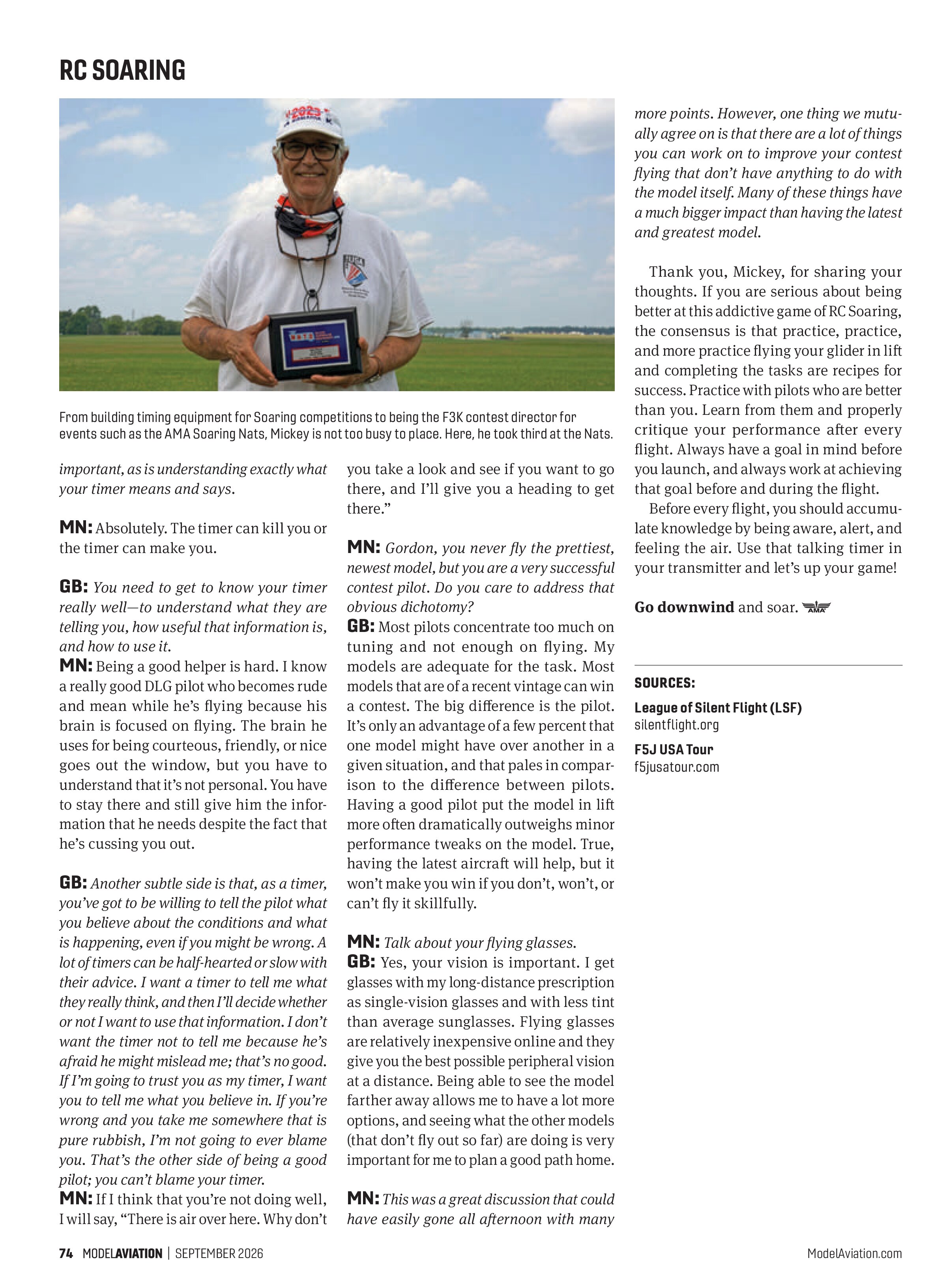
From building timing equipment for Soaring competitions to being the F3K contest director for events such as the AMA Soaring Nats, Mickey is not too busy to place. Here, he took third at the Nats.
important, as is understanding exactly what your timer means and says.
MN: Absolutely. The timer can kill you or the timer can make you.
GB: You need to get to know your timer really well—to understand what they are telling you, how useful that information is, and how to use it.
MN: Being a good helper is hard. I know a really good DLG pilot who becomes rude and mean while he’s flying because his brain is focused on flying. The brain he uses for being courteous, friendly, or nice goes out the window, but you have to understand that it’s not personal. You have to stay there and still give him the information that he needs despite the fact that he’s cussing you out.
GB: Another subtle side is that, as a timer, you’ve got to be willing to tell the pilot what you believe about the conditions and what is happening, even if you might be wrong. A lot of timers can be half-hearted or slow with their advice. I want a timer to tell me what they really think, and then I’ll decide whether or not I want to use that information. I don’t want the timer not to tell me because he’s afraid he might mislead me; that’s no good. If I’m going to trust you as my timer, I want you to tell me what you believe in. If you’re wrong and you take me somewhere that is pure rubbish, I’m not going to ever blame you. That’s the other side of being a good pilot; you can’t blame your timer.
MN: If I think that you’re not doing well, I will say, “There is air over here. Why don’t you take a look and see if you want to go there, and I’ll give you a heading to get there.”
MN: Gordon, you never fly the prettiest, newest model, but you are a very successful contest pilot. Do you care to address that obvious dichotomy?
GB: Most pilots concentrate too much on tuning and not enough on flying. My models are adequate for the task. Most models that are of a recent vintage can win a contest. The big difference is the pilot. It’s only an advantage of a few percent that one model might have over another in a given situation, and that pales in comparison to the difference between pilots. Having a good pilot put the model in lift more often dramatically outweighs minor performance tweaks on the model. True, having the latest aircraft will help, but it won’t make you win if you don’t, won’t, or can’t fly it skillfully.
MN: Talk about your flying glasses.
GB: Yes, your vision is important. I get glasses with my long-distance prescription as single-vision glasses and with less tint than average sunglasses. Flying glasses are relatively inexpensive online and they give you the best possible peripheral vision at a distance. Being able to see the model farther away allows me to have a lot more options, and seeing what the other models (that don’t fly out so far) are doing is very important for me to plan a good path home.
MN: This was a great discussion that could have easily gone all afternoon with many more points. However, one thing we mutually agree on is that there are a lot of things you can work on to improve your contest flying that don’t have anything to do with the model itself. Many of these things have a much bigger impact than having the latest and greatest model.
Thank you, Mickey, for sharing your thoughts. If you are serious about being better at this addictive game of RC Soaring, the consensus is that practice, practice, and more practice flying your glider in lift and completing the tasks are recipes for success. Practice with pilots who are better than you. Learn from them and properly critique your performance after every flight. Always have a goal in mind before you launch, and always work at achieving that goal before and during the flight.
Before every flight, you should accumulate knowledge by being aware, alert, and feeling the air. Use that talking timer in your transmitter and let’s up your game!
Go downwind and soar.
SOURCES:
League of Silent Flight (LSF)
silentflight.org
F5J USA Tour
f5jusatour.com