NASA HALL
OF FAME
INDUCTEES
By Stan Alexander | onawing4602@att.net
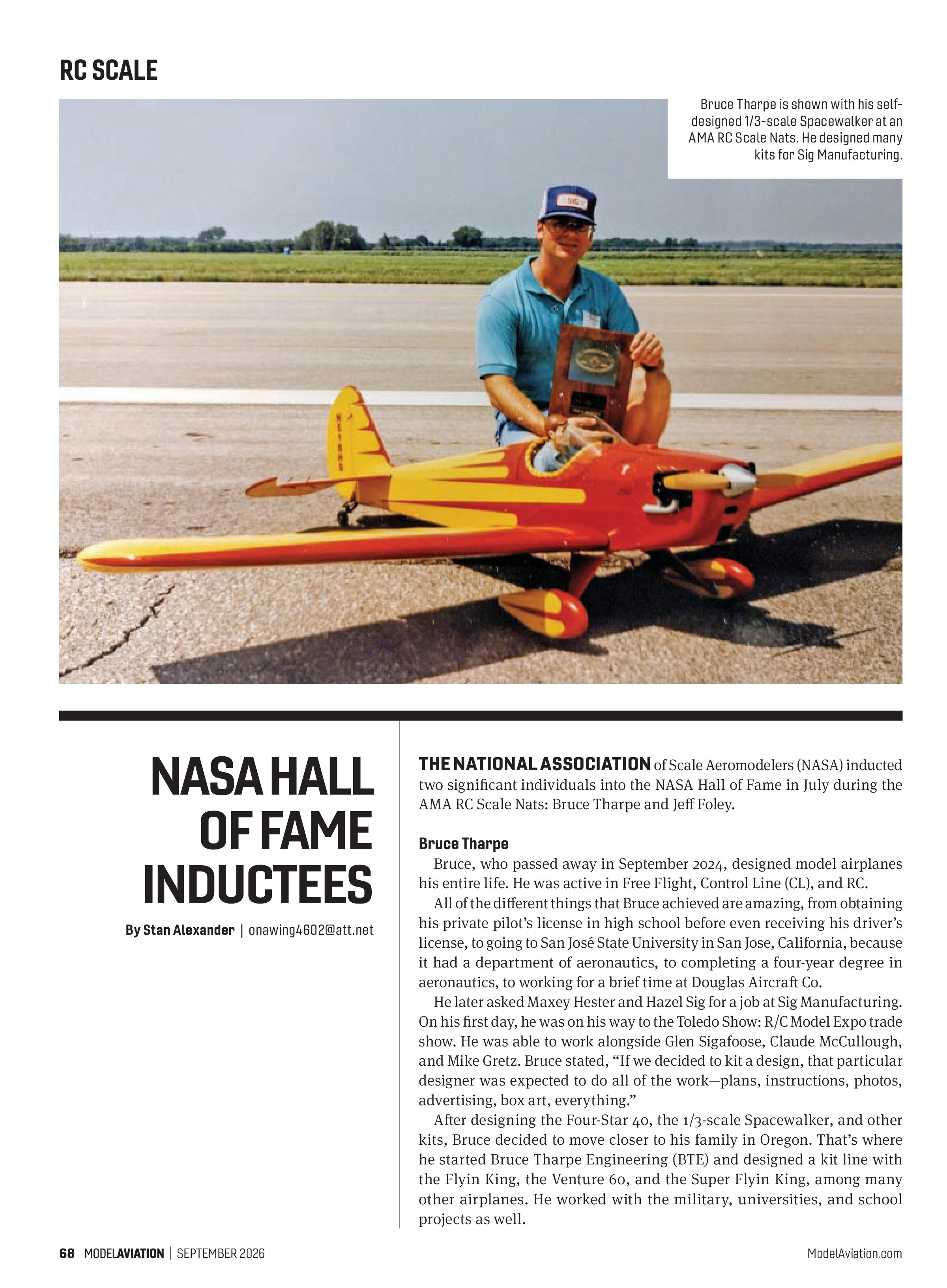
THE NATIONAL ASSOCIATION of Scale Aeromodelers (NASA) inducted two significant individuals into the NASA Hall of Fame in July during the AMA RC Scale Nats: Bruce Tharpe and Jeff Foley.
Bruce Tharpe
Bruce, who passed away in September 2024, designed model airplanes his entire life. He was active in Free Flight, Control Line (CL), and RC.
All of the different things that Bruce achieved are amazing, from obtaining his private pilot’s license in high school before even receiving his driver’s license, to going to San José State University in San Jose, California, because it had a department of aeronautics, to completing a four-year degree in aeronautics, to working for a brief time at Douglas Aircraft Co.
He later asked Maxey Hester and Hazel Sig for a job at Sig Manufacturing. On his first day, he was on his way to the Toledo Show; R/C Model Expo trade show. He was able to work alongside Glen Sigafoose, Claude McCullough, and Mike Gretz. Bruce stated, “If we decided to kit a design, that particular designer was expected to do all of the work—plans, instructions, photos, advertising, box art, everything.”
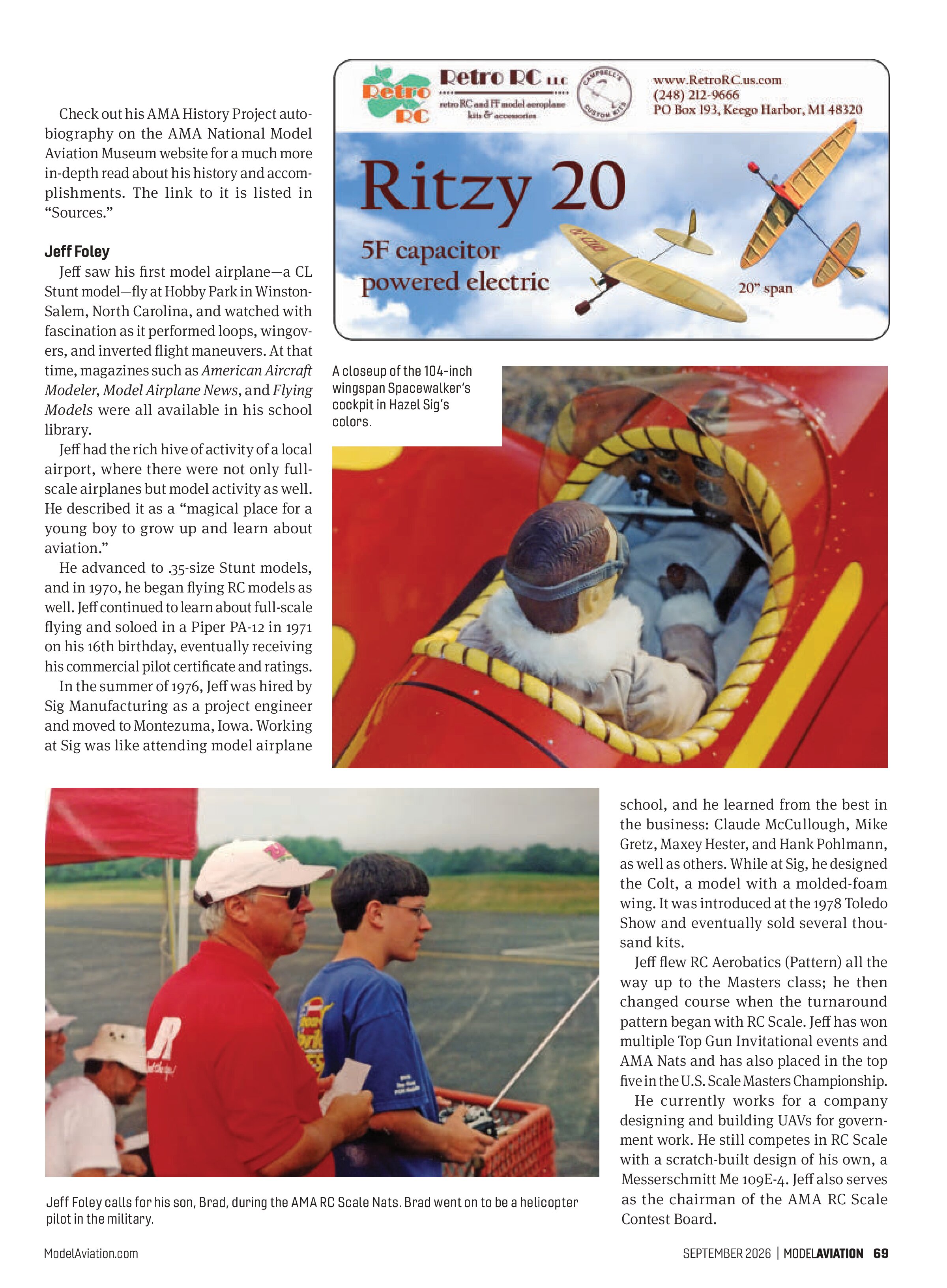
After designing the Four-Star 40, the 1/3-scale Spacewalker, and other kits, Bruce decided to move closer to his family in Oregon. That’s where he started Bruce Tharpe Engineering (BTE) and designed a kit line with the Flyin King, the Venture 60, and the Super Flyin King, among many other airplanes. He worked with the military, universities, and school projects as well.
Check out his AMA History Project autobiography on the AMA National Model Aviation Museum website for a much more in-depth read about his history and accomplishments. The link to it is listed in “Sources.”
Jeff Foley
Jeff saw his first model airplane—a CL Stunt model—fly at Hobby Park in Winston-Salem, North Carolina, and watched with fascination as it performed loops, wingovers, and inverted flight maneuvers. At that time, magazines such as American Aircraft Modeler, Model Airplane News, and Flying Models were all available in his school library.
Jeff had the rich hive of activity of a local airport, where there were not only full-scale airplanes but model activity as well. He described it as a “magical place for a young boy to grow up and learn about aviation.”
He advanced to .35-size Stunt models, and in 1970, he began flying RC models as well. Jeff continued to learn about full-scale flying and soloed in a Piper PA-12 in 1971 on his 16th birthday, eventually receiving his commercial pilot certificate and ratings.
In the summer of 1976, Jeff was hired by Sig Manufacturing as a project engineer and moved to Montezuma, Iowa. Working at Sig was like attending model airplane

school, and he learned from the best in the business: Claude McCullough, Mike Gretz, Maxey Hester, and Hank Pohlmann, as well as others. While at Sig, he designed the Colt, a model with a molded-foam wing. It was introduced at the 1978 Toledo Show and eventually sold several thousand kits.
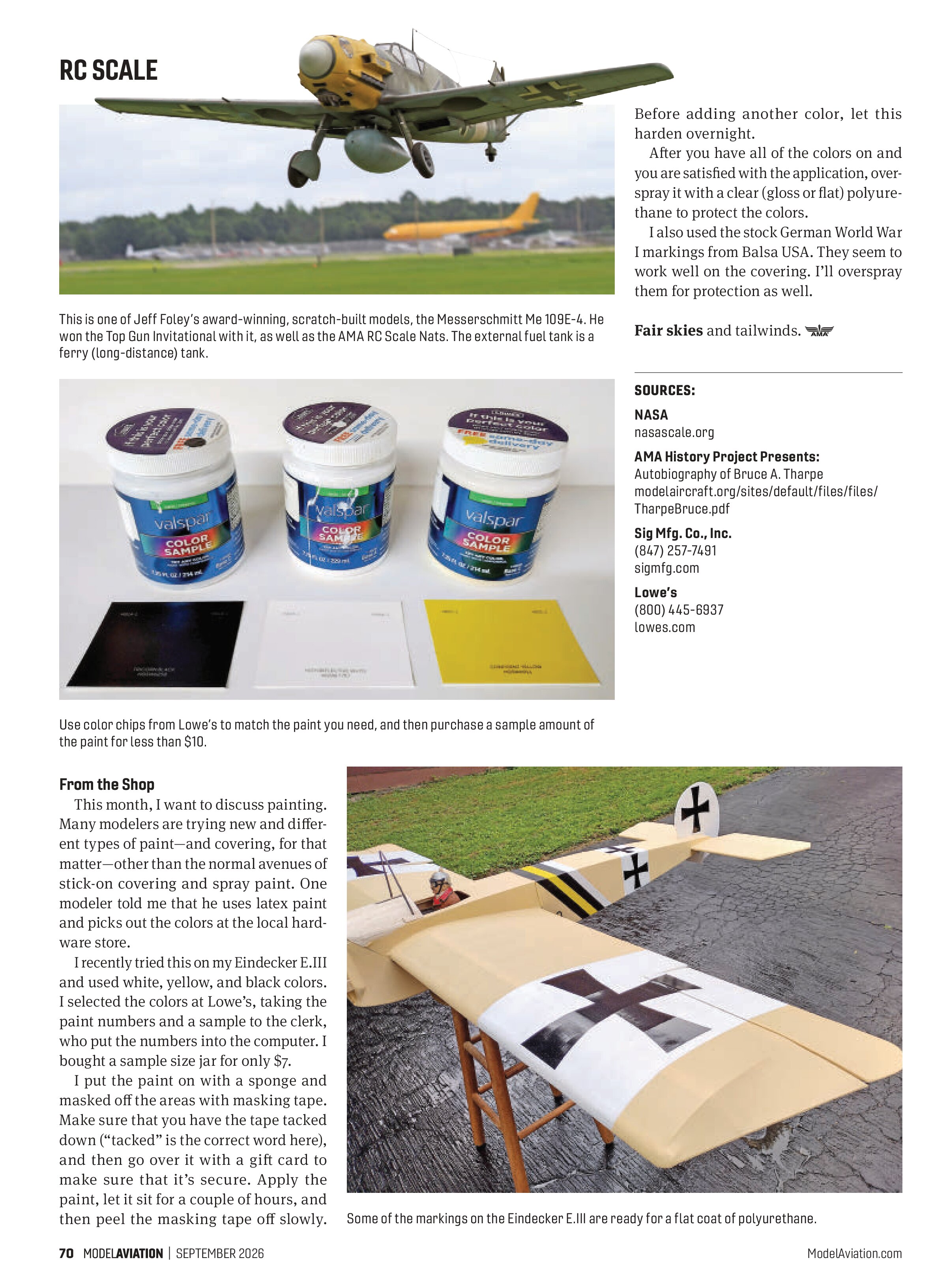
Jeff flew RC Aerobatics (Pattern) all the way up to the Masters class; he then changed course when the turnaround pattern began with RC Scale. Jeff has won multiple Top Gun Invitational events and AMA Nats and has also placed in the top five in the U.S. Scale Masters Championship.
He currently works for a company designing and building UAVs for government work. He still competes in RC Scale with a scratch-built design of his own, a Messerschmitt Me 109E-4. Jeff also serves as the chairman of the AMA RC Scale Contest Board.


Before adding another color, let this harden overnight.
After you have all of the colors on and you are satisfied with the application, overspray it with a clear (gloss or flat) polyurethane to protect the colors.
I also used the stock German World War I markings from Balsa USA. They seem to work well on the covering. I’ll overspray them for protection as well.
Fair skies and tailwinds.

From the Shop
This month, I want to discuss painting. Many modelers are trying new and different types of paint—and covering, for that matter—other than the normal avenues of stick-on covering and spray paint. One modeler told me that he uses latex paint and picks out the colors at the local hardware store.
I recently tried this on my Findecker E.III and used white, yellow, and black colors. I selected the colors at Lowe’s, taking the paint numbers and a sample to the clerk, who put the numbers into the computer. I bought a sample size jar for only $7.
I put the paint on with a sponge and masked off the areas with masking tape. Make sure that you have the tape tacked down (“tacked” is the correct word here), and then go over it with a gift card to make sure that it’s secure. Apply the paint, let it sit for a couple of hours, and then peel the masking tape off slowly.
Before adding another color, let this harden overnight.
After you have all of the colors on and you are satisfied with the application, overspray it with a clear (gloss or flat) polyurethane to protect the colors.
I also used the stock German World War I markings from Balsa USA. They seem to work well on the covering. I’ll overspray them for protection as well.

SOURCES:
NASA
nasascale.org
AMA History Project Presents:
Autobiography of Bruce A. Tharpe
modelaircraft.org/sites/default/files/files/TharpeBruce.pdf
Sig Mfg. Co., Inc.
(847) 257-7491
sigmfg.com
Lowe’s
(800) 445-6937
lowes.com