RC PYLON RACING

PERFECTLY ORDINARY; EXTENSIVELY PREPARED
By Tim Lampe | tim.lampe@hotmail.com
I’VE OCCASIONALLY MOCKED my late mother by using the term “wonderful” to describe something that is actually ordinary. To her, everything was wonderful. It turns out that I’m the same way.
When I heard that Jeff Burg, from Buffalo, New York, finished in fourth place at the Quarter 40 (Q-40) race at Markham Park in Sunrise, Florida, in April, I thought that it was pretty wonderful—but not ordinary.
I’d put myself in the same class as Jeff: We’re both darn good Pylon Racing pilots, but that makes us average because, with the exception of a handful of elite pilots, everyone is good. When an average but dedicated and prepared Pylon Racing pilot can compete with the best, it’s rewarding and validating.
In talking to Jeff about his results, he admitted that the premise of head-to-head AMA heat racing for points allows for good pilots to place high if they are competitive and can capitalize on the errors of better pilots. Make no mistake: It’s not easy just to be competitive.
The Markham Park race coincided with a vacation that Jeff and his family had been planning to New Smyrna Beach, Florida, so with an okay from his wife and daughters, the plan was to drop Jeff off at the race while they enjoyed shopping and sightseeing around the area. Before this caper could be complete, though, Jeff would need a teammate/caller. He had previously befriended fellow Pylon Racing pilot Kurt Bozarth, so the two teamed up for the first time ever.
In addition to calm and consistent calling from Kurt, Jeff also credits Matthew Fehling and Jacob Raquet—both of whom are surely elite Pylon Racing pilots—with imparting some last-second wisdom about engine needling and propeller selection. Jeff told me that he got in five good practice/tuning flights on location the day before the race. Given the competition and his relatively new foray into the Q-40 class, he set his goals realistically, which were to perfect his engine startup and needling routine on the start line, stay on the lead lap, and just log laps and flights.
Jeff was able to achieve the objective of logging laps because of a tactical decision made by himself and Kurt. The organizers decided to do “racehorse” starts, where all four airplanes are launched simultaneously rather than staggered starts of .5 seconds apart. This can result in more carnage right from takeoff. An approximate 20 mph crosswind would complicate the issue even more, so Jeff and Kurt agreed to hold each other’s airplanes for a second or two before launching to avoid any takeoff collisions that could happen in front of them.
Jeff told me that this paid off greatly; there were crashes in the first couple of heats that he and Kurt avoided. He won his first heat with a competitive time in the 1:03 to 1:04 range. He didn’t just win by default, and he had competitive speed.
Another cue that things were going well was that Jeff was using the same propeller and glow plug all day; it was a sign that he was getting good engine runs and not having to tamper with anything between rounds.
For pre-race preparation before the trip, Jeff measured his engines to make sure that the cylinder liner and head were set to Dub Jett’s specifications. He also told me that, on location, he added a little more exponential to the control throws, probably because he was getting such good engine runs and the airplane was actually flying faster than usual.
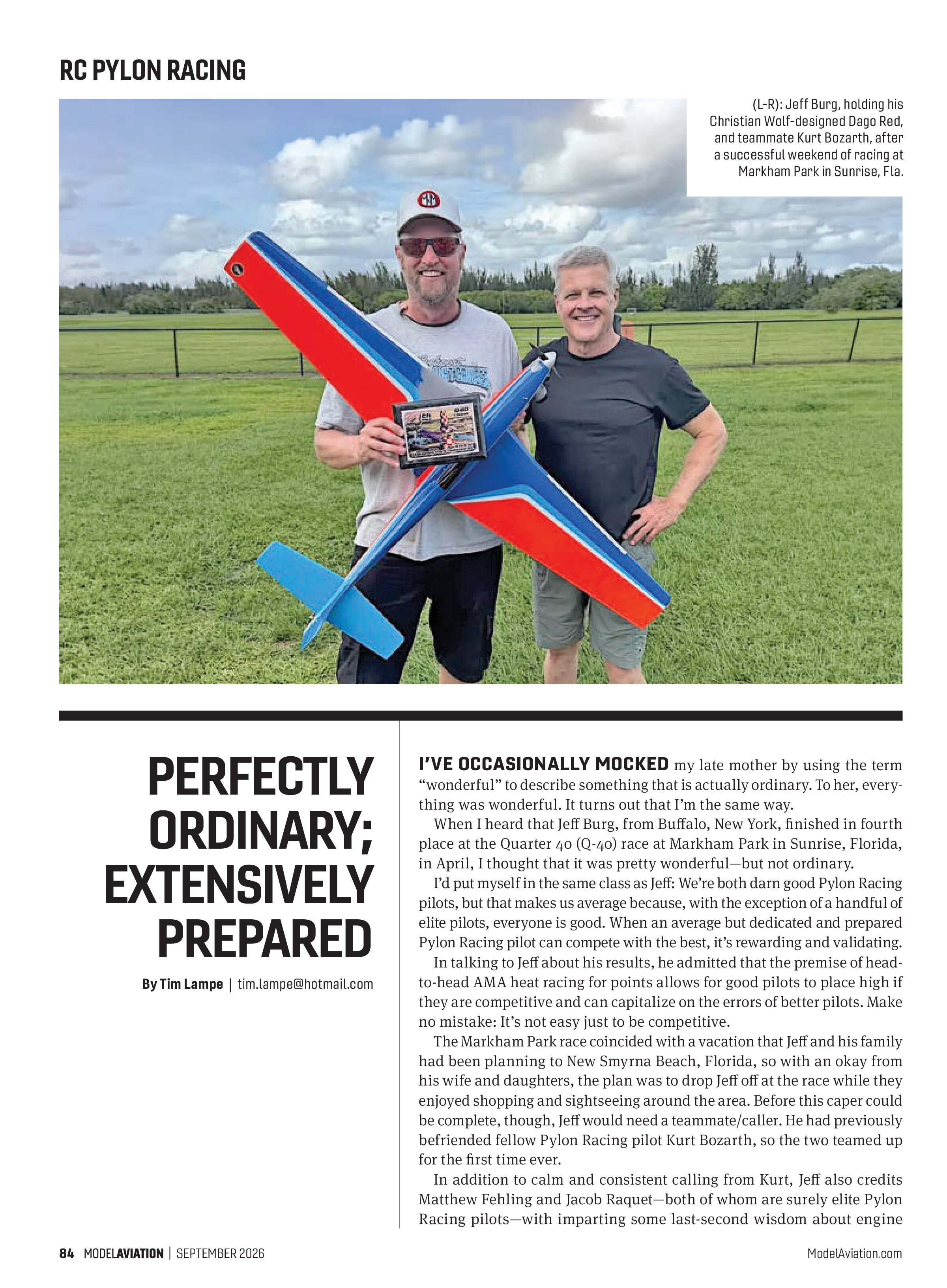
Jeff also wanted me to credit Dan Kane, Craig Grunkenmeyer, Dan Coe, and Richard Beers with technical assistance and encouragement going back to last year. He was racing his Dago Red by Christian Wolf, a design also flown by Dan Coe. Jeff told me a particular story where Dan had sent him a repair kit that contained balsa and a section of a leftover wing to repair Jeff’s wing from a previous incident. The primer over the patch at the left wing root can be seen in the photo.
Jeff would also like to credit A.J. Seaholm, who gave him a copy of his RealFlight flight simulator program that was modified specifically for Pylon Racing. He was able to keep his flying skills somewhat current by spending time on the simulator throughout the Buffalo winters.
As the day went on and the rounds clicked off, Jeff hadn’t kept up with the standings, but he said that the start-line official, Lonny Finch, had been updating
opportunity to fly the airplane on Saturday evening, but they stowed it away. I had no idea any of this was going on because I, like everyone else, was working on my own stuff. The hidden, individual battles and triumphs that unfold during an event are interesting.
Ray and Jacky work only 15 minutes from each other, so they hang out all of the time, although Jacky has only recently started calling for Ray. Ray told me that his fast time of 0:58.81 came in the second round against Dan Kane, who had a 0:58.98—two blazingly fast runs, with Ray getting the edge. In the fourth round, it was student versus teacher: Ray Coletto against Ray Brown, with Ray C. taking another win.
At the end of the day, it was Ray and Dub Jett who tied in points for first place, which would have resulted in a flyoff to determine the overall winner. Being conservative-minded and needing to catch an airline flight back home, Dub elected not to participate in the flyoff and handed Ray, who was the fastest pilot of the day anyway, the overall win.
The same as Jeff, Ray has several people he wants to thank and credit for his success, especially Ray Brown with his vast RC Pylon Racing experience and engine-setup expertise throughout the years.

him on his race times. He knew that he was probably in the top 10 but didn’t learn of his overall finish until the trophy presentation.
The Streak Continues
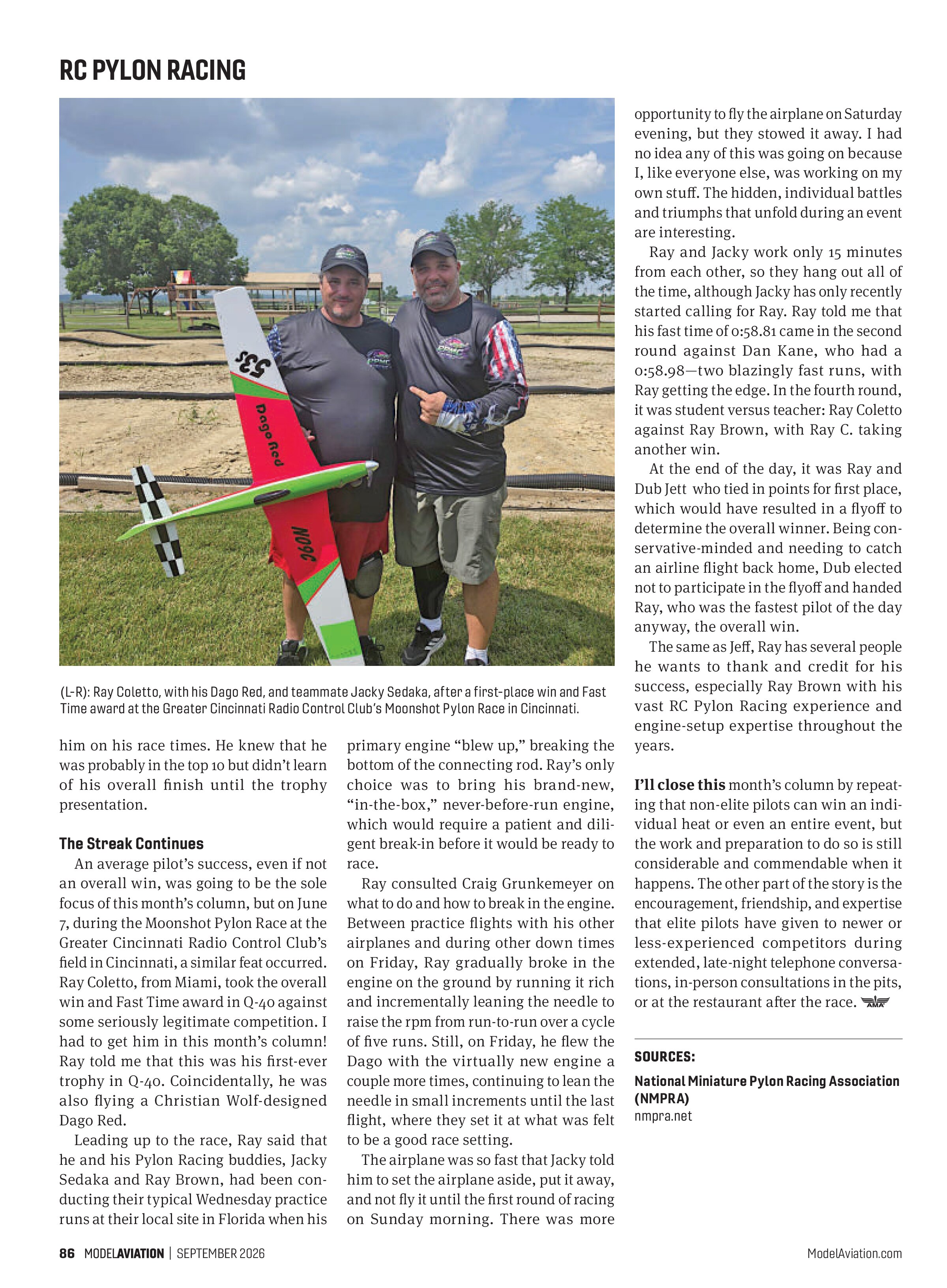
An average pilot’s success, even if not an overall win, was going to be the sole focus of this month’s column, but on June 7, during the Moonshot Pylon Race at the Greater Cincinnati Radio Control Club’s field in Cincinnati, a similar feat occurred. Ray Coletto, from Miami, took the overall win and Fast Time award in Q-40 against some seriously legitimate competition. I had to get him in this month’s column! Ray told me that this was his first-ever trophy in Q-40. Coincidentally, he was also flying a Christian Wolf-designed Dago Red.
Leading up to the race, Ray said that he and his Pylon Racing buddies, Jacky Sedaka and Ray Brown, had been conducting their typical Wednesday practice runs at their local site in Florida when his primary engine “blew up,” breaking the bottom of the connecting rod. Ray’s only choice was to bring his brand-new, “in-the-box,” never-before-run engine, which would require a patient and diligent break-in before it would be ready to race.
Ray consulted Craig Grunkenmeyer on what to do and how to break in the engine. Between practice flights with his other airplanes and during other down times on Friday, Ray gradually broke in the engine on the ground by running it rich and incrementally leaning the needle to raise the rpm from run-to-run over a cycle of five runs. Still, on Friday, he flew the Dago with the virtually new engine a couple more times, continuing to lean the needle in small increments until the last flight, where they set it at what was felt to be a good race setting.
The airplane was so fast that Jacky told him to set the airplane aside, put it away, and not fly it until the first round of racing on Sunday morning. There was more
I’ll close this month’s column by repeating that non-elite pilots can win an individual heat or even an entire event, but the work and preparation to do so is still considerable and commendable when it happens. The other part of the story is the encouragement, friendship, and expertise that elite pilots have given to newer or less-experienced competitors during extended, late-night telephone conversations, in-person consultations in the pits, or at the restaurant after the race.
SOURCES:
National Miniature Pylon Racing Association (NMPRA)
nmpra.net