BUILDING AND FLYING CANARDS
By Tim Bailiff | casurfisch@aol.com
THE VERY FIRST time I saw a “canard” in person was at an experimental aircraft fly-in. It was in Jurupa Valley, California, at a small airport called Flabob. From the moment I watched the pilot climb into his little two-seater airplane, I was intrigued. It had its wing in the back and the horizontal stabilizer in front of the cockpit. It looked turned around! In fact, the only thing that seemed to make sense was its rear-mounted vertical fins and rudders.
It was after watching it fly that I really got hooked! It flew so smoothly and gracefully, and that sound its pusher engine made in the air was distinctive. It was during that fly-in that I decided to experiment with canards. What I discovered inspired me enough to eventually build a number of RC canard park flyers of my own, but success didn’t come easily. I think you might find my journey interesting.
It Means Duck
If the word is unfamiliar, “canard” is actually French for “duck.” What I initially didn’t realize was that the Wright brothers experimented extensively with that kind of design. As we all know, the first recorded powered flight in 1903 was by their Wright Flyer. With its elevator mounted ahead of the wing, it was indeed a canard! Who would have thought?
I was initially interested in building a Control Line canard, which I did; however, my first design was a miserable failure. During repeated takeoff attempts, my airplane rotated then simply flipped over backward. Further attempts proved marginally successful but only after repeatedly adding an inordinate amount of weight to the nose. It just wasn’t making sense. The center of gravity (CG) was nothing like my other airplanes. That’s when I started doing my homework in earnest.
Drastically Different
With the wing in the back and the stabilizer and elevator up front, something was drastically different. I had initially assumed that a canard would balance about the same as a conventional airplane design; that is, the CG would fall somewhere on the forward third of the wing. Not so! Instead, the CG actually lies ahead of the wing. No wonder I initially failed!
Unlike conventional airplane designs, it turns out that a canard’s horizontal stabilizer carries part of the airplane’s weight. Furthermore, it is essential that it stalls before the wing does to allow the nose to drop. Should the reverse occur, the tail drops first. As you can imagine, the results could be catastrophic!
I learned that the proper CG location is determined by a number of factors, such as the wing area and its shape, the stabilizer area and its shape, and the distance the stabilizer is from the wing. This can be a pretty complicated calculation, but, thankfully, the internet today offers several canard CG calculators that ask specific questions and, after the necessary fields are populated, present the precise location for the CG. Cool, right?
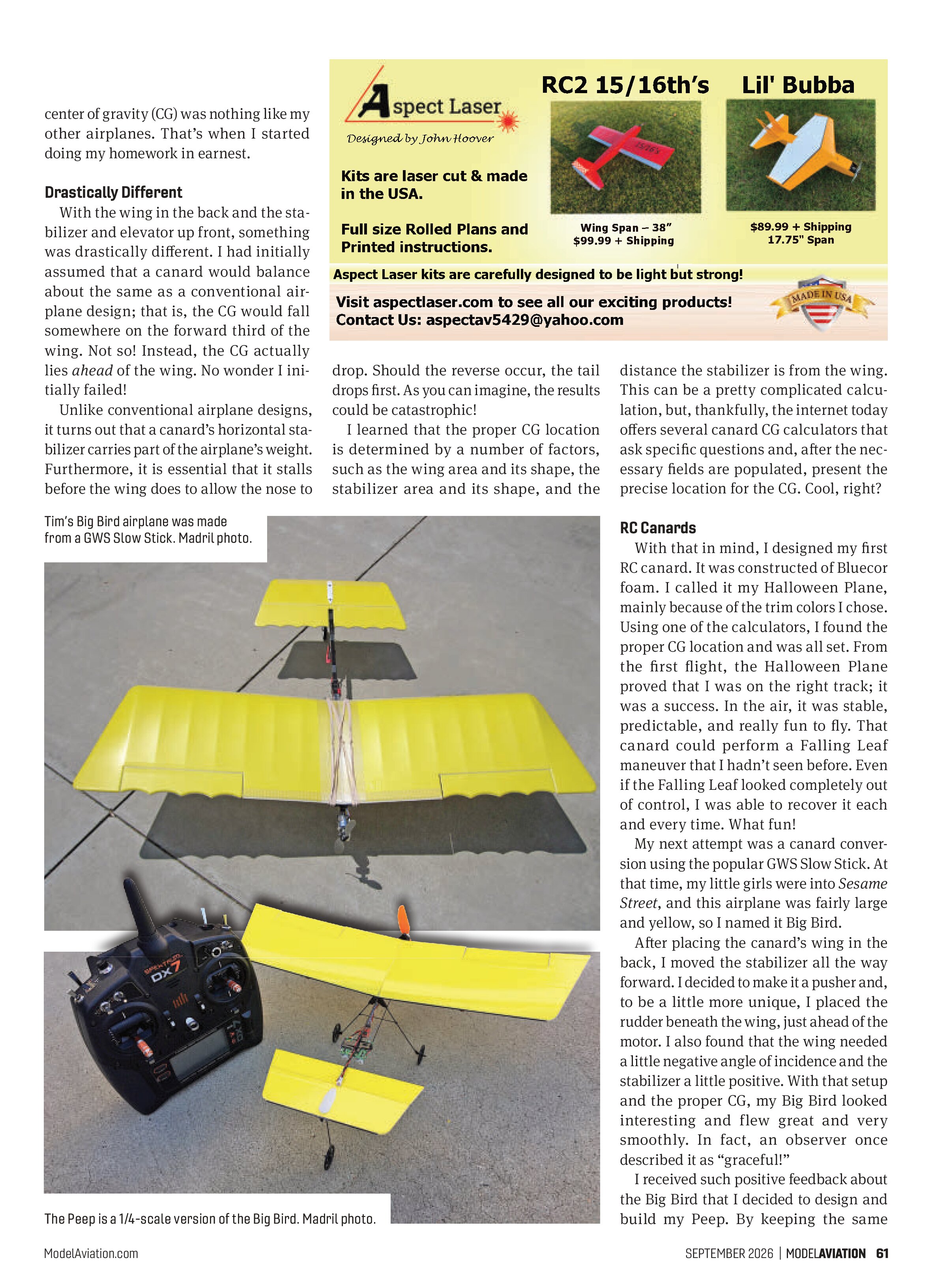
Tim’s Big Bird airplane was made from a GWS Slow Stick. Madril photo.

The Peep is a 1/4-scale version of the Big Bird. Madril photo.

RC Canards
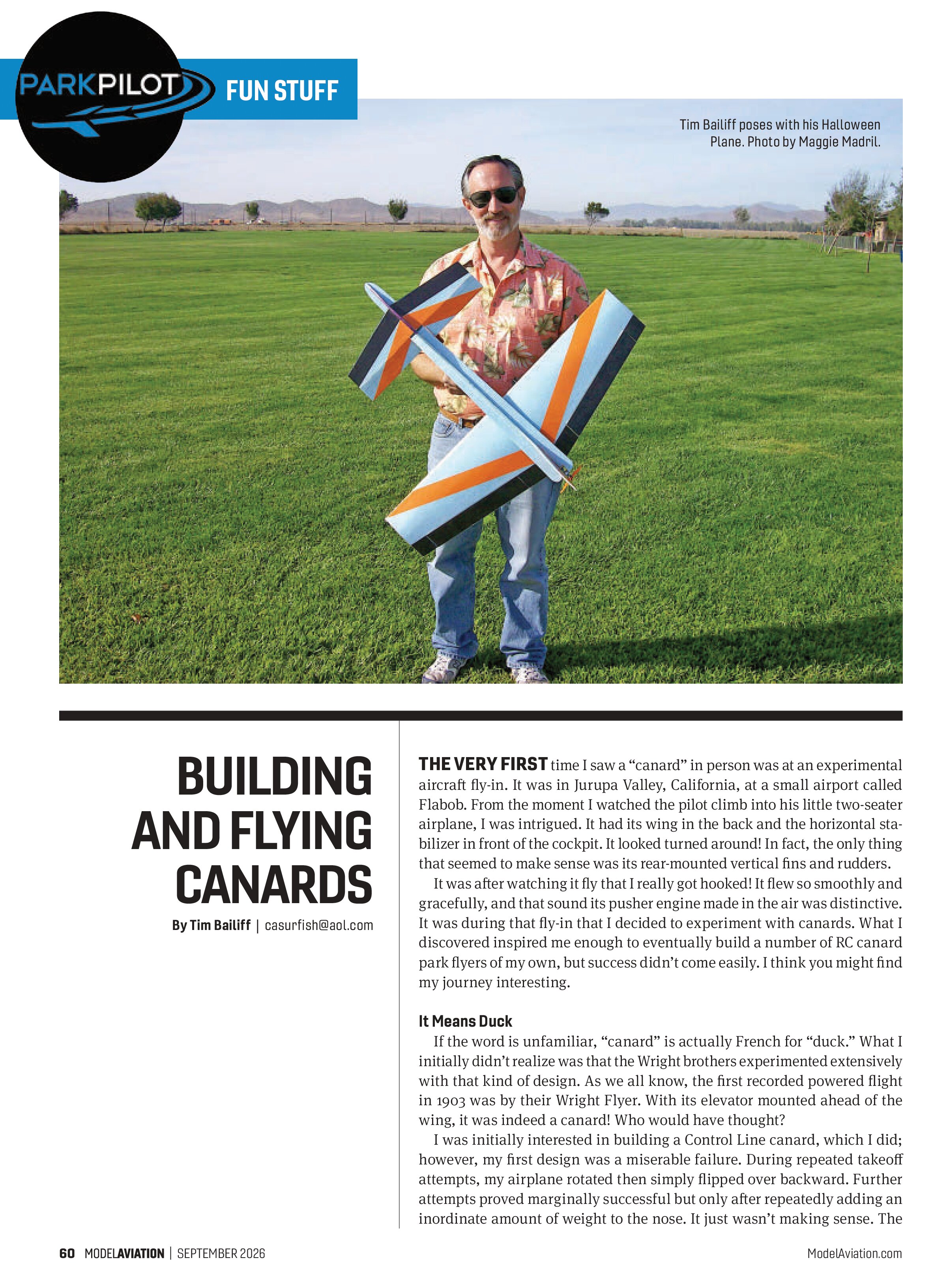
With that in mind, I designed my first RC canard. It was constructed of Bluecor foam. I called it my Halloween Plane, mainly because of the trim colors I chose. Using one of the calculators, I found the proper CG location and was all set. From the first flight, the Halloween Plane proved that I was on the right track; it was a success. In the air, it was stable, predictable, and really fun to fly. That canard could perform a Falling Leaf maneuver that I hadn’t seen before. Even if the Falling Leaf looked completely out of control, I was able to recover it each and every time. What fun!
My next attempt was a canard conversion using the popular GWS Slow Stick. At that time, my little girls were into Sesame Street, and this airplane was fairly large and yellow, so I named it Big Bird.
After placing the canard’s wing in the back, I moved the stabilizer all the way forward. I decided to make it a pusher and, to be a little more unique, I placed the rudder beneath the wing, just ahead of the motor. I also found that the wing needed a little negative angle of incidence and the stabilizer a little positive. With that setup and the proper CG, my Big Bird looked interesting and flew great and very smoothly. In fact, an observer once described it as “graceful!”
I received such positive feedback about the Big Bird that I decided to design and build my Peep. By keeping the same

proportions, the Peep is basically a 1/4-scale version of the Big Bird. It’s such a fun little canard. It’s built from 2 mm Depron and carbon-fiber rods. Using all micro-RC components, it is lightweight and maneuverable and can fly both inside and outdoors.
A Lot of Fun
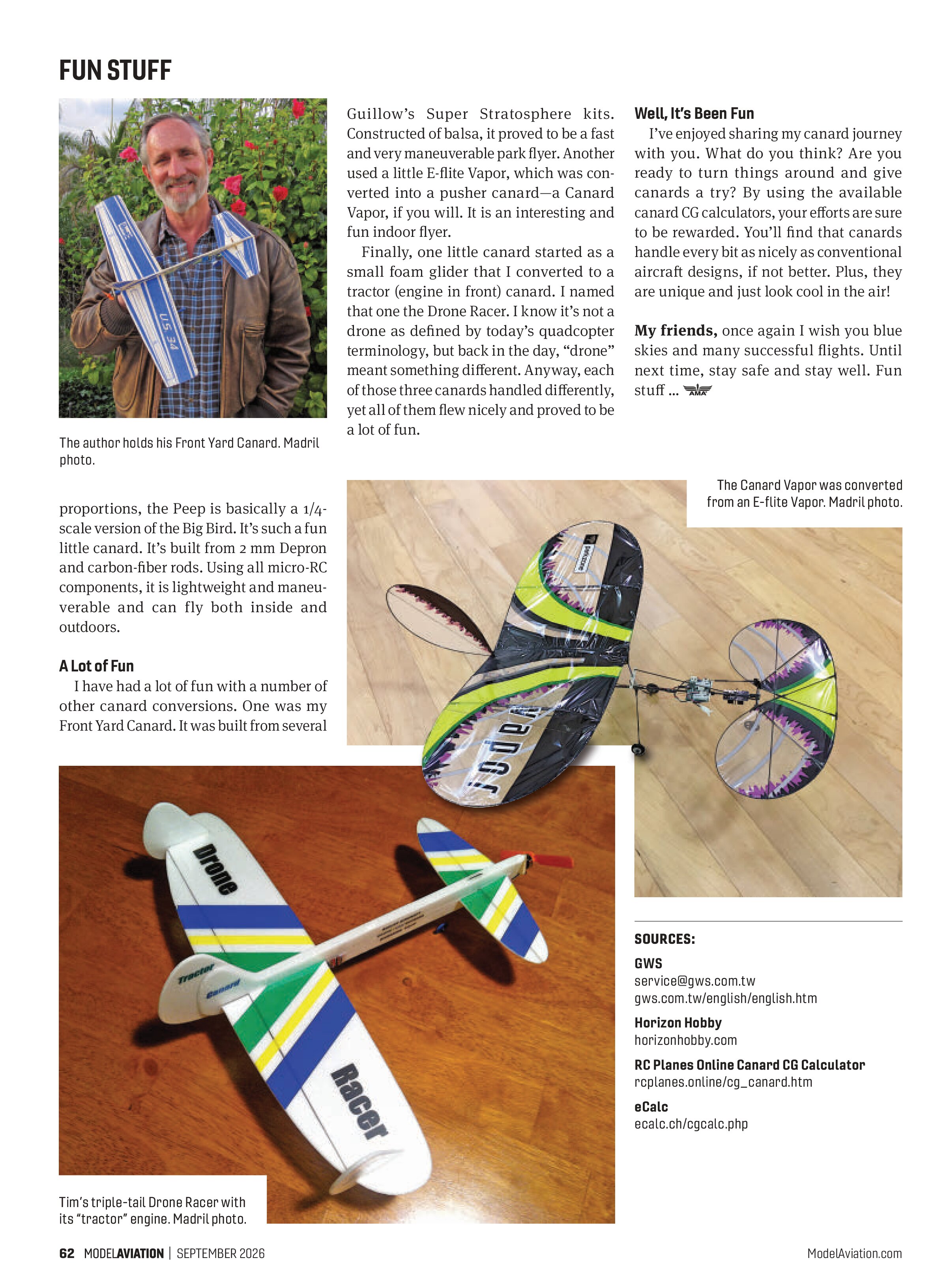
I have had a lot of fun with a number of other canard conversions. One was my Front Yard Canard. It was built from several Guillow’s Super Stratosphere kits. Constructed of balsa, it proved to be a fast and very maneuverable park flyer. Another used a little E-flite Vapor, which was converted into a pusher canard—a Canard Vapor, if you will. It is an interesting and fun indoor flyer.
Finally, one little canard started as a small foam glider that I converted to a tractor (engine in front) canard. I named that one the Drone Racer. I know it’s not a drone as defined by today’s quadcopter terminology, but back in the day, “drone” meant something different. Anyway, each of those three canards handled differently, yet all of them flew nicely and proved to be a lot of fun.


Well, It’s Been Fun
I’ve enjoyed sharing my canard journey with you. What do you think? Are you ready to turn things around and give canards a try? By using the available canard CG calculators, your efforts are sure to be rewarded. You’ll find that canards handle every bit as nicely as conventional aircraft designs, if not better. Plus, they are unique and just look cool in the air!
My friends, once again I wish you blue skies and many successful flights. Until next time, stay safe and stay well. Fun stuff ...
SOURCES:
GWS
service@gws.com.tw
gws.com.tw/english/english.htm
Horizon Hobby
horizonhobby.com
RC Planes Online Canard CG Calculator
rcplanes.online/cg_canard.htm
eCalc
ecalc.ch/cgcalc.php