INDOOR FREE FLIGHT
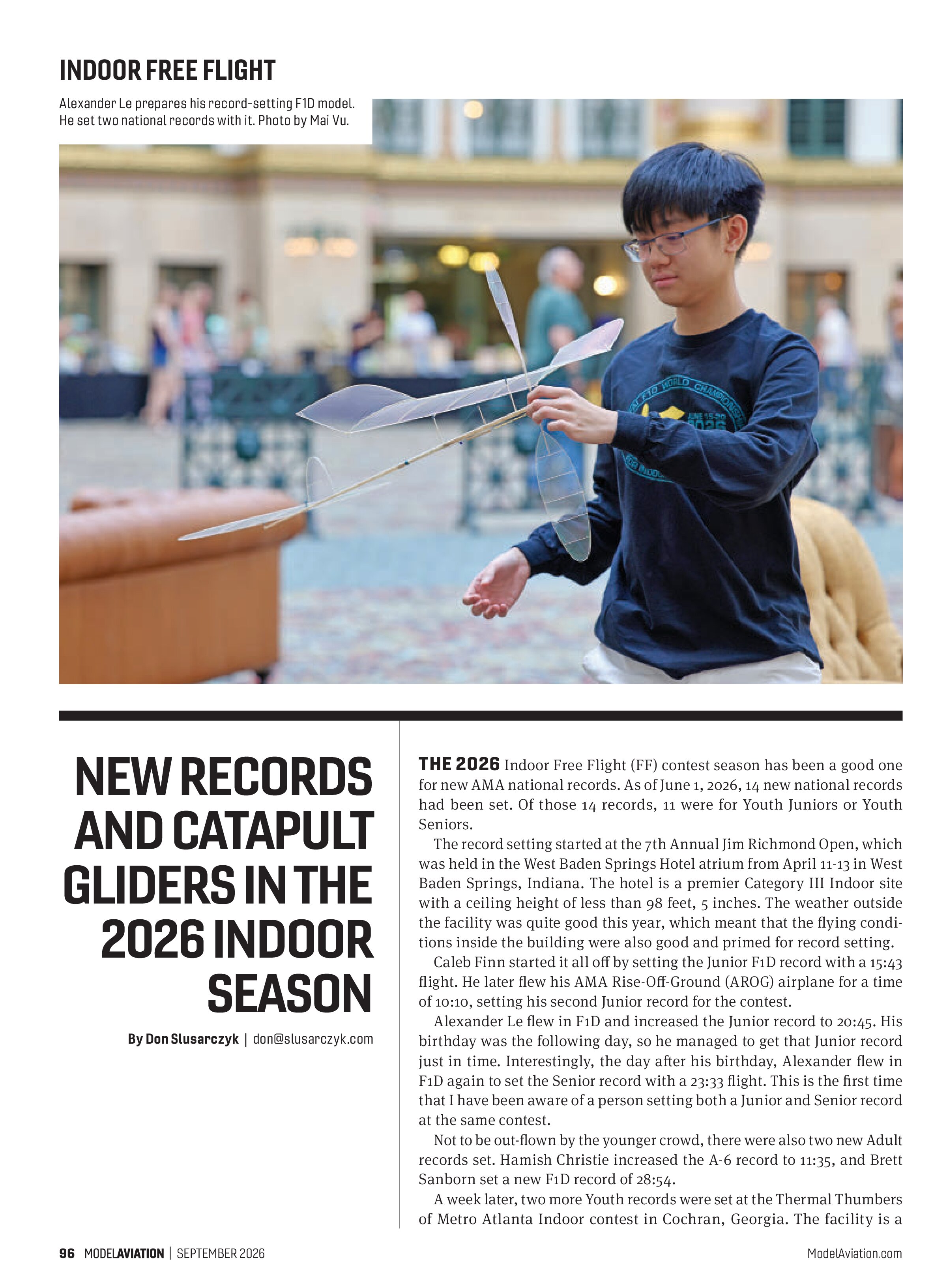
Alexander Le prepares his record-setting F1D model. He set two national records with it.
By Don Slusarczyk | don@slusarczyk.com

NEW RECORDS AND CATAPULT GLIDERS IN THE 2026 INDOOR SEASON
THE 2026 Indoor Free Flight (FF) contest season has been a good one for new AMA national records. As of June 1, 2026, 14 new national records had been set. Of those 14 records, 11 were for Youth Juniors or Youth Seniors.
The record setting started at the 7th Annual Jim Richmond Open, which was held in the West Baden Springs Hotel atrium from April 11-13 in West Baden Springs, Indiana. The hotel is a premier Category III Indoor site with a ceiling height of less than 98 feet, 5 inches. The weather outside the facility was quite good this year, which meant that the flying conditions inside the building were also good and primed for record setting.
Caleb Finn started it all off by setting the Junior F1D record with a 15:43 flight. He later flew his AMA Rise-Off-Ground (AROG) airplane for a time of 10:10, setting his second Junior record for the contest.
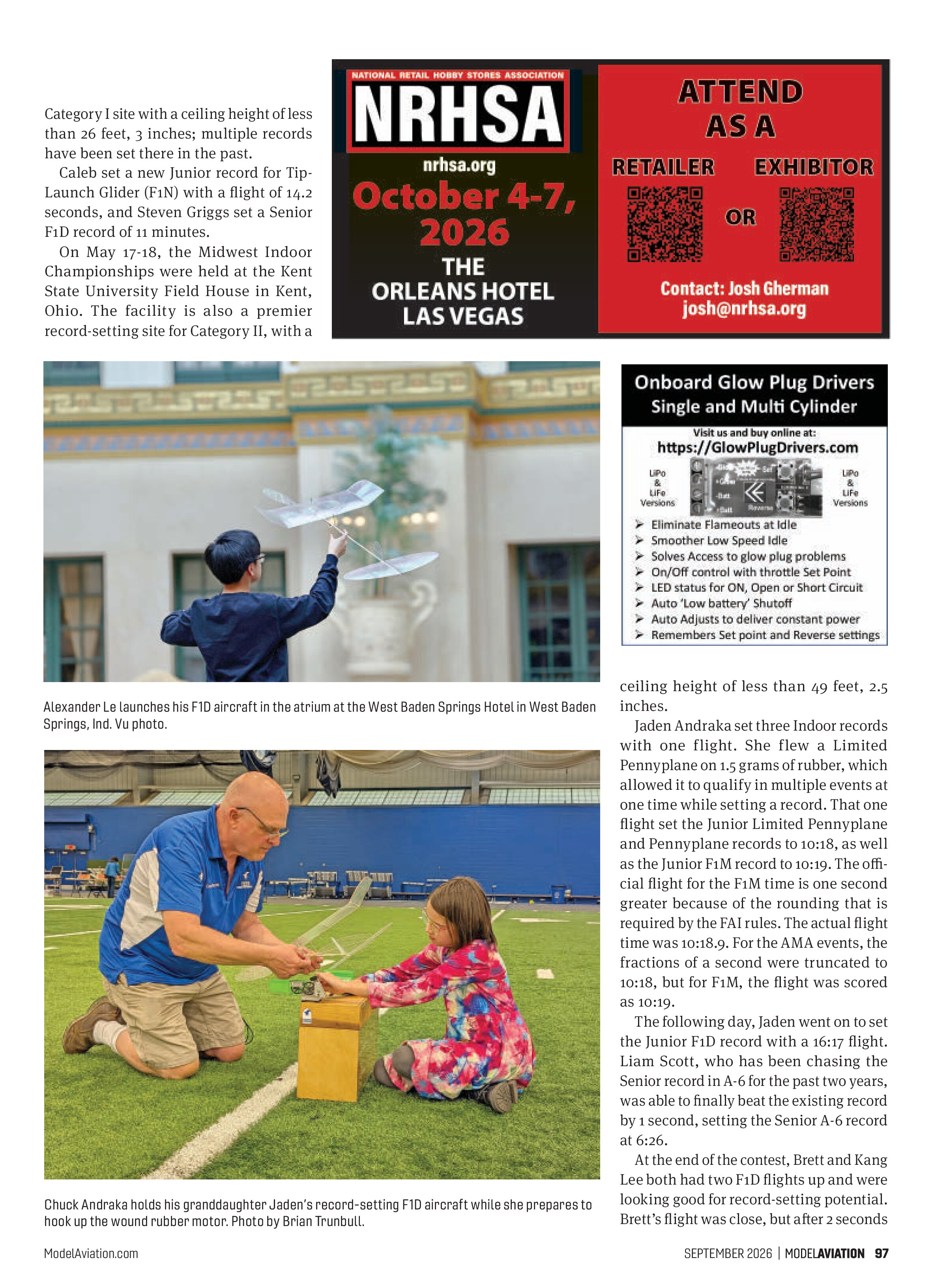
Alexander Le flew in F1D and increased the Junior record to 20:45. His birthday was the following day, so he managed to get that Junior record just in time. Interestingly, the day after his birthday, Alexander flew in F1D again to set the Senior record with a 23:33 flight. This is the first time that I have been aware of a person setting both a Junior and Senior record at the same contest.
Not to be out-flown by the younger crowd, there were also two new Adult records set. Hamish Christie increased the A-6 record to 11:35, and Brett Sanborn set a new F1D record of 28:54.
A week later, two more Youth records were set at the Thermal Thumbers of Metro Atlanta Indoor contest in Cochran, Georgia. The facility is a Category I site with a ceiling height of less than 26 feet, 3 inches; multiple records have been set there in the past.
Caleb set a new Junior record for Tip-Launch Glider (F1N) with a flight of 14.2 seconds, and Steven Griggs set a Senior F1D record of 11 minutes.
On May 17-18, the Midwest Indoor Championships were held at the Kent State University Field House in Kent, Ohio. The facility is also a premier record-setting site for Category II, with a ceiling height of less than 49 feet, 2.5 inches.

Jaden Andraka set three Indoor records with one flight. She flew a Limited Pennyplane on 1.5 grams of rubber, which allowed it to qualify in multiple events at one time while setting a record. That one flight set the Junior Limited Pennyplane and Pennyplane records to 10:18, as well as the Junior F1M record to 10:19. The official flight for the F1M time is one second greater because of the rounding that is required by the FAI rules. The actual flight time was 10:18.9. For the AMA events, the fractions of a second were truncated to 10:18, but for F1M, the flight was scored as 10:19.
The following day, Jaden went on to set the Junior F1D record with a 16:17 flight. Liam Scott, who has been chasing the Senior record in A-6 for the past two years, was able to finally beat the existing record by 1 second, setting the Senior A-6 record at 6:26.

At the end of the contest, Brett and Kang Lee both had two F1D flights up and were looking good for record-setting potential. Brett’s flight was close, but after 2 seconds

of propeller stop time were deducted for steering, it was just short of the record. Kang landed a few moments later with a time of 28:33, just beating the existing record.
Congratulations to all who have set records so far this year! Well done!
F1T (F1N-150)
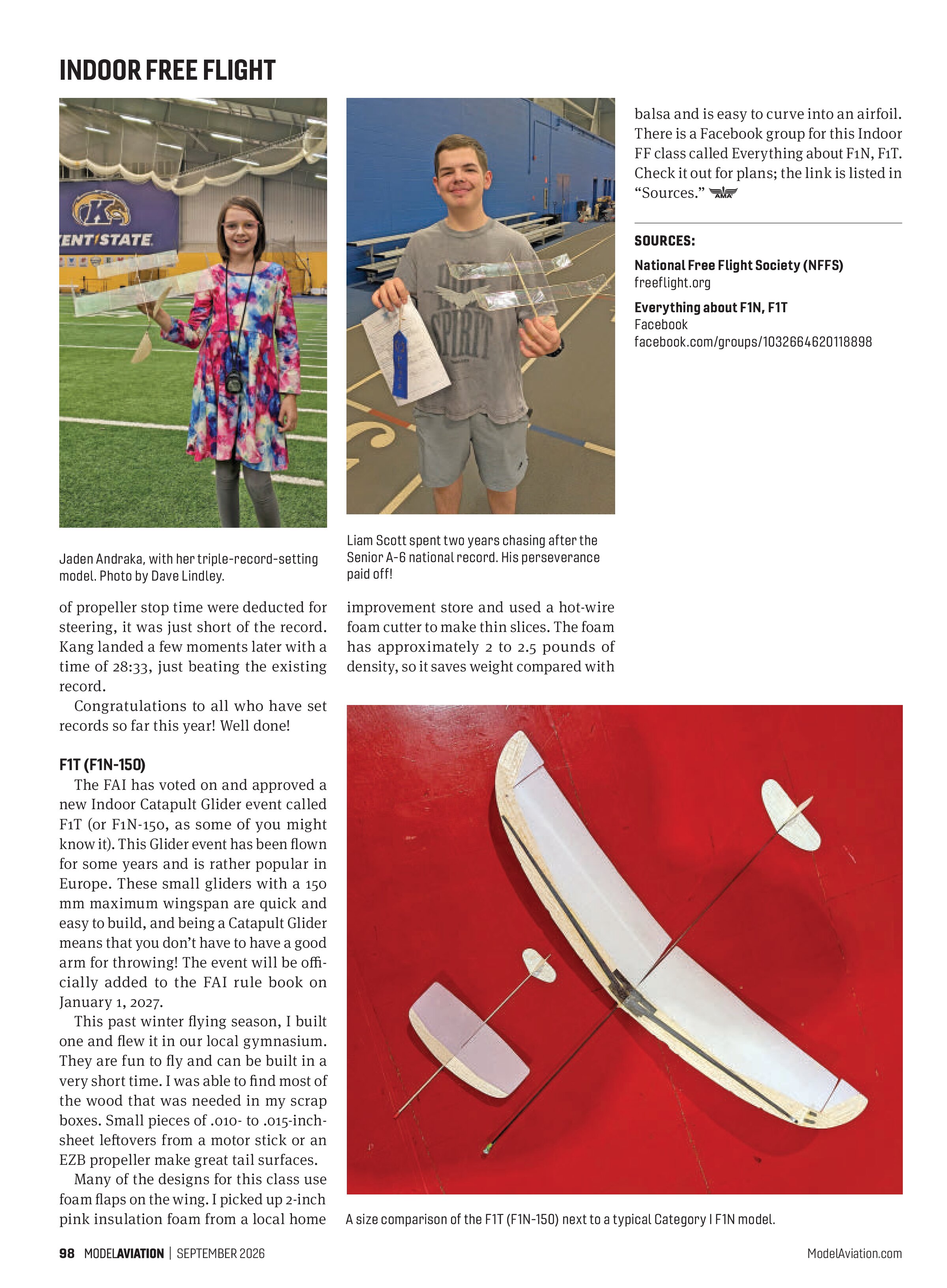
The FAI has voted on and approved a new Indoor Catapult Glider event called F1T (or F1N-150, as some of you might know it). This Glider event has been flown for some years and is rather popular in Europe. These small gliders with a 150 mm maximum wingspan are quick and easy to build, and being a Catapult Glider means that you don’t have to have a good arm for throwing! The event will be officially added to the FAI rule book on January 1, 2027.
This past winter flying season, I built one and flew it in our local gymnasium. They are fun to fly and can be built in a very short time. I was able to find most of the wood that was needed in my scrap boxes. Small pieces of .010- to .015-inch-sheet leftovers from a motor stick or an EZB propeller make great tail surfaces.
Many of the designs for this class use foam flaps on the wing. I picked up 2-inch pink insulation foam from a local home

balsa and is easy to curve into an airfoil. There is a Facebook group for this Indoor FF class called Everything about F1N, F1T. Check it out for plans; the link is listed in “Sources.”
SOURCES:
National Free Flight Society (NFFS)
freeflight.org
Everything about F1N, F1T
Facebook
facebook.com/groups/1032664620118898
improvement store and used a hot-wire foam cutter to make thin slices. The foam has approximately 2 to 2.5 pounds of density, so it saves weight compared with