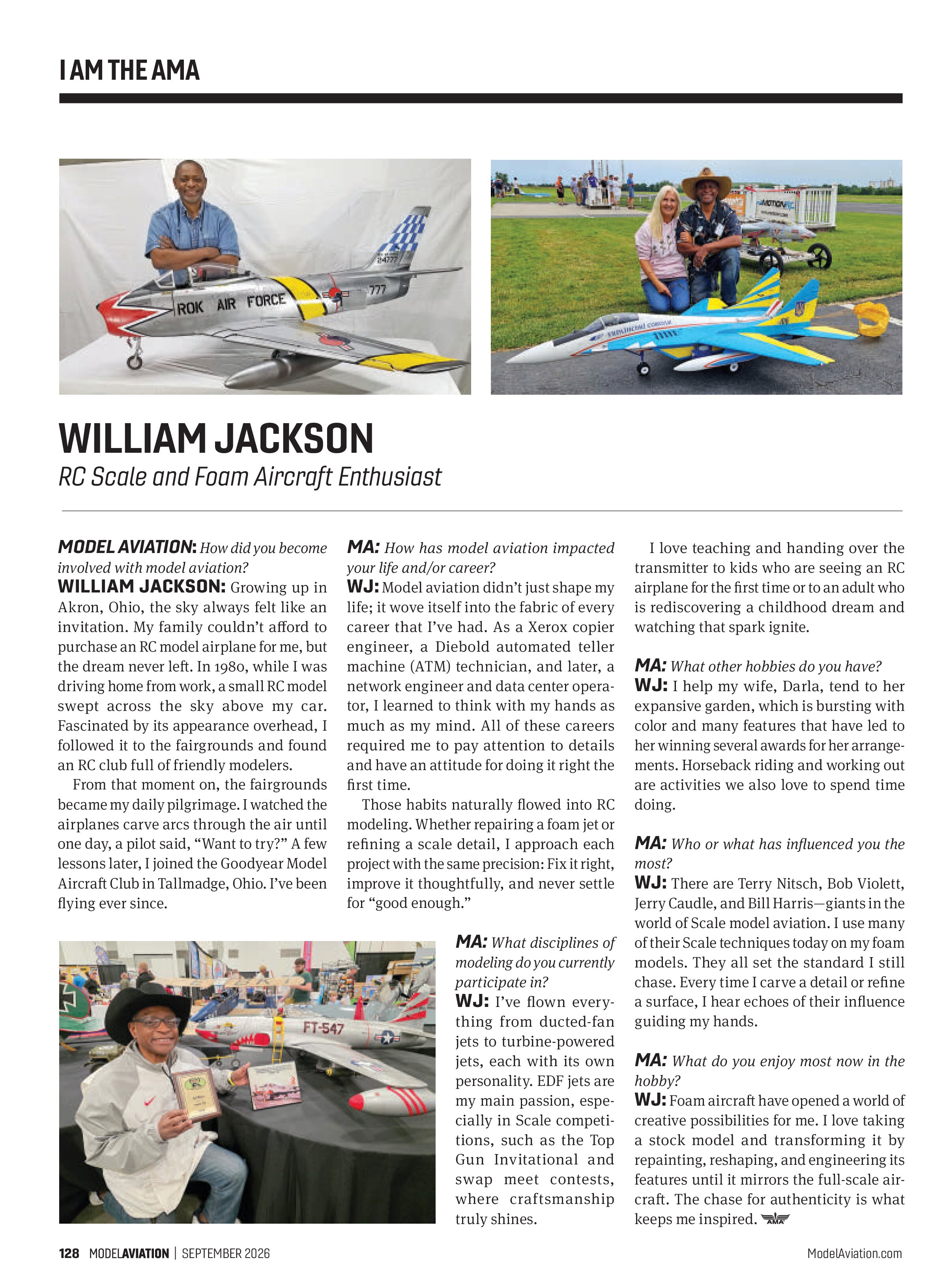
WILLIAM JACKSON
RC Scale and Foam Aircraft Enthusiast
MODEL AVIATION: How did you become involved with model aviation?
WILLIAM JACKSON: Growing up in Akron, Ohio, the sky always felt like an invitation. My family couldn’t afford to purchase an RC model airplane for me, but the dream never left. In 1980, while I was driving home from work, a small RC model swept across the sky above my car. Fascinated by its appearance overhead, I followed it to the fairgrounds and found an RC club full of friendly modelers.
From that moment on, the fairgrounds became my daily pilgrimage. I watched the airplanes carve arcs through the air until one day, a pilot said, “Want to try?” A few lessons later, I joined the Goodyear Model Aircraft Club in Tallmadge, Ohio. I’ve been flying ever since.

MA: How has model aviation impacted your life and/or career?
WJ: Model aviation didn’t just shape my life; it wove itself into the fabric of every career that I’ve had. As a Xerox copier engineer, a Diebold automated teller machine (ATM) technician, and later, a network engineer and data center operator, I learned to think with my hands as much as my mind. All of these careers required me to pay attention to details and have an attitude for doing it right the first time.
Those habits naturally flowed into RC modeling. Whether repairing a foam jet or refining a scale detail, I approach each project with the same precision: Fix it right, improve it thoughtfully, and never settle for “good enough.”
MA: What disciplines of modeling do you currently participate in?
WJ: I’ve flown everything from ducted-fan jets to turbine-powered jets, each with its own personality. EDF jets are my main passion, especially in Scale competitions, such as the Top Gun Invitational and swap meet contests, where craftsmanship truly shines.
MA: What other hobbies do you have?
WJ: I help my wife, Darla, tend to her expansive garden, which is bursting with color and many features that have led to her winning several awards for her arrangements. Horseback riding and working out are activities we also love to spend time doing.
MA: Who or what has influenced you the most?
WJ: There are Terry Nitsch, Bob Violett, Jerry Caudle, and Bill Harris—giants in the world of Scale model aviation. I use many of their Scale techniques today on my foam models. They all set the standard I still chase. Every time I carve a detail or refine a surface, I hear echoes of their influence guiding my hands.
MA: What do you enjoy most now in the hobby?
WJ: Foam aircraft have opened a world of creative possibilities for me. I love taking a stock model and transforming it by repainting, reshaping, and engineering its features until it mirrors the full-scale aircraft. The chase for authenticity is what keeps me inspired.