CONTROL LINE COMBAT
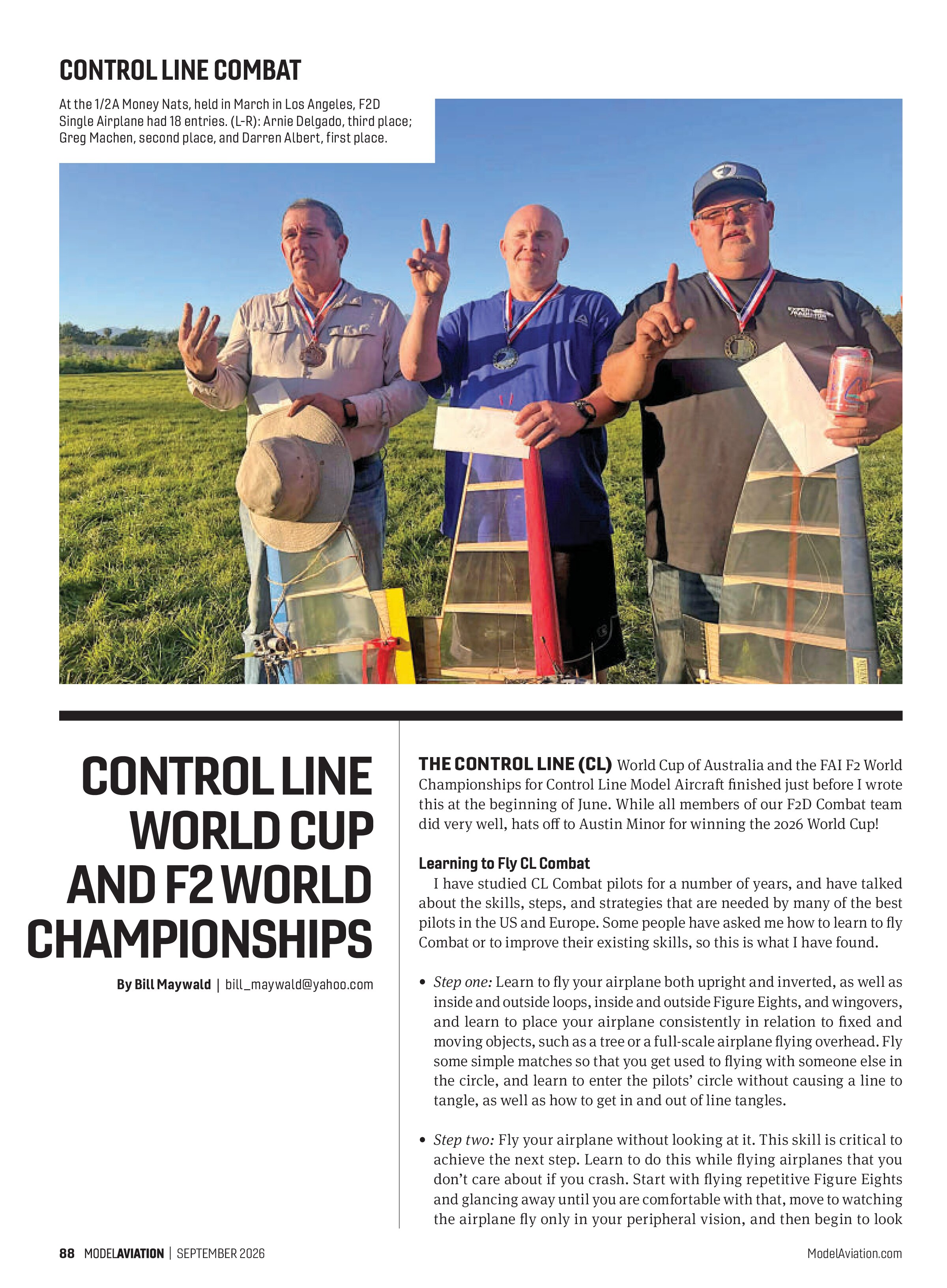
At the 1/2A Money Nats, held in March in Los Angeles, F2D Single Airplane had 18 entries. (L-R): Arnie Delgado, third place; Greg Machen, second place, and Darren Albert, first place.

CONTROL LINE WORLD CUP AND F2 WORLD CHAMPIONSHIPS
By Bill Maywald | bill_maywald@yahoo.com
THE CONTROL LINE (CL) World Cup of Australia and the FAI F2 World Championships for Control Line Model Aircraft finished just before I wrote this at the beginning of June. While all members of our F2D Combat team did very well, hats off to Austin Minor for winning the 2026 World Cup!
Learning to Fly CL Combat
I have studied CL Combat pilots for a number of years, and have talked about the skills, steps, and strategies that are needed by many of the best pilots in the US and Europe. Some people have asked me how to learn to fly Combat or to improve their existing skills, so this is what I have found.
- Step one: Learn to fly your airplane both upright and inverted, as well as inside and outside loops, inside and outside Figure Eights, and wingovers, and learn to place your airplane consistently in relation to fixed and moving objects, such as a tree or a full-scale airplane flying overhead. Fly some simple matches so that you get used to flying with someone else in the circle, and learn to enter the pilots’ circle without causing a line to tangle, as well as how to get in and out of line tangles.
- Step two: Fly your airplane without looking at it. This skill is critical to achieve the next step. Learn to do this while flying airplanes that you don’t care about if you crash. Start with flying repetitive Figure Eights and glancing away until you are comfortable with that, move to watching the airplane fly only in your peripheral vision, and then begin to look away completely for several maneuvers.
Another tool is to fly Vertical Eights, where the bottom of the maneuver is low to the ground and the top of the maneuver is higher and higher, until you are actually recovering the airplane from behind your head without turning to

position is favorable for you. This also prevents surprise cuts, kills, or midair collisions from happening because you didn’t see your opponent’s aircraft coming into your field of view.
When both airplanes are in your field of view, you should be able to switch into “TV mode,” where your eyes stop tracking individual airplanes (either yours or your opponents) and you are able to see the action like it is occurring on a TV screen. Remember, your airplane will go where you look, so when it is time to attack, watch the streamer and where you want to cut it.
- Step four: Situational awareness is not a skill we in the US have ever learned while flying AMA Fast Combat, where the solution to every problem is to just kill your opponent as quickly as possible. It is, however, extremely critical
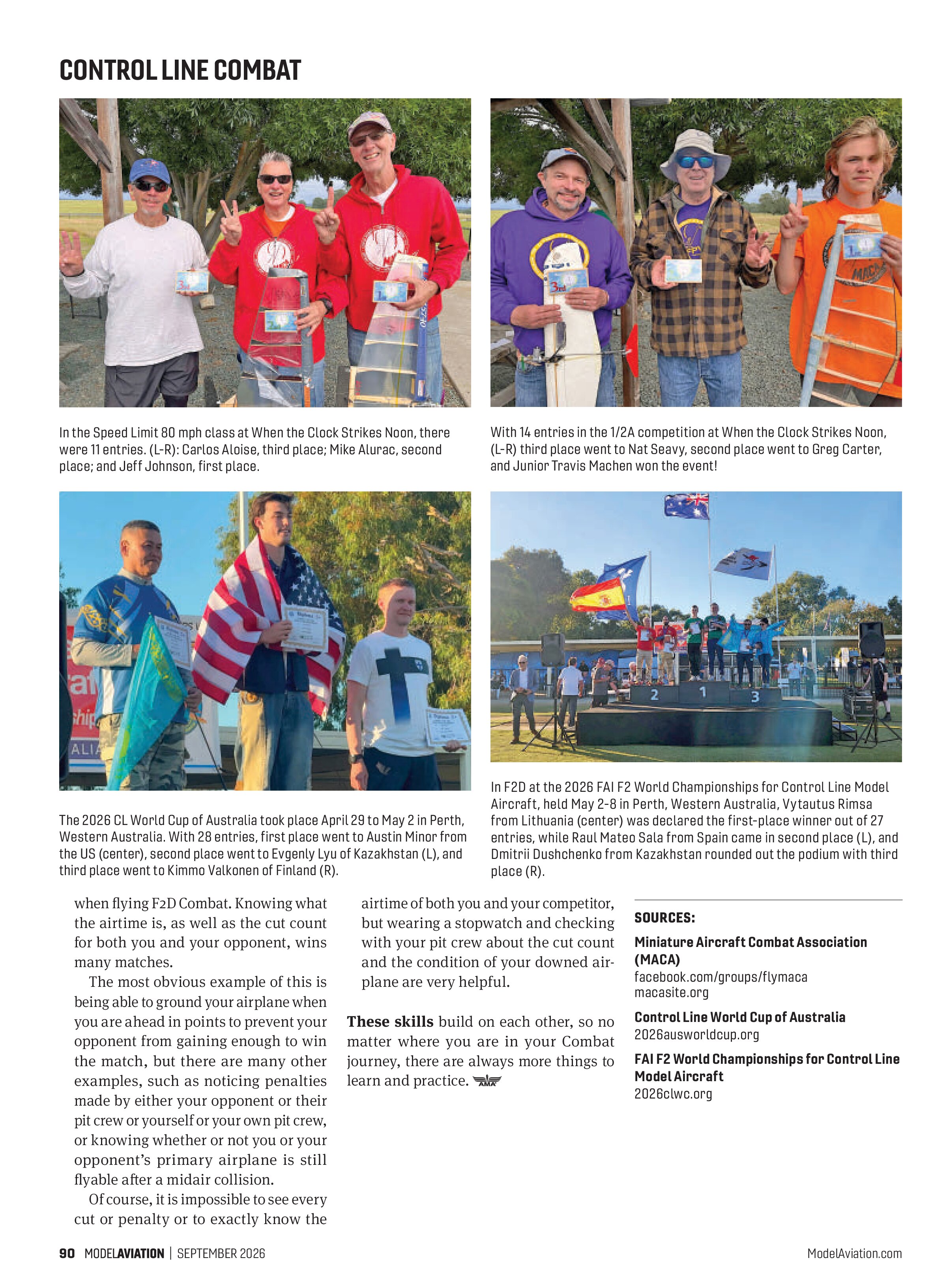
The 1/2A class at the 1/2A Money Nats had 20 entries. (L-R): Mike Alurac, first place; Bill Maywald, second place; Darren Albert, third place.
look for it. This is also a critical skill for achieving the next step.
I recommend practicing these skills every time you fly because you will continue to develop more-complex maneuvers of which you are comfortable flying “eyes off,” including inverted flight. In the end, you will be flying your airplane without really thinking about it.
- Step three: Use strategy while flying. This involves keeping your eyes on your opponent’s airplane while thinking about what they are trying to do offensively and defensively and also thinking about what you are trying to do offensively and defensively. This requires you to use most of your brain capacity to fly Combat instead focusing on flying the airplane.
You want to be able to look around to find your opponent’s airplane and either avoid it because the position is bad for you or attack it because the

When the Clock Strikes Noon took place in April in Ione, Calif. There were 12 entries in F2D Single Airplane. (L-R): Mike Alurac, third place; Bill Maywald, second place; and Greg Machen, first place.


when flying F2D Combat. Knowing what the airtime is, as well as the cut count for both you and your opponent, wins many matches. The most obvious example of this is being able to ground your airplane when you are ahead in points to prevent your opponent from gaining enough to win the match, but there are many other examples, such as noticing penalties made by either your opponent or their pit crew or yourself or your own pit crew, or knowing whether or not you or your opponent’s primary airplane is still flyable after a midair collision. Of course, it is impossible to see every cut or penalty or to exactly know the airtime of both you and your competitor, but wearing a stopwatch and checking with your pit crew about the cut count and the condition of your downed airplane are very helpful.
These skills build on each other, so no matter where you are in your Combat journey, there are always more things to learn and practice.
SOURCES:
Miniature Aircraft Combat Association (MACA)
facebook.com/groups/flymaca
macasite.org
Control Line World Cup of Australia
2026ausworldcup.org
FAI F2 World Championships for Control Line Model Aircraft
2026clwc.org