AROUND THE PATCH

IN THE
FOOTSTEPS
OF GIANTS
By Thayer Syme | thayer@flying-models.com
“I DON’T MEAN to interrupt, but I think you might be able to take a nice picture of my family. Would you mind?”
Thus began a brief interaction with the father/husband of a lovely family of five in the Science Museum in London. I had just finished a two-week business trip to the East Midlands and was soaking up a little more aviation history before returning home when he approached me.
“Of course,” I replied, as he offered me his smartphone. I carefully aligned a storied airplane above their heads and asked where they were from.
“Pakistan.”
I chuckled and commented that the diminutive green and silver biplane named Jason that hung above them had flown through Pakistan in 1930, piloted by a 26-year-old aviatrix who was midway to becoming the first woman to fly solo from England to Australia.
“Her name is Amy Johnson. She remains quite famous today, if you wish to find out more.”
“Thanks. By the way, what is your favorite airplane?” he queried.
“There are so many that I am not sure I can narrow it down to just one,” I replied as I gestured toward Jason. “That said, I am very partial to this one and its various siblings and cousins.”
“Mine is the SR-71,” he countered.
“A worthy choice indeed, considering much of its design was calculated with slide rules.”
He ambled off to rejoin his wife and children as I contemplated Amy’s 19-day journey to the far reaches of the empire and her later aerial adventures.
Amy met and married Jim Mollison two years after her flight to Australia. A well-known pilot in his own right, Jim stood first in line in early 1934 when de Havilland announced its planned production of a bespoke racer for the MacRobertson International Air Race, with prerace delivery assured.
The MacRobertson Race is widely regarded as the single greatest air race ever flown. The route stretched across the British Empire. Entries would launch from Mildenhall (approximately 70 miles west of London) that October and finish in Melbourne, Australia. A generous prize pool of £15,000—with £10,000 promised to the winner—ensured that the race would draw worldwide attention to the commemoration of Melbourne’s 100th birthday.
Geoffrey de Havilland had expressed concern that the race might not be won by an English aircraft and considered this an untenable result; thus, de Havilland Aircraft built three new aircraft that were designed specifically for the MacRobertson challenge in a little more than nine months.
The new design, of course, was de Havilland’s famous DH.88 Comet.
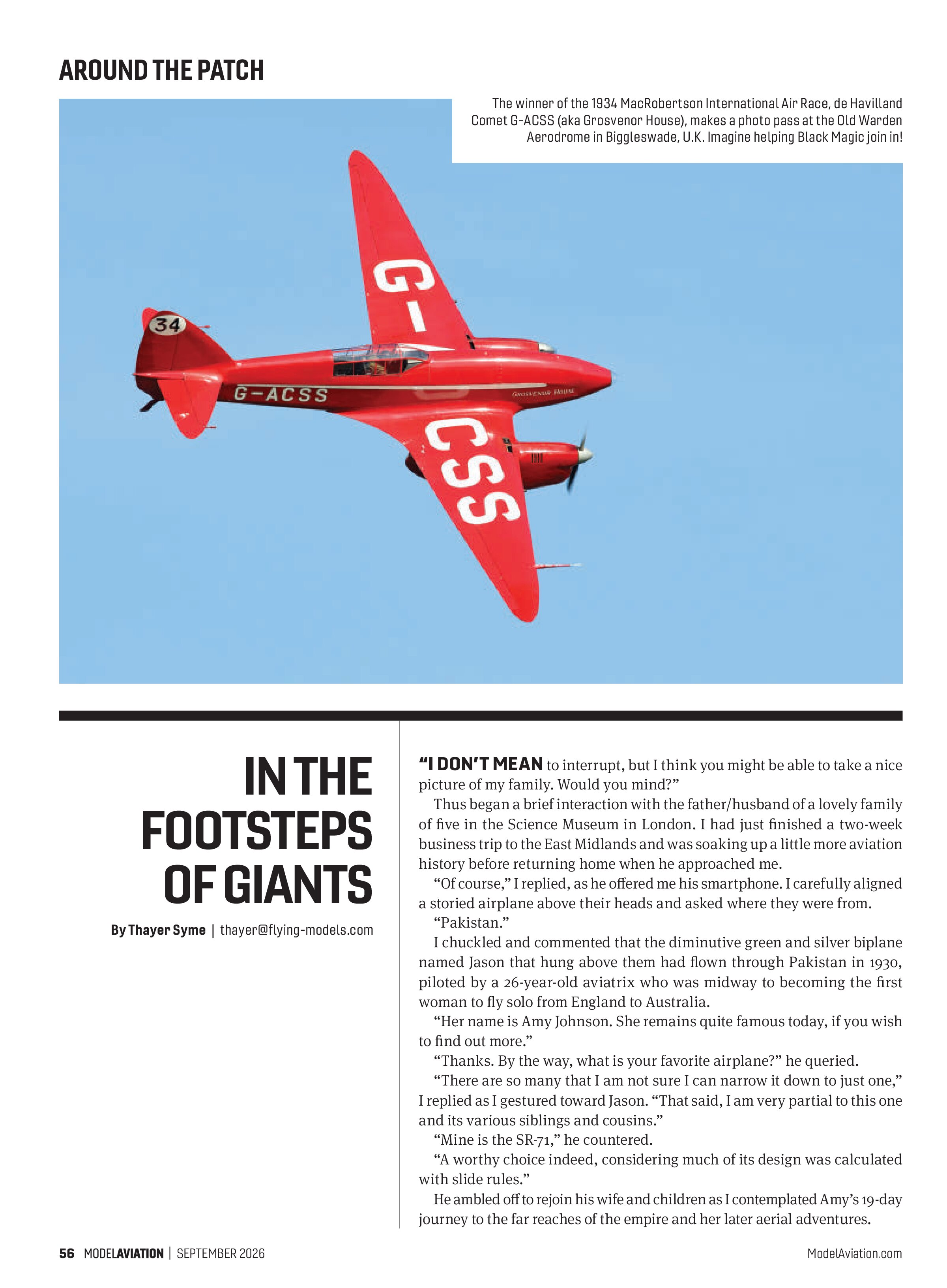
Many will be aware of the ultimate winner of the race, G-ACSS, which was resplendent in its gleaming red paint with “Grosvenor House” emblazoned on its nose to promote the hotel of the same name. Now owned by the Shuttleworth Trust, Grosvenor House is quite possibly the singularly most important British aircraft that is still flying. It can be seen in action during the collection’s several display days each year.
I first read about Amy and her de Havilland Gipsy Moth named Jason in the late 1970s, as well as the MacRobertson race and the Comets, while traveling through Australia a few years later. Needless to say, the dream of seeing G-ACSS in person had been on my life list ever since.
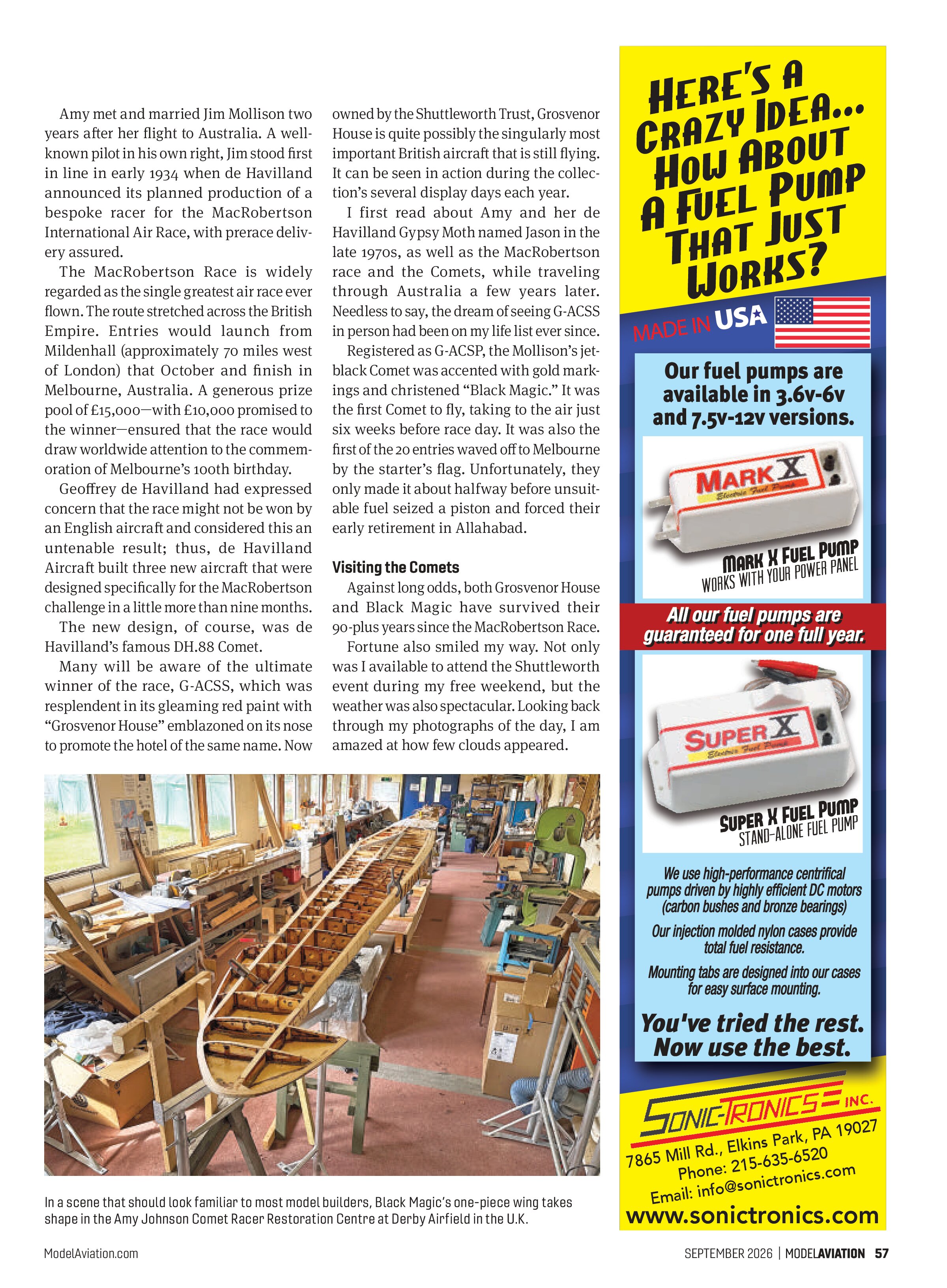
Registered as G-ACSP, the Mollison’s jet-black Comet was accented with gold markings and christened “Black Magic.” It was the first Comet to fly, taking to the air just six weeks before race day. It was also the first of the 20 entries waved off to Melbourne by the starter’s flag. Unfortunately, they only made it about halfway before unsuitable fuel seized a piston and forced their early retirement in Allahabad.
Visiting the Comets
Against long odds, both Grosvenor House and Black Magic have survived their 90-plus years since the MacRobertson Race.
Fortune also smiled my way. Not only was I available to attend the Shuttleworth event during my free weekend, but the weather was also spectacular. Looking back through my photographs of the day, I am amazed at how few clouds appeared.


Grosvenor House certainly seems to enjoy its life on a country estate. Its first pass along the flightline was met with applause from the crowd and hundreds of camera shutters. With nearly 40 years of anticipation, I had waited too long to watch that pass through a lens and so enjoyed its sight and song without a camera or cellphone in hand.
I can say that my visit to the Shuttleworth Collection lived up to all that I had imagined and beyond. More than 30 aircraft were demonstrated throughout the day, and the action was nonstop.
The following day was very different, but just as gratifying.
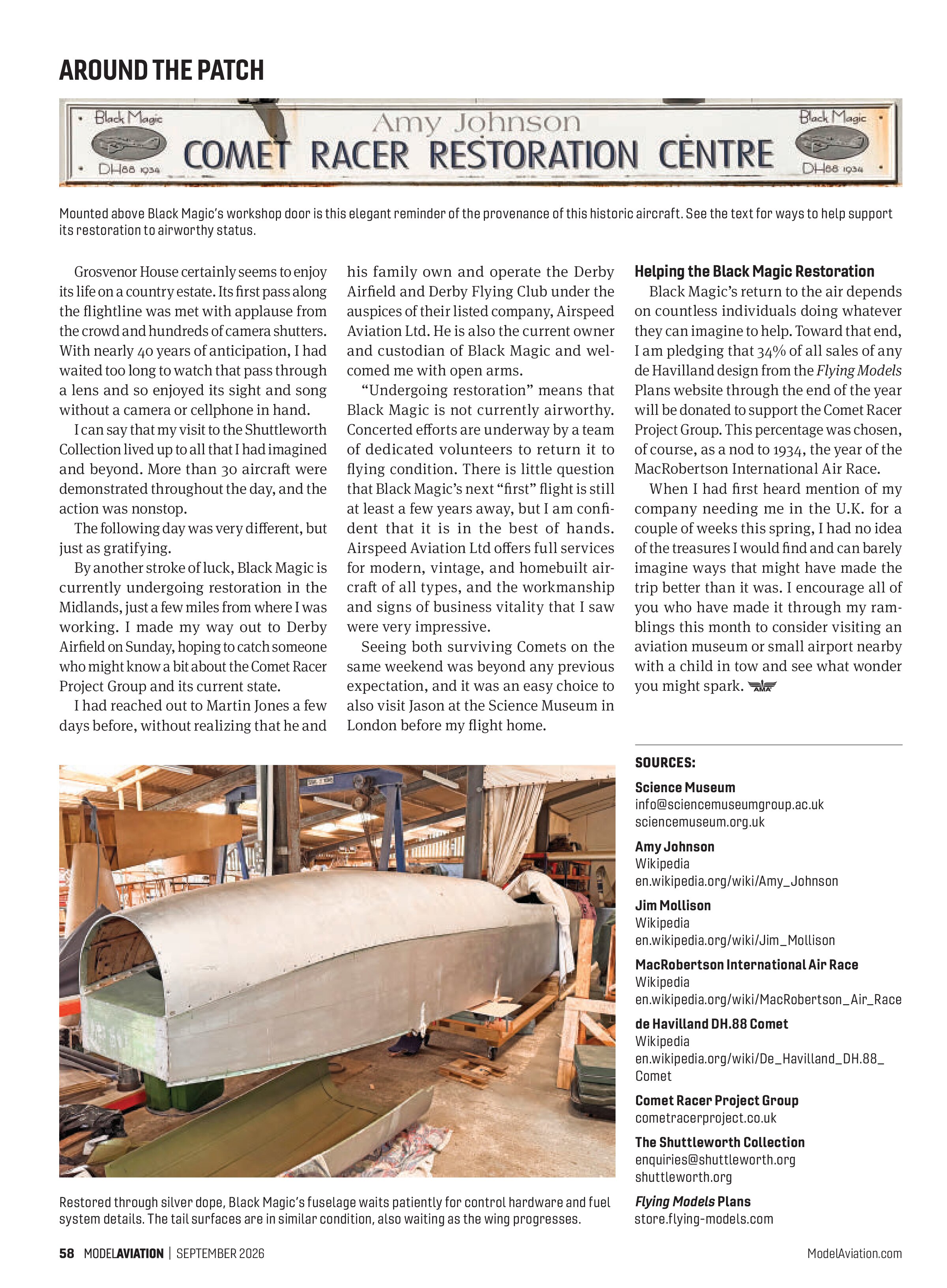
By another stroke of luck, Black Magic is currently undergoing restoration in the Midlands, just a few miles from where I was working. I made my way out to Derby Airfield on Sunday, hoping to catch someone who might know a bit about the Comet Racer Project Group and its current state.
I had reached out to Martin Jones a few days before, without realizing that he and
his family own and operate the Derby Airfield and Derby Flying Club under the auspices of their listed company, Airspeed Aviation Ltd. He is also the current owner and custodian of Black Magic and welcomed me with open arms.
“Undergoing restoration” means that Black Magic is not currently airworthy. Concerted efforts are underway by a team of dedicated volunteers to return it to flying condition. There is little question that Black Magic’s next “first” flight is still at least a few years away, but I am confident that it is in the best of hands. Airspeed Aviation Ltd offers full services for modern, vintage, and homebuilt aircraft of all types, and the workmanship and signs of business vitality that I saw were very impressive.
Seeing both surviving Comets on the same weekend was beyond any previous expectation, and it was an easy choice to also visit Jason at the Science Museum in London before my flight home.

Helping the Black Magic Restoration
Black Magic’s return to the air depends on countless individuals doing whatever they can imagine to help. Toward that end, I am pledging that 34% of all sales of any de Havilland design from the Flying Models Plans website through the end of the year will be donated to support the Comet Racer Project Group. This percentage was chosen, of course, as a nod to 1934, the year of the MacRobertson International Air Race.
When I had first heard mention of my company needing me in the U.K. for a couple of weeks this spring, I had no idea of the treasures I would find and can barely imagine ways that might have made the trip better than it was. I encourage all of you who have made it through my ramblings this month to consider visiting an aviation museum or small airport nearby with a child in tow and see what wonder you might spark.
SOURCES:
Science Museum
info@sciencemuseumgroup.ac.uk
sciencemuseum.org.uk
Amy Johnson
Wikipedia
en.wikipedia.org/wiki/Amy_Johnson
Jim Mollison
Wikipedia
en.wikipedia.org/wiki/Jim_Mollison
MacRobertson International Air Race
Wikipedia
en.wikipedia.org/wiki/MacRobertson_Air_Race
de Havilland DH.88 Comet
Wikipedia
en.wikipedia.org/wiki/De_Havilland_DH.88_Comet
Comet Racer Project Group
cometracerproject.co.uk
The Shuttleworth Collection
enquiries@shuttleworth.org
shuttleworth.org
Flying Models Plans
store.flying-models.com