DUMAS PRODUCTS SAYS GOODBYE AFTER 80 YEARS
By Holly Silvers, Associate Editor | holly@modelaircraft.org
AFTER 80 YEARS of manufacturing, Dumas Products announced that it would close its doors on May 15, 2026. The Tucson, Arizona-based company had been a mainstay of the hobby since Al Dumas first founded the business in Milwaukee, Wisconsin, in 1946. In those early years, Dumas Products sold simple balsa wood sheets with parts printed on the wood for modelers to cut out by hand.
In 1950, Al relocated with his mother to Tucson and set up shop at 2114 S. Alvernon St. Two years later, the business was sold, changing hands two more times until it was purchased in 1963 by Jay Brandon, the father of Dumas’ final owner, Rob Brandon. A professional engineer by trade, Jay had moved to Tucson and, with the help of his father, saw a business opportunity in the model industry. At the time of the sale, the company had zero employees and occupied only a 1,200 sq. ft. space.
Under this new leadership, the company ended a 7-year drought of new product releases by introducing a PT boat kit and purchasing American Junior Aircraft boat kits to sell. In the late 1960s, Dumas Products purchased Veco Airplanes from Henry Engineering, a deal that gave Dumas access to a 60-ton die-cutting press that allowed the company to branch out into the model airplane market. The acquisition of this new machinery and inventory also required the company to move and expand its headquarters to South Park Avenue in Tucson.
Dumas eventually established itself as a leader in Scale marine models, developing as many as six new kits a year. The product line grew to include approximately 100 models, ranging from fishing boats and tugs to racing hydroplanes that were capable of speeds of more than 60 mph.
A major milestone occurred around 1980 when the company moved to its final location at 909 E. 17th St. in Tucson and secured an exclusive license to manufacture mahogany Chris-Craft runabouts, which remain a signature of the brand.
While the company briefly moved away from model aircraft when liability insurance made flying Control Line difficult in public, Dumas returned to the hobby in 1997 by developing a line of rubber-powered, laser-cut balsa wood Scale model airplanes that were meant for calm flying days or indoor flying. At the time of the company’s closing,

80 boat kits and 106 airplane kits were available for purchase.
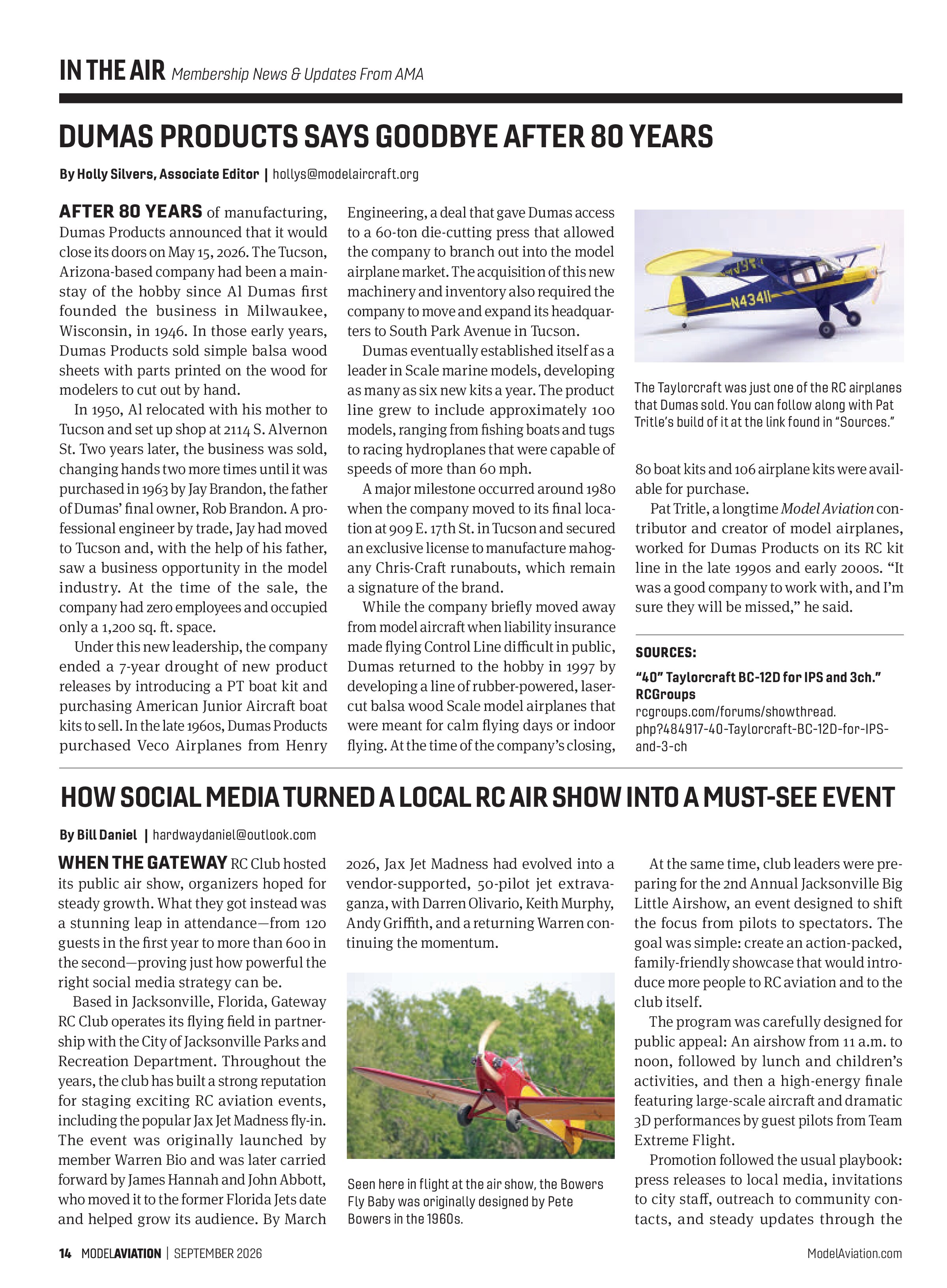
Pat Tritle, a longtime Model Aviation contributor and creator of model airplanes, worked for Dumas Products on its RC kit line in the late 1990s and early 2000s. “It was a good company to work with, and I’m sure they will be missed,” he said.
SOURCES:
“40” Taylorcraft BC-12D for IPS and 3ch.”
RCGroups
rcgroups.com/forums/showthread.php?484917-40-Taylorcraft-BC-12D-for-IPS-and-3-ch
HOW SOCIAL MEDIA TURNED A LOCAL RC AIR SHOW INTO A MUST-SEE EVENT
By Bill Daniel | hardwaydaniel@outlook.com
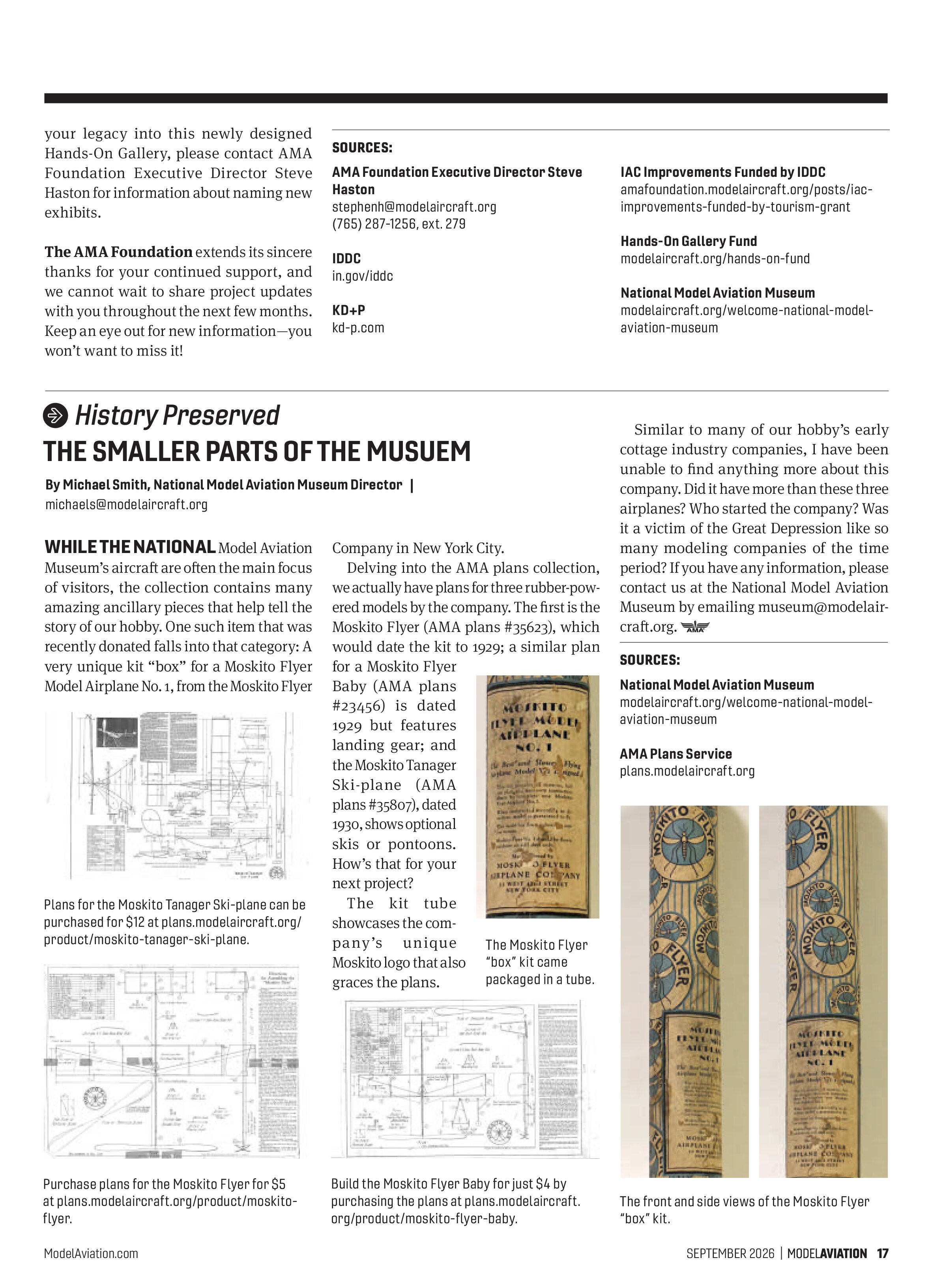
WHEN THE GATEWAY RC Club hosted its public air show, organizers hoped for steady growth. What they got instead was a stunning leap in attendance—from 120 guests in the first year to more than 600 in the second—proving just how powerful the right social media strategy can be.
Based in Jacksonville, Florida, Gateway RC Club operates its flying field in partnership with the City of Jacksonville Parks and Recreation Department. Throughout the years, the club has built a strong reputation for staging exciting RC aviation events, including the popular Jax Jet Madness fly-in. The event was originally launched by member Warren Bio and was later carried forward by James Hannah and John Abbott, who moved it to the former Florida Jets date and helped grow its audience. By March
2026, Jax Jet Madness had evolved into a vendor-supported, 50-pilot jet extravaganza, with Darren Olivario, Keith Murphy, Andy Griffith, and a returning Warren continuing the momentum.

At the same time, club leaders were preparing for the 2nd Annual Jacksonville Big Little Airshow, an event designed to shift the focus from pilots to spectators. The goal was simple: create an action-packed, family-friendly showcase that would introduce more people to RC aviation and to the club itself.
The program was carefully designed for public appeal: An airshow from 11 a.m. to noon, followed by lunch and children’s activities, and then a high-energy finale featuring large-scale aircraft and dramatic 3D performances by guest pilots from Team Extreme Flight.
Promotion followed the usual playbook: press releases to local media, invitations to city staff, outreach to community contacts, and steady updates through the club’s Facebook page. One connection, however, changed everything.
That connection was Eric Dunn, a Jacksonville-based social media personality who is known for spotlighting fun, free activities in the city’s extensive parks system. The club invited him to attend Jax Jet Madness, where the speed, sound, and spectacle of 50 jets in action made an immediate impression. Eric’s enthusiasm translated into compelling online coverage, and his posts gave the Jacksonville Big Little Airshow visibility far beyond the club’s usual reach.
According to organizers, every guest they spoke with said that they had heard about the event on Facebook. Organizers Bill Daniel, Jeremy Lee, and Wayne Clark had expected attendance to grow from roughly 100 guests to perhaps 200. Instead, the event drew more than 600 spectators—a result that underscored the influence of social media when it’s paired with the right messenger.
For Gateway RC Club, the lesson was clear: Traditional promotion still matters, but social media can dramatically amplify visibility when it reaches the right audience through trusted local voices.


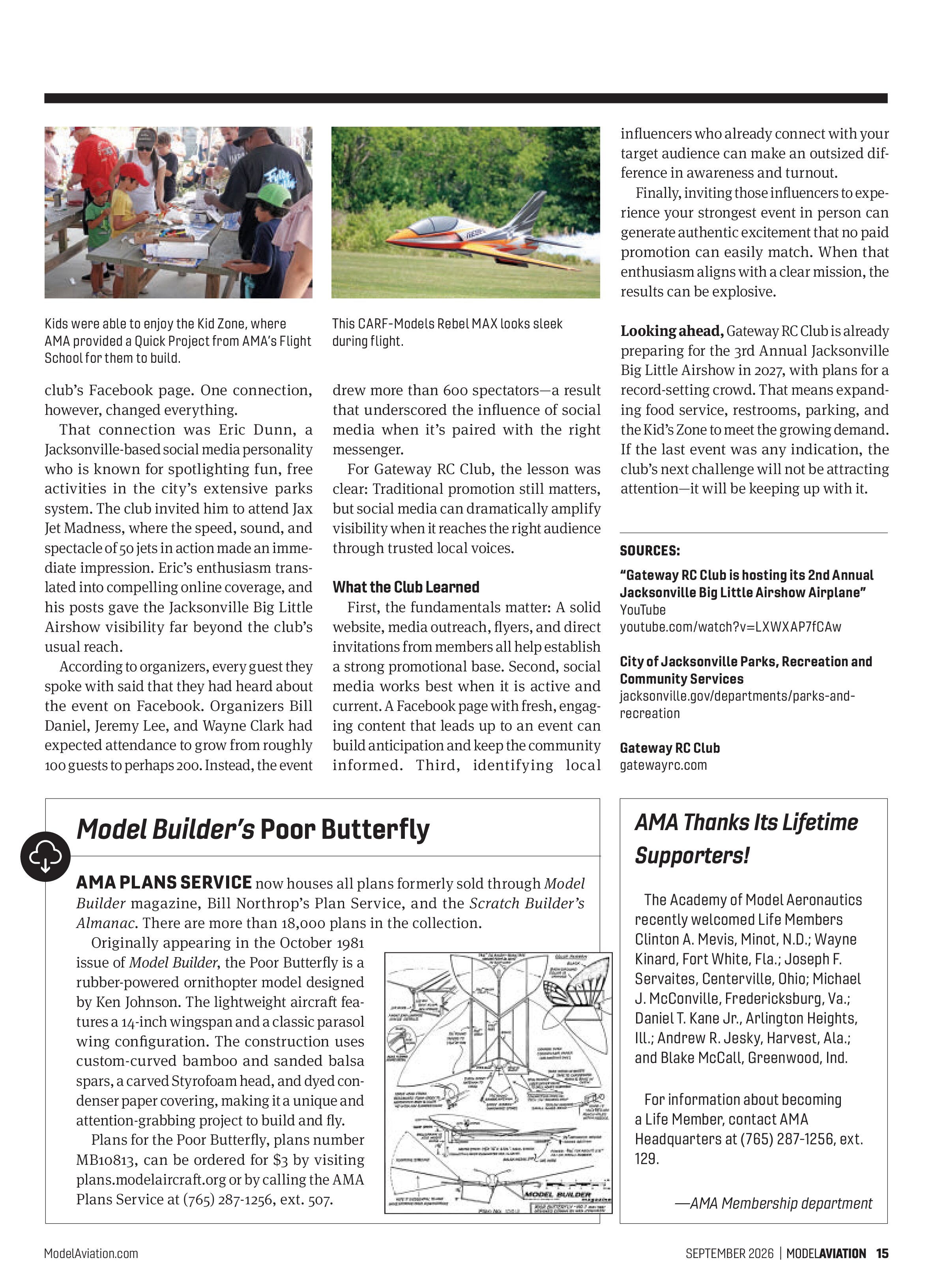
Kids were able to enjoy the Kid Zone, where AMA provided a Quick Project from AMA’s Flight School for them to build.
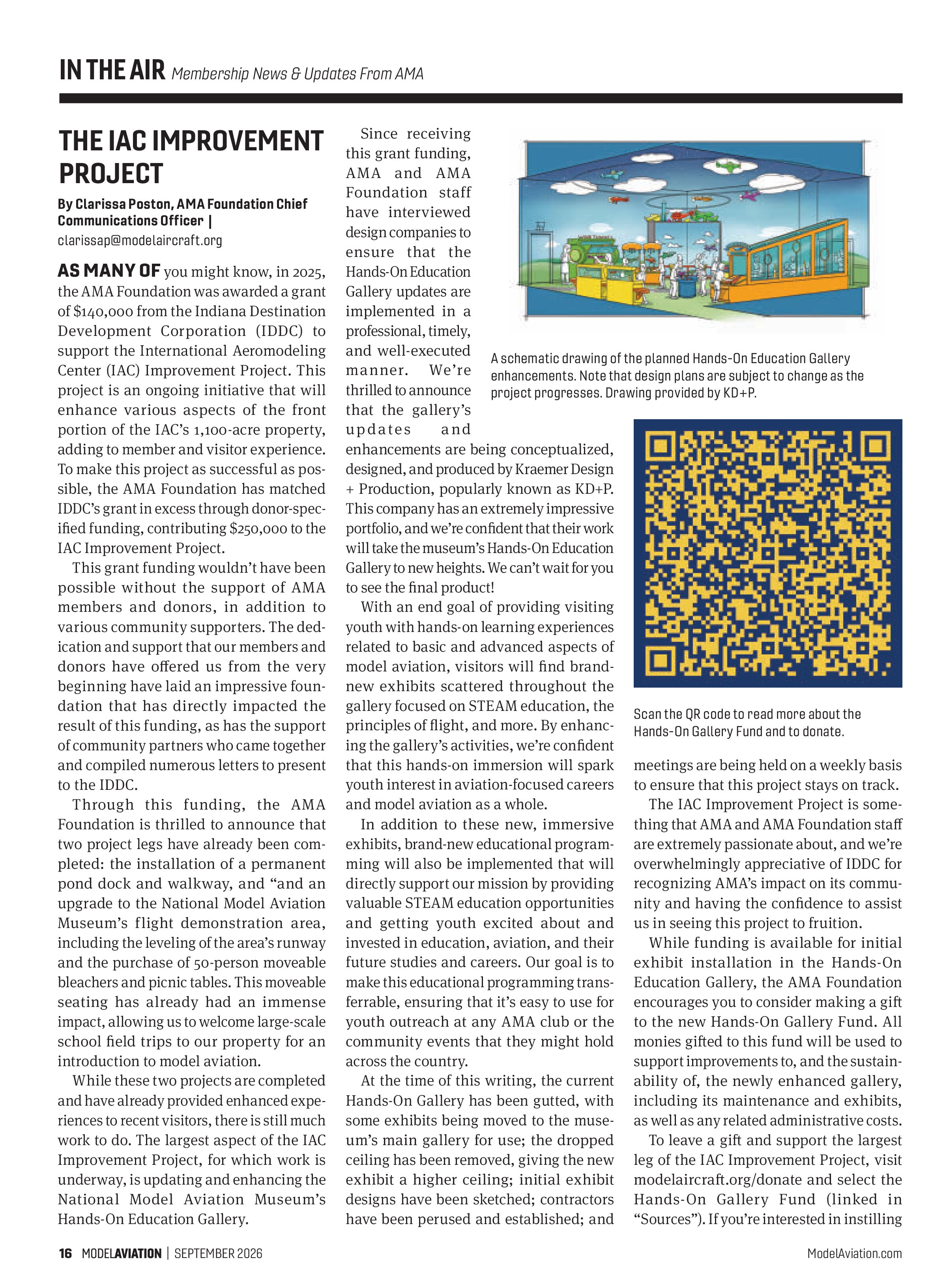
This CARF-Models Rebel MAX looks sleek during flight.
influencers who already connect with your target audience can make an outsized difference in awareness and turnout.
Finally, inviting those influencers to experience your strongest event in person can generate authentic excitement that no paid promotion can easily match. When that enthusiasm aligns with a clear mission, the results can be explosive.
What the Club Learned
First, the fundamentals matter: A solid website, media outreach, flyers, and direct invitations from members all help establish a strong promotional base. Second, social media works best when it is active and current. A Facebook page with fresh, engaging content that leads up to an event can build anticipation and keep the community informed. Third, identifying local influencers who already connect with your target audience can make an outsized difference in awareness and turnout.
Looking ahead, Gateway RC Club is already preparing for the 3rd Annual Jacksonville Big Little Airshow in 2027, with plans for a record-setting crowd. That means expanding food service, restrooms, parking, and the Kid’s Zone to meet the growing demand. If the last event was any indication, the club’s next challenge will not be attracting attention—it will be keeping up with it.
SOURCES:
“Gateway RC Club is hosting its 2nd Annual Jacksonville Big Little Airshow Airplane”
YouTube
youtube.com/watch?v=LXWXAP7fCAW
City of Jacksonville Parks, Recreation and Community Services
jacksonville.gov/departments/parks-and-recreation
Gateway RC Club
gatewayrc.com
Model Builder’s Poor Butterfly
AMA PLANS SERVICE now houses all plans formerly sold through Model Builder magazine, Bill Northrop’s Plan Service, and the Scratch Builder’s Almanac. There are more than 18,000 plans in the collection.
Originally appearing in the October 1981 issue of Model Builder, the Poor Butterfly is a rubber-powered ornithopter model designed by Ken Johnson. The lightweight aircraft features a 14-inch wingspan and a classic parasol wing configuration. The construction uses custom-curved bamboo and sanded balsa spars, a carved Styrofoam head, and dyed condenser paper covering, making it a unique and attention-grabbing project to build and fly.
Plans for the Poor Butterfly, plans number MB10813, can be ordered for $3 by visiting plans.modelaircraft.org or by calling the AMA Plans Service at (765) 287-1256, ext. 507.

AMA Thanks Its Lifetime Supporters!
The Academy of Model Aeronautics recently welcomed Life Members Clinton A. Mevis, Minot, N.D.; Wayne Kinard, Fort White, Fla.; Joseph F. Servaites, Centerville, Ohio; Michael J. McConville, Fredericksburg, Va.; Daniel T. Kane Jr., Arlington Heights, Ill.; Andrew R. Jesky, Harvest, Ala.; and Blake McCall, Greenwood, Ind.
For information about becoming a Life Member, contact AMA Headquarters at (765) 287-1256, ext. 129.
—AMA Membership department
THE IAC IMPROVEMENT PROJECT
By Clarissa Poston, AMA Foundation Chief Communications Officer | clarissap@modelaircraft.org
AS MANY OF you might know, in 2025, the AMA Foundation was awarded a grant of $140,000 from the Indiana Destination Development Corporation (IDDC) to support the International Aeromodeling Center (IAC) Improvement Project. This project is an ongoing initiative that will enhance various aspects of the front portion of the IAC’s 1,100-acre property, adding to member and visitor experience. To make this project as successful as possible, the AMA Foundation has matched IDDC’s grant in excess through donor-specified funding, contributing $250,000 to the IAC Improvement Project.
This grant funding wouldn’t have been possible without the support of AMA members and donors, in addition to various community supporters. The dedication and support that our members and donors have offered us from the very beginning have laid an impressive foundation that has directly impacted the result of this funding, as has the support of community partners who came together and compiled numerous letters to present to the IDDC.
Through this funding, the AMA Foundation is thrilled to announce that two project legs have already been completed: the installation of a permanent pond dock and walkway, and “and an upgrade to the National Model Aviation Museum’s flight demonstration area, including the leveling of the area’s runway and the purchase of 50-person moveable bleachers and picnic tables. This moveable seating has already had an immense impact, allowing us to welcome large-scale school field trips to our property for an introduction to model aviation.
While these two projects are completed and have already provided enhanced experiences to recent visitors, there is still much work to do. The largest aspect of the IAC Improvement Project, for which work is underway, is updating and enhancing the National Model Aviation Museum’s Hands-On Education Gallery.
Since receiving this grant funding, AMA and AMA Foundation staff have interviewed design companies to ensure that the Hands-On Education Gallery updates are implemented in a professional, timely, and well-executed manner. We’re thrilled to announce that the gallery’s updates and enhancements are being conceptualized, designed, and produced by Kraemer Design + Production, popularly known as KD+P. This company has an extremely impressive portfolio, and we’re confident that their work will take the museum’s Hands-On Education Gallery to new heights. We can’t wait for you to see the final product!
With an end goal of providing visiting youth with hands-on learning experiences related to basic and advanced aspects of model aviation, visitors will find brand-new exhibits scattered throughout the gallery focused on STEAM education, the principles of flight, and more. By enhancing the gallery’s activities, we’re confident that this hands-on immersion will spark youth interest in aviation-focused careers and model aviation as a whole.
In addition to these new, immersive exhibits, brand-new educational programming will also be implemented that will directly support our mission by providing valuable STEAM education opportunities and getting youth excited about and invested in education, aviation, and their future studies and careers. Our goal is to make this educational programming transferable, ensuring that it’s easy to use for youth outreach at any AMA club or the community events that they might hold across the country.
At the time of this writing, the current Hands-On Gallery has been gutted, with some exhibits being moved to the museum’s main gallery for use; the dropped ceiling has been removed, giving the new exhibit a higher ceiling; initial exhibit designs have been sketched; contractors have been perused and established; and meetings are being held on a weekly basis to ensure that this project stays on track.
The IAC Improvement Project is something that AMA and AMA Foundation staff are extremely passionate about, and we’re overwhelmingly appreciative of IDDC for recognizing AMA’s impact on its community and having the confidence to assist us in seeing this project to fruition.
While funding is available for initial exhibit installation in the Hands-On Education Gallery, the AMA Foundation encourages you to consider making a gift to the new Hands-On Gallery Fund. All monies gifted to this fund will be used to support improvements to, and the sustainability of, the newly enhanced gallery, including its maintenance and exhibits, as well as any related administrative costs.
To leave a gift and support the largest leg of the IAC Improvement Project, visit modelaircraft.org/donate and select the Hands-On Gallery Fund (linked in “Sources”). If you’re interested in instilling your legacy into this newly designed Hands-On Gallery, please contact AMA Foundation Executive Director Steve Haston for information about naming new exhibits.
The AMA Foundation extends its sincere thanks for your continued support, and we cannot wait to share project updates with you throughout the next few months. Keep an eye out for new information—you won’t want to miss it!


SOURCES:
AMA Foundation Executive Director Steve Haston
stephenh@modelaircraft.org
(765) 287-1256, ext. 279
IDDC
in.gov/iddc
KD+P
kd-p.com
IAC Improvements Funded by IDDC
amafoundation.modelaircraft.org/posts/iac-improvements-funded-by-tourism-grant
Hands-On Gallery Fund
modelaircraft.org/hands-on-fund
National Model Aviation Museum
modelaircraft.org/welcome-national-model-aviation-museum