ADVANCED FLIGHT TECHNOLOGIES

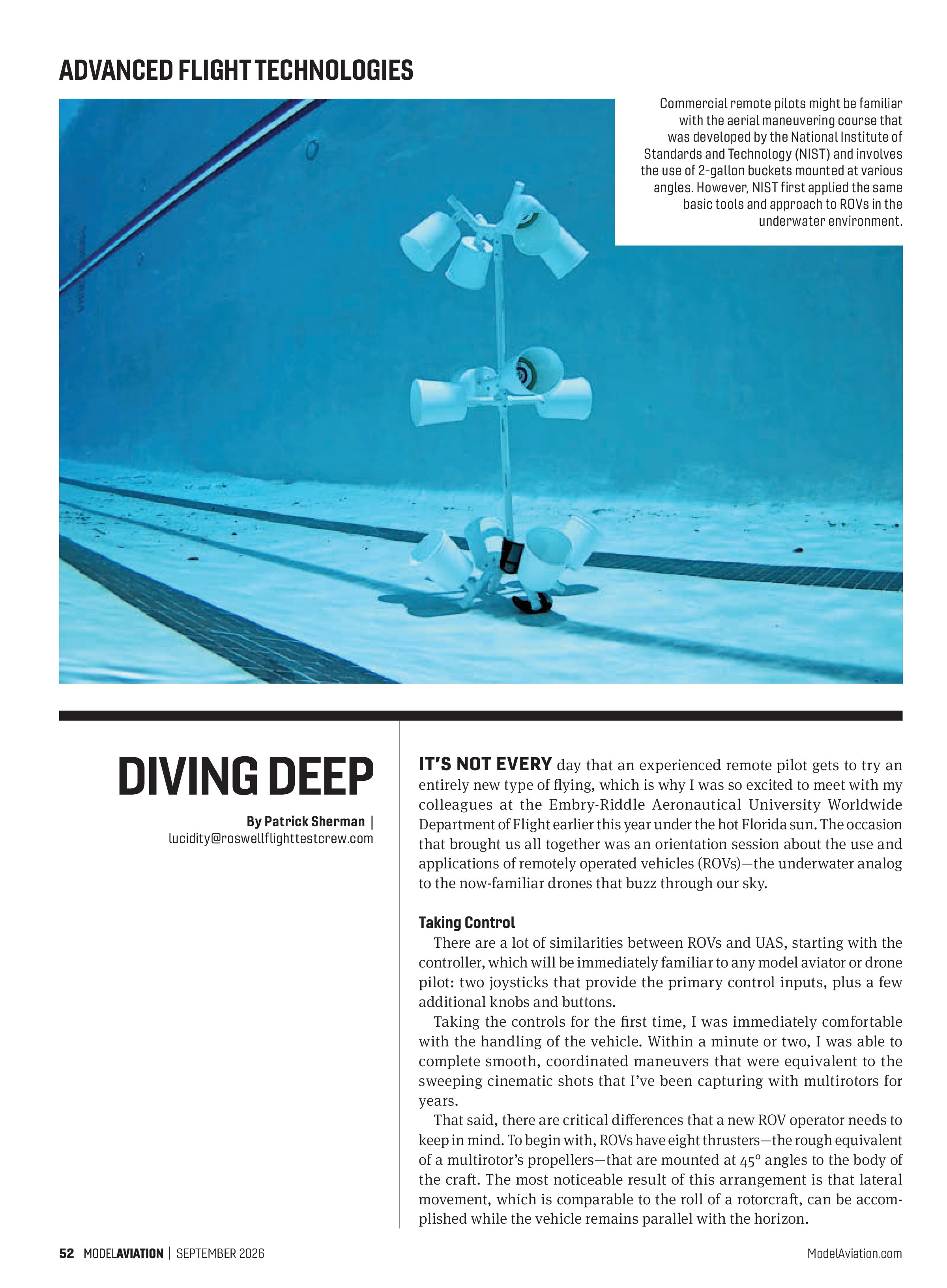
Commercial remote pilots might be familiar with the aerial maneuvering course that was developed by the National Institute of Standards and Technology (NIST) and involves the use of 2-gallon buckets mounted at various angles. However, NIST first applied the same basic tools and approach to ROVs in the underwater environment.
DIVING DEEP
By Patrick Sherman
lucidity@roswellflighttestcrew.com
IT'S NOT EVERY day that an experienced remote pilot gets to try an entirely new type of flying, which is why I was so excited to meet with my colleagues at the Embry-Riddle Aeronautical University Worldwide Department of Flight earlier this year under the hot Florida sun. The occasion that brought us all together was an orientation session about the use and applications of remotely operated vehicles (ROVs)—the underwater analog to the now-familiar drones that buzz through our sky.
Taking Control
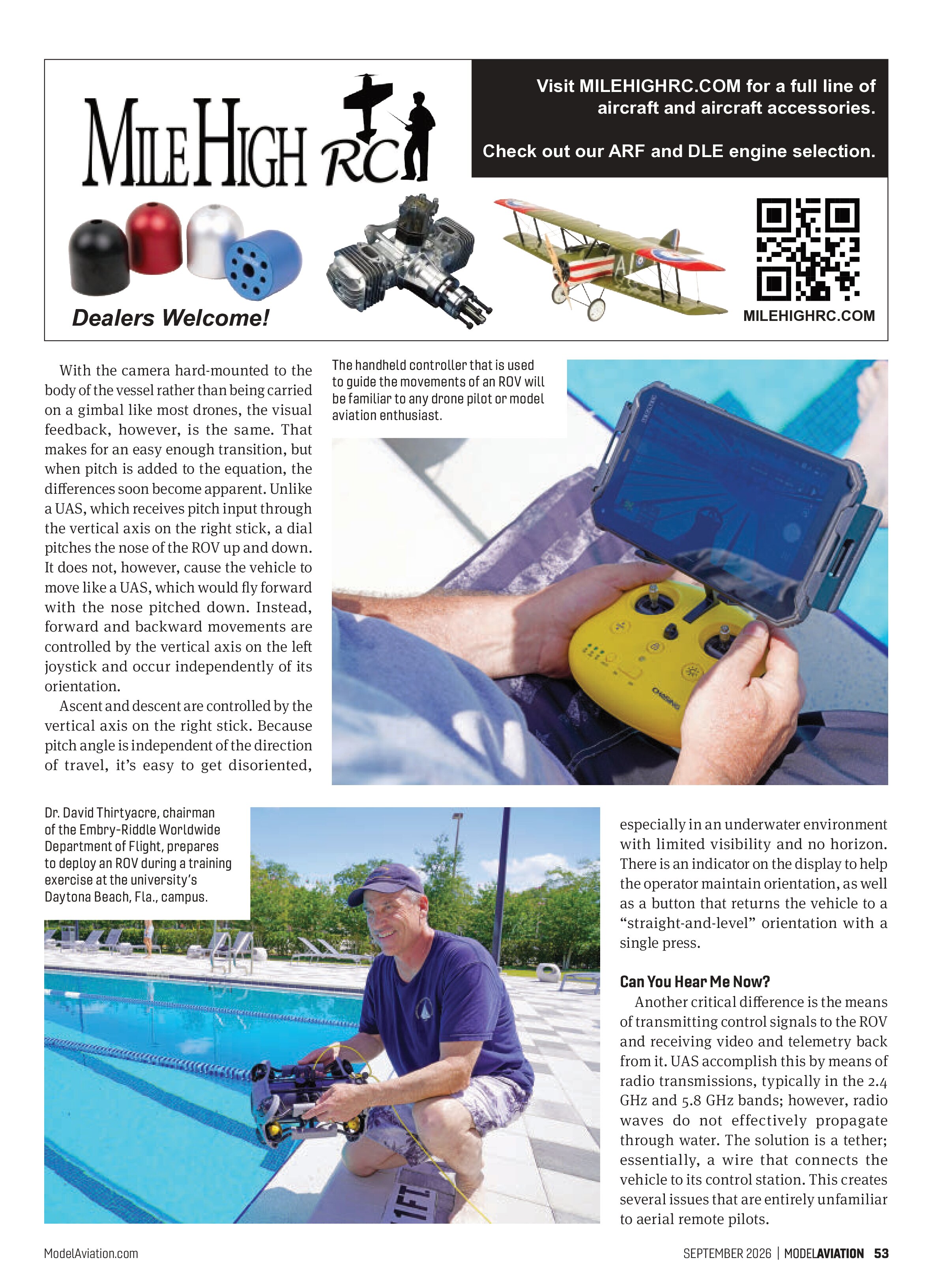
There are a lot of similarities between ROVs and UAS, starting with the controller, which will be immediately familiar to any model aviator or drone pilot: two joysticks that provide the primary control inputs, plus a few additional knobs and buttons.
Taking the controls for the first time, I was immediately comfortable with the handling of the vehicle. Within a minute or two, I was able to complete smooth, coordinated maneuvers that were equivalent to the sweeping cinematic shots that I’ve been capturing with multirotors for years.
That said, there are critical differences that a new ROV operator needs to keep in mind. To begin with, ROVs have eight thrusters—the rough equivalent of a multirotor’s propellers—that are mounted at 45° angles to the body of the craft. The most noticeable result of this arrangement is that lateral movement, which is comparable to the roll of a rotorcraft, can be accomplished while the vehicle remains parallel with the horizon.
With the camera hard-mounted to the body of the vessel rather than being carried on a gimbal like most drones, the visual feedback, however, is the same. That makes for an easy enough transition, but when pitch is added to the equation, the differences soon become apparent. Unlike a UAS, which receives pitch input through the vertical axis on the right stick, a dial pitches the nose of the ROV up and down. It does not, however, cause the vehicle to move like a UAS, which would fly forward with the nose pitched down. Instead, forward and backward movements are controlled by the vertical axis on the left joystick and occur independently of its orientation.
Ascent and descent are controlled by the vertical axis on the right stick. Because pitch angle is independent of the direction of travel, it’s easy to get disoriented,

especially in an underwater environment with limited visibility and no horizon. There is an indicator on the display to help the operator maintain orientation, as well as a button that returns the vehicle to a “straight-and-level” orientation with a single press.
Can You Hear Me Now?
Another critical difference is the means of transmitting control signals to the ROV and receiving video and telemetry back from it. UAS accomplish this by means of radio transmissions, typically in the 2.4 GHz and 5.8 GHz bands; however, radio waves do not effectively propagate through water. The solution is a tether; essentially, a wire that connects the vehicle to its control station. This creates several issues that are entirely unfamiliar to aerial remote pilots.

As a novice ROV operator who was steering a vessel around a swimming pool, the primary application appeared to be to capture imagery, the same as what I have been doing with UAS for the past 16 years. Similar to UAS, though, there are additional applications that are not evident to the new user.
I was specifically astonished to learn that my Embry-Riddle colleagues had succeeded in creating 3D models by using photogrammetry that was derived from images captured using an ROV. Bear in mind that this was accomplished without GPS-driven waypoints or any other form of automated stabilization or route planning—and in an open-water environment with currents and limited visibility.
Another fundamental difference is that ROVs can interact physically with their surroundings in ways that would be an absolute disaster for a UAS. This can include deliberate manipulation involving the use of a robotic claw.
While the price of these units is roughly on par with a high-quality aerial imaging drone and will likely preclude recreational operations for the time being, I’m excited to see what new capabilities and applications they will bring to the undersea environment.


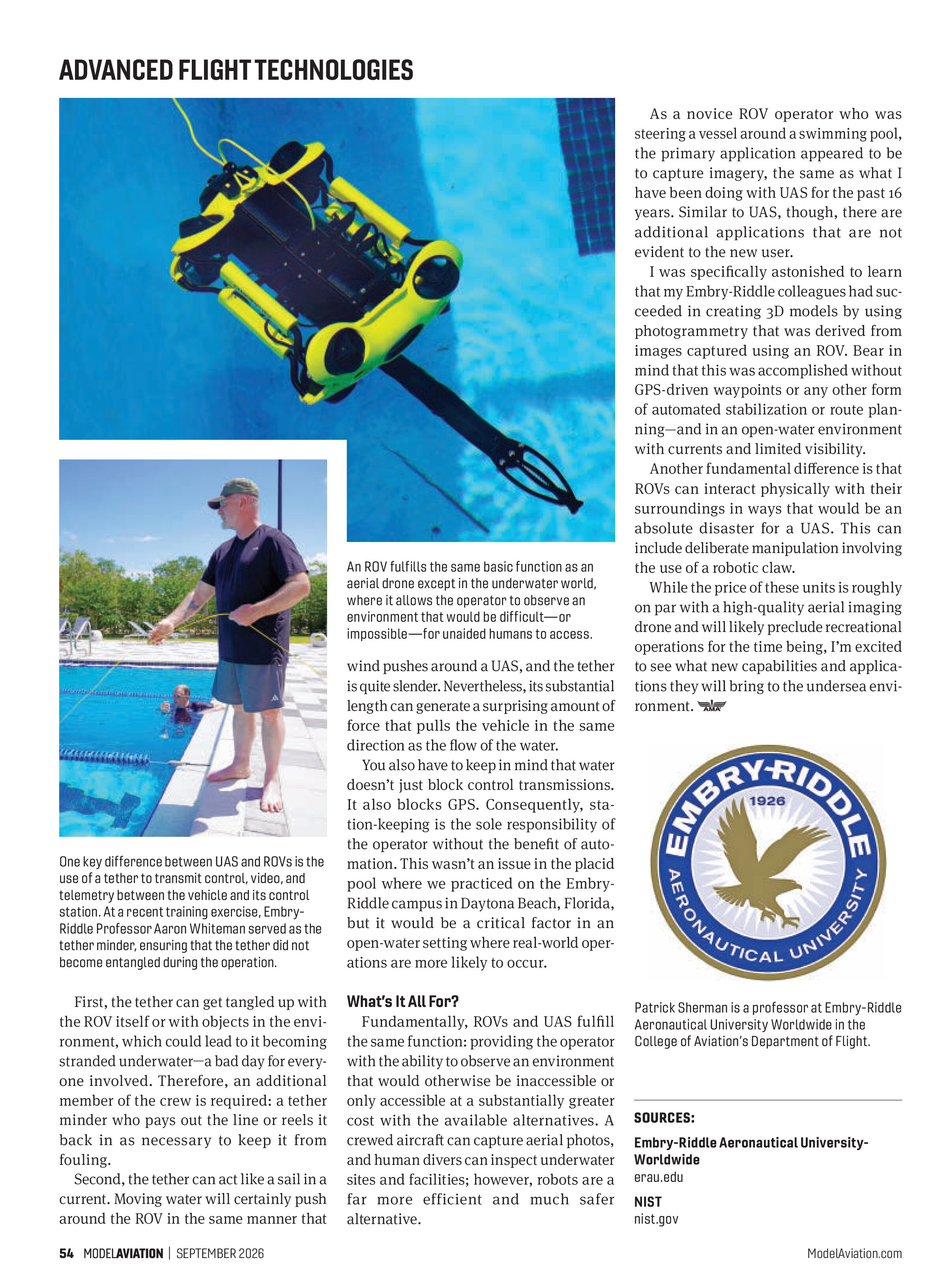
One key difference between UAS and ROVs is the use of a tether to transmit control, video, and telemetry between the vehicle and its control station. At a recent training exercise, Embry-Riddle Professor Aaron Whiteman served as the tether minder, ensuring that the tether did not become entangled during the operation.
First, the tether can get tangled up with the ROV itself or with objects in the environment, which could lead to it becoming stranded underwater—a bad day for everyone involved. Therefore, an additional member of the crew is required: a tether minder who pays out the line or reels it back in as necessary to keep it from fouling.
Second, the tether can act like a sail in a current. Moving water will certainly push around the ROV in the same manner that wind pushes around a UAS, and the tether is quite slender. Nevertheless, its substantial length can generate a surprising amount of force that pulls the vehicle in the same direction as the flow of the water.
You also have to keep in mind that water doesn’t just block control transmissions. It also blocks GPS. Consequently, station-keeping is the sole responsibility of the operator without the benefit of automation. This wasn’t an issue in the placid pool where we practiced on the Embry-Riddle campus in Daytona Beach, Florida, but it would be a critical factor in an open-water setting where real-world operations are more likely to occur.
What’s It All For?
Fundamentally, ROVs and UAS fulfill the same function: providing the operator with the ability to observe an environment that would otherwise be inaccessible or only accessible at a substantially greater cost with the available alternatives. A crewed aircraft can capture aerial photos, and human divers can inspect underwater sites and facilities; however, robots are a far more efficient and much safer alternative.
Patrick Sherman is a professor at Embry-Riddle Aeronautical University Worldwide in the College of Aviation’s Department of Flight.
SOURCES:
Embry-Riddle Aeronautical University-Worldwide
erau.edu
NIST
nist.gov