SMALL-FIELD FLYING

WITH SUMMER UPON us, flying season is in full swing. Here in the high desert, we tend to fly in the cool of the morning, and by the heat of the day, we’re back inside taking care of those minor bumps, bruises, and other things that might need our attention to keep the flying stock in good working order.
It’s also a good time to do a little research in preparation for the future projects that we’re thinking about for the winter building season. Being that it’s never too late to learn, it’s always fun to take a break and maybe look in on a video or two that covers an area of the hobby that we’re interested in and might like to know more about.
Personally, I do a fair amount of research online, but I’ve never been a video “binge watcher,” and I often avoid long videos and dissertations completely; however, my good friend, Stan Johnson, sent over a video about Cox Models, and since I’m in the generation that grew up with the sounds and smells of those little Cox screamers, I thought it might be worth a look.
Despite the fact that the video is a little more than an hour long, I could not walk away. It’s very well done and is full of insights into the evolution of the hobby from where we were in the 1950s and 1960s until now. Having grown up in that era, I was one of those schoolyard fliers, and it’s an era that I’m glad I did not miss. You can find the link to the video in “Sources.”
Ironically, my first experience with park flyers was with the Comet 54-inch Taylorcraft, which was converted to three-channel RC and powered by a Cox Queen Bee .074 engine. Up at 5,600 feet, the model was grossly underpowered, but I probably learned more about flying RC airplanes from that model than all of the others combined.
The next airplane was the Golden Age Reproductions 24-inch wingspan Fleet PT-11 trainer that was converted to two-channel RC and powered by a non-throttled Babe Bee .049 engine.
In the Free Flight (FF) realm, the Pacific Ace 30 still sports the Tee Dee .010 engine that it was flown on for several years. The Golden Bee .049 engine that powered the Veco Little Tomahawk that taught me to fly U-Control (Control Line) in 1964 now resides in a Goldberg Little Toot biplane. The Little Tomahawk, Taylorcraft, and the Fleet PT-11 have long since passed on, but I still have the Queen Bee that spewed caster oil, which was the Taylorcraft’s ultimate undoing. All that remains of the Fleet is the homemade fiberglass cowling and its William’s Brothers dummy radial engine cylinders. Beyond that, only fond memories remain.
Back to the Present
The readers have been busy with some interesting models, as well as ideas and offshoots of things that have been mentioned in the column.
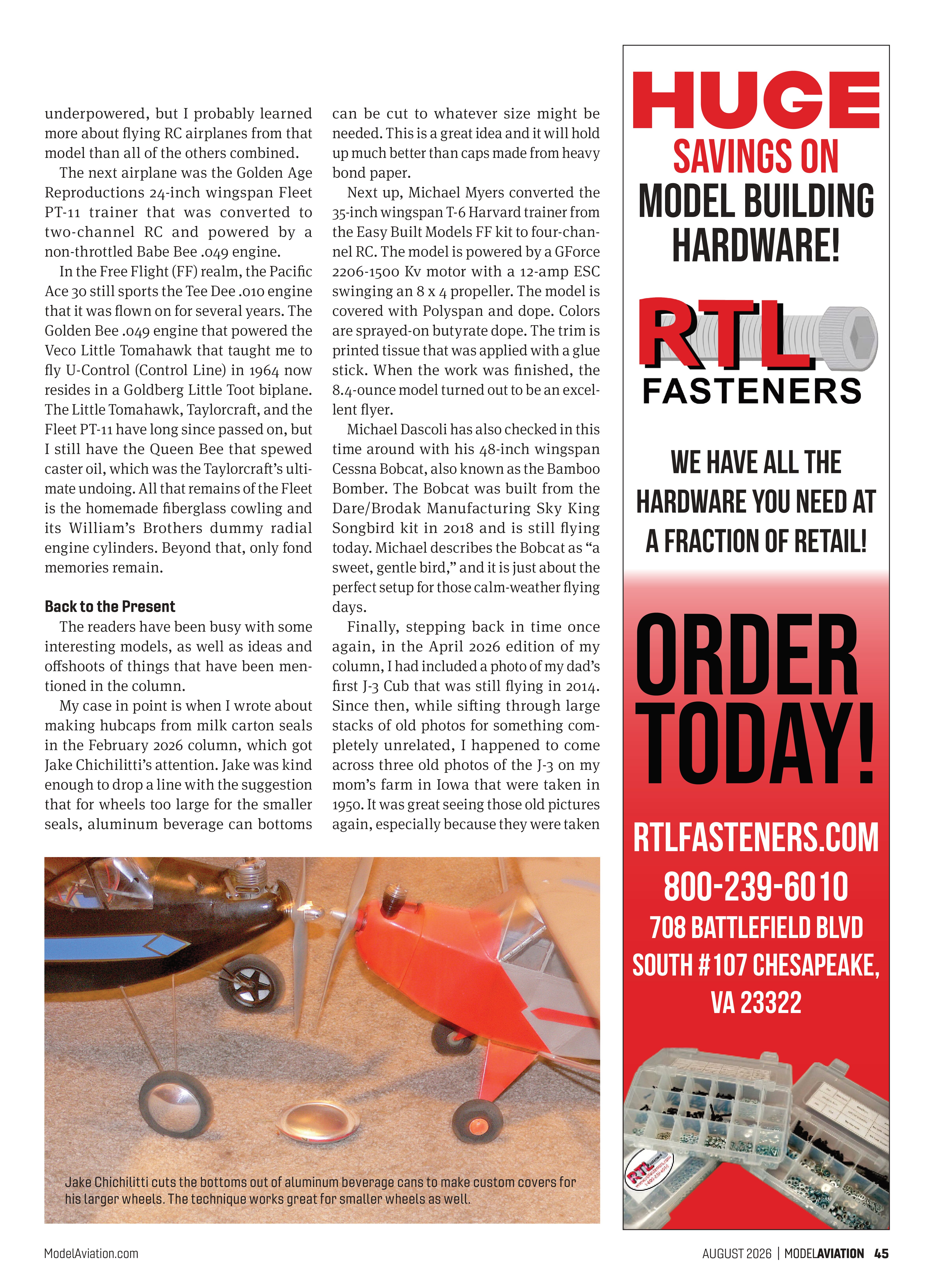
My case in point is when I wrote about making hubcaps from milk carton seals in the February 2026 column, which got Jake Chichilitti’s attention. Jake was kind enough to drop a line with the suggestion that for wheels too large for the smaller seals, aluminum beverage can bottoms can be cut to whatever size might be needed. This is a great idea and it will hold up much better than caps made from heavy bond paper.
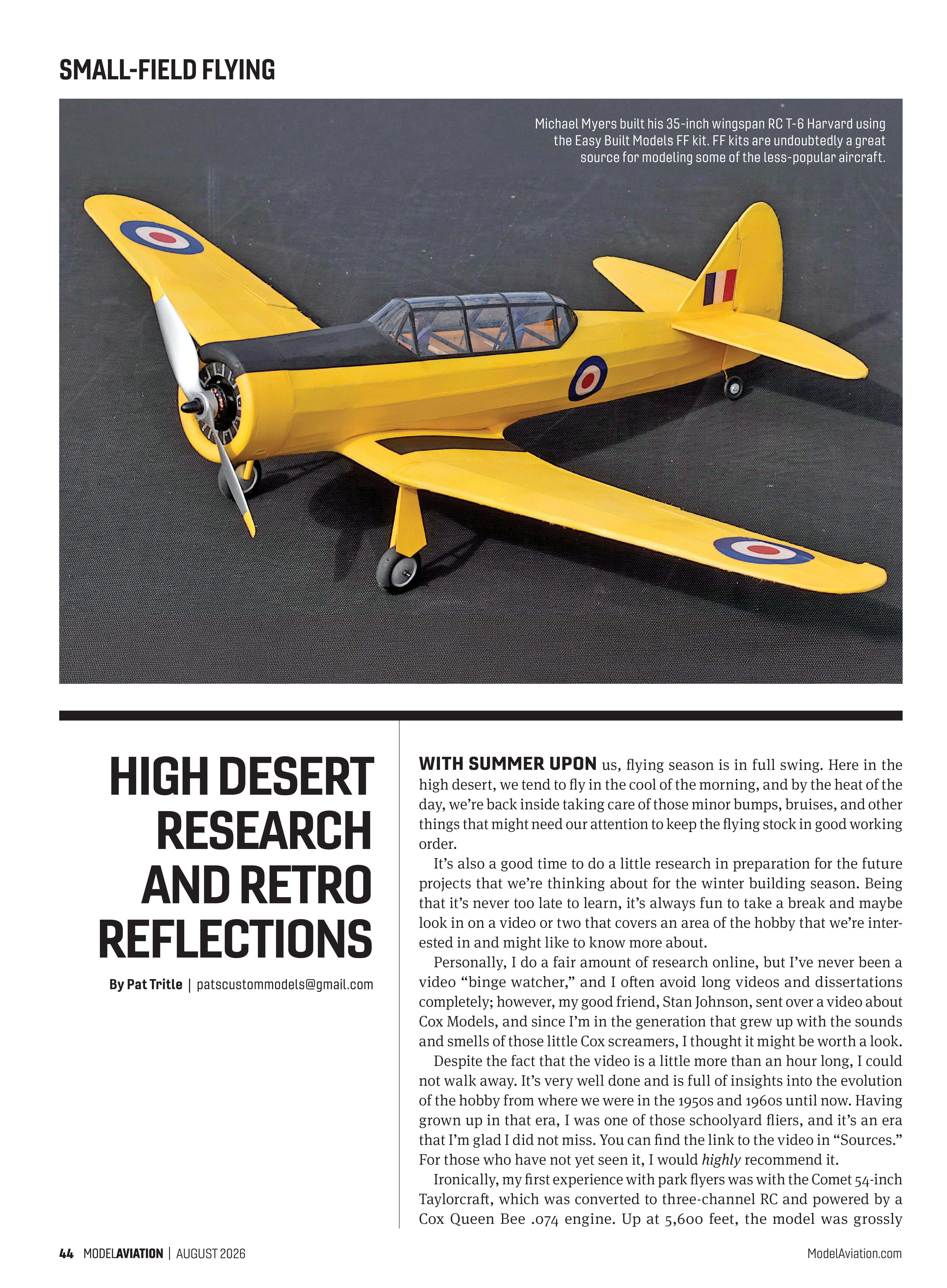
Next up, Michael Myers converted the 35-inch wingspan T-6 Harvard trainer from the Easy Built Models FF kit to four-channel RC. The model is powered by a GForce 2206-1500 Kv motor with a 12-amp ESC swinging an 8 x 4 propeller. The model is covered with Polyspan and dope. Colors are sprayed-on butyrate dope. The trim is printed tissue that was applied with a glue stick. When the work was finished, the 8.4-ounce model turned out to be an excellent flyer.
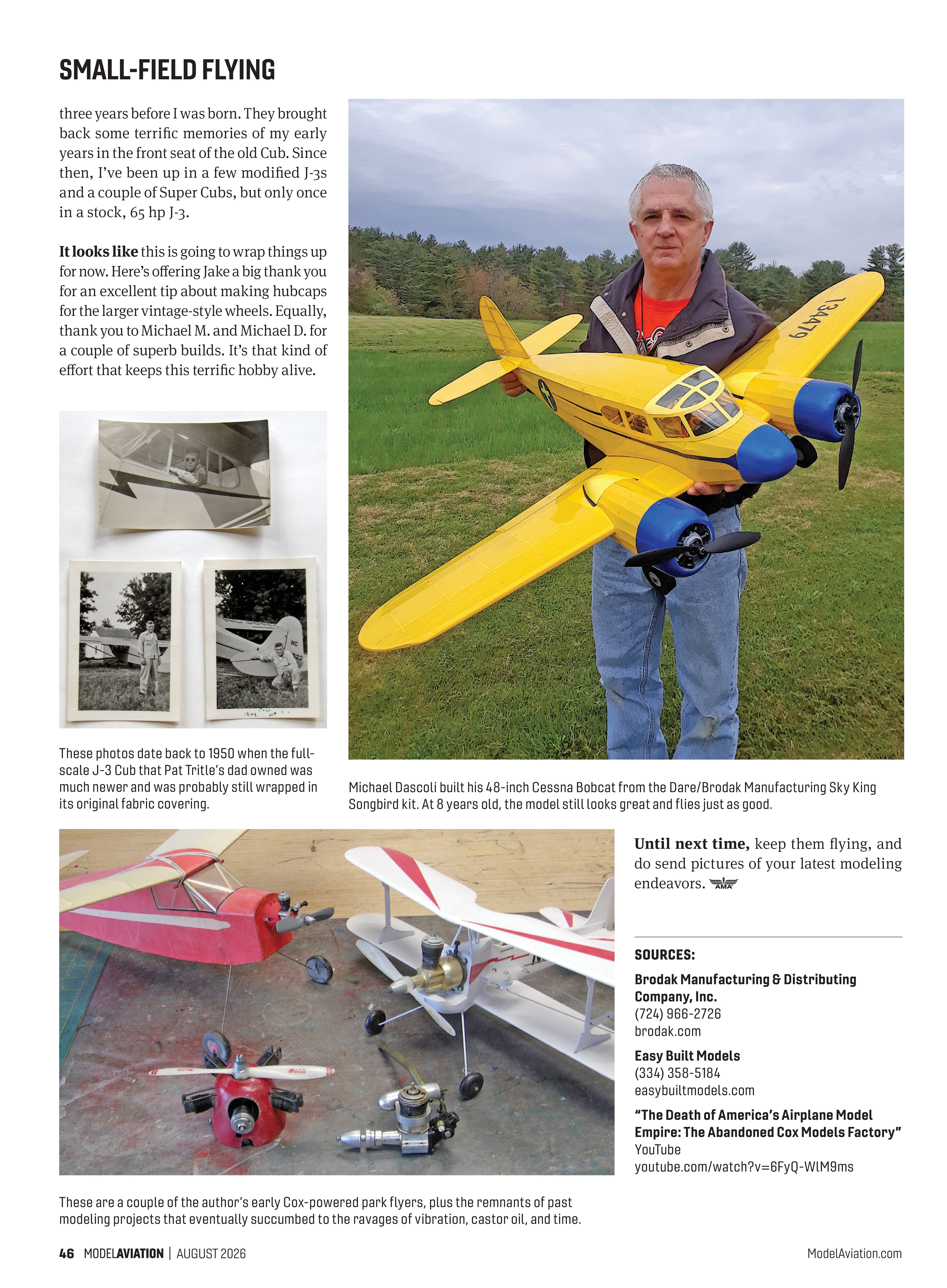
Michael Dascoli has also checked in this time around with his 48-inch wingspan Cessna Bobcat, also known as the Bamboo Bomber. The Bobcat was built from the Dare/Brodak Manufacturing Sky King Songbird kit in 2018 and is still flying today. Michael describes the Bobcat as “a sweet, gentle bird,” and it is just about the perfect setup for those calm-weather flying days.

Jake Chichilitti cuts the bottoms out of aluminum beverage cans to make custom covers for his larger wheels. The technique works great for smaller wheels as well.
three years before I was born. They brought back some terrific memories of my early years in the front seat of the old Cub. Since then, I’ve been up in a few modified J-3s and a couple of Super Cubs, but only once in a stock, 65 hp J-3.
It looks like this is going to wrap things up for now. Here’s offering Jake a big thank you for an excellent tip about making hubcaps for the larger vintage-style wheels. Equally, thank you to Michael M. and Michael D. for a couple of superb builds. It’s that kind of effort that keeps this terrific hobby alive.


Until next time, keep them flying, and do send pictures of your latest modeling endeavors.

SOURCES:
Brodak Manufacturing & Distributing Company, Inc.
(724) 966-2726
brodak.com
Easy Built Models
(334) 358-5184
easybuiltmodels.com
"The Death of America's Airplane Model Empire: The Abandoned Cox Models Factory"
YouTube
youtube.com/watch?v=6FyQ-WlM9ms