RC SCALE AEROBATICS

EDUCATIONAL RESOURCES AND PREPARATION BASICS
By John Glezellis | jglezellis@gmail.com
IN MY LAST DISCUSSION, I examined a few ways in which pilots can prepare for an International Miniature Aerobatic Club (IMAC) competition—specifically how you can learn a given routine, the roles and responsibilities of a caller, and the benefits that a modern radio system can have to serve as a substitute caller should the need arise.
This month, I will continue to explore how you can prepare for a given aerobatic competition. I will begin by looking at a few educational resources that exist and can be leveraged, in addition to a few strategies that pilots can implement within their daily routine to ensure that they are prepared to the maximum extent on the day of an event.
Without further delay, let’s get started!
Educational Resources
Throughout the years, the official IMAC website has always contained valuable information regarding the schedules that are being flown, the rules in which all competitors are judged against, contest calendars, and certain guides with respect to learning Aresti, only to name a few.
I recently came across a few items that are of tremendous value, such as a presentation of the 2026 Basic schedule. This presentation is unique because it contains individual pages that are devoted to each figure flown and includes a written description for each maneuver, which is beneficial for those who are learning Aresti and how to interpret each element of a figure.
wing and stabilizer half is secured, and all preflight activities have been completed. When the temperature is high, I keep the fuel tank empty and the fuel source in the shade until I am a few pilots away from my flight to prevent hot fuel from being supplied to the carburetor, which will become an issue.
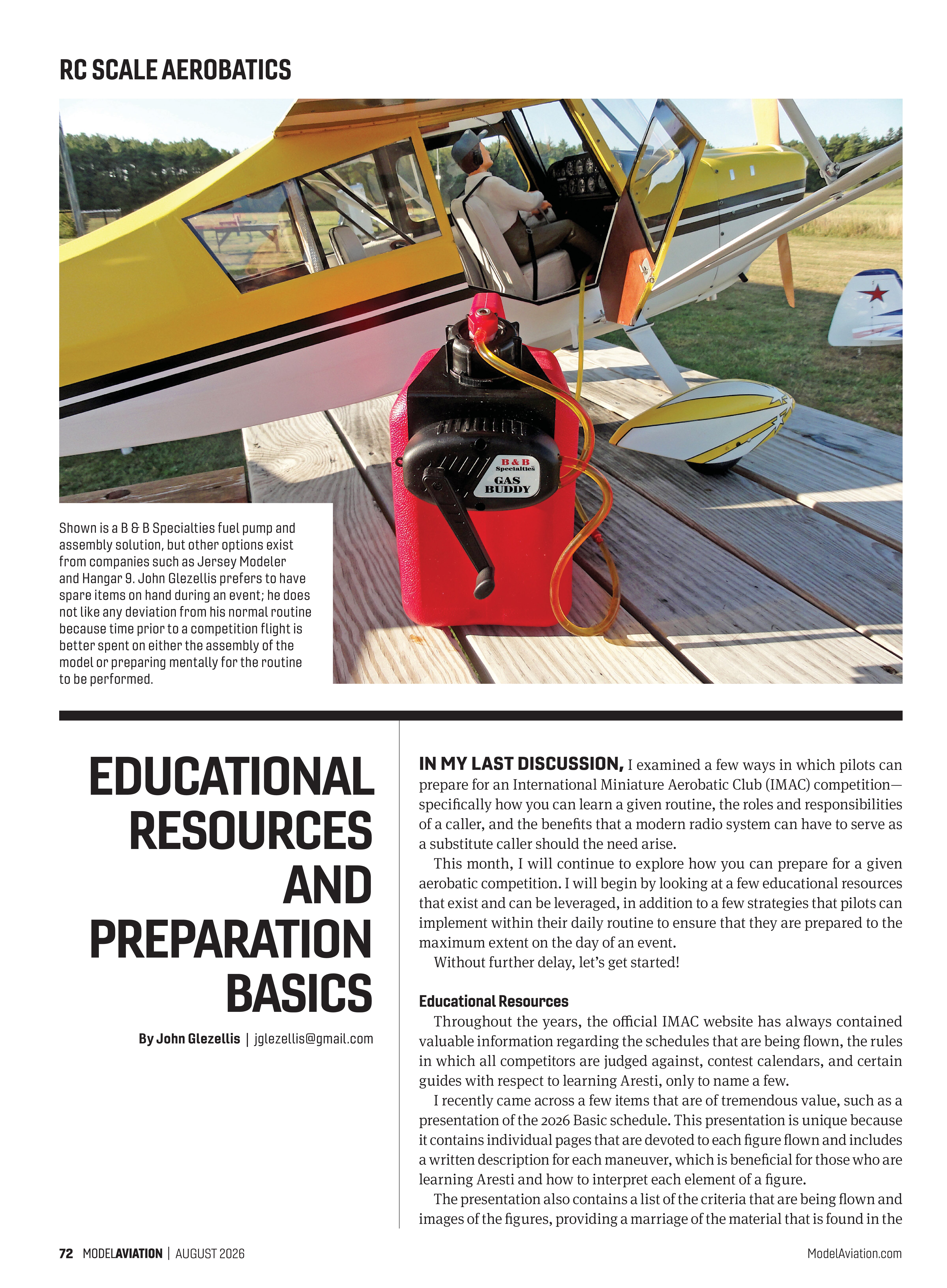
Jersey Modeler offers a few different electronic and manual pump options for kerosene/diesel, glow, smoke, and gas. I urge that if you are using an electronic pump, have a manual pump as a spare in case it fails at the field or competition site. Similarly, even if you are using a manual pump as the main pump, have a spare.
Other options are the Hangar 9 Ultra Fuel Pump, which is designed for gas and glow fuels, or offerings from B & B Specialites, LLC. Regardless of the pump being used, ensure that it is suitable for the fuel source at hand.
I prefer to have spare items on hand during an event because I tend to be very procedural and I do not like any deviation from my normal routine. In other words, I do not want to spend valuable time working to track down another fuel pump when that time is better spent on the assembly of the aircraft and mental preparation for the sequence at hand.
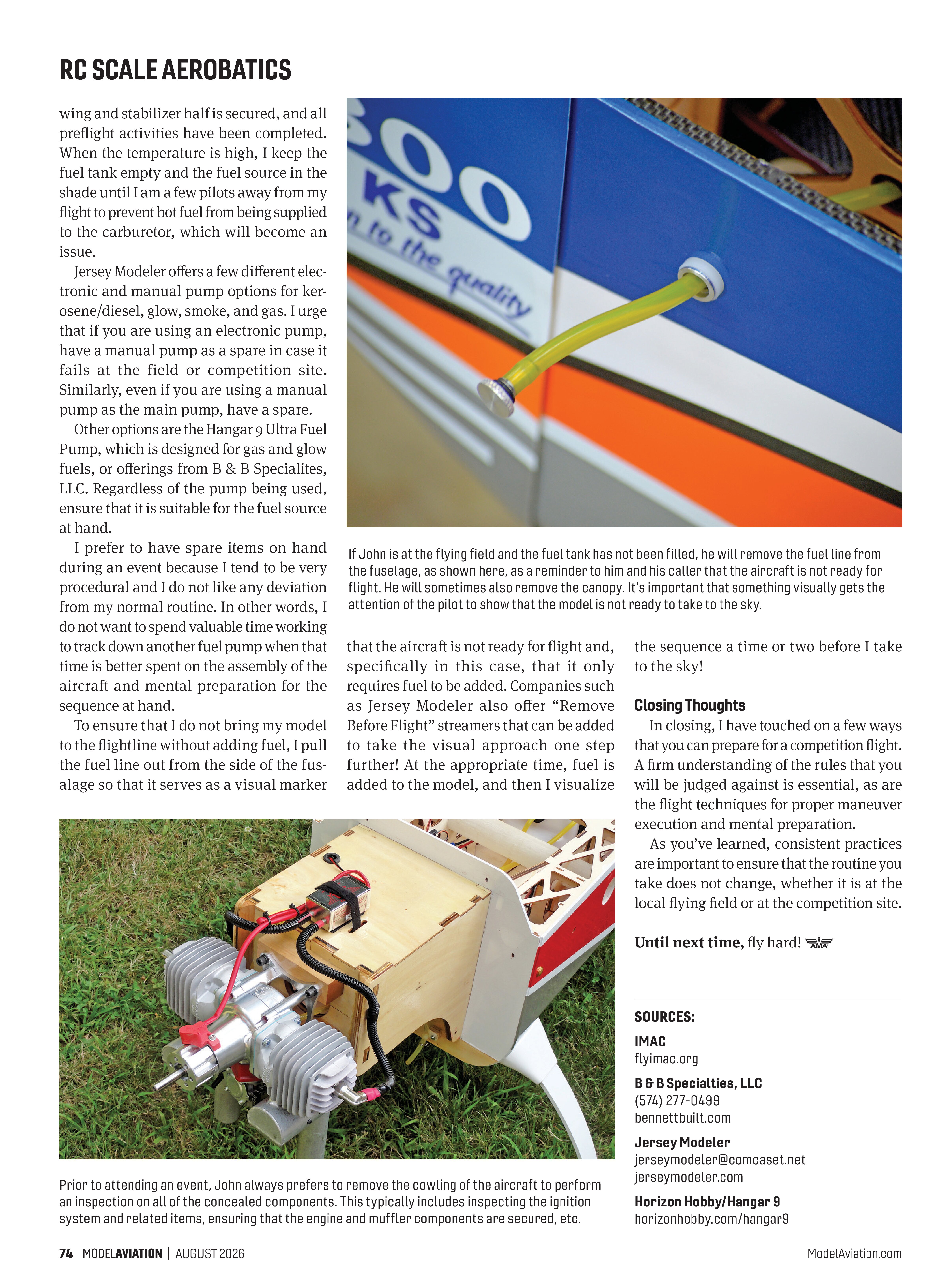
To ensure that I do not bring my model to the flightline without adding fuel, I pull the fuel line out from the side of the fuselage so that it serves as a visual marker

If John is at the flying field and the fuel tank has not been filled, he will remove the fuel line from the fuselage, as shown here, as a reminder to him and his caller that the aircraft is not ready for flight. He will sometimes also remove the canopy. It's important that something visually gets the attention of the pilot to show that the model is not ready to take to the sky.
that the aircraft is not ready for flight and, specifically in this case, that it only requires fuel to be added. Companies such as Jersey Modeler also offer “Remove Before Flight” streamers that can be added to take the visual approach one step further! At the appropriate time, fuel is added to the model, and then I visualize the sequence a time or two before I take to the sky!
Closing Thoughts
In closing, I have touched on a few ways that you can prepare for a competition flight. A firm understanding of the rules that you will be judged against is essential, as are the flight techniques for proper maneuver execution and mental preparation.
As you've learned, consistent practices are important to ensure that the routine you take does not change, whether it is at the local flying field or at the competition site.
Until next time, fly hard!

Prior to attending an event, John always prefers to remove the cowling of the aircraft to perform an inspection on all of the concealed components. This typically includes inspecting the ignition system and related items, ensuring that the engine and muffler components are secured, etc.