THE ADVENTUROUS LIFE OF FRANK ZAIC
By Bob Angel | samrcflier@verizon.net

HERE'S A FAMILIAR name among Old-Timer modelers: Frank Zaic (August 1, 1912 to May 27, 2005). His life and career were so extensive and varied that I must confess that I didn't have to look much beyond his combined 23-page AMA History Project biography/autobiography to prepare this limited sketch of his life.
I had the privilege of meeting and chatting with Frank in person only once when he stopped by the Society of Antique Modelers (SAM) booth and introduced himself during one of AMA's modeling exhibitions in Pasadena, California. At the time, he was planning his final move from California to Guatemala, where he and his wife, Carmen, retired. He was a modest, soft-spoken gentleman.
A partial list of his honors and awards includes Hall of Fame inductions into AMA, the National Free Flight Society (NFFS), SAM, and Kits and Plans Antiquious (KAPA). Incidentally, KAPA faded into history some years back, but its brother organization, the Model Engine Collectors Association (MECA), remains smaller but active.
Frank and Lt. H.W. Alden started publication of Model Aviation in 1935, and in 1936, Frank was one of the founders of AMA. He was a member of the US Wakefield teams in 1934 and 1935, and in 1937, he flew in the Wakefield event while also serving as the team's manager. He managed the team again in 1939. He also designed AMA's torch and wings logo, which you can find still in use today.
Today, Frank's best remembered through his extensive writings in Model Aviation and other periodicals. I've accumulated 10 of his almost-annual writings...
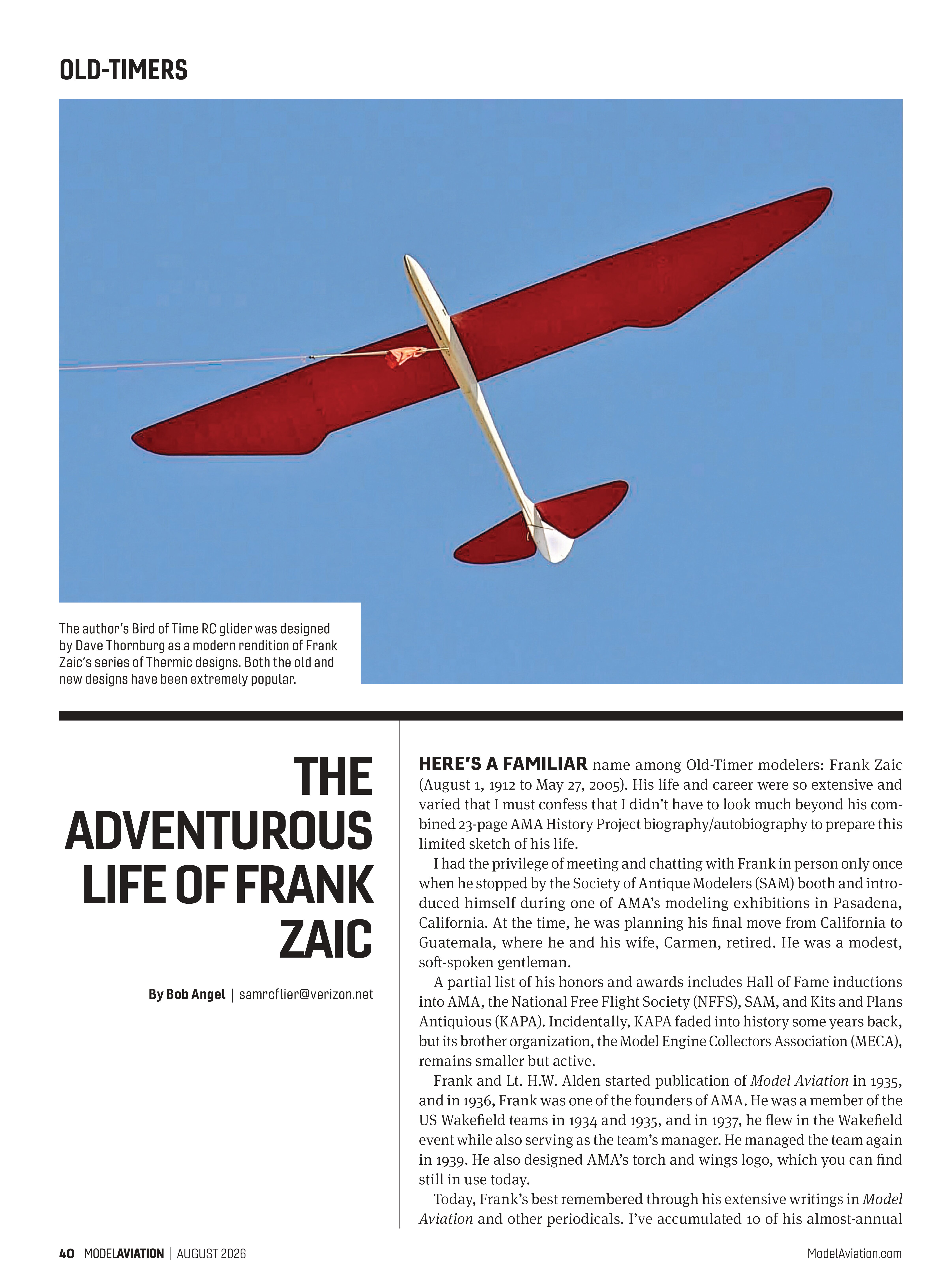
The author's Bird of Time RC glider was designed by Dave Thornburg as a modern rendition of Frank Zaic's series of Thermic designs. Both the old and new designs have been extremely popular.

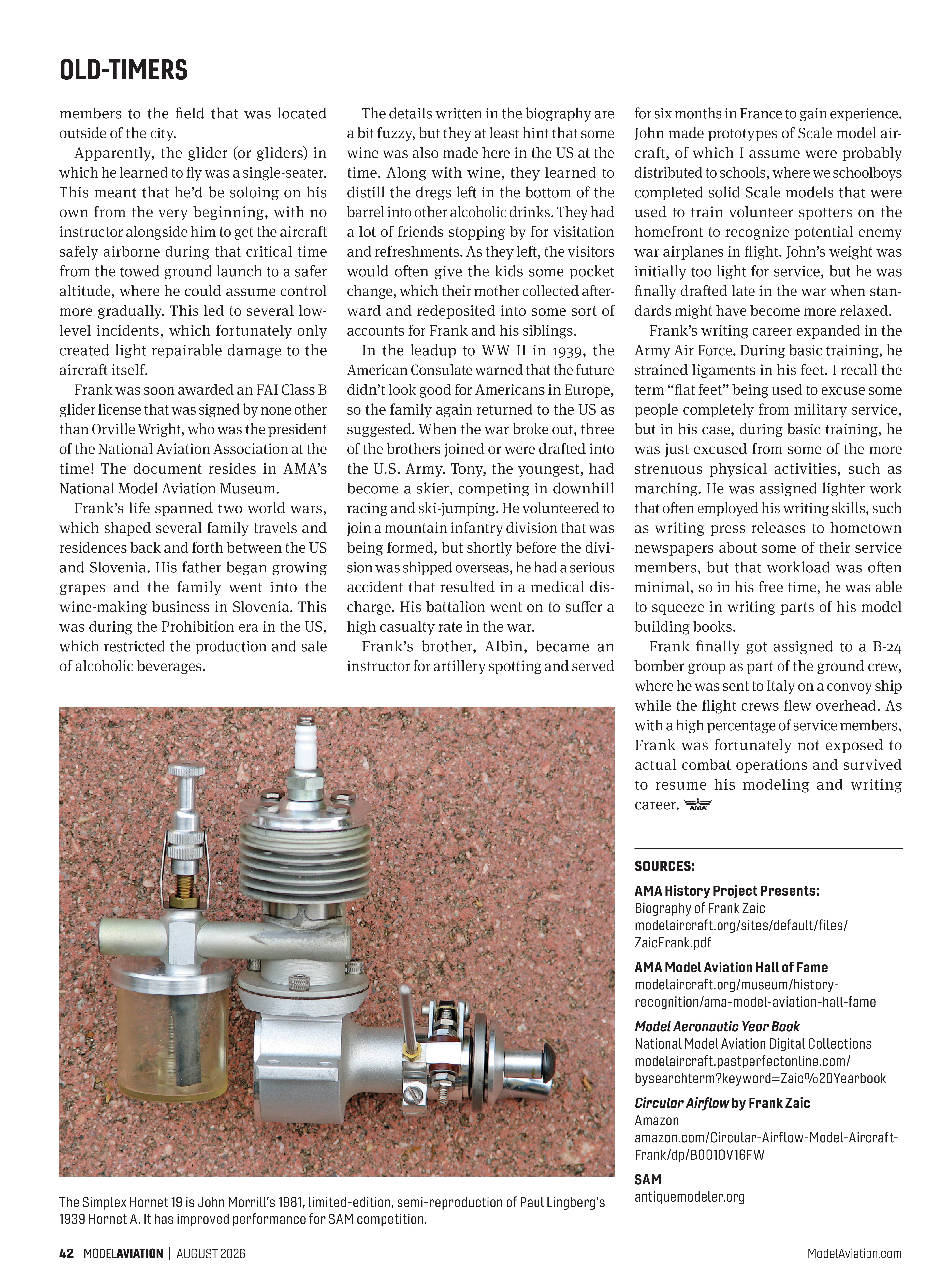
The large and small of it: The 1935 Forster .99 is barely under 1 cu. in. The 1940s Super Atom .09 closes in at just 1/10 cu. in.
members to the field that was located outside of the city.
Apparently, the glider (or gliders) in which he learned to fly was a single-seater. This meant that he'd be soloing on his own from the very beginning, with no instructor alongside him to get the aircraft safely airborne during that critical time from the towed ground launch to a safer altitude, where he could assume control more gradually. This led to several low-level incidents, which fortunately only created light repairable damage to the aircraft itself.
Frank was soon awarded an FAI Class B glider license that was signed by none other than Orville Wright, who was the president of the National Aviation Association at the time! The document resides in AMA's National Model Aviation Museum.
Frank's life spanned two world wars, which shaped several family travels and residences back and forth between the US and Slovenia. His father began growing grapes and the family went into the wine-making business in Slovenia. This was during the Prohibition era in the US, which restricted the production and sale of alcoholic beverages.
The details written in the biography are a bit fuzzy, but they at least hint that some wine was also made here in the US at the time. Along with wine, they learned to distill the dregs left in the bottom of the barrel into other alcoholic drinks. They had a lot of friends stopping by for visitation and refreshments. As they left, the visitors would often give the kids some pocket change, which their mother collected afterward and redeposited into some sort of accounts for Frank and his siblings.
In the leadup to WW II in 1939, the American Consulate warned that the future didn't look good for Americans in Europe, so the family again returned to the US as suggested. When the war broke out, three of the brothers joined or were drafted into the U.S. Army. Tony, the youngest, had become a skier, competing in downhill racing and ski-jumping. He volunteered to join a mountain infantry division that was being formed, but shortly before the division was shipped overseas, he had a serious accident that resulted in a medical discharge. His battalion went on to suffer a high casualty rate in the war.
Frank's brother, Albin, became an instructor for artillery spotting and served for six months in France to gain experience. John made prototypes of Scale model aircraft, of which I assume were probably distributed to schools, where we schoolboys completed solid Scale models that were used to train volunteer spotters on the homefront to recognize potential enemy war airplanes in flight. John's weight was initially too light for service, but he was finally drafted late in the war when standards might have become more relaxed.
Frank's writing career expanded in the Army Air Force. During basic training, he strained ligaments in his feet. I recall the term "flat feet" being used to excuse some people completely from military service, but in his case, during basic training, he was just excused from some of the more strenuous physical activities, such as marching. He was assigned lighter work that often employed his writing skills, such as writing press releases to hometown newspapers about some of their service members, but that workload was often minimal, so in his free time, he was able to squeeze in writing parts of his model building books.
Frank finally got assigned to a B-24 bomber group as part of the ground crew, where he was sent to Italy on a convoy ship while the flight crews flew overhead. As with a high percentage of service members, Frank was fortunately not exposed to actual combat operations and survived to resume his modeling and writing career.