THE DT

By Don DeLoach | dadl72@gmail.com
UNTIL THE EARLY 1940S, it was common for Free Flight (FF) models to fly out of sight while in thermals. In fact, it was rare for modelers to even give such flights a second thought. According to legendary AMA Hall of Famer Chet Lanzo, "We just became fast builders." Chet once wrote that a typical contest weekend meant arriving with twice as many models as he left with. By the mid-1940s, with increasing model performance and the institution of maximum (or max) flight times in AMA contests, flying for dozens of minutes was no longer the goal. The time for dethermalizers (DTs) had come.
The idea behind the DT is to completely stall the model and have it drop out of lift rapidly—at approximately 10 feet per second. This almost always breaks the model out of even the strongest lift and returns it to the ground within 2 or so minutes.
The first DTs were popout rudder tabs that spun models out of thermals. These tabs sometimes worked too well, resulting in damage from hard landings. Parachutes that were deployed by a fuse or a timer were also tried, with some success. The popup stabilizer DT eventually followed and has continued to this day as the most common DT arrangement.
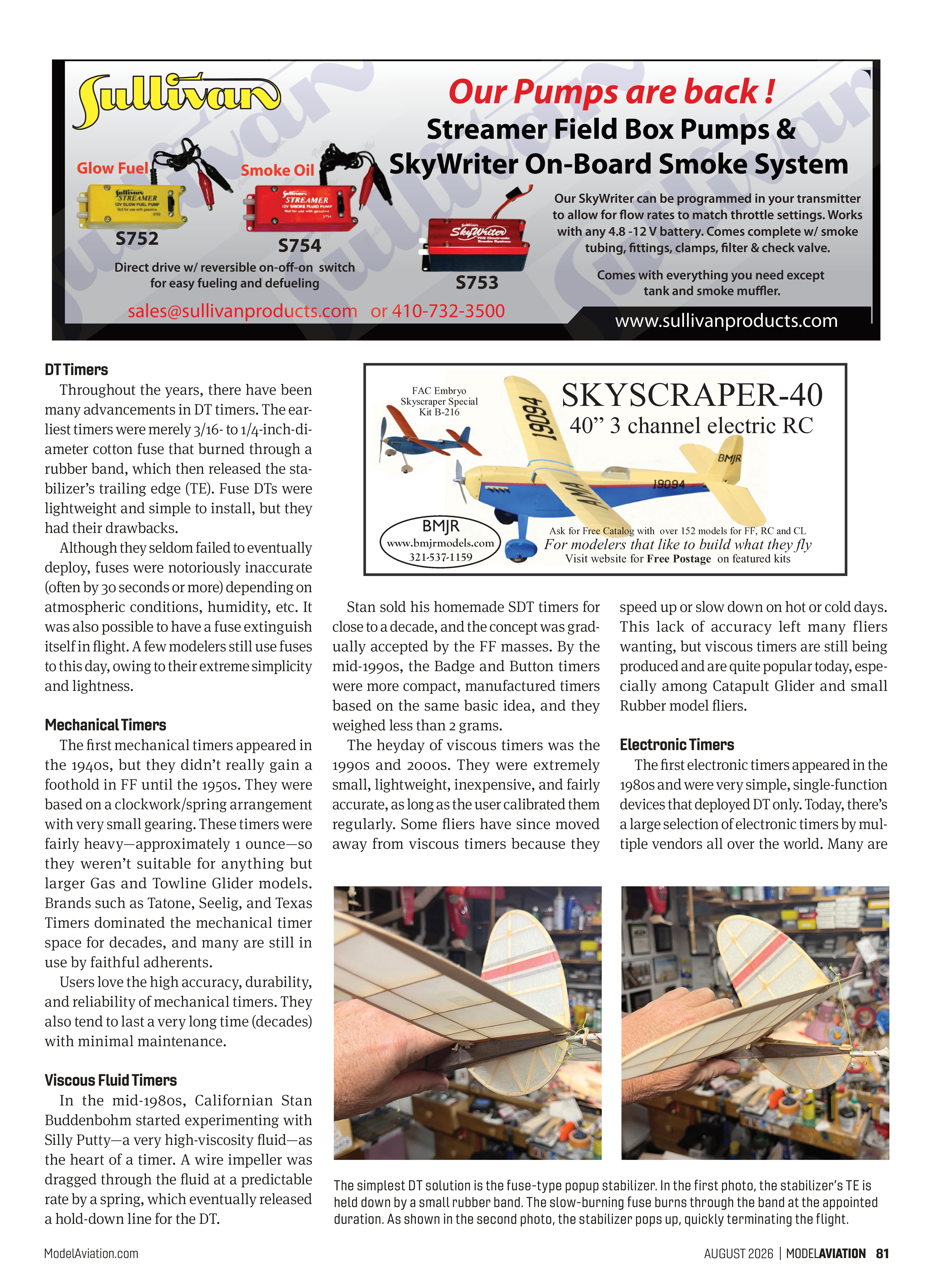
In this type of DT, the stabilizer is held down on the front and rear by rubber bands in tension. When a fuse or timer releases the rear hold-down band, the stabilizer rises up to a -35° to -45° angle, putting the model in a deep stall and dropping it safely out of the thermal.
DT Timers
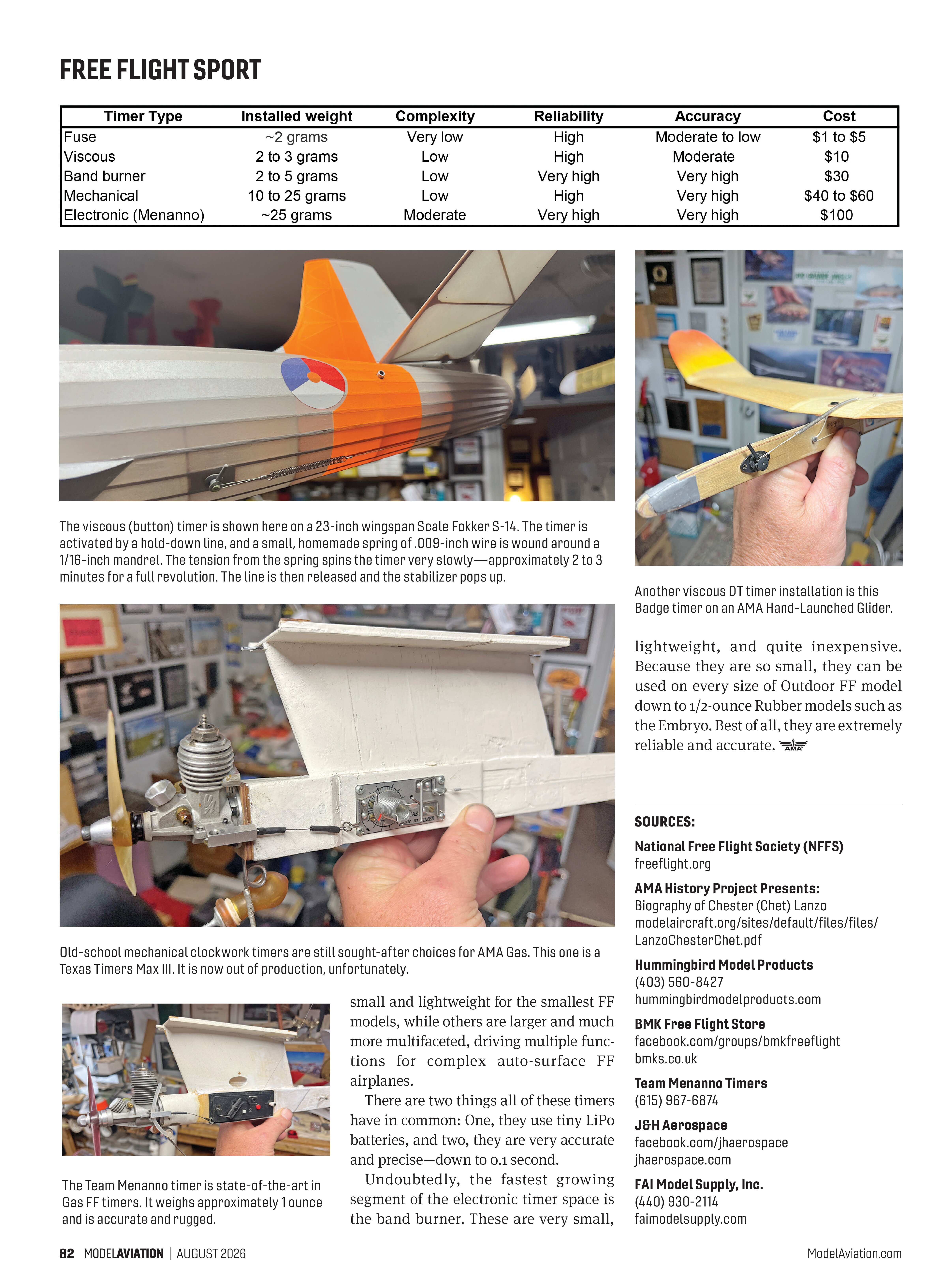
Throughout the years, there have been many advancements in DT timers. The earliest timers were merely 3/16- to 1/4-inch-diameter cotton fuse that burned through a rubber band, which then released the stabilizer’s trailing edge (TE). Fuse DTs were lightweight and simple to install, but they had their drawbacks.
Although they seldom failed to eventually deploy, fuses were notoriously inaccurate (often by 30 seconds or more) depending on atmospheric conditions, humidity, etc. It was also possible to have a fuse extinguish itself in flight. A few modelers still use fuses to this day, owing to their extreme simplicity and lightness.
Mechanical Timers
The first mechanical timers appeared in the 1940s, but they didn’t really gain a foothold in FF until the 1950s. They were based on a clockwork/spring arrangement with very small gearing. These timers were fairly heavy—approximately 1 ounce—so they weren’t suitable for anything but larger Gas and Towline Glider models. Brands such as Tatone, Seelig, and Texas Timers dominated the mechanical timer space for decades, and many are still in use by faithful adherents.
Viscous Fluid Timers
In the mid-1980s, Californian Stan Buddenbohm started experimenting with Silly Putty—a very high-viscosity fluid—as the heart of a timer. A wire impeller was dragged through the fluid at a predictable rate by a spring, which eventually released a hold-down line for the DT.
Electronic Timers
The first electronic timers appeared in the 1980s and were very simple, single-function devices that deployed DT only. Today, there’s a large selection of electronic timers by multiple vendors all over the world. Many are small, lightweight, inexpensive, and fairly accurate, as long as the user calibrated them regularly.
The viscous (button) timer is shown here on a 23-inch wingspan Scale Fokker S-14. The timer is activated by a hold-down line, and a small, homemade spring of .009-inch wire is wound around a 1/16-inch mandrel. The tension from the spring spins the timer very slowly—approximately 2 to 3 minutes for a full revolution. The line is then released and the stabilizer pops up.


Another viscous DT timer installation is this Badge timer on an AMA Hand-Launched Glider.
Old-school mechanical clockwork timers are still sought-after choices for AMA Gas. This one is a Texas Timers Max III. It is now out of production, unfortunately.

The Team Menanno timer is state-of-the-art in Gas FF timers. It weighs approximately 1 ounce and is accurate and rugged.

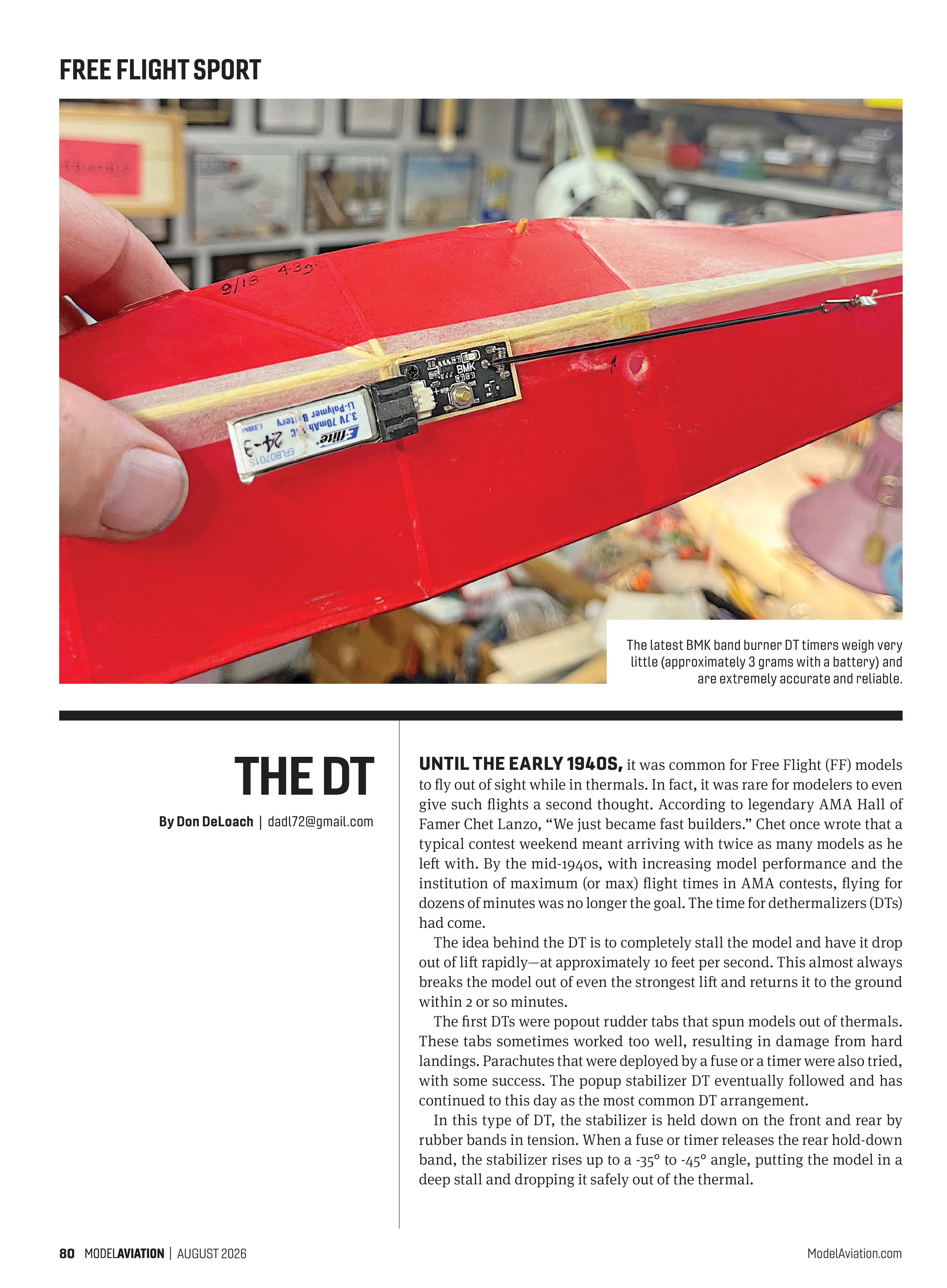
lightweight, and quite inexpensive. Because they are so small, they can be used on every size of Outdoor FF model down to 1/2-ounce Rubber models such as the Embryo. Best of all, they are extremely reliable and accurate.
small and lightweight for the smallest FF models, while others are larger and much more multifaceted, driving multiple functions for complex auto-surface FF airplanes.
There are two things all of these timers have in common: One, they use tiny LiPo batteries, and two, they are very accurate and precise—down to 0.1 second.
Undoubtedly, the fastest growing segment of the electronic timer space is the band burner.