ELECTRICS
By Terry Dunn | terrydunn74@gmail.com

A FEW OUTSTANDING ELECTRIC MODELS
I RECENTLY HAD the opportunity to fly several new electric-powered models. I thought that three of them were especially unique and fun. These models come from smaller companies and are not necessarily on everyone’s radar. They are all worthy of notice, so I want to shine a spotlight on them here.
13th Squadron Bf 109
In my October 2025 “Electrics” column, I mentioned the first kit release from the upstart RC company 13th Squadron. The kit is a Scale model of the famous Messerschmitt Bf 109 fighter. It is made primarily of laser-cut foam board.
My home club, the Green Bay Model Airplane Club in Green Bay, Wisconsin, chose the 13th Squadron kit as the basis for a winter group-build project. More than a dozen members participated. The club treasurer, Ehren Graf, spearheaded the project by coordinating a bulk purchase of the kits from 13th Squadron, as well as matching power system components from Innov8tive Designs.
We met up five times throughout the winter months to work on our airplanes. The participants reflected a wide range of modeling backgrounds. Most of them quickly absorbed the nuances of working with foam board and hot glue. Above all, we had a good time hanging out together while working on our models.
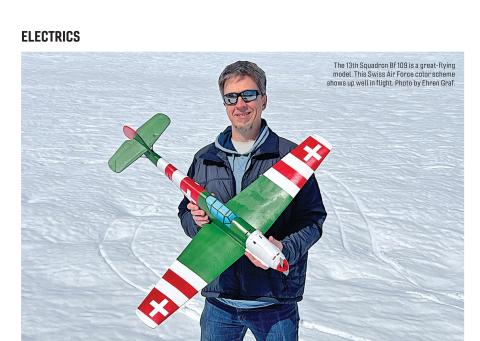
I actually built two Bf 109 kits during the project. One is finished in a Swiss Air Force color scheme. I chose this motif because I thought that the wide red and white stripes would provide good in-flight visibility ... and they do! After several outings with this model, I am happy to report that it flies very nicely. It is fast, nimble, and looks great in the air.
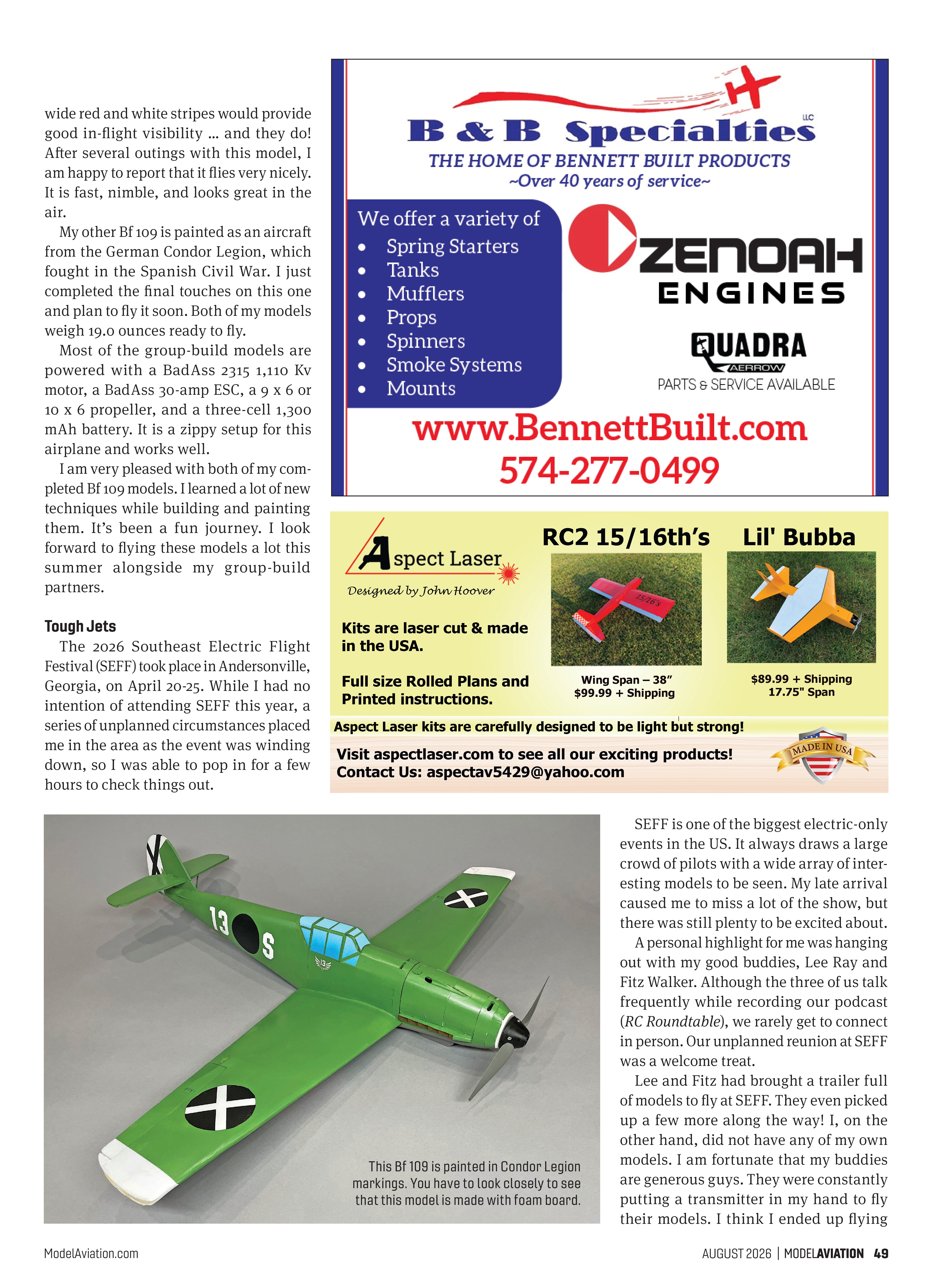
My other Bf 109 is painted as an aircraft from the German Condor Legion, which fought in the Spanish Civil War. I just completed the final touches on this one and plan to fly it soon. Both of my models weigh 19.0 ounces ready to fly.
Most of the group-build models are powered with a BadAss 2315 1,110 Kv motor, a BadAss 30-amp ESC, a 9 x 6 or 10 x 6 propeller, and a three-cell 1,300 mAh battery. It is a zippy setup for this airplane and works well.
I am very pleased with both of my completed Bf 109 models. I learned a lot of new techniques while building and painting them. It’s been a fun journey. I look forward to flying these models a lot this summer alongside my group-build partners.

This Bf 109 is painted in Condor Legion markings. You have to look closely to see that this model is made with foam board.

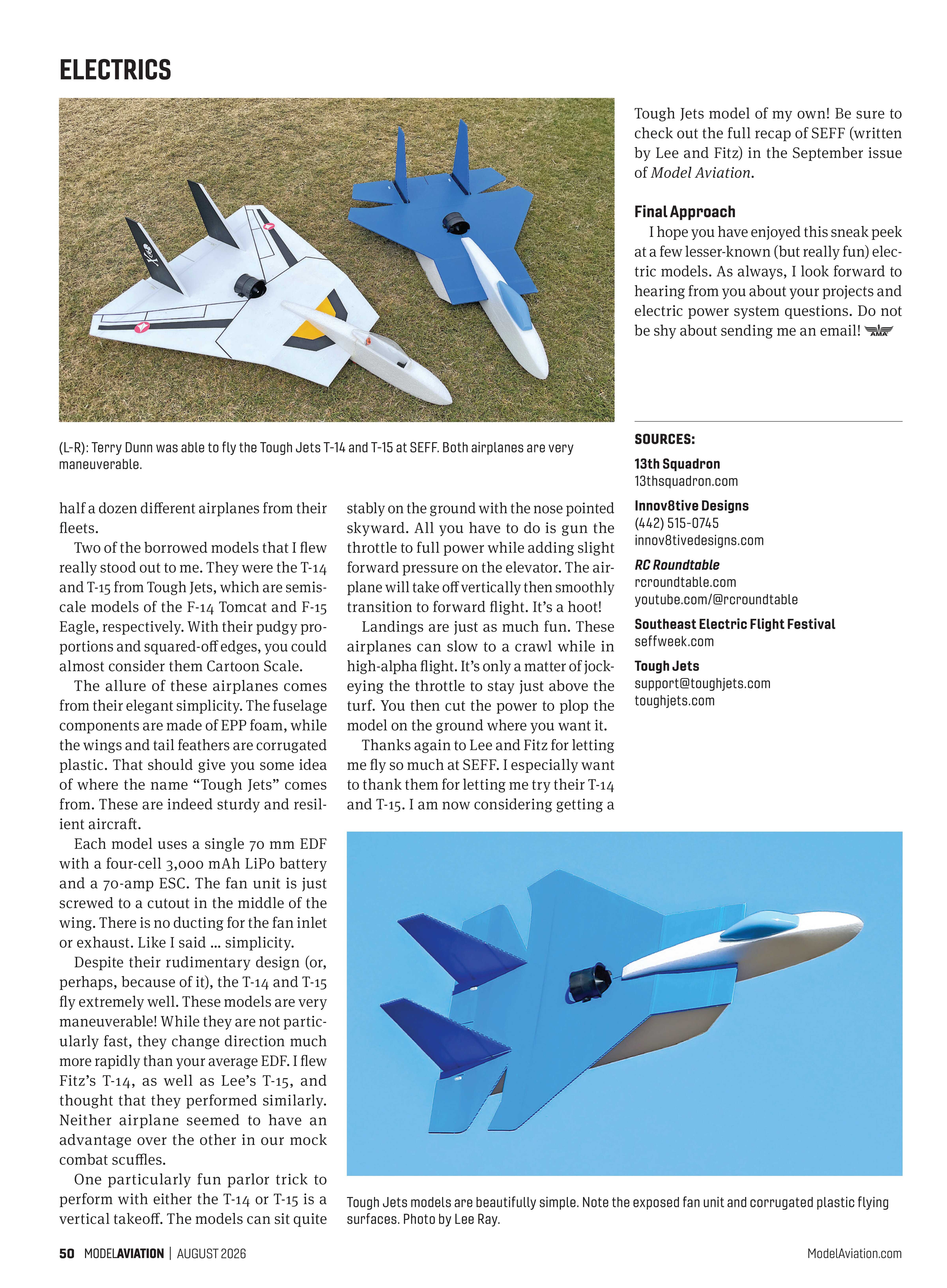
(L-R): Terry Dunn was able to fly the Tough Jets T-14 and T-15 at SEFF. Both airplanes are very maneuverable.
half a dozen different airplanes from their fleets.
Two of the borrowed models that I flew really stood out to me. They were the T-14 and T-15 from Tough Jets, which are semiscale models of the F-14 Tomcat and F-15 Eagle, respectively. With their pudgy proportions and squared-off edges, you could almost consider them Cartoon Scale.
The allure of these airplanes comes from their elegant simplicity. The fuselage components are made of EPP foam, while the wings and tail feathers are corrugated plastic. That should give you some idea of where the name “Tough Jets” comes from. These are indeed sturdy and resilient aircraft.
Each model uses a single 70 mm EDF with a four-cell 3,000 mAh LiPo battery and a 70-amp ESC. The fan unit is just screwed to a cutout in the middle of the wing. There is no ducting for the fan inlet or exhaust. Like I said … simplicity.
Despite their rudimentary design (or, perhaps, because of it), the T-14 and T-15 fly extremely well. These models are very maneuverable! While they are not particularly fast, they change direction much more rapidly than your average EDF. I flew Fitz’s T-14, as well as Lee’s T-15, and thought that they performed similarly. Neither airplane seemed to have an advantage over the other in our mock combat scuffles.
One particularly fun parlor trick to perform with either the T-14 or T-15 is a vertical takeoff. The models can sit quite stably on the ground with the nose pointed skyward. All you have to do is gun the throttle to full power while adding slight forward pressure on the elevator. The airplane will take off vertically then smoothly transition to forward flight. It’s a hoot!
Landings are just as much fun. These airplanes can slow to a crawl while in high-alpha flight. It’s only a matter of jockeying the throttle to stay just above the turf. You then cut the power to plop the model on the ground where you want it.
Thanks again to Lee and Fitz for letting me fly so much at SEFF. I especially want to thank them for letting me try their T-14 and T-15. I am now considering getting a Tough Jets model of my own! Be sure to check out the full recap of SEFF (written by Lee and Fitz) in the September issue of Model Aviation.
Final Approach
I hope you have enjoyed this sneak peek at a few lesser-known (but really fun) electric models. As always, I look forward to hearing from you about your projects and electric power system questions. Do not be shy about sending me an email!

SOURCES:
13th Squadron
13thsquadron.com
Innov8tive Designs
(442) 515-0745
innov8tivedesigns.com
RC Roundtable
rcroundtable.com
youtube.com/@rcroundtable
Southeast Electric Flight Festival
seffweek.com
Tough Jets
support@toughjets.com
toughjets.com