CHANGES TO MODEL AVIATION SUBSCRIPTION POLICY
AMA IS COMMITTED to delivering the quality of the magazine you value.
Because of rising production and distribution costs, effective September 1, 2026, all eligible new and renewing AMA members will automatically be subscribed to Model Aviation Digital at no additional cost, and a $10 annual fee will be implemented for those members who choose to receive the print edition of Model Aviation. This decision follows careful evaluation and thoughtful discussion to ensure that we can sustainably maintain the quality of the magazine you value.
We understand that changes to long-standing member benefits can be frustrating, especially for those who value the print edition. At less than $1 per month, this adjustment allows us to continue producing a printed, monthly publication that covers all facets of this great hobby while sharing the latest news from AMA.
The digital edition offers an enhanced experience, including direct links to bonus content, videos, and advertisers—providing even more ways to stay engaged and informed.
To confirm that AMA has your correct email address on file or to update it, visit your online member profile by logging in at modelaircraft.org/user/login, or contact the Membership department at member-support@modelaircraft.org.
Model Aviation remains the only aeromodeling magazine that is printed and distributed in the US, and we are proud to continue offering both print and digital options to serve the diverse preferences of our membership. We appreciate your understanding and ongoing support as we adapt to ensure the long-term strength of this valued member benefit.
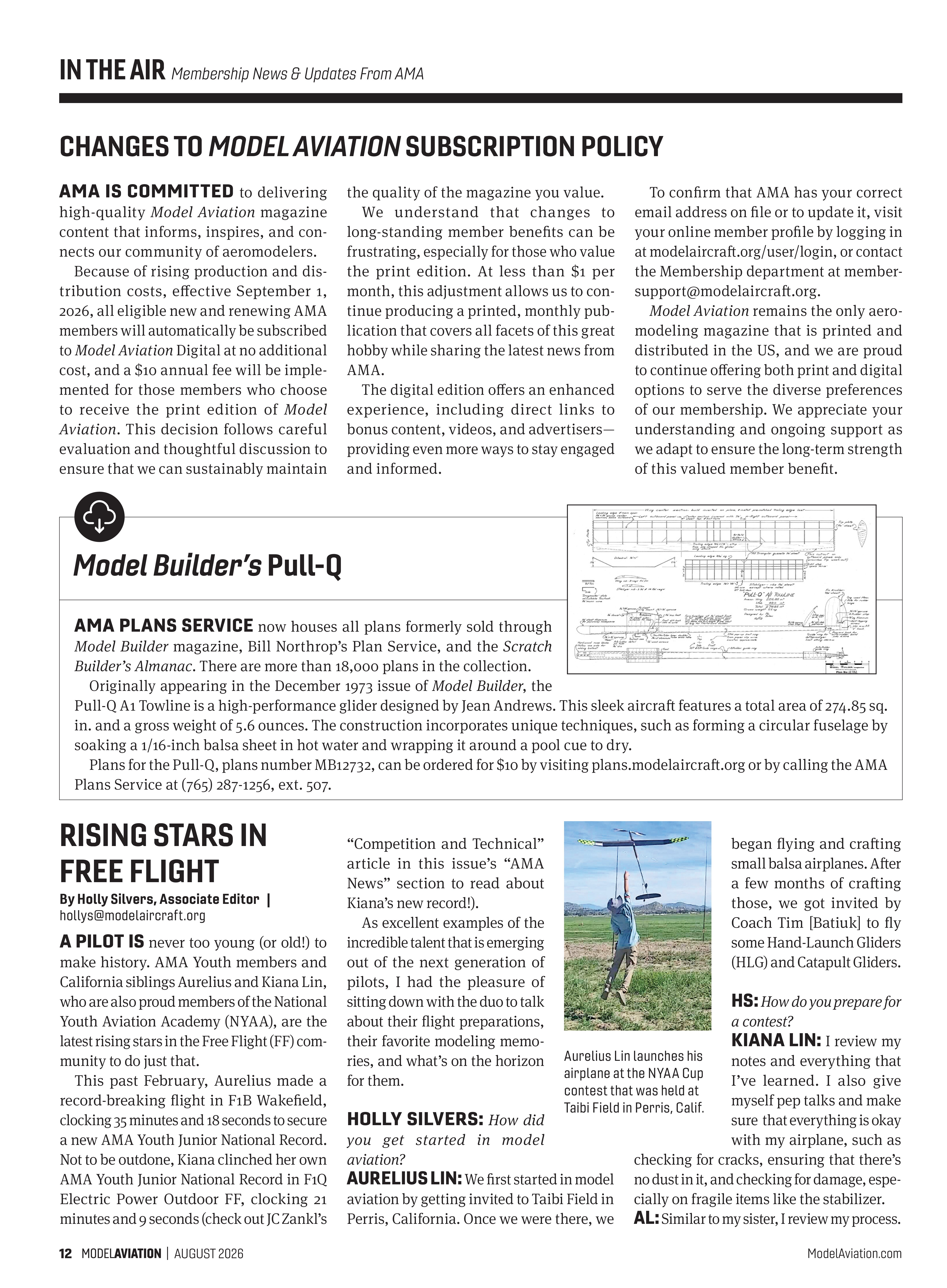
Model Builder’s Pull-Q
AMA PLANS SERVICE now houses all plans formerly sold through Model Builder magazine, Bill Northrop’s Plan Service, and the Scratch Builder’s Almanac. There are more than 18,000 plans in the collection.
Originally appearing in the December 1973 issue of Model Builder, the Pull-Q A1 Towline is a high-performance glider designed by Jean Andrews. This sleek aircraft features a total area of 274.85 sq. in. and a gross weight of 5.6 ounces. The construction incorporates unique techniques, such as forming a circular fuselage by soaking a 1/16-inch balsa sheet in hot water and wrapping it around a pool cue to dry.
Plans for the Pull-Q, plans number MB12732, can be ordered for $10 by visiting plans.modelaircraft.org or by calling the AMA Plans Service at (765) 287-1256, ext. 507.

RISING STARS IN FREE FLIGHT
By Holly Silvers, Associate Editor
hollys@modelaircraft.org
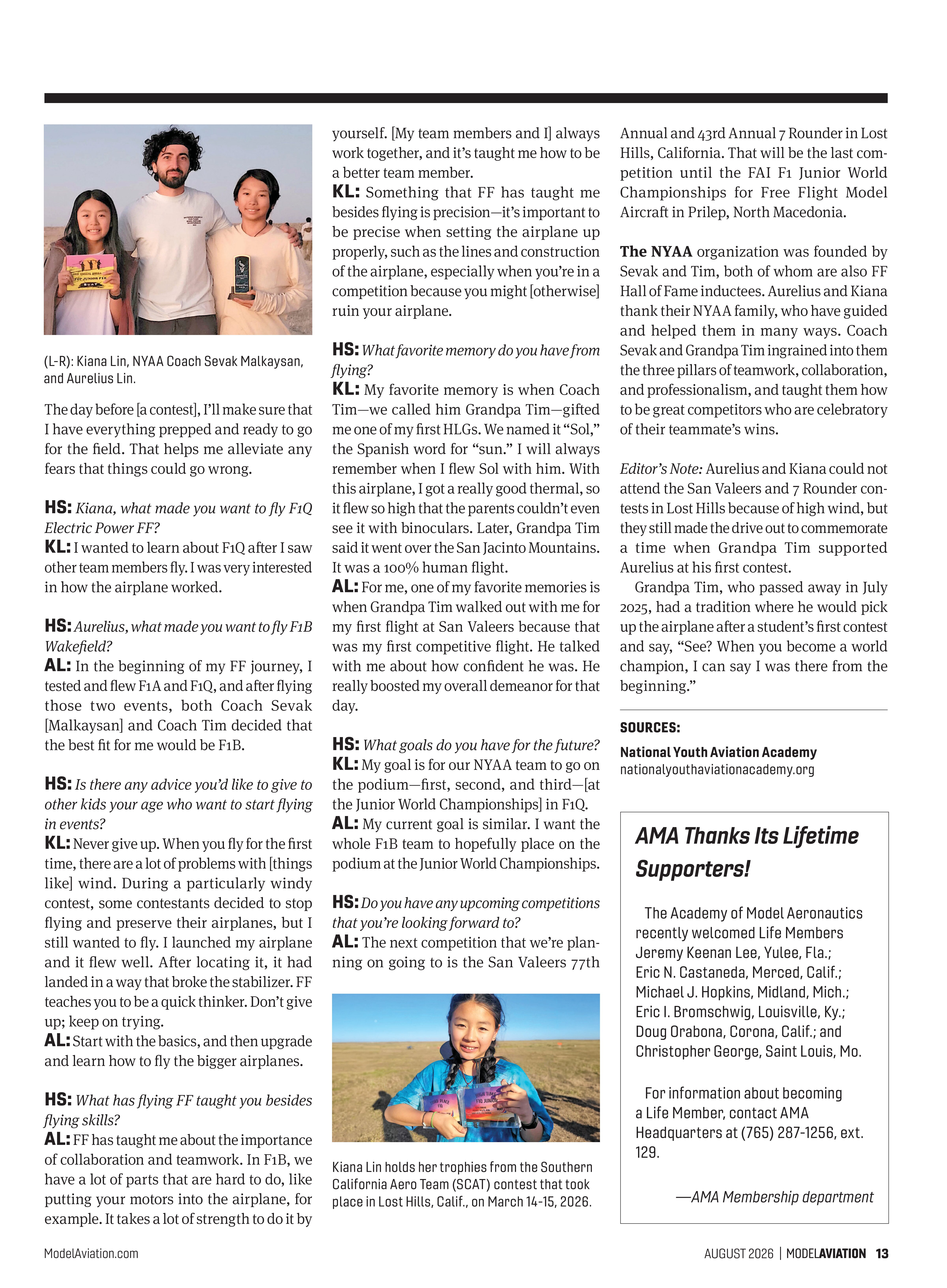
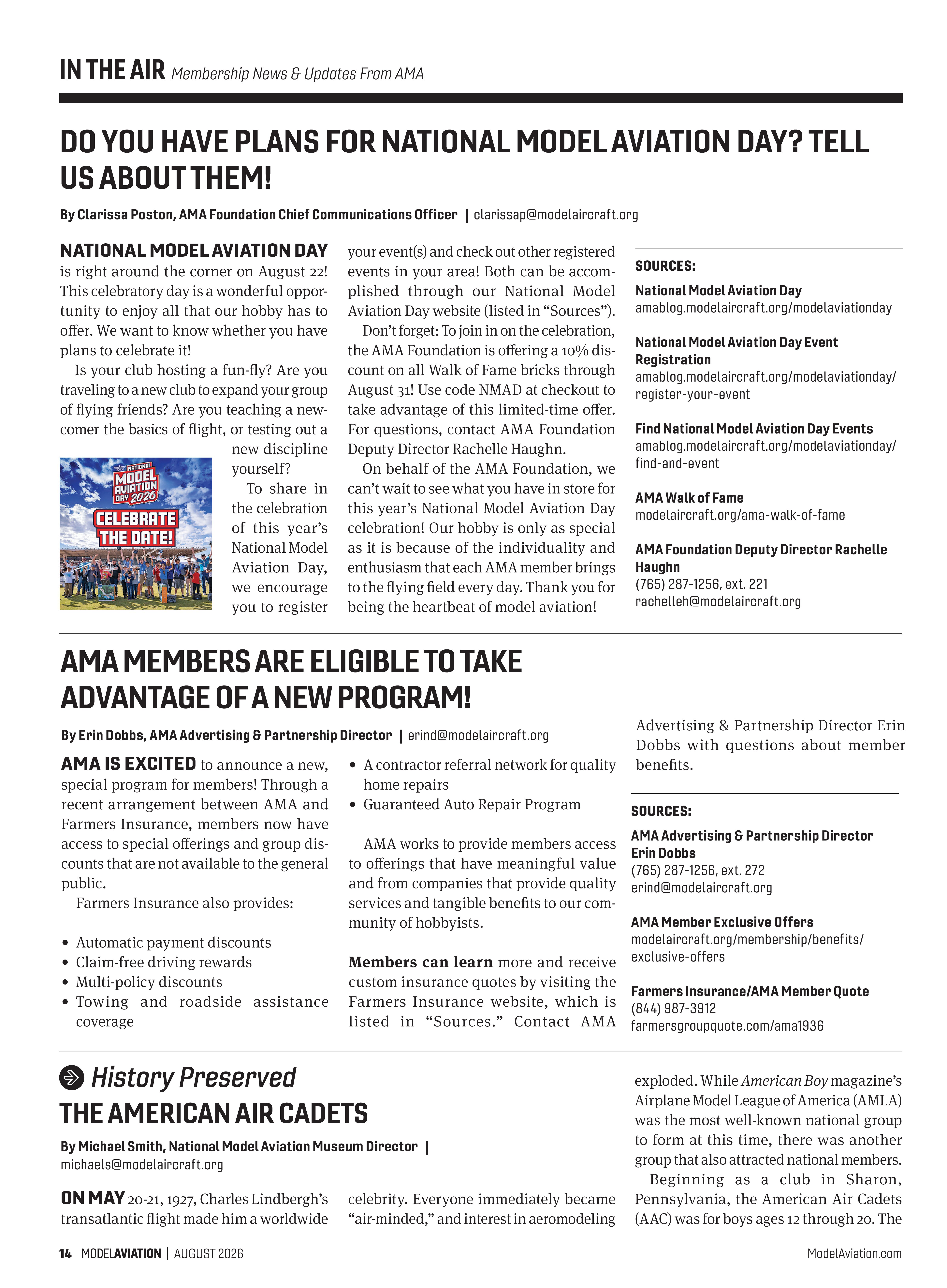
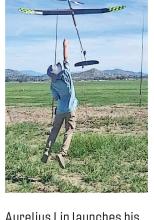
A PILOT IS never too young (or old!) to make history. AMA Youth members and California siblings Aurelius and Kiana Lin, who are also proud members of the National Youth Aviation Academy (NYAA), are the latest rising stars in the Free Flight (FF) community to do just that.
This past February, Aurelius made a record-breaking flight in F1B Wakefield, clocking 35 minutes and 18 seconds to secure a new AMA Youth Junior National Record. Not to be outdone, Kiana clinched her own AMA Youth Junior National Record in F1Q Electric Power Outdoor FF, clocking 21 minutes and 9 seconds (check out JC Zankl’s “Competition and Technical” article in this issue’s “AMA News” section to read about Kiana’s new record!).
As excellent examples of the incredible talent that is emerging out of the next generation of pilots, I had the pleasure of sitting down with the duo to talk about their flight preparations, their favorite modeling memories, and what’s on the horizon for them.
HOLLY SILVERS: How did you get started in model aviation?
AURELIUS LIN: We first started in model aviation by getting invited to Taibi Field in Perris, California. Once we were there, we began flying and crafting small balsa airplanes. After a few months of crafting those, we got invited by Coach Tim [Batiuk] to fly some Hand-Launch Gliders (HLG) and Catapult Gliders.

HS: How do you prepare for a contest?
KIANA LIN: I review my notes and everything that I’ve learned. I also give myself pep talks and make sure that everything is okay with my airplane, such as checking for cracks, ensuring that there’s no dust in it, and checking for damage, especially on fragile items like the stabilizer.
AL: Similar to my sister, I review my process.
KL: Something that FF has taught me besides flying is precision—it’s important to be precise when setting the airplane up properly, such as the lines and construction of the airplane, especially when you’re in a competition because you might [otherwise] ruin your airplane.
HS: What favorite memory do you have from flying?
KL: My favorite memory is when Coach Tim—we called him Grandpa Tim—gifted me one of my first HLGs. We named it “Sol,” the Spanish word for “sun.” I will always remember when I flew Sol with him. With this airplane, I got a really good thermal, so it flew so high that the parents couldn’t even see it with binoculars. Later, Grandpa Tim said it went over the San Jacinto Mountains. It was a 100% human flight.
AL: For me, one of my favorite memories is when Grandpa Tim walked out with me for my first flight at San Valeers because that was my first competitive flight. He talked with me about how confident he was. He really boosted my overall demeanor for that day.
HS: What goals do you have for the future?
KL: My goal is for our NYAA team to go on the podium—first, second, and third—[at the Junior World Championships] in F1Q.
AL: My current goal is similar. I want the whole F1B team to hopefully place on the podium at the Junior World Championships.
HS: Do you have any upcoming competitions that you’re looking forward to?
AL: The next competition that we’re planning on going to is the San Valeers 77th Annual and 43rd Annual 7 Rounder in Lost Hills, California. That will be the last competition until the FAI F1 Junior World Championships for Free Flight Model Aircraft in Prilep, North Macedonia.
The NYAA organization was founded by Sevak and Tim, both of whom are also FF Hall of Fame inductees. Aurelius and Kiana thank their NYAA family, who have guided and helped them in many ways. Coach Sevak and Grandpa Tim ingrained into them the three pillars of teamwork, collaboration, and professionalism, and taught them how to be great competitors who are celebratory of their teammate’s wins.
Editor’s Note: Aurelius and Kiana could not attend the San Valeers and 7 Rounder contests in Lost Hills because of high wind, but they still made the drive out to commemorate a time when Grandpa Tim supported Aurelius at his first contest.
Grandpa Tim, who passed away in July 2025, had a tradition where he would pick up the airplane after a student’s first contest and say, “See? When you become a world champion, I can say I was there from the beginning.”

The day before [a contest], I’ll make sure that I have everything prepped and ready to go for the field. That helps me alleviate any fears that things could go wrong.
HS: Kiana, what made you want to fly F1Q Electric Power FF?
KL: I wanted to learn about F1Q after I saw other team members fly. I was very interested in how the airplane worked.
HS: Aurelius, what made you want to fly F1B Wakefield?
AL: In the beginning of my FF journey, I tested and flew F1A and F1Q, and after flying those two events, both Coach Sevak [Malkaysan] and Coach Tim decided that the best fit for me would be F1B.
HS: Is there any advice you’d like to give to other kids your age who want to start flying in events?
KL: Never give up. When you fly for the first time, there are a lot of problems with [things like] wind. During a particularly windy contest, some contestants decided to stop flying and preserve their airplanes, but I still wanted to fly. I launched my airplane and it flew well. After locating it, it had landed in a way that broke the stabilizer. FF teaches you to be a quick thinker. Don’t give up; keep on trying.
AL: Start with the basics, and then upgrade and learn how to fly the bigger airplanes.
HS: What has flying FF taught you besides flying skills?
AL: FF has taught me about the importance of collaboration and teamwork. In F1B, we have a lot of parts that are hard to do, like putting your motors into the airplane, for example. It takes a lot of strength to do it by yourself. [My team members and I] always work together, and it’s taught me how to be a better team member.

SOURCES:
National Youth Aviation Academy
nationalyouthaviationacademy.org
History Preserved
THE AMERICAN AIR CADETS
By Michael Smith, National Model Aviation Museum Director | michaels@modelaircraft.org
ON MAY 20-21, 1927, Charles Lindbergh’s transatlantic flight made him a worldwide celebrity. Everyone immediately became “air-minded,” and interest in aeromodeling
The American Air Cadets was for boys ages 12 through 20. The first headquarters was in New York before moving to Iowa City, Iowa, “because of the central location and situation on the transcontinental air route.” This move included the establishment of a supply department, and Aero Mechanics magazine carried AAC news.
The AAC looked “to teach members to build model airplanes, thus educating them in the fundamentals of aviation.” Founder William Wishart noted, “It is realized that the industry of aviation will soon be dependent upon the youth of today for new ideas and inventions, as well as carrying on the industry as a whole. For this reason, an organization of this nature is, in the minds of the Advisors, the only means of encouraging this sort of work.”
Supporters included U.S. Secretary of Labor James Davis, Amelia Earhart, National Board of Aeronautics Chairman Arthur Lynch, and Col. Charles Lindbergh, who donated a trophy at one of the AAC’s first contests.
AAC articles that were distributed by the Associated Press encouraged new clubs to form across the US with support from groups such as the Boy Scouts, YMCA, and Rotary. O.J. Sand, a representative of the AAC, would travel to cities across the US and meet with businessmen who were interested in chartering a club. Once formed, clubs offered instructional classes


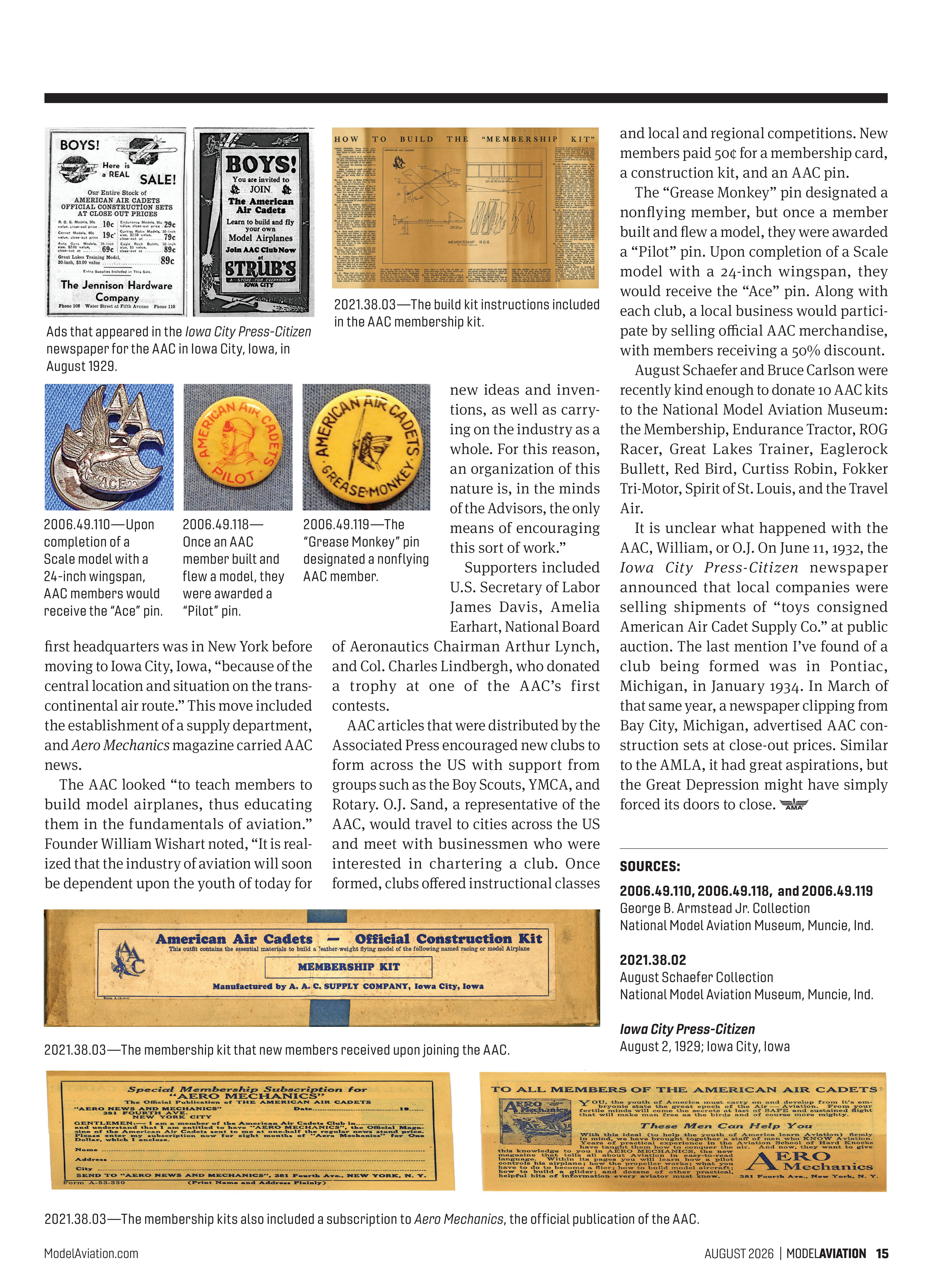
and local and regional competitions. New members paid 50¢ for a membership card, a construction kit, and an AAC pin.
The “Grease Monkey” pin designated a nonflying member, but once a member built and flew a model, they were awarded a “Pilot” pin. Upon completion of a Scale model with a 24-inch wingspan, they would receive the “Ace” pin. Along with each club, a local business would participate by selling official AAC merchandise, with members receiving a 50% discount.
August Schaefer and Bruce Carlson were recently kind enough to donate 10 AAC kits to the National Model Aviation Museum: the Membership, Endurance Tractor, ROG Racer, Great Lakes Trainer, Eaglerock Bullett, Red Bird, Curtiss Robin, Fokker Tri-Motor, Spirit of St. Louis, and the Travel Air.
It is unclear what happened with the AAC, William, or O.J. On June 11, 1932, the Iowa City Press-Citizen newspaper announced that local companies were selling shipments of “toys consigned American Air Cadet Supply Co.” at public auction. The last mention I’ve found of a club being formed was in Pontiac, Michigan, in January 1934. In March of that same year, a newspaper clipping from Bay City, Michigan, advertised AAC construction sets at close-out prices. Similar to the AMLA, it had great aspirations, but the Great Depression might have simply forced its doors to close.
SOURCES:
2006.49.110, 2006.49.118, and 2006.49.119
George B. Armstead Jr. Collection
National Model Aviation Museum, Muncie, Ind.
2021.38.02
August Schaefer Collection
National Model Aviation Museum, Muncie, Ind.
Iowa City Press-Citizen
August 2, 1929; Iowa City, Iowa