90 Years of AMA
By Holly Silvers

For 90 years, AMA has been the heart of model aviation. What began in 1936 as a small gathering of visionaries has evolved into the world’s largest aeromodeling organization, serving more than 195,000 members and 2,500 chartered clubs.
Today, that legacy is best felt at the International Aeromodeling Center (IAC) in Muncie, Indiana, a sprawling 1,100-acre “mecca” that exists as a living monument to the hobby. From world-class flightlines to the one-of-a-kind National Model Aviation Museum, AMA has become an influential, dedicated voice for the hobby and has created a passionate community of aviation enthusiasts that spans the globe.
Photos provided by AMA and the National Model Aviation Museum, except as noted
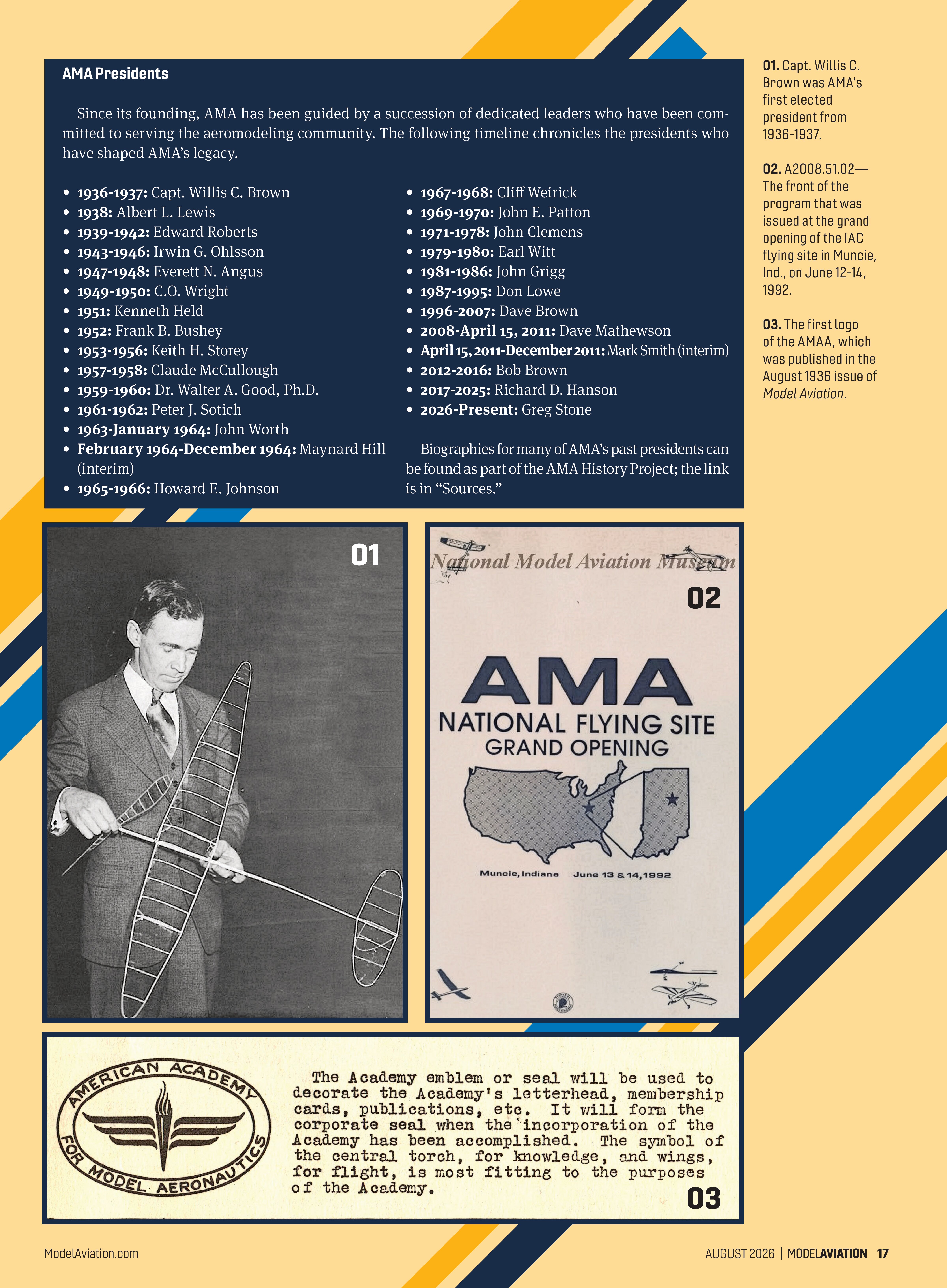
AMA Presidents
Since its founding, AMA has been guided by a succession of dedicated leaders who have been committed to serving the aeromodeling community. The following timeline chronicles the presidents who have shaped AMA’s legacy.
- 1936-1937: Capt. Willis C. Brown
- 1938: Albert L. Lewis
- 1939-1942: Edward Roberts
- 1943-1946: Irwin G. Ohlsson
- 1947-1948: Everett N. Angus
- 1949-1950: C.O. Wright
- 1951: Kenneth Held
- 1952: Frank B. Bushey
- 1953-1956: Keith H. Storey
- 1957-1958: Claude McCullough
- 1959-1960: Dr. Walter A. Good, Ph.D.
- 1961-1962: Peter J. Sotich
- 1963-January 1964: John Worth
- February 1964-December 1964: Maynard Hill (interim)
- 1965-1966: Howard E. Johnson
- 1967-1968: Cliff Weirick
- 1969-1970: John E. Patton
- 1971-1978: John Clemens
- 1979-1980: Earl Witt
- 1981-1986: John Grigg
- 1987-1995: Don Lowe
- 1996-2007: Dave Brown
- 2008-April 15, 2011: Dave Mathewson
- April 15, 2011-December 2011: Mark Smith (interim)
- 2012-2016: Bob Brown
- 2017-2025: Richard D. Hanson
- 2026-Present: Greg Stone
Biographies for many of AMA’s past presidents can be found as part of the AMA History Project; the link is in “Sources.”


Founding the Future
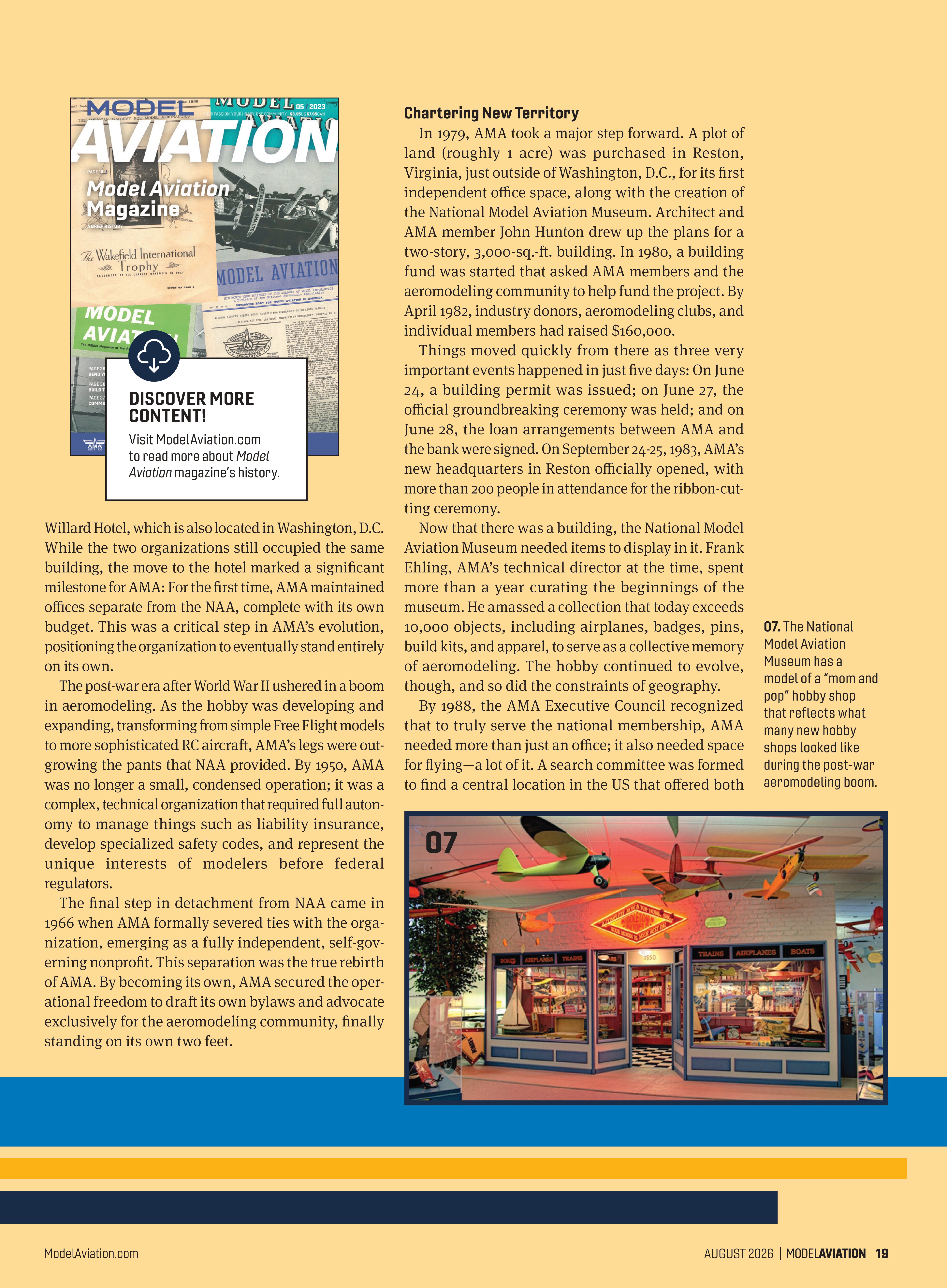
At the 1935 National Aeromodeling Championships (known today as the Nats) in Detroit, Michigan, the leaders of the aeromodeling community met with a singular, ambitious goal. They sought a “self-governing body of aeromodeling experts … that should be expert guidance of, for, and by model builders.” That shared vision quickly solidified into a plan and, by 1936, it culminated in the formal establishment of the American Academy of Model Aeronautics (AMAA).
The scale of the founders’ ambition was palpable. In 1936, the AMAA Headquarters wasn’t set up in a garage or rundown business space, but rather right in the heart of the RCA Building (now known as the Comcast Building) at Rockefeller Center in New York City. This was a bold statement by the founders. By establishing the headquarters in the iconic skyscraper, AMAA wasn’t just claiming a place of business; it was signaling to the world that model aviation was a serious, disciplined sport and hobby worthy of just as much attention as full-scale aircraft.
To steer the brand-new AMAA, a council elected Willis C. Brown as the first president. From those Manhattan offices, Willis and early staff established the Academy’s credibility, turning the ambitious goals from that first meeting at the 1935 Detroit Nats into the safety standards and professional identity that would define the hobby and the organization for generations to come.


Chartering New Territory
In 1979, AMA took a major step forward. A plot of land (roughly 1 acre) was purchased in Reston, Virginia, just outside of Washington, D.C., for its first independent office space, along with the creation of the National Model Aviation Museum. Architect and AMA member John Hunton drew up the plans for a two-story, 3,000‑sq.-ft. building. In 1980, a building fund was started that asked AMA members and the aeromodeling community to help fund the project. By April 1982, industry donors, aeromodeling clubs, and individual members had raised $160,000.
Things moved quickly from there as three very important events happened in just five days: On June 24, a building permit was issued; on June 27, the official groundbreaking ceremony was held; and on June 28, the loan arrangements between AMA and the bank were signed. On September 24-25, 1983, AMA’s new headquarters in Reston officially opened, with more than 200 people in attendance for the ribbon-cutting ceremony.
Willard Hotel, which is also located in Washington, D.C. While the two organizations still occupied the same building, the move to the hotel marked a significant milestone for AMA: For the first time, AMA maintained offices separate from the NAA, complete with its own budget. This was a critical step in AMA’s evolution, positioning the organization to eventually stand entirely on its own.


Holly Silvers

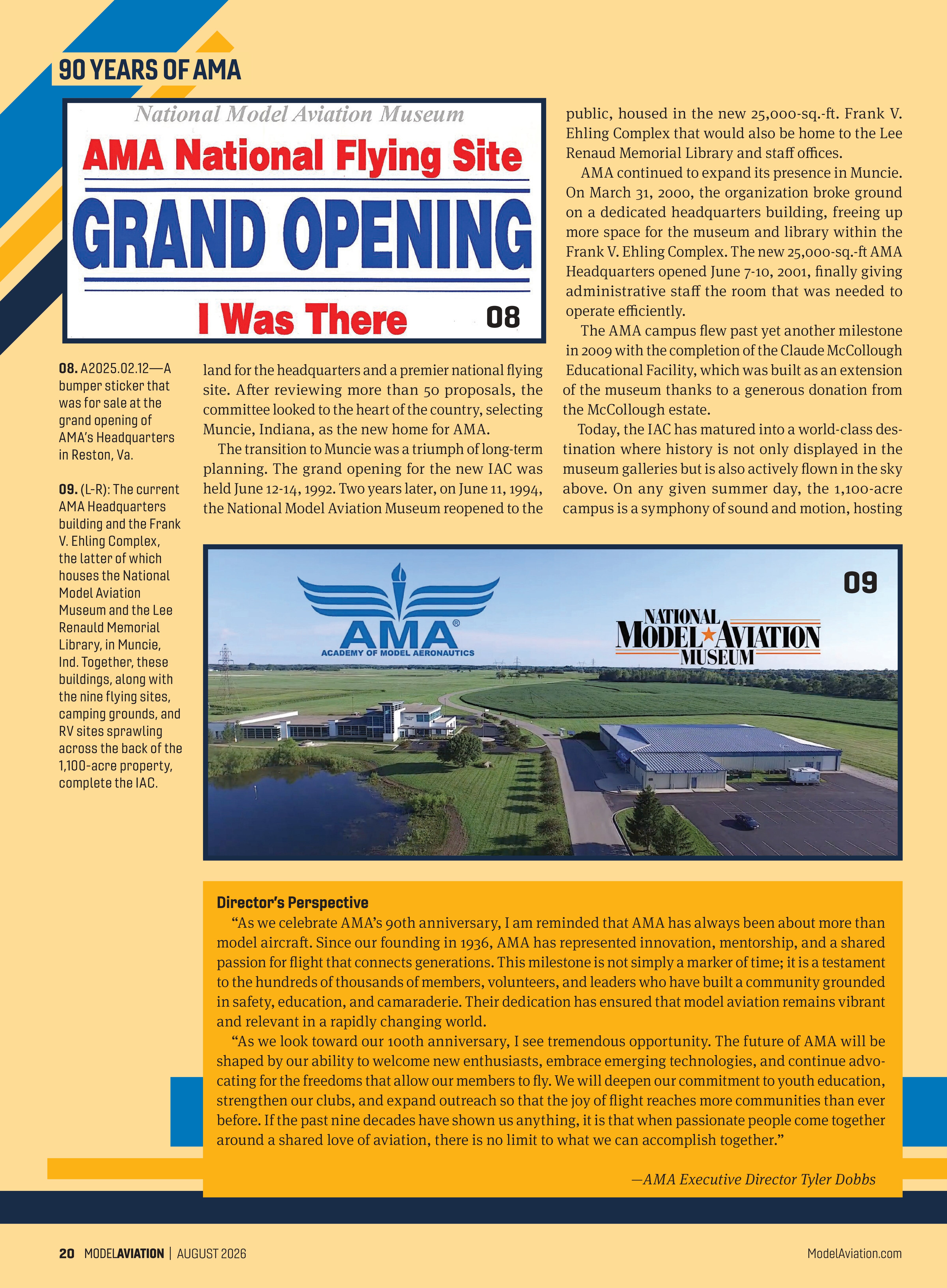
land for the headquarters and a premier national flying site. After reviewing more than 50 proposals, the committee looked to the heart of the country, selecting Muncie, Indiana, as the new home for AMA.
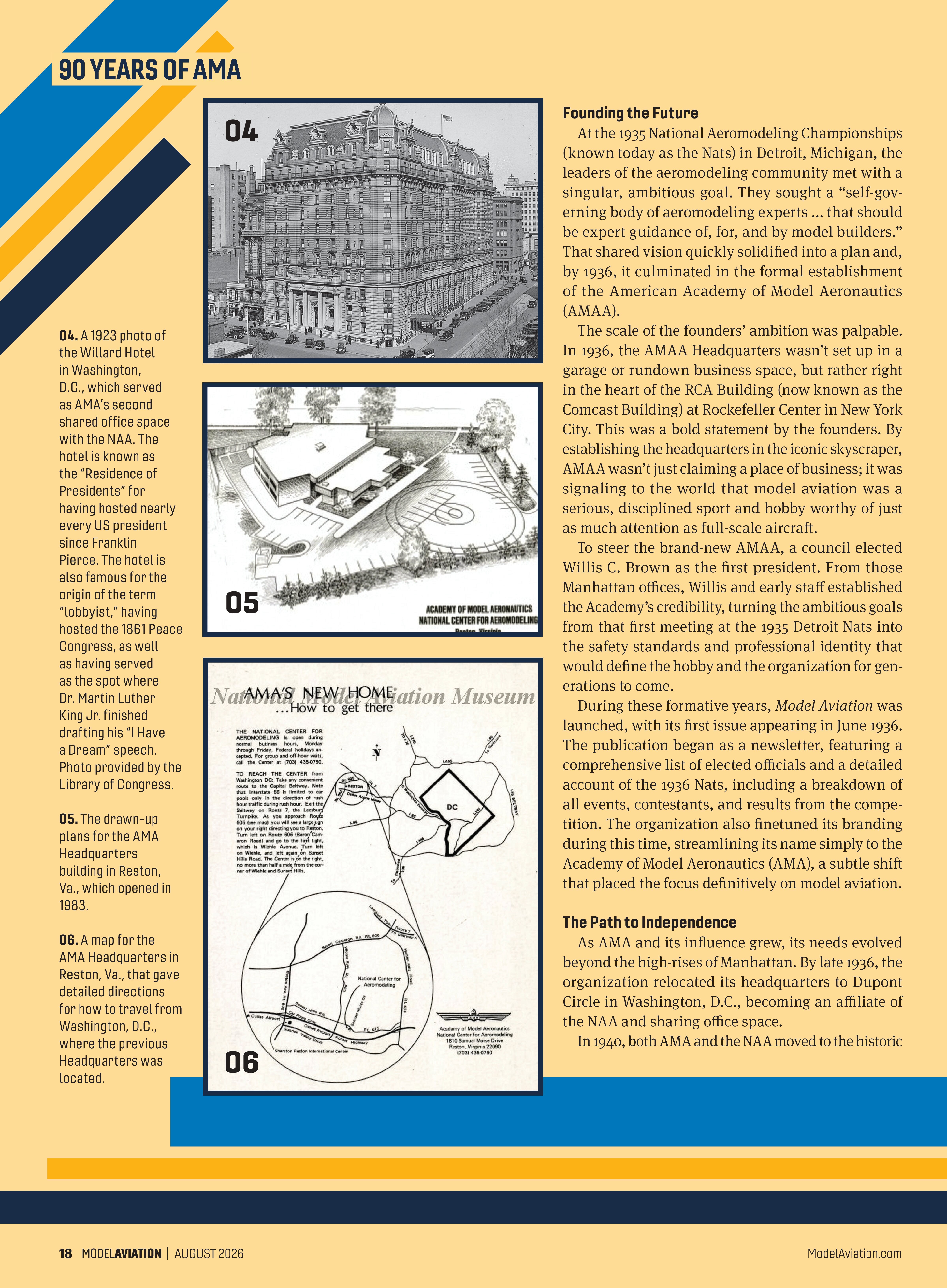
The transition to Muncie was a triumph of long-term planning. The grand opening for the new IAC was held June 12-14, 1992. Two years later, on June 11, 1994, the National Model Aviation Museum reopened to the public, housed in the new 25,000-sq.-ft. Frank V. Ehling Complex that would also be home to the Lee Renaud Memorial Library and staff offices.
AMA continued to expand its presence in Muncie. On March 31, 2000, the organization broke ground on a dedicated headquarters building, freeing up more space for the museum and library within the Frank V. Ehling Complex. The new 25,000-sq.-ft AMA Headquarters opened June 7-10, 2001, finally giving administrative staff the room that was needed to operate efficiently.
The AMA campus flew past yet another milestone in 2009 with the completion of the Claude McCollough Educational Facility, which was built as an extension of the museum thanks to a generous donation from the McCollough estate.
Today, the IAC has matured into a world-class destination where history is not only displayed in the museum galleries but is also actively flown in the sky above. On any given summer day, the 1,100-acre campus is a symphony of sound and motion, hosting everything from MultiGP Drone Racing and UAS4STEM competitions to high-stakes FAI world championships and the Nats.
The IAC stands as a testament to what a community can achieve when it invests in its future, providing a home for modelers to pass the love of flight from one generation to the next, all largely thanks to the support that our community has for AMA, but, perhaps more importantly, thanks to the love every aeromodeler dedicates to our hobby.

President’s Perspective
“As we celebrate the 90th anniversary of AMA, we have an opportunity not only to reflect on our history but to also look ahead to the future that we are building together. For nine decades, AMA members and clubs have preserved and advanced the joy, craftsmanship, innovation, and community that define model aviation. Generations of members have passed along their knowledge, mentored newcomers, and ensured that the spirit of flight continues to inspire people of all ages.
“My hope as we move toward our 100th anniversary is that AMA continues to evolve while staying grounded in the values that brought us here. I want to see an organization with strong and active clubs, growing membership, thriving youth programs, and expanded opportunities for education and outreach. I hope AMA is recognized not only as the leader in model aviation but also as a gateway to aviation, aerospace, engineering, and innovation for future generations.
“Most importantly, I hope that when we celebrate our centennial, we can proudly say that we have strengthened the culture of mentorship and community that makes this hobby so special. The next decade is an opportunity to grow, adapt, and inspire—and I believe that the future of AMA is bright because of the passion and dedication of our members.”
—AMA President Greg Stone
Counting Down to 100
As AMA’s 90 years are celebrated, we want to extend a heartfelt thank you to our members and clubs. You are the heartbeat of our organization, and your passion and dedication are the reasons AMA has grown from a small group of visionaries in 1936 to the global leader in aeromodeling it is today. This milestone anniversary is a tribute to the community that has kept the joy of flight alive for nine incredible decades.
While AMA takes pride in its past, we are even more excited for the future as we look toward our 100th anniversary in 2036. We can’t wait to celebrate a full century of innovation and mentorship with our community. We’re planning a big party, and we hope that you can come celebrate with us.
SOURCES:
AMA History
modelaircraft.org/history-recognition/history-project/ama-history
AMA History Project
modelaircraft.org/museum/history-recognition/ama-history-project
Model Aviation, June 1936
modelaircraft.org/sites/default/files/MA_Vol1_No1_%20June1936_Model_Aviation-web.pdf
“Model Aviation Magazine” by Clarissa Poston
Model Aviation, May 2023
Willard Hotel, 1923
Library of Congress, Prints & Photographs Division, LC-DIG-npcc-07799
loc.gov/item/2016834140
A2008.51.02
Collection #0198, Donated by Gary Rice
National Model Aviation Museum, Muncie, Ind.