The Magic Sword of Modeling and Other Tales
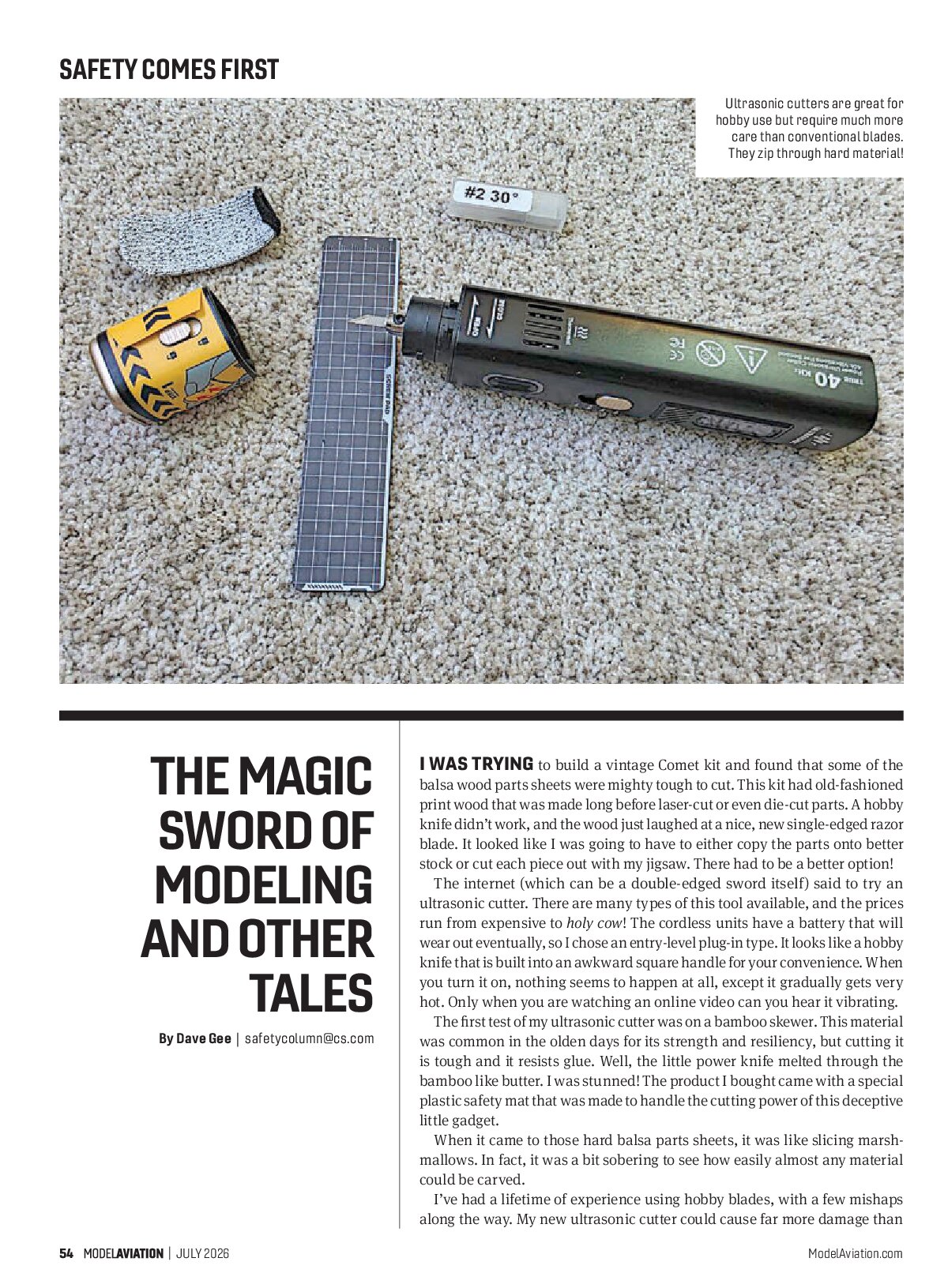
Ultrasonic cutters are great for hobby use but require much more care than conventional blades. They zip through hard material!
I was trying to build a vintage Comet kit and found that some of the balsa wood parts sheets were mighty tough to cut. This kit had old-fashioned print wood that was made long before laser-cut or even die-cut parts. A hobby knife didn’t work, and the wood just laughed at a nice, new single-edged razor blade. It looked like I was going to have to either copy the parts onto better stock or cut each piece out with my jigsaw. There had to be a better option!
The internet (which can be a double-edged sword itself) said to try an ultrasonic cutter. There are many types of this tool available, and the prices run from expensive to holy cow! The cordless units have a battery that will wear out eventually, so I chose an entry-level plug-in type. It looks like a hobby knife that is built into an awkward square handle for your convenience. When you turn it on, nothing seems to happen at all, except it gradually gets very hot. Only when you are watching an online video can you hear it vibrating.
The first test of my ultrasonic cutter was on a bamboo skewer. This material was common in the olden days for its strength and resiliency, but cutting it is tough and it resists glue. Well, the little power knife melted through the bamboo like butter. I was stunned! The product I bought came with a special plastic safety mat that was made to handle the cutting power of this deceptive little gadget.
When it came to those hard balsa parts sheets, it was like slicing marshmallows. In fact, it was a bit sobering to see how easily almost any material could be carved.
I’ve had a lifetime of experience using hobby blades, with a few mishaps along the way. My new ultrasonic cutter could cause far more damage than a regular knife in a moment of carelessness! The non-ergonomic handle is a factor, as is the awkward power cord (a poor choice, as it turned out).
In my opinion, an ultrasonic cutter is an excellent modeling tool, especially if you do fine work with hardwood; however, it has great potential for injury if proper care is not used at all times. Do your research, watch instruction videos, read the manual, and then stay on high alert when you are using one. You’ll be amazed at how handy it can be!
A Roof Over Their Heads
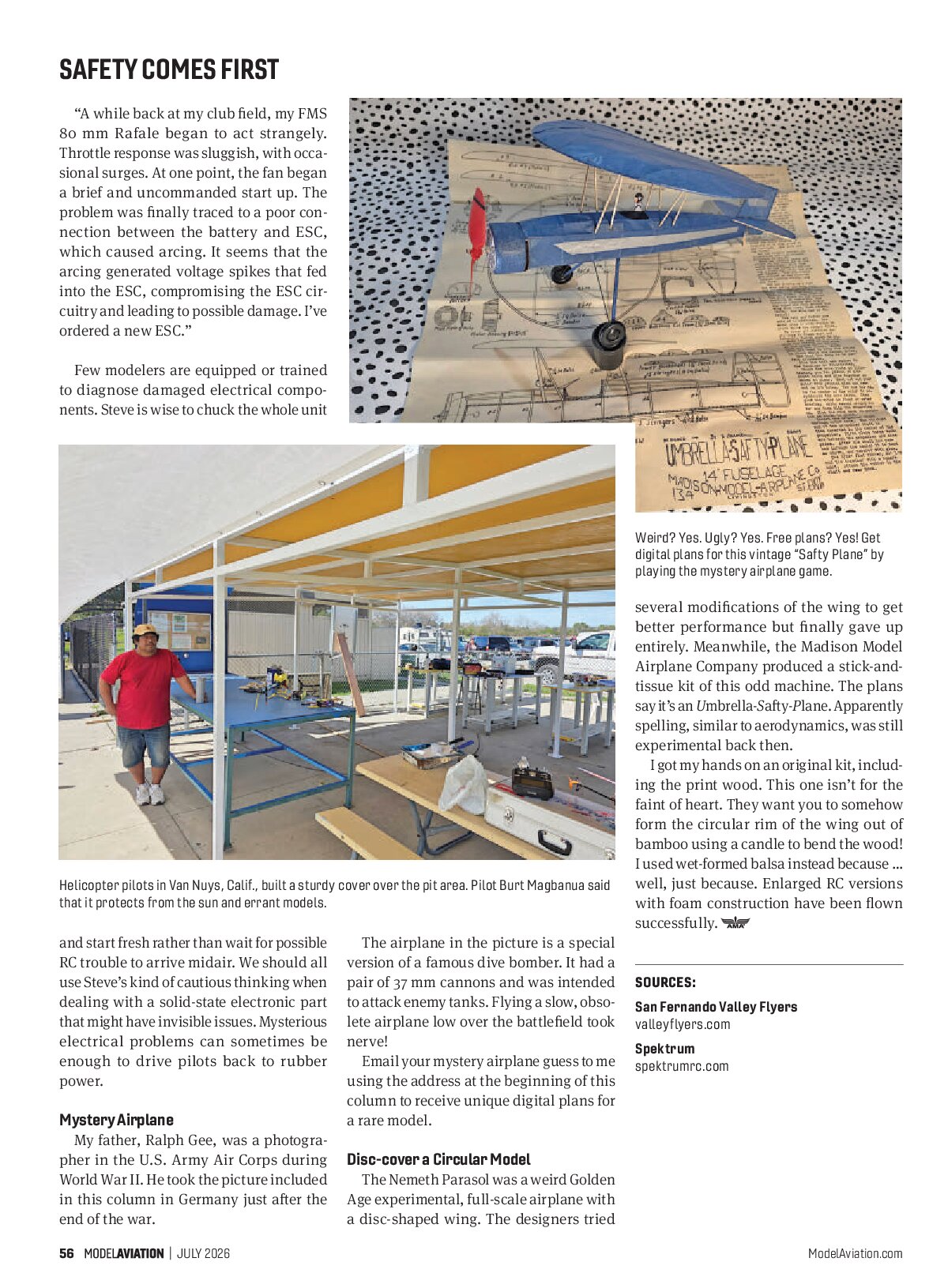
The San Fernando Valley Flyers’ Apollo XI RC field at Sepulveda Basin in Los Angeles has a dedicated RC helicopter area. It’s a great spot to watch skillful pilots maneuver their choppers, and I enjoy seeing them tinker with the intricate mechanical parts of these models.
The club just finished building a sturdy new shelter over the workbenches in the pit area. I confirmed that it was newly built by suavely leaning against a freshly painted support post. Experienced RC heli pilot Burt Magbanua explained that the structure gave protection from more than the weather. It was made strong enough to withstand a falling model, just in case (heaven forbid) a rotorcraft should make an unplanned descent.
These modelers know about how to use upstream measures to avoid incidents. Planning ahead to stop a hazard before it exists is forward thinking!
Preflight List? Check!
Expert flier Ron Struss emailed me to express satisfaction with his Spektrum transmitter, which has a preflight checklist feature. He said that it requires a checkoff before the model can be flown.
Preflight checklists are a wise thing to use when operating a model aircraft. Many other RC system manufacturers also include built-in preflight checklists nowadays, and I’m glad to see it. How many incidents never happen because of this programming feature?

The Story Arc of an Arcing Story
Steve Mizerany solved a mystery. He wrote:
“A while back at my club field, my FMS 80 mm Rafale began to act strangely. Throttle response was sluggish, with occasional surges. At one point, the fan began a brief and uncommanded start up. The problem was finally traced to a poor connection between the battery and ESC, which caused arcing. It seems that the arcing generated voltage spikes that fed into the ESC, compromising the ESC circuitry and leading to possible damage. I’ve ordered a new ESC.”
Few modelers are equipped or trained to diagnose damaged electrical components. Steve is wise to chuck the whole unit and start fresh rather than wait for possible RC trouble to arrive midair. We should all use Steve’s kind of cautious thinking when dealing with a solid-state electronic part that might have invisible issues. Mysterious electrical problems can sometimes be enough to drive pilots back to rubber power.
Mystery Airplane
My father, Ralph Gee, was a photographer in the U.S. Army Air Corps during World War II. He took the picture included in this column in Germany just after the end of the war.
The airplane in the picture is a special version of a famous dive bomber. It had a pair of 37 mm cannons and was intended to attack enemy tanks. Flying a slow, obsolete airplane low over the battlefield took nerve!
Email your mystery airplane guess to me using the address at the beginning of this column to receive unique digital plans for a rare model.
Disc-cover a Circular Model
The Nemeth Parasol was a weird Golden Age experimental, full-scale airplane with a disc-shaped wing. The designers tried several modifications of the wing to get better performance but finally gave up entirely. Meanwhile, the Madison Model Airplane Company produced a stick-and-tissue kit of this odd machine. The plans say it’s an Umbrella-Safty-Plane. Apparently spelling, similar to aerodynamics, was still experimental back then.
I got my hands on an original kit, including the print wood. This one isn’t for the faint of heart. They want you to somehow form the circular rim of the wing out of bamboo using a candle to bend the wood! I used wet-formed balsa instead because … well, just because. Enlarged RC versions with foam construction have been flown successfully.


SOURCES
- San Fernando Valley Flyers
- valleyflyers.com
- Spektrum
spektrumrc.com