FAI F4 World Championships
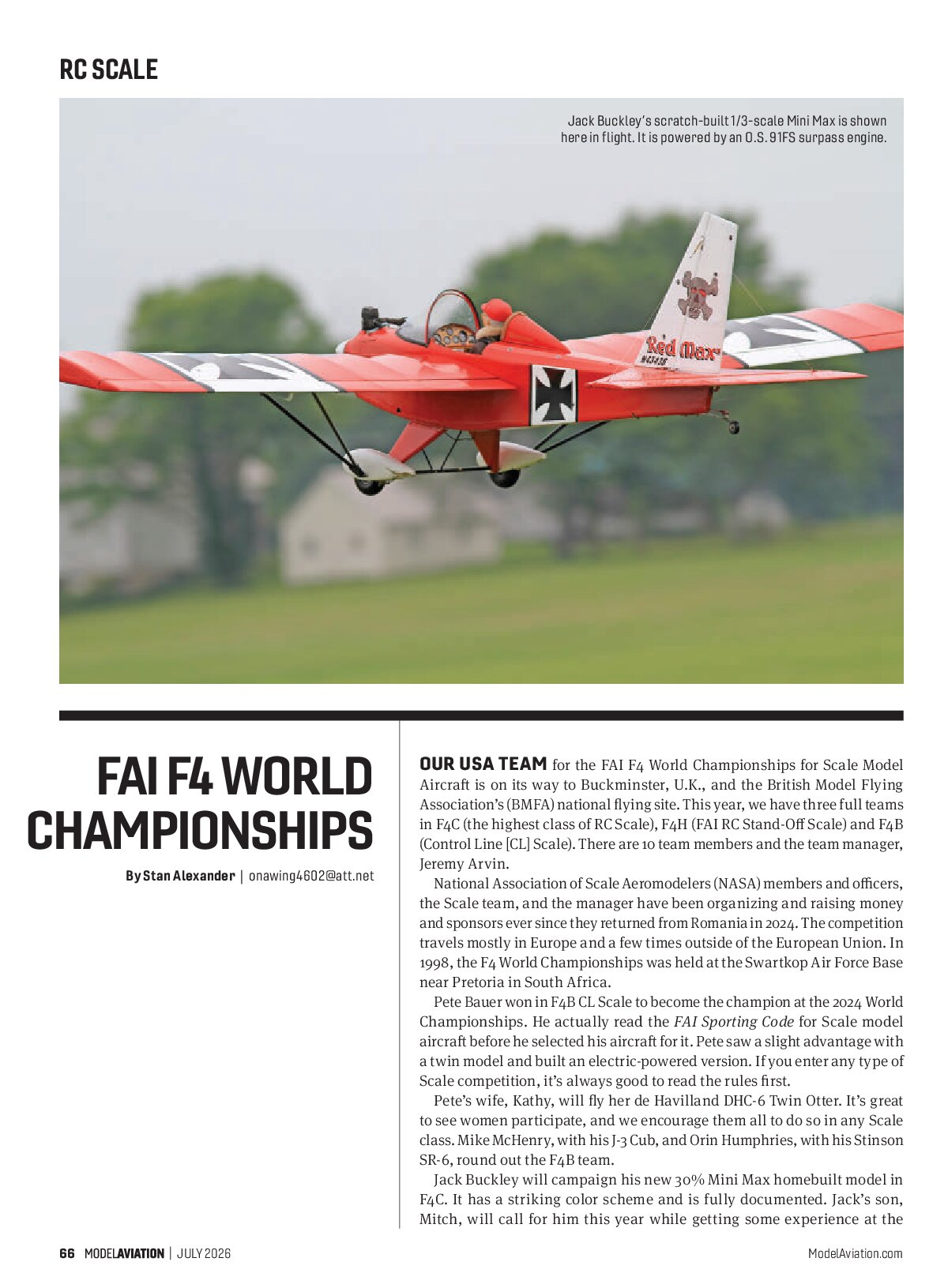
Jack Buckley’s scratch-built 1/3-scale Mini Max is shown here in flight. It is powered by an O.S. 91FS surpass engine.
Our USA team for the FAI F4 World Championships for Scale Model Aircraft is on its way to Buckminster, U.K., and the British Model Flying Association’s (BMFA) national flying site. This year, we have three full teams in F4C (the highest class of RC Scale), F4H (FAI RC Stand-Off Scale) and F4B (Control Line [CL] Scale). There are 10 team members and the team manager, Jeremy Arvin.
National Association of Scale Aeromodelers (NASA) members and officers, the Scale team, and the manager have been organizing and raising money and sponsors ever since they returned from Romania in 2024. The competition travels mostly in Europe and a few times outside of the European Union. In 1998, the F4 World Championships was held at the Swartkop Air Force Base near Pretoria in South Africa.
Pete Bauer won in F4B CL Scale to become the champion at the 2024 World Championships. He actually read the FAI Sporting Code for Scale model aircraft before he selected his aircraft for it. Pete saw a slight advantage with a twin model and built an electric-powered version. If you enter any type of Scale competition, it’s always good to read the rules first.
Pete’s wife, Kathy, will fly her de Havilland DHC-6 Twin Otter. It’s great to see women participate, and we encourage them all to do so in any Scale class. Mike McHenry, with his J-3 Cub, and Orin Humphries, with his Stinson SR-6, round out the F4B team.
Jack Buckley will campaign his new 30% Mini Max homebuilt model in F4C. It has a striking color scheme and is fully documented. Jack’s son, Mitch, will call for him this year while getting some experience at the Worlds. This Mini Max has been called the “giant killer,” finishing much higher in competition than many other models that cost thousands more to build and fly.
Several team members are new or have new models, such as Mike Barbee with his Perceval Petrel Q.6 and Peter Fynn flying his scratch-built Southern Martlet. Keith Numbers will fly his 1/3-scale Royal Aircraft Factory F.E.8, and Ben Andrus has finished his Fairchild 24, which has been in the works for several years.
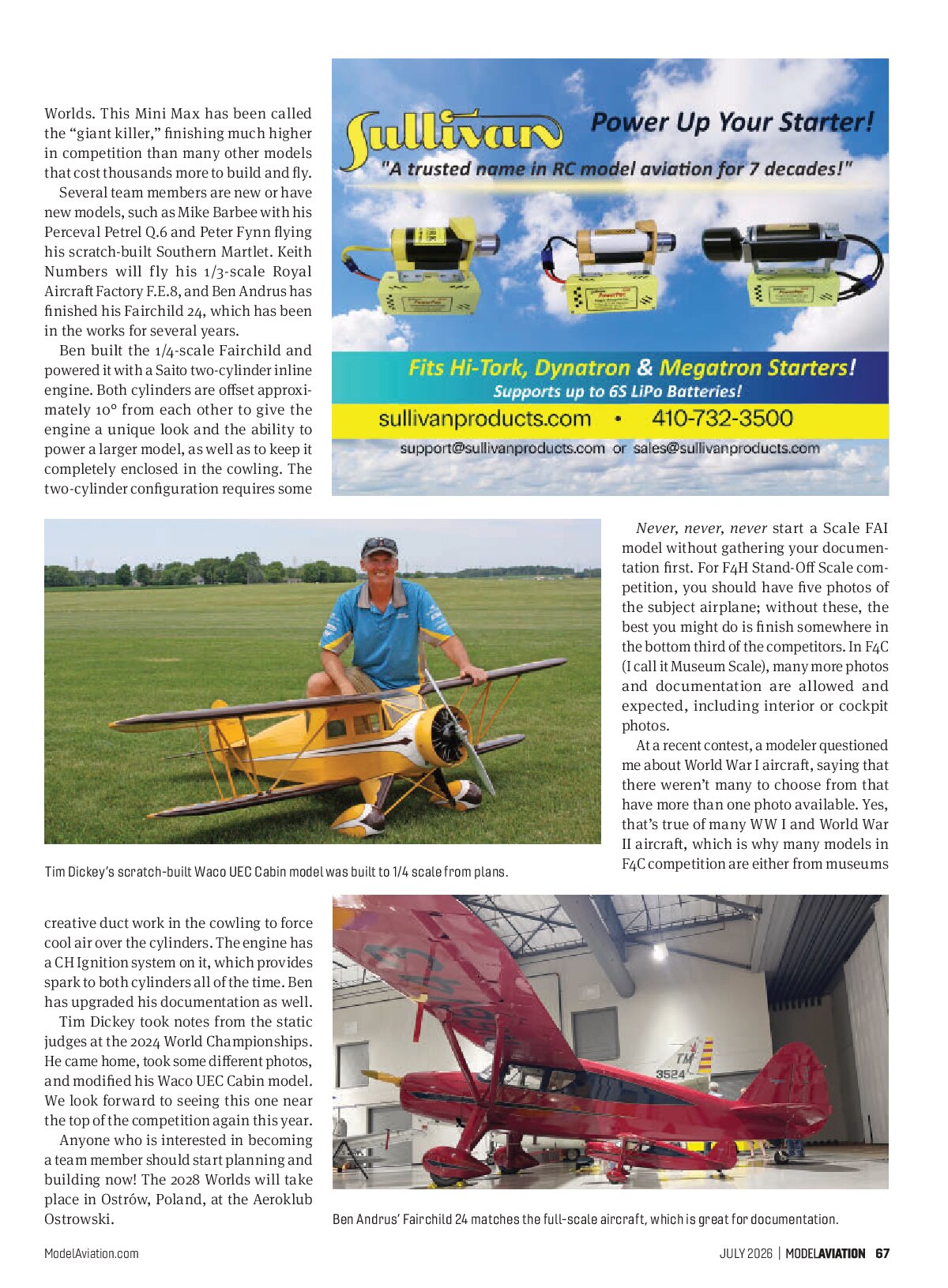
Ben built the 1/4-scale Fairchild and powered it with a Saito two-cylinder inline engine. Both cylinders are offset approximately 10° from each other to give the engine a unique look and the ability to power a larger model, as well as to keep it completely enclosed in the cowling. The two-cylinder configuration requires some creative duct work in the cowling to force cool air over the cylinders. The engine has a CH Ignition system on it, which provides spark to both cylinders all of the time. Ben has upgraded his documentation as well.
Tim Dickey took notes from the static judges at the 2024 World Championships. He came home, took some different photos, and modified his Waco UEC Cabin model. We look forward to seeing this one near the top of the competition again this year.
Anyone who is interested in becoming a team member should start planning and building now! The 2028 Worlds will take place in Ostrów, Poland, at the Aeroklub Ostrowski.
Never, never, never start a Scale FAI model without gathering your documentation first. For F4H Stand-Off Scale competition, you should have five photos of the subject airplane; without these, the best you might do is finish somewhere in the bottom third of the competitors. In F4C (I call it Museum Scale), many more photos and documentation are allowed and expected, including interior or cockpit photos.
At a recent contest, a modeler questioned me about World War I aircraft, saying that there weren’t many to choose from that have more than one photo available. Yes, that’s true of many WW I and World War II aircraft, which is why many models in F4C competition are either from museums or from a modeler’s local source, such as an airport or private field. They have much better access to full-scale aircraft and can document all aspects of the airplane.
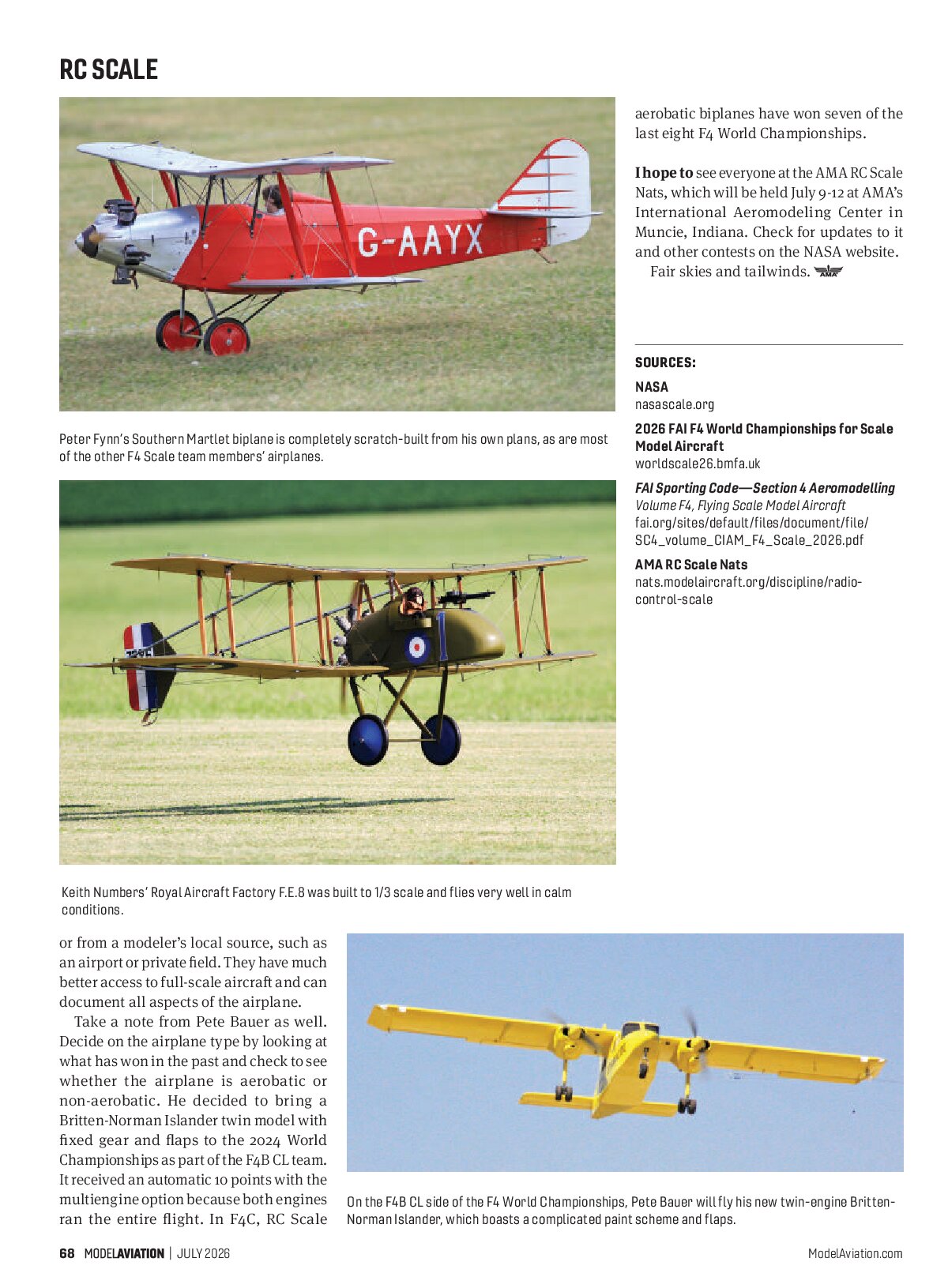
Take a note from Pete Bauer as well. Decide on the airplane type by looking at what has won in the past and check to see whether the airplane is aerobatic or non-aerobatic. He decided to bring a Britten-Norman Islander twin model with fixed gear and flaps to the 2024 World Championships as part of the F4B CL team. It received an automatic 10 points with the multiengine option because both engines ran the entire flight. In F4C, RC Scale aerobatic biplanes have won seven of the last eight F4 World Championships.


I hope to see everyone at the AMA RC Scale Nats, which will be held July 9-12 at AMA’s International Aeromodeling Center in Muncie, Indiana. Check for updates to it and other contests on the NASA website.
Fair skies and tailwinds.


Photo captions
Ben Andrus’ Fairchild 24 matches the full-scale aircraft, which is great for documentation.
On the F4B CL side of the F4 World Championships, Pete Bauer will fly his new twin-engine Britten-Norman Islander, which boasts a complicated paint scheme and flaps.
SOURCES
- NASA
- nasascale.org
- 2026 FAI F4 World Championships for Scale Model Aircraft
- worldscale26.bmfa.uk
- FAI Sporting Code—Section 4 Aeromodelling
Volume F4, Flying Scale Model Aircraft - fai.org/sites/default/files/document/file/SC4_volume_CIAM_F4_Scale_2026.pdf
- AMA RC Scale Nats
- nats.modelaircraft.org/discipline/radio-control-scale