Rules deviation for Q-40 Nelson engines
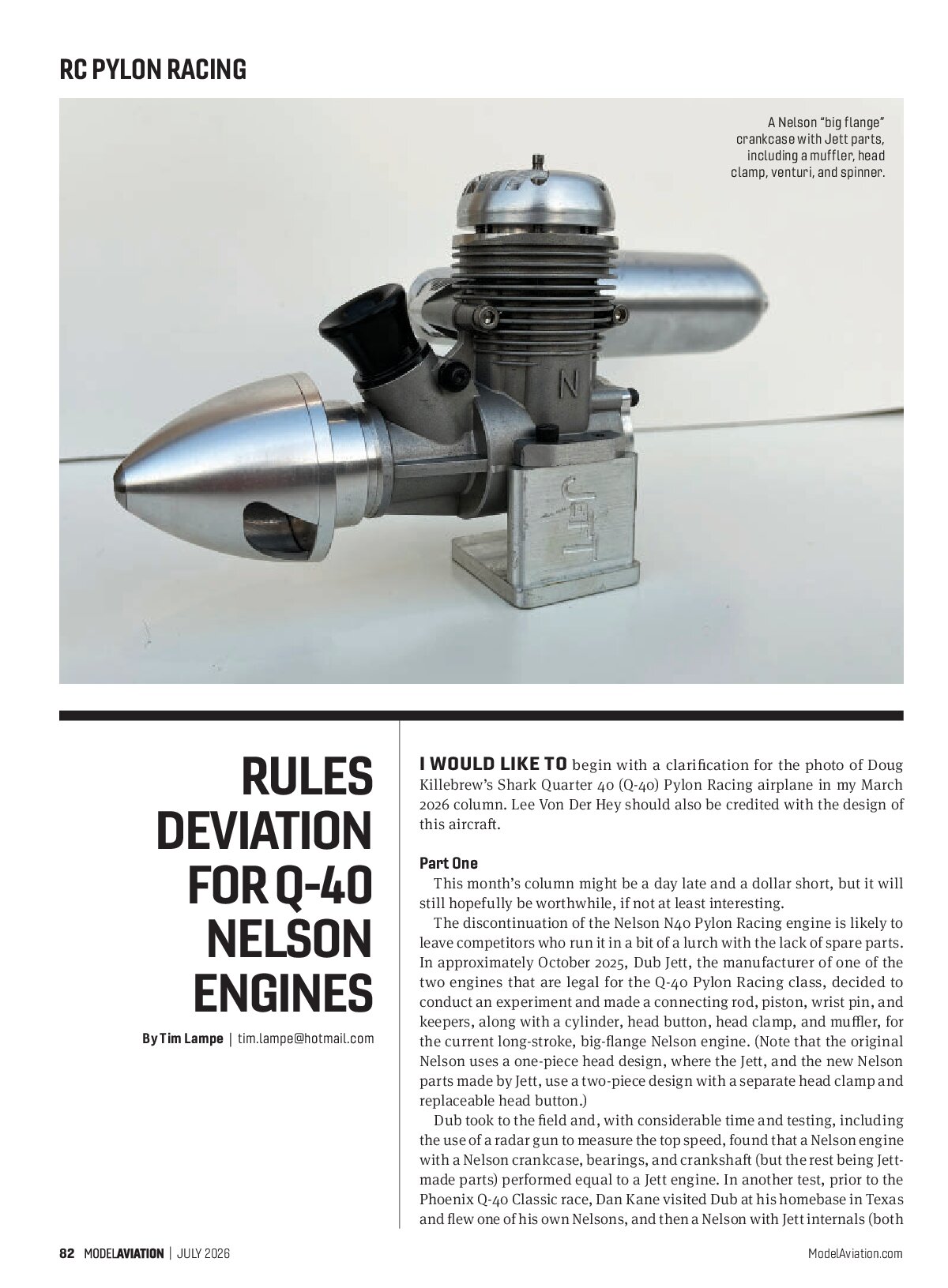
A Nelson “big flange” crankcase with Jett parts, including a muffler, head clamp, venturi, and spinner.
I would like to begin with a clarification for the photo of Doug Killebrew’s Shark Quarter 40 (Q-40) Pylon Racing airplane in my March 2026 column. Lee Von Der Hey should also be credited with the design of this aircraft.
Part One
This month’s column might be a day late and a dollar short, but it will still hopefully be worthwhile, if not at least interesting.
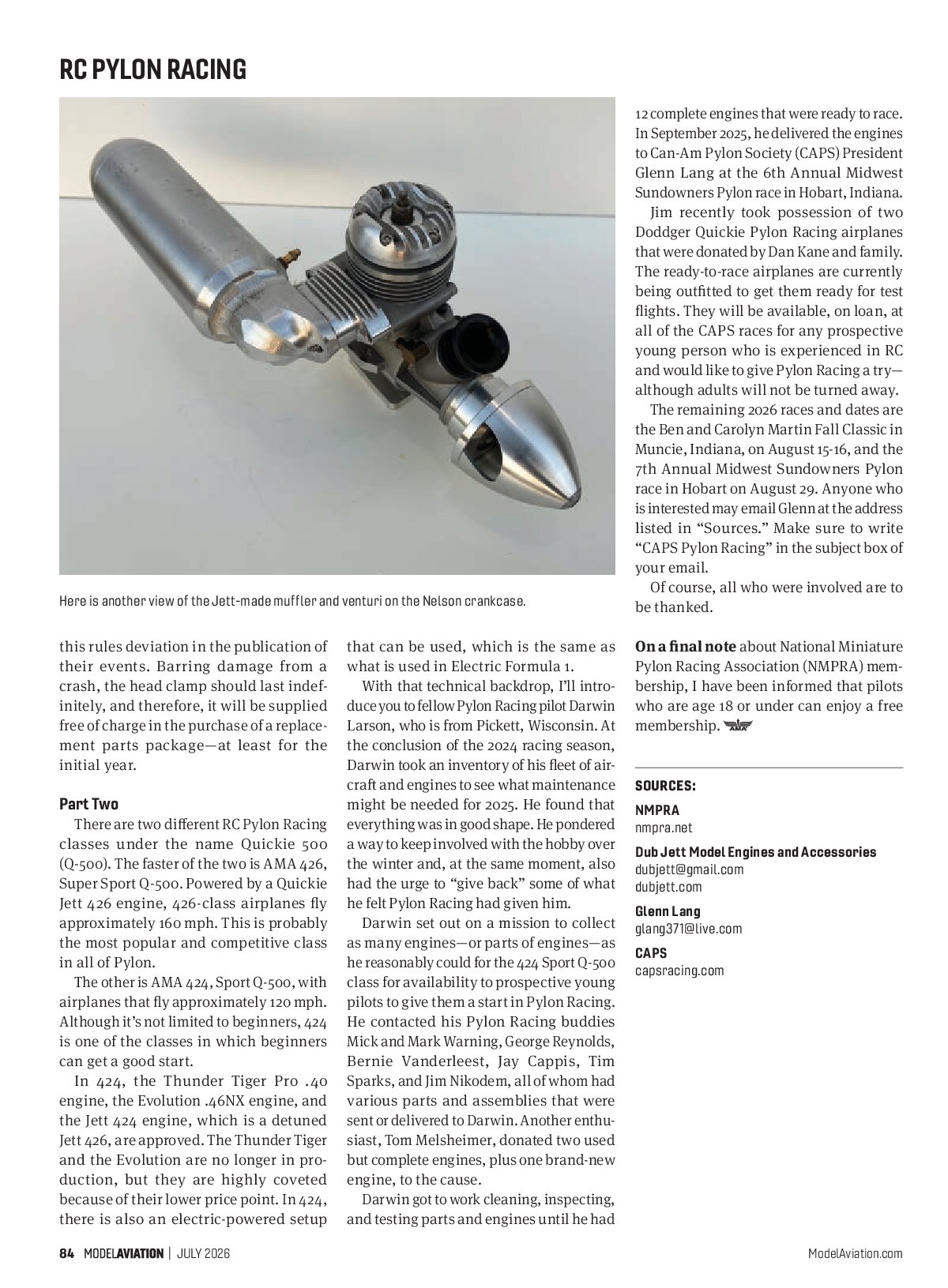
The discontinuation of the Nelson N40 Pylon Racing engine is likely to leave competitors who run it in a bit of a lurch with the lack of spare parts. In approximately October 2025, Dub Jett, the manufacturer of one of the two engines that are legal for the Q-40 Pylon Racing class, decided to conduct an experiment and made a connecting rod, piston, wrist pin, and keepers, along with a cylinder, head button, head clamp, and muffler, for the current long-stroke, big-flange Nelson engine. (Note that the original Nelson uses a one-piece head design, where the Jett, and the new Nelson parts made by Jett, use a two-piece design with a separate head clamp and replaceable head button.)
Dub took to the field and, with considerable time and testing, including the use of a radar gun to measure the top speed, found that a Nelson engine with a Nelson crankcase, bearings, and crankshaft (but the rest being Jett-made parts) performed equal to a Jett engine. In another test, prior to the Phoenix Q-40 Classic race, Dan Kane visited Dub at his homebase in Texas and flew one of his own Nelsons, and then a Nelson with Jett internals (both with a Nelson muffler and with a Nelson muffler made by Jett) in one of his own airplanes. Measured by a radar gun on the course, the results were all identical. Further testing has been conducted with the same results.
Hopefully, this effort will keep the Nelson engine in play. Dub also mentioned the possibility of using the current Jett crankshaft in the Nelson case, only with a different front bearing, but this has not yet been tested, so a replacement crankshaft is not available at this time.
While I’m on the subject of crankshafts, Dub also offered that it is possible to recondition a worn Nelson crankpin by “flash-chroming” and polishing it, as long as the crankpin is still round. There is no plan to make a Nelson crankcase.
In discussing this opportunity with the AMA Pylon Racing Contest Board, Dub stipulated that he would make parts according to the same techniques and philosophy that he uses to make the parts for his own engines. For example, the flange on the Nelson cylinder liner has a larger diameter and is thicker than the flange on the Jett cylinder liner. Although the flange on the Jett-made liner for the Nelson will retain the necessary thickness, the diameter will be smaller to work with the new head button and clamp that were previously mentioned.
Additionally, whereas the wrist pin in the Nelson engine was 5 mm, it will now be 6 mm—the same as the Jett—making it much easier to remove the clips to replace any of the parts that are involved.
While on the subject of cylinder liners, Dub told me that the dry-fit of the Nelson case with his parts is .185 inch, which is the same as the original Nelson engine. The dry-fit of the Jett is typically about .146 inch. The dry-fit is the distance between the top of the piston at top dead center and the top of the cylinder liner with no shims.
The noncurrent, short-stroke version of the Nelson can work with the new Jett parts, but the crankcase has to be modified. With the addition of a .050-inch cylinder-liner shim, which is also available, the small flange, long-stroke Nelson can also be configured to work with the Jett parts, with no modifications required.
Regarding spinners, the Jett spinner will fit the Nelson, but it requires a different tapered collet, propeller washer, and spinner bolt. The spinner kits are on Dub’s website (listed in “Sources”), but I didn’t see the muffler yet or the rest of the parts when I wrote this in the middle of April.
The public announcement to proceed with this endeavor was made at the Phoenix Q-40 Classic in January. Because of the time it takes to adopt new rules, at the time that this column was written, Nelson replacement parts that are made by Jett had not yet been officially approved, but it appears to be a forgone conclusion. In the meantime, contest directors have been urged to announce this rules deviation in the publication of their events. Barring damage from a crash, the head clamp should last indefinitely, and therefore, it will be supplied free of charge in the purchase of a replacement parts package—at least for the initial year.
Part Two
There are two different RC Pylon Racing classes under the name Quickie 500 (Q-500). The faster of the two is AMA 426, Super Sport Q-500. Powered by a Quickie Jett 426 engine, 426-class airplanes fly approximately 160 mph. This is probably the most popular and competitive class in all of Pylon.
The other is AMA 424, Sport Q-500, with airplanes that fly approximately 120 mph. Although it’s not limited to beginners, 424 is one of the classes in which beginners can get a good start.
In 424, the Thunder Tiger Pro .40 engine, the Evolution .46NX engine, and the Jett 424 engine, which is a detuned Jett 426, are approved. The Thunder Tiger and the Evolution are no longer in production, but they are highly coveted because of their lower price point. In 424, there is also an electric-powered setup that can be used, which is the same as what is used in Electric Formula 1.
With that technical backdrop, I’ll introduce you to fellow Pylon Racing pilot Darwin Larson, who is from Pickett, Wisconsin. At the conclusion of the 2024 racing season, Darwin took an inventory of his fleet of aircraft and engines to see what maintenance might be needed for 2025. He found that everything was in good shape. He pondered a way to keep involved with the hobby over the winter and, at the same moment, also had the urge to “give back” some of what he felt Pylon Racing had given him.
Darwin set out on a mission to collect as many engines—or parts of engines—as he reasonably could for the 424 Sport Q-500 class for availability to prospective young pilots to give them a start in Pylon Racing. He contacted his Pylon Racing buddies Mick and Mark Warning, George Reynolds, Bernie Vanderleest, Jay Cappis, Tim Sparks, and Jim Nikodem, all of whom had various parts and assemblies that were sent or delivered to Darwin. Another enthusiast, Tom Melsheimer, donated two used but complete engines, plus one brand-new engine, to the cause.
Darwin got to work cleaning, inspecting, and testing parts and engines until he had 12 complete engines that were ready to race. In September 2025, he delivered the engines to Can-Am Pylon Society (CAPS) President Glenn Lang at the 6th Annual Midwest Sundowners Pylon race in Hobart, Indiana.
Jim recently took possession of two Doddger Quickie Pylon Racing airplanes that were donated by Dan Kane and family. The ready-to-race airplanes are currently being outfitted to get them ready for test flights. They will be available, on loan, at all of the CAPS races for any prospective young person who is experienced in RC and would like to give Pylon Racing a try—although adults will not be turned away.
The remaining 2026 races and dates are the Ben and Carolyn Martin Fall Classic in Muncie, Indiana, on August 15-16, and the 7th Annual Midwest Sundowners Pylon race in Hobart on August 29. Anyone who is interested may email Glenn at the address listed in “Sources.” Make sure to write “CAPS Pylon Racing” in the subject box of your email.
Of course, all who were involved are to be thanked.
On a final note about National Miniature Pylon Racing Association (NMPRA) membership, I have been informed that pilots who are age 18 or under can enjoy a free membership.

SOURCES
- NMPRA
- nmpra.net
- Dub Jett Model Engines and Accessories
dubjett@gmail.com - dubjett.com
- Glenn Lang
- glang371@live.com
- CAPS
- capsracing.com