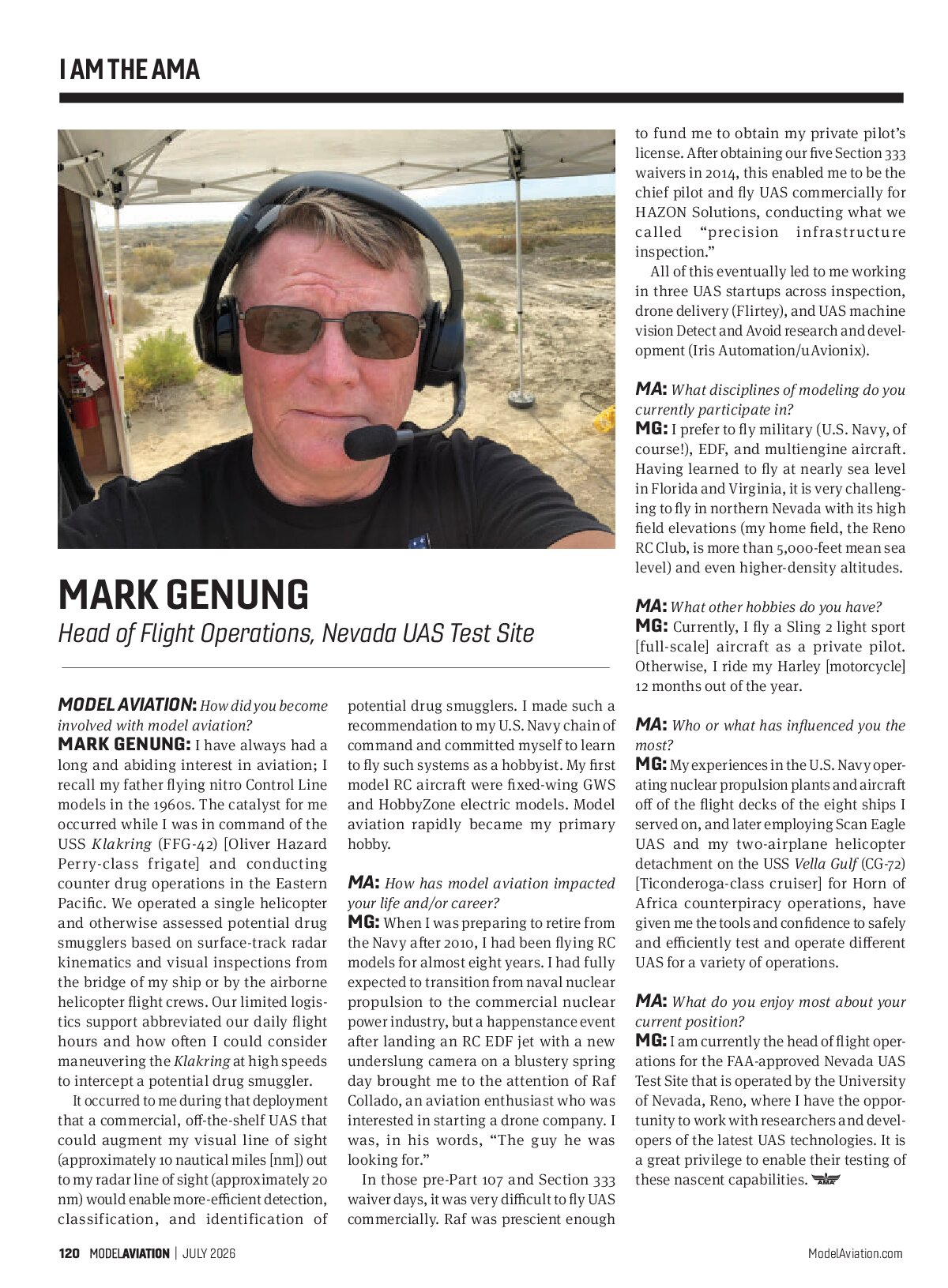
Mark Genung
Head of Flight Operations, Nevada UAS Test Site
Model Aviation: How did you become involved with model aviation?
Mark Genung: I have always had a long and abiding interest in aviation; I recall my father flying nitro Control Line models in the 1960s. The catalyst for me occurred while I was in command of the USS Klakring (FFG-42) [Oliver Hazard Perry-class frigate] and conducting counter drug operations in the Eastern Pacific. We operated a single helicopter and otherwise assessed potential drug smugglers based on surface-track radar kinematics and visual inspections from the bridge of my ship or by the airborne helicopter flight crews. Our limited logistics support abbreviated our daily flight hours and how often I could consider maneuvering the Klakring at high speeds to intercept a potential drug smuggler.
It occurred to me during that deployment that a commercial, off-the-shelf UAS that could augment my visual line of sight (approximately 10 nautical miles [nm]) out to my radar line of sight (approximately 20 nm) would enable more-efficient detection, classification, and identification of potential drug smugglers. I made such a recommendation to my U.S. Navy chain of command and committed myself to learn to fly such systems as a hobbyist. My first model RC aircraft were fixed-wing GWS and HobbyZone electric models. Model aviation rapidly became my primary hobby.
MA: How has model aviation impacted your life and/or career?
MG: When I was preparing to retire from the Navy after 2010, I had been flying RC models for almost eight years. I had fully expected to transition from naval nuclear propulsion to the commercial nuclear power industry, but a happenstance event after landing an RC EDF jet with a new underslung camera on a blustery spring day brought me to the attention of Raf Collado, an aviation enthusiast who was interested in starting a drone company. I was, in his words, “The guy he was looking for.”
In those pre-Part 107 and Section 333 waiver days, it was very difficult to fly UAS commercially. Raf was prescient enough to fund me to obtain my private pilot’s license. After obtaining our five Section 333 waivers in 2014, this enabled me to be the chief pilot and fly UAS commercially for HAZON Solutions, conducting what we called “precision infrastructure inspection.”
All of this eventually led to me working in three UAS startups across inspection, drone delivery (Flirtey), and UAS machine vision Detect and Avoid research and development (Iris Automation/uAvionix).
MA: What disciplines of modeling do you currently participate in?
MG: I prefer to fly military (U.S. Navy, of course!), EDF, and multiengine aircraft. Having learned to fly at nearly sea level in Florida and Virginia, it is very challenging to fly in northern Nevada with its high field elevations (my home field, the Reno RC Club, is more than 5,000-feet mean sea level) and even higher-density altitudes.
MA: What other hobbies do you have?
MG: Currently, I fly a Sling 2 light sport [full-scale] aircraft as a private pilot. Otherwise, I ride my Harley [motorcycle] 12 months out of the year.
MA: Who or what has influenced you the most?
MG: My experiences in the U.S. Navy operating nuclear propulsion plants and aircraft off of the flight decks of the eight ships I served on, and later employing Scan Eagle UAS and my two-airplane helicopter detachment on the USS Vella Gulf (CG-72) [Ticonderoga-class cruiser] for Horn of Africa counterpiracy operations, have given me the tools and confidence to safely and efficiently test and operate different UAS for a variety of operations.
MA: What do you enjoy most about your current position?
MG: I am currently the head of flight operations for the FAA-approved Nevada UAS Test Site that is operated by the University of Nevada, Reno, where I have the opportunity to work with researchers and developers of the latest UAS technologies. It is a great privilege to enable their testing of these nascent capabilities.