Are you interested in sharing your handiwork? Visit ModelAviation.com for submission guidelines.
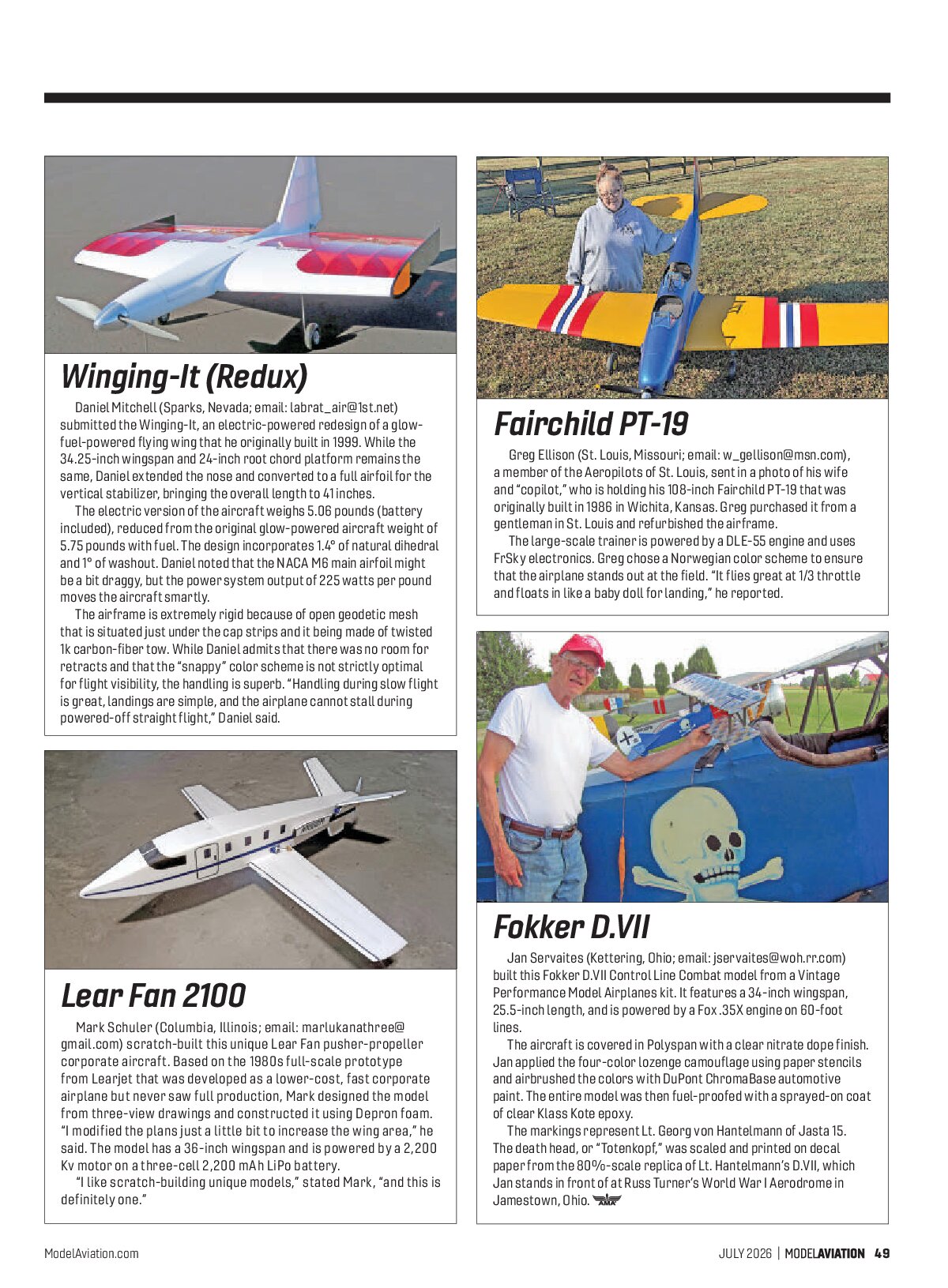
Siblings Nolan (age 8) and Amelia (age 5) Nagley, from Redmond, Washington, launched their RC journey with a Timber Evolution that was rescued from a trash can. “It needed some love to become airworthy,” said their father, Mark Nagley (email: mark.nagley@gmail.com). After the bad servos were swapped out and a few cracks repaired, it was flying again.
The family also refurbished a Sig Mfg. Clipped-Wing Cub that they picked up at a swap meet, powering it with a 710 Kv motor on a 4S battery and a Spektrum radio.
Nolan has discovered a passion for the workshop and is currently building an Easy Sport 60, while Amelia “insists on doing everything her big brother does.” As future fourth-generation RC pilots, the siblings are learning the full spectrum of the hobby by building, refurbishing, and repairing, as well as flying at Marymoor Park in Redmond.
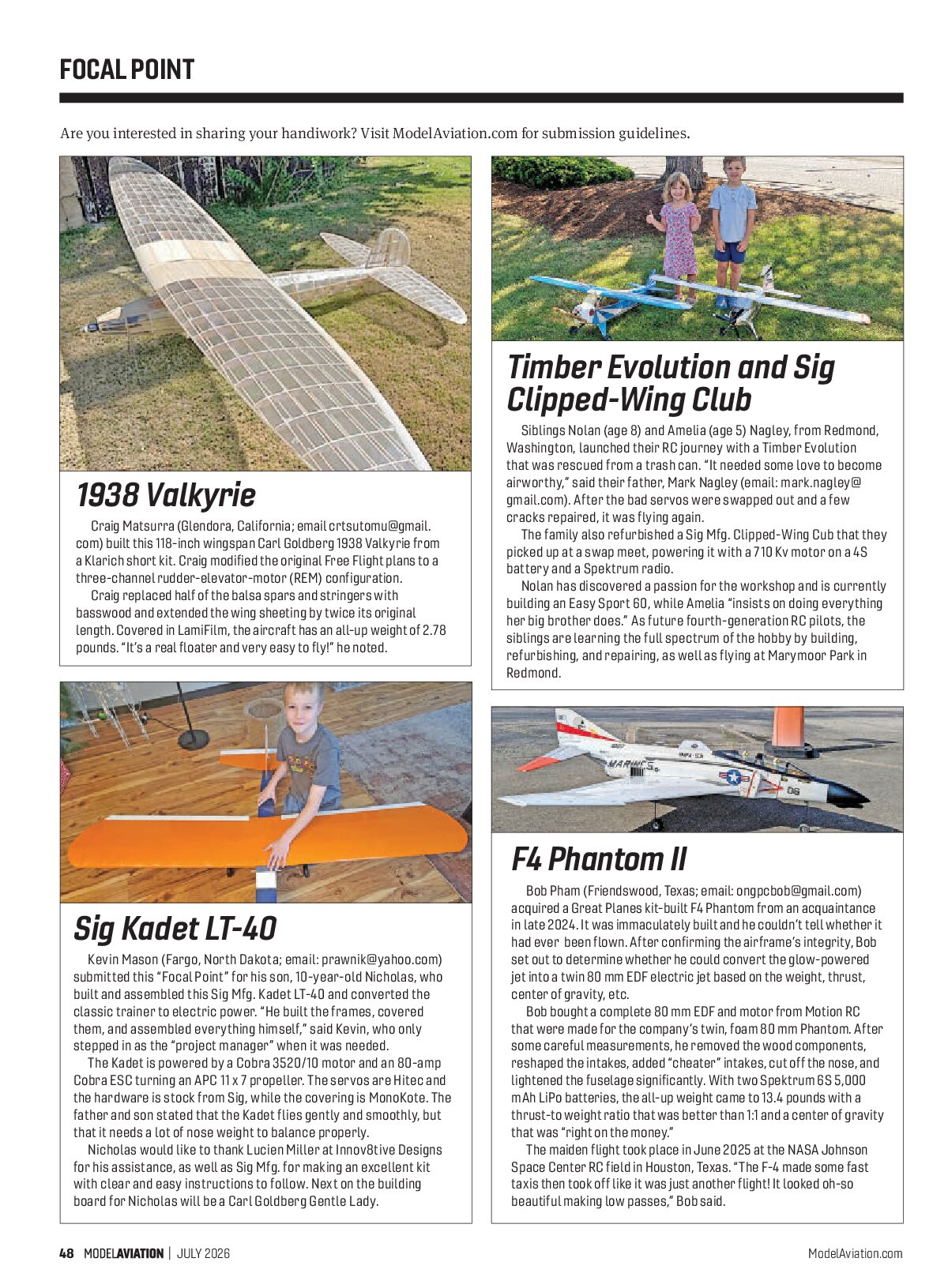
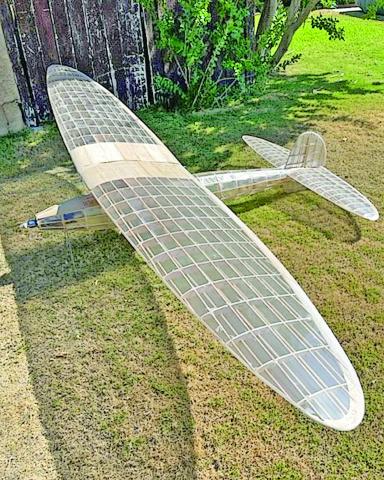
Craig Matsurra (Glendora, California; email crtsutomu@gmail.com) built this 118-inch wingspan Carl Goldberg 1938 Valkyrie from a Klarich short kit. Craig modified the original Free Flight plans to a three-channel rudder-elevator-motor (REM) configuration.
Craig replaced half of the balsa spars and stringers with basswood and extended the wing sheeting by twice its original length. Covered in LamiFilm, the aircraft has an all-up weight of 2.78 pounds. “It’s a real floater and very easy to fly!” he noted.
Bob Pham (Friendswood, Texas; email: ongpcbob@gmail.com) acquired a Great Planes kit-built F4 Phantom from an acquaintance in late 2024. It was immaculately built and he couldn’t tell whether it had ever been flown. After confirming the airframe’s integrity, Bob set out to determine whether he could convert the glow-powered jet into a twin 80 mm EDF electric jet based on the weight, thrust, center of gravity, etc.
Bob bought a complete 80 mm EDF and motor from Motion RC that were made for the company’s twin, foam 80 mm Phantom. After some careful measurements, he removed the wood components, reshaped the intakes, added “cheater” intakes, cut off the nose, and lightened the fuselage significantly. With two Spektrum 6S 5,000 mAh LiPo batteries, the all-up weight came to 13.4 pounds with a thrust-to weight ratio that was better than 1:1 and a center of gravity that was “right on the money.”
The maiden flight took place in June 2025 at the NASA Johnson Space Center RC field in Houston, Texas. “The F-4 made some fast taxis then took off like it was just another flight! It looked oh-so beautiful making low passes,” Bob said.
Kevin Mason (Fargo, North Dakota; email: prawnik@yahoo.com) submitted this “Focal Point” for his son, 10-year-old Nicholas, who built and assembled this Sig Mfg. Kadet LT-40 and converted the classic trainer to electric power. “He built the frames, covered them, and assembled everything himself,” said Kevin, who only stepped in as the “project manager” when it was needed.
The Kadet is powered by a Cobra 3520/10 motor and an 80-amp Cobra ESC turning an APC 11 x 7 propeller. The servos are Hitec and the hardware is stock from Sig, while the covering is MonoKote. The father and son stated that the Kadet flies gently and smoothly, but that it needs a lot of nose weight to balance properly.
Nicholas would like to thank Lucien Miller at Innov8tive Designs for his assistance, as well as Sig Mfg. for making an excellent kit with clear and easy instructions to follow. Next on the building board for Nicholas will be a Carl Goldberg Gentle Lady.


Daniel Mitchell (Sparks, Nevada; email: labrat_air@1st.net) submitted the Winging-It, an electric-powered redesign of a glow-fuel-powered flying wing that he originally built in 1999. While the 34.25-inch wingspan and 24-inch root chord platform remains the same, Daniel extended the nose and converted to a full airfoil for the vertical stabilizer, bringing the overall length to 41 inches.
The electric version of the aircraft weighs 5.06 pounds (battery included), reduced from the original glow-powered aircraft weight of 5.75 pounds with fuel. The design incorporates 1.4° of natural dihedral and 1° of washout. Daniel noted that the NACA M6 main airfoil might be a bit draggy, but the power system output of 225 watts per pound moves the aircraft smartly.
The airframe is extremely rigid because of open geodetic mesh that is situated just under the cap strips and it being made of twisted 1k carbon-fiber tow. While Daniel admits that there was no room for retracts and that the “snappy” color scheme is not strictly optimal for flight visibility, the handling is superb. “Handling during slow flight is great, landings are simple, and the airplane cannot stall during powered-off straight flight,” Daniel said.
Greg Ellison (St. Louis, Missouri; email: w_gellison@msn.com), a member of the Aeropilots of St. Louis, sent in a photo of his wife and “copilot,” who is holding his 108-inch Fairchild PT-19 that was originally built in 1986 in Wichita, Kansas. Greg purchased it from a gentleman in St. Louis and refurbished the airframe.
The large-scale trainer is powered by a DLE-55 engine and uses FrSky electronics. Greg chose a Norwegian color scheme to ensure that the airplane stands out at the field. “It flies great at 1/3 throttle and floats in like a baby doll for landing,” he reported.
Jan Servaites (Kettering, Ohio; email: jservaites@woh.rr.com) built this Fokker D.VII Control Line Combat model from a Vintage Performance Model Airplanes kit. It features a 34-inch wingspan, 25.5-inch length, and is powered by a Fox .35X engine on 60-foot lines.
The aircraft is covered in Polyspan with a clear nitrate dope finish. Jan applied the four-color lozenge camouflage using paper stencils and airbrushed the colors with DuPont ChromaBase automotive paint. The entire model was then fuel-proofed with a sprayed-on coat of clear Klass Kote epoxy.
The markings represent Lt. Georg von Hantelmann of Jasta 15. The death head, or “Totenkopf,” was scaled and printed on decal paper from the 80%-scale replica of Lt. Hantelmann’s D.VII, which Jan stands in front of at Russ Turner’s World War I Aerodrome in Jamestown, Ohio.
Mark Schuler (Columbia, Illinois; email: marlukanathree@gmail.com) scratch-built this unique Lear Fan pusher-propeller corporate aircraft. Based on the 1980s full-scale prototype from Learjet that was developed as a lower-cost, fast corporate airplane but never saw full production, Mark designed the model from three-view drawings and constructed it using Depron foam. “I modified the plans just a little bit to increase the wing area,” he said. The model has a 36-inch wingspan and is powered by a 2,200 Kv motor on a three-cell 2,200 mAh LiPo battery.
“I like scratch-building unique models,” stated Mark, “and this is definitely one.”