
Learn to Walk Before You Fly
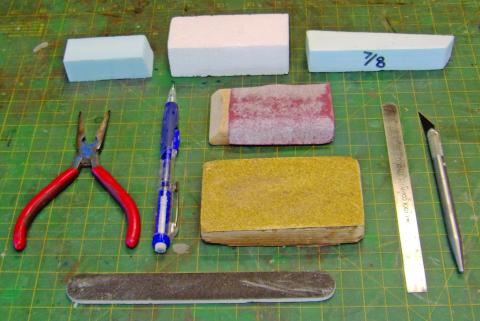
A lineup of the hand tools that you’ll need to get started in building your first simple kit.
Small-Field Flying
This issue of Model Aviation magazine is dedicated to newcomers in the hobby, so I thought that, because my column is basically geared toward building the models we fly, I’d offer up a few tips for getting off to a good start with developing your modeling skills.
From the rank of beginner to “modeler,” it’s essential that you start with a simple project that you can finish. Building models is no different from learning to play a musical instrument; if you plan on being successful, you simply have to start at the beginning and build your skills along the way. I’ve been building models for nearly 67 years and still learn something from almost every modeling project.
Where does a new builder go to get started? My suggestion has always been to start with a simple kit, whether it is Free Flight (FF), Control Line (CL), or RC. Much of the success in modeling is determined by the builder’s ability to read and interpret the plans and instructions that are provided in the kit. When it comes to reading plans, volumes could be written on the subject, and for that reason, starting simple will add to your skills a little at a time without the risk of overwhelming the fledgling modeler.
Even for an RC flier, it’s not necessary to start with an RC kit; after all, the goal is to learn to build, which you can do while you’re flying the models you already have. Starting with something such as the Guillow’s Simple Build n’ Fly Series Fly Boy (Kit 4401) will kick off the learning process at the ground floor with deciphering the plans, learning the terminology, and following basic building instructions.
Building a simple kit doesn’t require anything exotic in the way of tools—only basic items such as a hobby knife, common hand tools, and sandpaper are needed. In the end, you don’t even need to cover your first model; simply finish the basic structure and hang it in your shop as an incentive to move on to more complex projects.
Another good place to start for someone who has already done some building but might have been away for some time is with a model such as those from Stevens AeroModel. The company offers a number of kits that are well engineered, easy to build, and proven to be good flyers. Included in its lineup are a several excellent three- and four-channel RC trainers, as well as more advanced kits for those who have some building and flying experience.
Once you have a few rudimentary builds under your belt, there are more advanced FF, RC, and even CL kits available from companies such as Guillow’s and Brodak Manufacturing that are geared toward the experienced modeler, with a wide variety of available modeling subjects.
Sanding plays a big part in a nicely finished model; here’s a tip I received not long ago from a friend and fellow FFer, Gregg Goris. He and I were discussing sanding techniques that are used on the more-delicate FF structures but will also work on larger models. Holding frames in place while sanding can be a real challenge, but he suggested to first tape a sheet of medium-grit sandpaper to the building board rough-side-up, and then lay the part to be sanded on that.
With the part held securely in place, use a block or bar sander to sand it into uniform thickness. Various sizes of sanding blocks can be easily made from pine blocks, with the sandpaper secured using spray adhesive. Two different grits of sandpaper on each block will allow both rough- and finish-sanding using the same block. You can also make various shapes that will aid in other areas of the frames that are being shaped and sanded.
The bottom line when it comes to learning to build and developing your modeling skills and building style is to start simple. In other words, learn to walk before you run. Everyone loves a fire-breathing warbird, but because of their inherent complexity, those types of models aren’t well-suited for the young builder. After all, the goal of learning to build and fly our model airplanes is success, and, in the giant scheme of things, success will undoubtedly be your greatest motivator.
My advice is this: Start simple and strive toward the more complex models in small steps. As you progress, the tools for them can be acquired a little at a time until you find that you have a well-equipped shop with everything you need to build some beautiful models.

Throughout the years, I’ve had the opportunity to build and fly many types of models, starting with FF, then advancing to CL, and, finally, into RC. All three provide challenges that are unique unto themselves, but in every case, the basic building techniques that are required are very similar. They have all provided the knowledge, skill, and confidence for one another.
The one thing I can say without reservation is that there is no greater satisfaction in this hobby than that which comes from flying a model you have built with your own hands.


SOURCES
- Guillow’s
(781) 245-5255 - guillow.com
- Stevens AeroModel
(719) 387-4187 - stevensaero.com
- Easy Built Models
(334) 358-5184 - easybuiltmodels.com
- Brodak Manufacturing
(724) 966-2726 - brodak.com


