Steps to Learning New Sequences
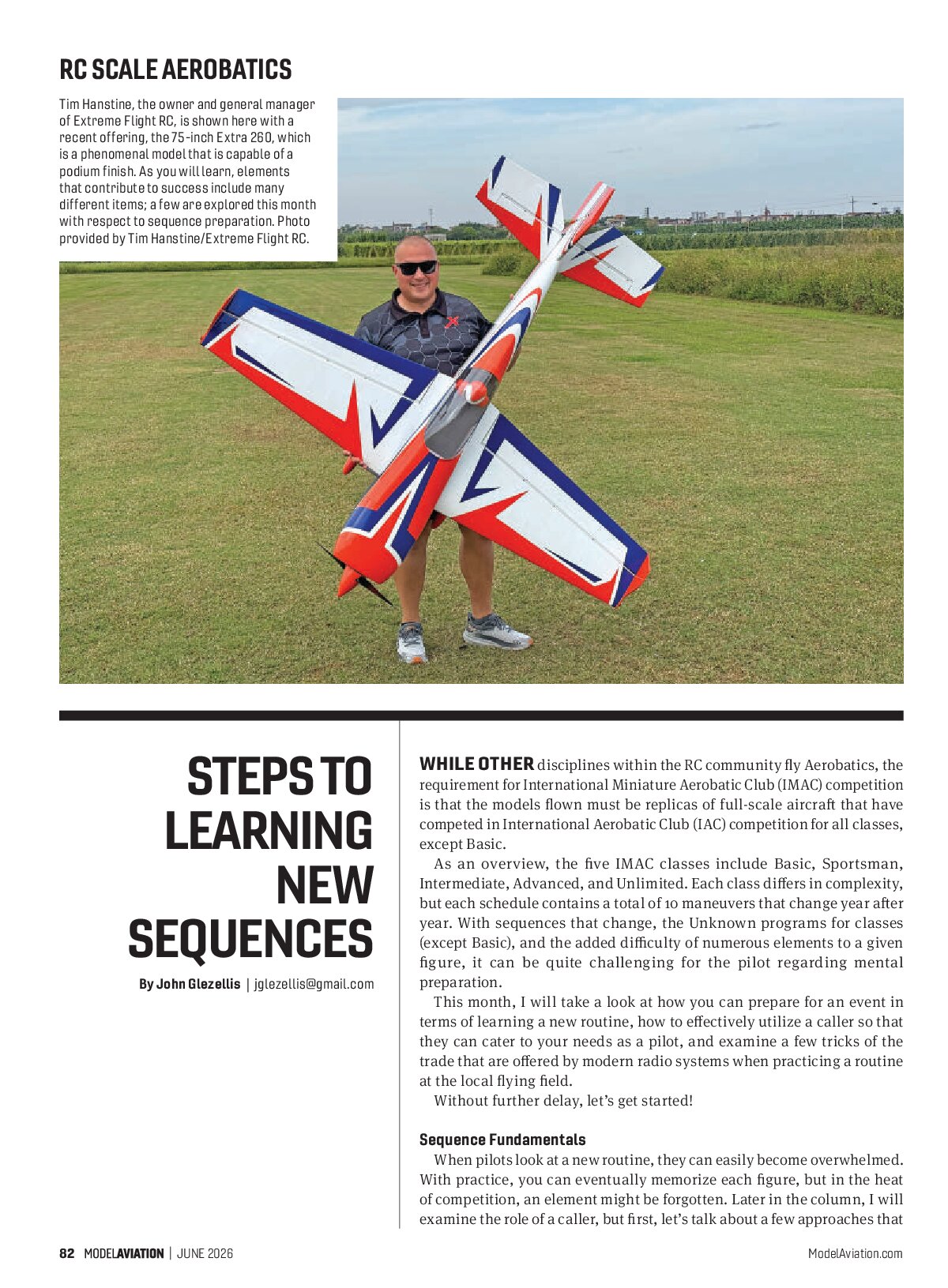
Tim Hanstine, the owner and general manager of Extreme Flight RC, is shown here with a recent offering, the 75-inch Extra 260, which is a phenomenal model that is capable of a podium finish. As you will learn, elements that contribute to success include many different items; a few are explored this month with respect to sequence preparation. Photo provided by Tim Hanstine/Extreme Flight RC.
While other disciplines within the RC community fly Aerobatics, the requirement for International Miniature Aerobatic Club (IMAC) competition is that the models flown must be replicas of full-scale aircraft that have competed in International Aerobatic Club (IAC) competition for all classes, except Basic.
As an overview, the five IMAC classes include Basic, Sportsman, Intermediate, Advanced, and Unlimited. Each class differs in complexity, but each schedule contains a total of 10 maneuvers that change year after year. With sequences that change, the Unknown programs for classes (except Basic), and the added difficulty of numerous elements to a given figure, it can be quite challenging for the pilot regarding mental preparation.
This month, I will take a look at how you can prepare for an event in terms of learning a new routine, how to effectively utilize a caller so that they can cater to your needs as a pilot, and examine a few tricks of the trade that are offered by modern radio systems when practicing a routine at the local flying field.
Without further delay, let’s get started!
Sequence Fundamentals
When pilots look at a new routine, they can easily become overwhelmed. With practice, you can eventually memorize each figure, but in the heat of competition, an element might be forgotten. Later in the column, I will examine the role of a caller, but first, let’s talk about a few approaches that I have taken when I’m learning a new sequence.
As with all things, what might work for one individual might not always work for another. Use the items below as a guide and modify them, as needed, to cater to your needs.
In short, the steps that I follow include:
- Begin by visiting the official IMAC website, listed in “Sources,” and print out a copy of the sequence in Aresti form.
- Using a pencil, mark specific elements of the figure in terms of what a hesitation roll, snap roll, and spin are, as well as the required number of rotations.
- Note any pull or push element that is either a solid or dashed radius, as well as upright and inverted entries and/or exits to each maneuver.
- Before typing or writing out a routine, I prefer to “fly” the program with a stick airplane to visualize the timing and positioning of each figure. Document any exit that must be high in altitude, for example, to allow sufficient altitude for the following maneuver.
To illustrate this, the 2026 Basic class requires you to complete a large Immelmann turn (maneuver four). This then allows for sufficient space to perform a 45° downline that is centered on the pilot. These reminders can then be mentioned in the individual maneuver descriptions in the step that follows.
For a Known program, I will then type the sequence out. Even if a given routine can be found written out online, I will take the time to type out each figure in the exact way that I prefer my caller to read it back to me.
For example, with the second maneuver of the 2026 Advanced Known program, the pilot performs a half-reverse Cuban 8 that features a 3/4 roll, followed by three points of a four-point roll in the opposite direction on the upline. You might prefer to have your caller read out, “Perform a 3/4 roll to the left. See the top of the model, and then three of four to the right on the upline.” Or, you might prefer, “Pull to a 45° upline followed by a 3/4 roll and an opposite-direction three points of a four-point roll.” In short, some prefer their caller to read out directions, while others prefer to list the action needed, etc.
- Should you wish to omit the earlier step or check to ensure that your understanding of the figure is accurate, written sequences are available on the IMAC website under “2026 Knowns,” and then by selecting “2026 Call Sheets.”
- For any directional items that might change when wind is present, I will typically leave an underscore when I’m typing the routine out. Once it’s printed, I will keep a few copies in my flight box and/or transmitter case and will write in the directional element the day of the event.

Another option that I have done in the past is to have four versions of the same routine, with all directional elements written out for a left to right start, a right to left start, or wind blowing in or out for any cross-box elements.
If time allows, for a Known program, I might spend time on the flight simulator going over the sequence and familiarizing myself with the orientation of the airplane at different segments of each maneuver. When you attempt your first few flights outdoors, I recommend that you take a step back and try each maneuver separately.
In summary, don’t overwhelm yourself by taking off and starting the entire routine. When you’re at the local flying field, bring a copy of the Aresti diagrams for your competition class, as well as a written description of the sequence, so that a fellow club member can read it for you while you are flying. Remember, even if you are familiar with Aresti, not everyone is.
A caller is someone who stands behind the pilot and lets them know what maneuver is next, as well as the individual elements that are found within that figure. Callers can also remind the pilot of certain positioning techniques for maneuver placement, what rates and/or flight modes you will need to utilize to perform a specific element, which direction to pivot should a Hammerhead be performed into the wind, and so forth.
Consider the caller as an extension of the pilot at times. Because the caller is looking at what maneuver is next, they might also have time to view the figure and offer certain tips to ensure that proper control inputs are given to result in the best geometric representation of the figure. The caller also serves as a spotter to watch for other aircraft in the air!
Having a consistent caller, especially at an event, is important because everyone has a slightly different style and preferred timing for reading off the description of the maneuver.
Trick for Transmitter Audio Alerts
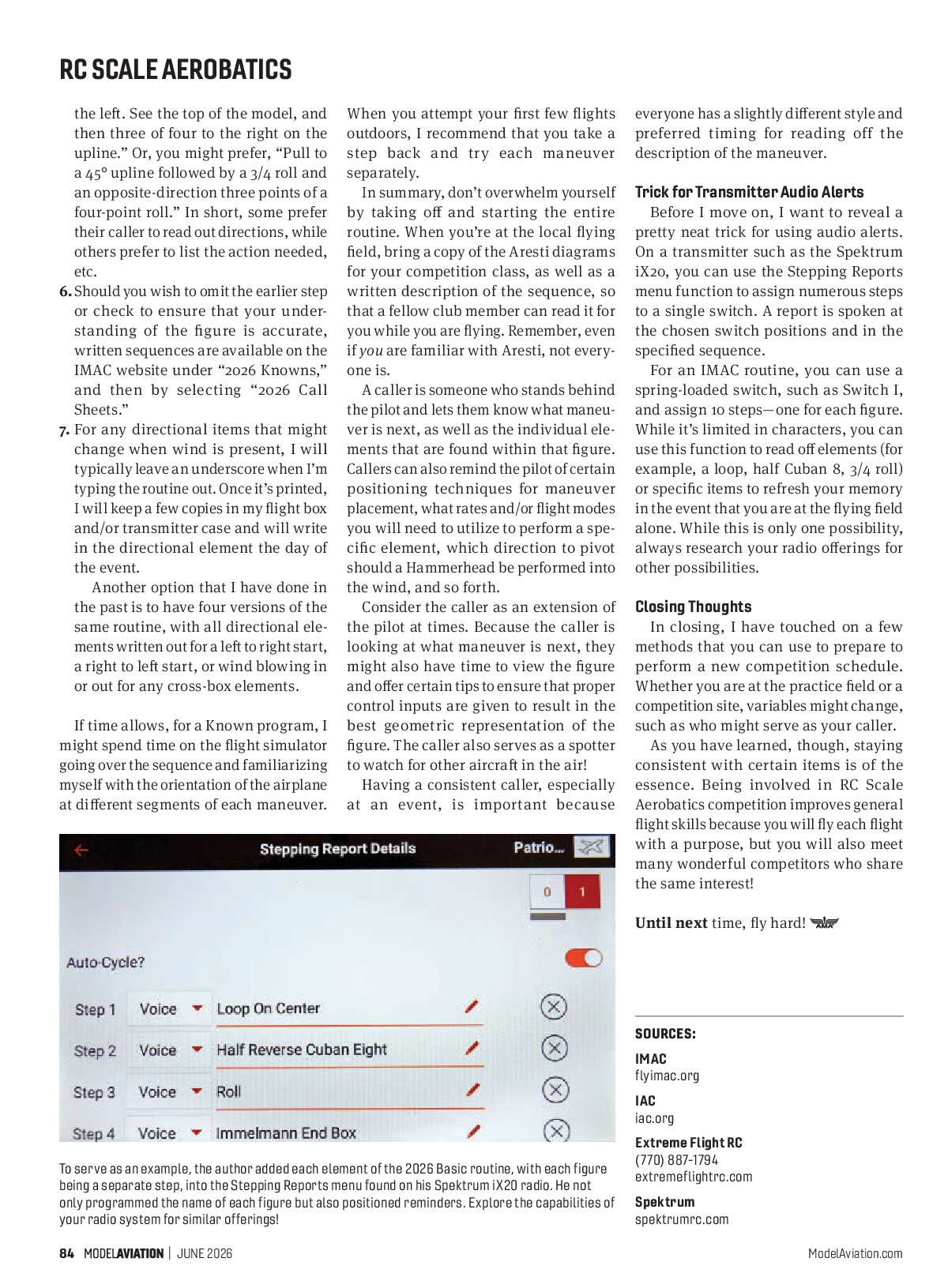
Before I move on, I want to reveal a pretty neat trick for using audio alerts. On a transmitter such as the Spektrum iX20, you can use the Stepping Reports menu function to assign numerous steps to a single switch. A report is spoken at the chosen switch positions and in the specified sequence.
For an IMAC routine, you can use a spring-loaded switch, such as Switch I, and assign 10 steps—one for each figure. While it’s limited in characters, you can use this function to read off elements (for example, a loop, half Cuban 8, 3/4 roll) or specific items to refresh your memory in the event that you are at the flying field alone. While this is only one possibility, always research your radio offerings for other possibilities.
Closing Thoughts
In closing, I have touched on a few methods that you can use to prepare to perform a new competition schedule. Whether you are at the practice field or a competition site, variables might change, such as who might serve as your caller.
As you have learned, though, staying consistent with certain items is of the essence. Being involved in RC Scale Aerobatics competition improves general flight skills because you will fly each flight with a purpose, but you will also meet many wonderful competitors who share the same interest!
Until next time, fly hard!

SOURCES
- IMAC
- flyimac.org
- IAC
- iac.org
- Extreme Flight RC
(770) 887-1794 - extremeflightrc.com
- Spektrum
spektrumrc.com