
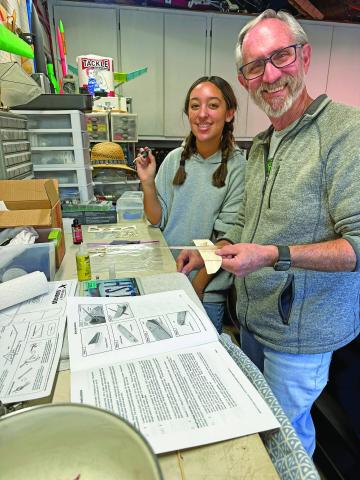
Tim Bailiff (aka Grandpa) helps his granddaughter, Brooke, build her glider. Photo by Maggie Madril.
Being a Grandpa Has Its Rewards
By Tim Bailiff | casurfish@aol.com
Welcome, my friends. It’s good to have you back. This month, I’d like to share with you an experience that I recently had. For you older modelers, I’m sure many of you have had similar experiences. For you younger pilots, it’s guaranteed that your time will come. I’m speaking of having the opportunity and privilege of sharing your modeling and piloting knowledge with someone else. Whether it’s with fellow pilots at the flying field or family members in my workshop, I’m always eager to share some of the knowledge I’ve acquired. Although it’s hard to believe, after 70-plus years, some of it is actually good information!


Several evenings ago, my teenage granddaughter, Brooke, approached me with a request. She asked whether I could help her build a small balsa glider. “What?” I said. “Wait, I mean yes … Yes!” Her question caught me by surprise, but I was absolutely delighted that she had asked. I was aware that she had recently joined the Civil Air Patrol (CAP); however, that was all I knew.
She then went on to explain that her squadron was being taught basic aerodynamics. The instructor offered them model gliders as a way to help the cadets learn about airplanes and flight in general. The glider kit was a Stevens AeroModel SCImOn 20. It’s a beautifully engineered little project designed for club and educational programs. It proved to be perfect for Brooke’s first build.
What fun we both had! The kit was laser-cut so that the pieces were easily removed from the balsa sheet. Brooke read the instruction manual, which described each piece and told her what they were and where they should go. The kit even came with a nice plans set. I showed her how to gently sand a few rough spots and round off the leading and trailing edges. I also taught her how to carefully use CA glue and kicker.
That evening, she learned about its three-piece wing and the fuselage, what dihedral was, and where the wing should be positioned. She saw how to align the wing so that it was straight and true, and she learned where to glue the horizontal and vertical stabilizers. I was amazed at her interest and the appropriate questions that she asked. Hey, she was really getting it!
The project then became even more interesting. As it turned out, this was a Catapult Glider, so it came complete with a small dowel and a fairly large rubber band. It also came with plywood doublers, of which Brooke glued to either side of the glider’s hooked nose. I explained that plywood is harder and tougher than balsa and would keep the little hook that is carved in its nose from ripping off. I also added that it gave strength to the entire nose area in general, which was good to have should the glider fly into something.
Finally, all of the construction was done and all she had left was to balance her glider. I explained that all airplanes and gliders have a center of gravity around which they must balance. In this case, the little wing halves had etched dots that showed her exactly where the model should balance. By design, one of the plywood nose doublers had a slot cut into it. This was where the manual instructed her to add little bits of clay (also included in the kit) until the glider sat nice and level when it was lifted right under the wing dots. I could see the excitement in her eyes when it was done. She knew that the next step was the test flight!
Off to the front yard we strolled. During our short walk, I explained what possibilities she should expect. I explained to her tail heavy versus nose heavy, what each would do to the airplane, and what it would look like in the air. I then told her how adding or removing clay could remedy the problem.
I showed Brooke where to grab her glider under the wing in order to launch it. Because there was a slight breeze, I instructed her to launch into the wind, explaining that even full-scale airplanes and gliders do the same. I also told her that a gentle push forward was all that was needed for this first flight and that more was not better. I explained further that we were not going to use the catapult that evening, mainly because I didn’t want to retrieve her glider from the roof!
When we were in position, Brooke faced into the wind and launched her glider. Believe it or not, on her very first toss, it gracefully flew all the way across our yard and gently touched down on the grass. It was balanced perfectly, and her first maiden flight ever was a resounding success. A dozen more flights were successfully made, and our great evening of modeling and flying ended with a high five. She then told me how happy she was and ole Grandpa got a hug and a kiss on the cheek (happy tears). Yes, being a grandpa has its rewards!
As of this writing, Brooke wants to become a pilot. If all goes according to her plan, she’d like to fly for the U.S. Air Force. I pray that God flies with her and keeps her (and her airplane) healthy and safe.


My friends, thank you for allowing me to share my wonderful grandpa experience with you. I wish you many happy and memorable experiences as well.
If I might suggest, always share your knowledge and wisdom with family and friends. Be particularly mindful of your fledgling pilots and modelers. The interactions you have with them serve as valuable memories for you as well.
Until my next column, I wish you calm air and blue skies. Stay safe and be well. Fun stuff …


SOURCES
- Stevens AeroModel
(719) 387-4187 - stevensaero.com


