
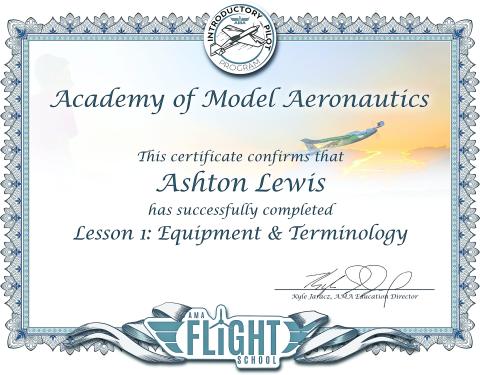
Certificates are issued after each lesson is successfully completed.
Introducing the AMA Intro Pilot Ground School
By Kyle Jaracz, AMA Education Director |
kylej@modelaircraft.org
Greetings, everyone! I’ve been excited to share this news with you for some time now, but we had to ensure that the beta-testing was completed before we cleared the runway for a full release.
I am thrilled to announce that we have officially migrated our Intro Pilot Ground School training into Moodle, our online learning management module!
This isn’t just a digitized paper pamphlet or a PDF file. Our team spent months distilling the “secret sauce” from dozens of training manuals that have been used successfully by model aviation clubs across the country. We’ve taken those decades of expert trainer knowledge and structured them into a comprehensive, modern resource that is interactive and free for anyone to access.
A New Tool for the Modern Instructor
I know what some of you might be thinking: “I’ve been an Intro Pilot Instructor for 20 years; do I have to change how I teach?” The answer is a resounding no. Many of our instructors have successfully minted new pilots for seasons on end, and we aren’t here to tell you that there’s only one way to fly. We recognize, however, that even the best flight instruction can benefit from a formal “ground school” foundation. In full-scale aviation, a student doesn’t just jump into a Cessna 172 and start the engine; they spend hours hitting the books so that when they finally sit in the cockpit, they understand the why behind the how.
Think of the Moodle module as a force multiplier for your existing program. We’ve organized the material into digestible chapters that cover everything from model aviation terminology to recognizing traffic patterns at the field. At the end of each section, the learner receives a certificate of completion that they can bring to the field to show exactly what they’ve mastered, which allows you to spend less time talking at the bench and more time on the buddy box. It ensures that when you say, “Give it a bit of left aileron,” the student isn’t searching their memory for what that is—they’re already making the correction.


Empowering the Solo Learner
While AMA will always recommend that a newcomer connect with an experienced instructor or a local club for that first takeoff, we realize that some choose to learn on their own. The “barrier to entry” has lowered significantly thanks to RTF foamies with SAFE technology. Consequently, some enthusiasts prefer to learn the ropes at their own pace before ever heading to a chartered AMA field.
This choice can be costly and frustrating, leading to the “dreaded” first-flight crash that drives many potential hobbyists away before they’ve truly begun. By making this resource free and accessible, we are providing a “safe harbor” of vetted information. Instead of relying on random, sometimes contradictory internet videos, a solo learner can follow a structured path that emphasizes safety, legal compliance, and the fundamental physics of flight.
What’s Included?
Let’s walk through the roadmap we’ve built for our new members. The Intro Pilot Ground School is broken into an introductory module that is followed by seven progressive lessons.
The Introduction: Joining the Community
The introduction answers the question, “Why does AMA matter?” New members are introduced to a community of enthusiasts who explain the “safety net” of insurance and the wealth of resources that are available through Model Aviation magazine and local clubs.
We also guide them on how to find local subject matter experts using the AMA Club Finder and encourage them to visit local hobby stores and clubs to see the different disciplines in action. This is where the journey starts—learning that there is a difference between fixed-wing and rotary-wing aircraft, gas and electric, or competitive and recreational flying. We even touch on the importance of using a flight simulator to build muscle memory before that first propeller starts spinning.
Lesson 1: Equipment and Terminology
The first hurdle for any newcomer is the language. This lesson ensures that a new pilot can identify the fuselage, the empennage, and the control surfaces on an airplane without hesitation. It goes deeper than just labels though. We also introduce the four forces of flight (lift, weight, thrust, and drag) and mention balance as well. Understanding how these forces interact is the “lightbulb moment” where a hobbyist begins to think like a pilot.
Crucially, this lesson concludes with the AMA Safety Code, cementing the idea that safety isn’t an afterthought—it’s the foundation.
Lesson 2: Preflight and Post-Flight Basics
Flight is only a small part of the experience. This lesson covers the “envelope” of the flight—what happens before and after. Students are taught how to navigate a flying site, the vital importance of a preflight checklist, and how to communicate with an instructor. They also prepare for the “what ifs,” such as handling a dead-stick landing or a sudden crosswind.

Lesson 3: The Art of the Takeoff
There is nothing quite like the adrenaline of the first takeoff. Lesson 3 focuses on the mechanics of leaving the ground. We cover the necessity of announcing your intentions to other pilots, identifying wind direction, and the nuanced use of the throttle, as well as torque management: why that airplane might want to veer as the power comes up and how to use the rudder to keep it on the centerline.
Lessons 4 and 5: Maneuvering and the Traffic Pattern
Once the aircraft is “three-mistakes high,” the real fun begins. Lesson 4 covers straight-and-level flight, climbing, gliding turns, and the most important skill, orientation. Learning how to control the aircraft when it is flying toward you is a “brain-bending” moment for every beginner; we provide the mental framework to master it.
Lesson 5 takes those maneuvers and puts them into the traffic pattern. We teach new members how patterns are established and why they are the key to a safe, organized flying field. By understanding upwind, crosswind, downwind, and base legs, new members become a predictable and respected part of the local club environment.
Lessons 6 and 7: Landings and the Solo
Landings are often the most intimidating part of the process. In Lesson 6, we break down the etiquette of the approach, the importance of calling your landings, and the difference between a touch-and-go and a full stop.
Finally, Lesson 7 prepares students for their first solo flight. It manages expectations and explains that while the instructor might not be on the buddy box, they are still there as a mentor, guiding the student through this ultimate rite of passage.
A Vision for the Future
This is just the first step in a much larger vision for the AMA Education team. While this initial module focuses on traditional fixed-wing aircraft, our goal is to build a “one-stop shop” for all things model aviation. We want our training to reflect the diversity in our hobby and sport.
In the coming months, we will roll out focused ground school modules for other disciplines, including:
- Free Flight: Mastering the art of the trim, the thermal, and the beauty of an unpowered glide.
- Control Line: Understanding the physics of the circle and the unique “feel” of being physically connected to the aircraft.
- Helicopters and multirotors: Navigating the complexities of vertical flight, collective pitch, and modern stabilization systems.
Why This Matters Now
We recognize the importance of safe flying in the National Airspace System. Our efforts are toward growing a safe hobby and sporting environment, while also significantly contributing to the US aviation industry. We also recognize the demand for pilots, technicians, and engineers, so bringing new pilots into our hobby is more than just growing our membership; it’s about preparing people for future careers.
AMA is the “front door” to the aerospace world. By providing professional, high-quality, free training, we are showing the world that modelers aren’t just “playing with toys”—we are practicing a sophisticated discipline.
Whether you are a veteran instructor who is looking for a way to streamline your syllabus or a curious newcomer who just bought their first foamie, this platform is for you. We’ve removed the barriers and organized the knowledge. All that’s left is for you to log in.
Head over to the link listed in “Sources” and create your free account. Let’s work together to ensure that the next generation of pilots start their journey with their feet on the ground and their heads in the clouds—informed, prepared, and ready to fly.
See you at the field!

SOURCES
- AMA Learning/Intro Pilot Ground School
- learn.modelaircraft.org


