Newcomers can fly
Old-Timers too
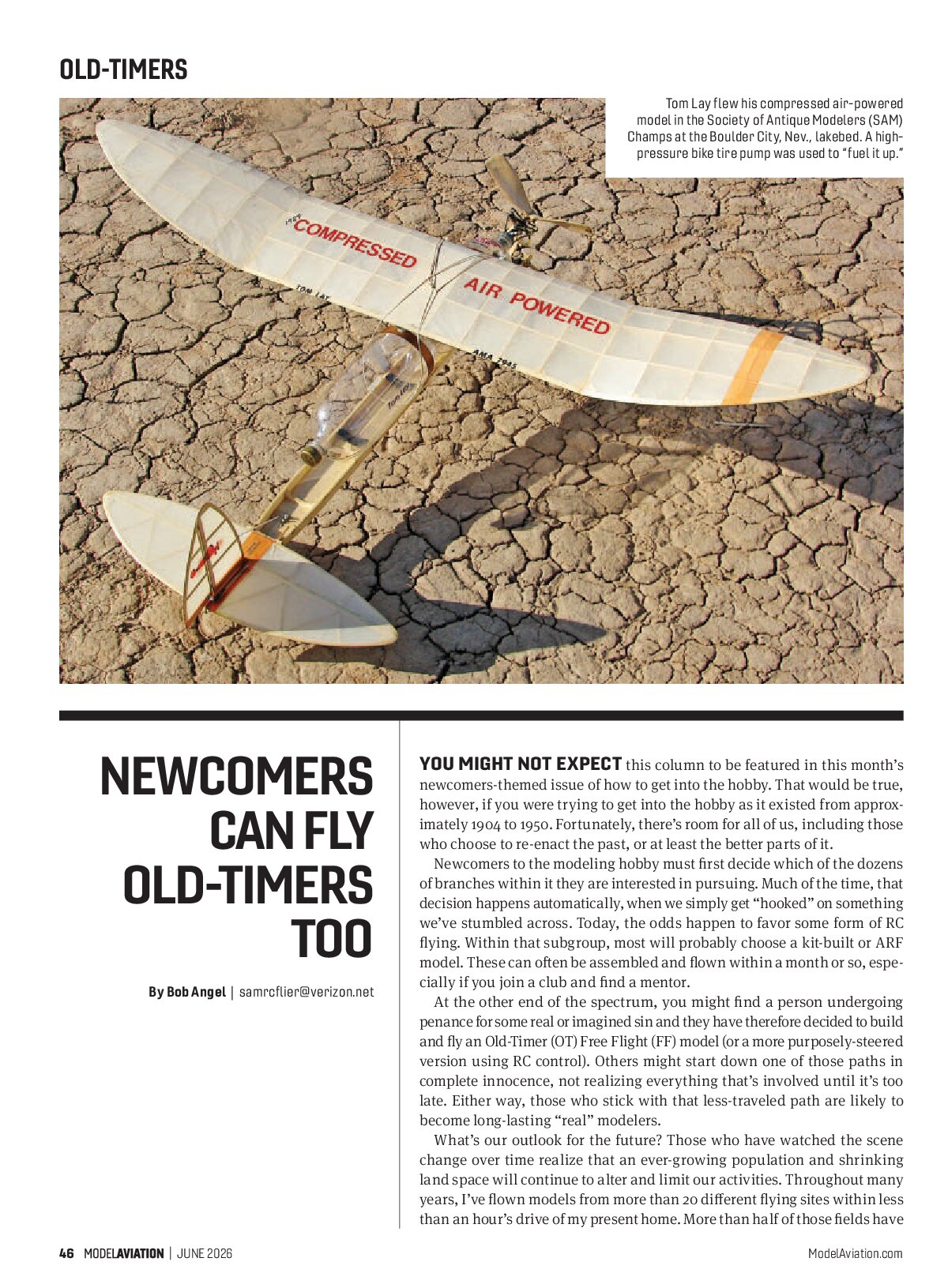
Tom Lay flew his compressed air-powered model in the Society of Antique Modelers (SAM) Champs at the Boulder City, Nev., lakebed. A high-pressure bike tire pump was used to “fuel it up.”
You might not expect this column to be featured in this month’s newcomers-themed issue of how to get into the hobby. That would be true, however, if you were trying to get into the hobby as it existed from approximately 1904 to 1950. Fortunately, there’s room for all of us, including those who choose to re-enact the past, or at least the better parts of it.
Newcomers to the modeling hobby must first decide which of the dozens of branches within it they are interested in pursuing. Much of the time, that decision happens automatically, when we simply get “hooked” on something we’ve stumbled across. Today, the odds happen to favor some form of RC flying. Within that subgroup, most will probably choose a kit-built or ARF model. These can often be assembled and flown within a month or so, especially if you join a club and find a mentor.
At the other end of the spectrum, you might find a person undergoing penance for some real or imagined sin and they have therefore decided to build and fly an Old-Timer (OT) Free Flight (FF) model (or a more purposely-steered version using RC control). Others might start down one of those paths in complete innocence, not realizing everything that’s involved until it’s too late. Either way, those who stick with that less-traveled path are likely to become long-lasting “real” modelers.
What’s our outlook for the future? Those who have watched the scene change over time realize that an ever-growing population and shrinking land space will continue to alter and limit our activities. Throughout many years, I’ve flown models from more than 20 different flying sites within less than an hour’s drive of my present home. More than half of those fields have since closed to model flying because of various types of “progress.”
Less than a month prior to this writing, RC flying was shut down on most military bases, including a major local one, as world tensions mounted. That base had recently hosted the biggest portion of our area’s RC flying. It’s hard to predict when—or if—those restrictions might end. If not soon, it will produce a significant impact on immediate and future RC building and flying as interest wanes and basic skills become lost.
Let’s review some of the challenges and options that are still open to those of us who have chosen to fly OT models.
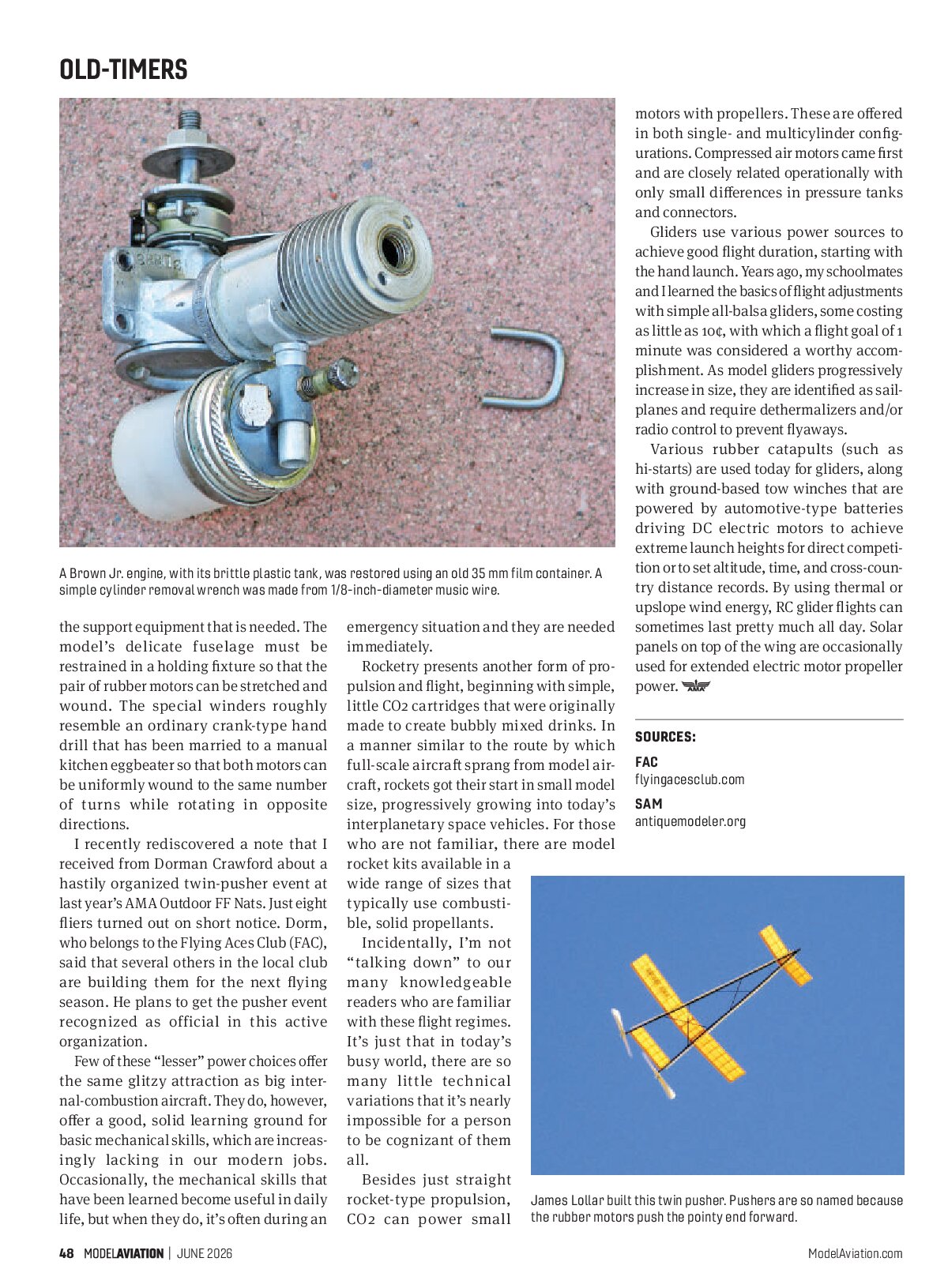
One problem we present to the world is noise. While we’ve developed and improved mufflers for years, civilization continues filling in more closely around us, requiring major shifts into ever more quiet power types. Original spark-ignition engines create the most noise and irritation for nearby neighbors, and their usage continues to shrink. They were first replaced by glow engines, which can be muffled more effectively without overheating and damage.
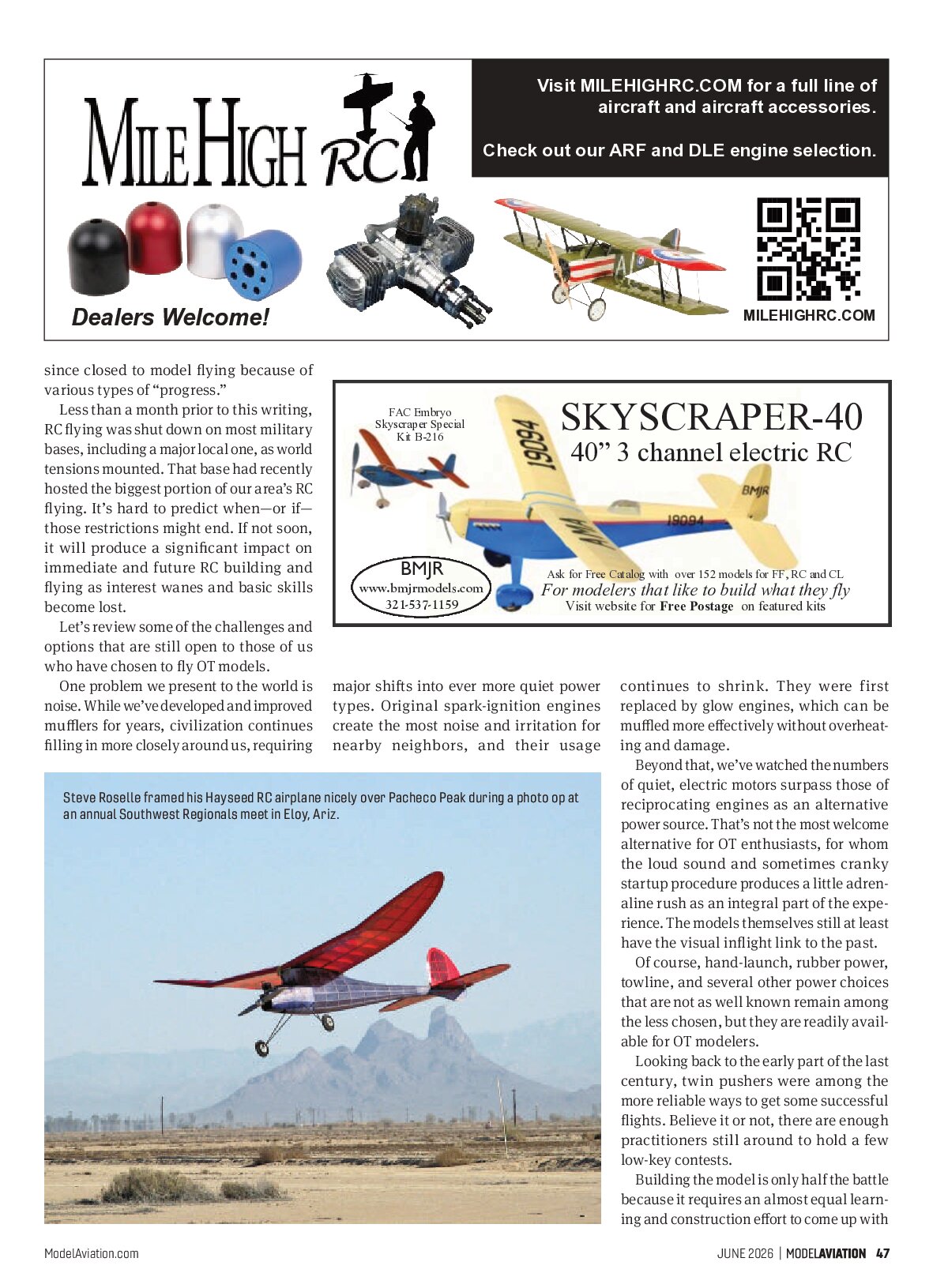
Beyond that, we’ve watched the numbers of quiet, electric motors surpass those of reciprocating engines as an alternative power source. That’s not the most welcome alternative for OT enthusiasts, for whom the loud sound and sometimes cranky startup procedure produces a little adrenaline rush as an integral part of the experience. The models themselves still at least have the visual inflight link to the past.
Of course, hand-launch, rubber power, towline, and several other power choices that are not as well known remain among the less chosen, but they are readily available for OT modelers.
Looking back to the early part of the last century, twin pushers were among the more reliable ways to get some successful flights. Believe it or not, there are enough practitioners still around to hold a few low-key contests.
Building the model is only half the battle because it requires an almost equal learning and construction effort to come up with the support equipment that is needed. The model’s delicate fuselage must be restrained in a holding fixture so that the pair of rubber motors can be stretched and wound. The special winders roughly resemble an ordinary crank-type hand drill that has been married to a manual kitchen eggbeater so that both motors can be uniformly wound to the same number of turns while rotating in opposite directions.
I recently rediscovered a note that I received from Dorman Crawford about a hastily organized twin-pusher event at last year’s AMA Outdoor FF Nats. Just eight fliers turned out on short notice. Dorm, who belongs to the Flying Aces Club (FAC), said that several others in the local club are building them for the next flying season. He plans to get the pusher event recognized as official in this active organization.
Few of these “lesser” power choices offer the same glitzy attraction as big internal-combustion aircraft. They do, however, offer a good, solid learning ground for basic mechanical skills, which are increasingly lacking in our modern jobs. Occasionally, the mechanical skills that have been learned become useful in daily life, but when they do, it’s often during an emergency situation and they are needed immediately.
Rocketry presents another form of propulsion and flight, beginning with simple, little CO2 cartridges that were originally made to create bubbly mixed drinks. In a manner similar to the route by which full-scale aircraft sprang from model aircraft, rockets got their start in small model size, progressively growing into today’s interplanetary space vehicles. For those who are not familiar, there are model rocket kits available in a wide range of sizes that typically use combustible, solid propellants.
Incidentally, I’m not “talking down” to our many knowledgeable readers who are familiar with these flight regimes. It’s just that in today’s busy world, there are so many little technical variations that it’s nearly impossible for a person to be cognizant of them all.
Besides just straight rocket-type propulsion, CO2 can power small motors with propellers. These are offered in both single- and multicylinder configurations. Compressed air motors came first and are closely related operationally with only small differences in pressure tanks and connectors.
Gliders use various power sources to achieve good flight duration, starting with the hand launch. Years ago, my schoolmates and I learned the basics of flight adjustments with simple all-balsa gliders, some costing as little as 10¢, with which a flight goal of 1 minute was considered a worthy accomplishment. As model gliders progressively increase in size, they are identified as sailplanes and require dethermalizers and/or radio control to prevent flyaways.
Various rubber catapults (such as hi-starts) are used today for gliders, along with ground-based tow winches that are powered by automotive-type batteries driving DC electric motors to achieve extreme launch heights for direct competition or to set altitude, time, and cross-country distance records. By using thermal or upslope wind energy, RC glider flights can sometimes last pretty much all day. Solar panels on top of the wing are occasionally used for extended electric motor propeller power.


SOURCES
- FAC
- flyingacesclub.com
- SAM
- antiquemodeler.org