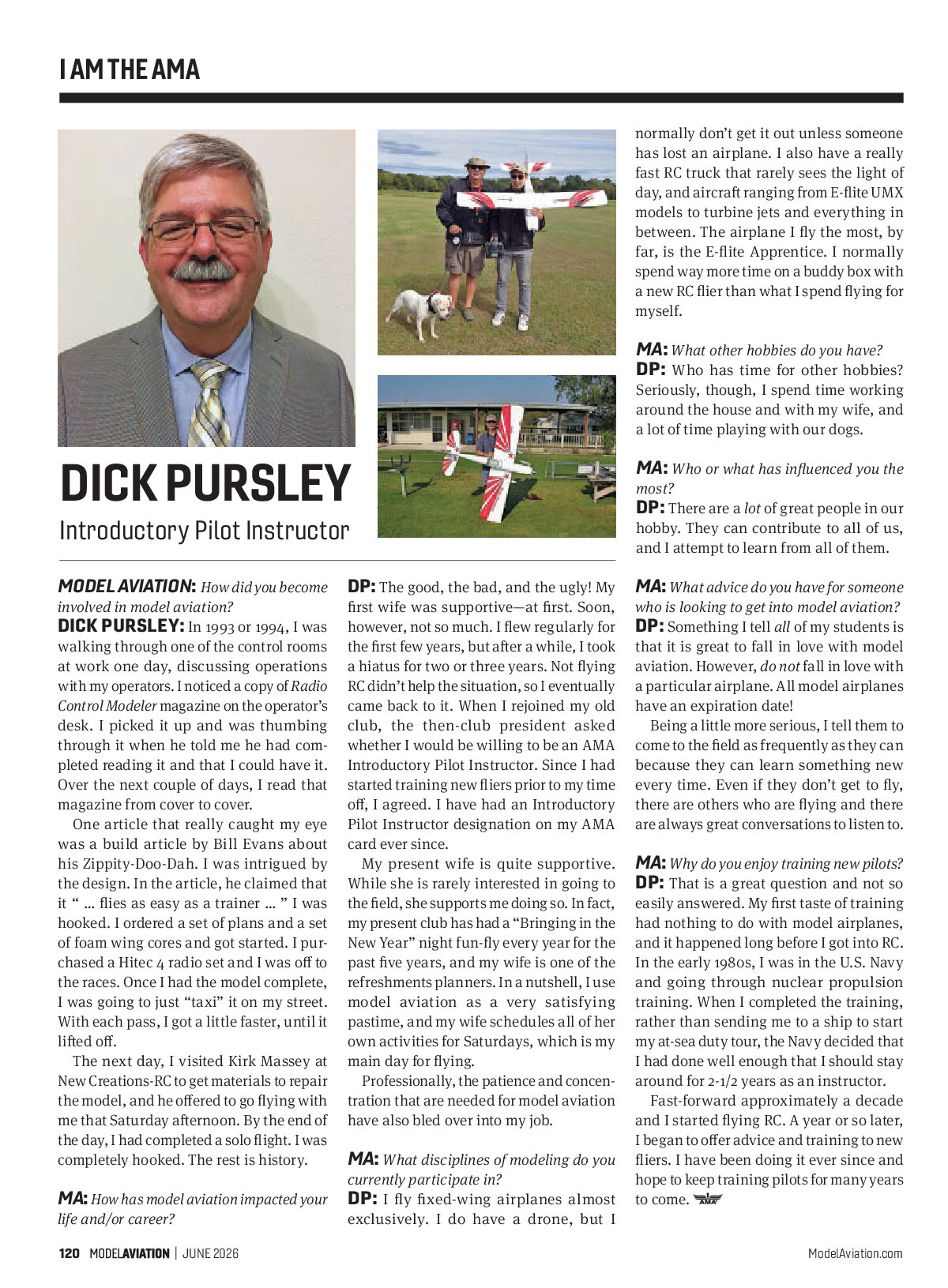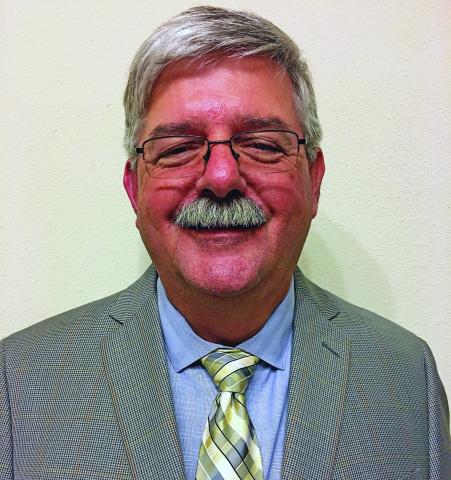
Dick Pursley
Introductory Pilot Instructor
Model Aviation: How did you become involved in model aviation?
Dick Pursley: In 1993 or 1994, I was walking through one of the control rooms at work one day, discussing operations with my operators. I noticed a copy of Radio Control Modeler magazine on the operator’s desk. I picked it up and was thumbing through it when he told me he had completed reading it and that I could have it. Over the next couple of days, I read that magazine from cover to cover.
One article that really caught my eye was a build article by Bill Evans about his Zippity-Doo-Dah. I was intrigued by the design. In the article, he claimed that it “ … flies as easy as a trainer … ” I was hooked. I ordered a set of plans and a set of foam wing cores and got started. I purchased a Hitec 4 radio set and I was off to the races. Once I had the model complete, I was going to just “taxi” it on my street. With each pass, I got a little faster, until it lifted off.
The next day, I visited Kirk Massey at New Creations-RC to get materials to repair the model, and he offered to go flying with me that Saturday afternoon. By the end of the day, I had completed a solo flight. I was completely hooked. The rest is history.
MA: How has model aviation impacted your life and/or career?
DP: The good, the bad, and the ugly! My first wife was supportive—at first. Soon, however, not so much. I flew regularly for the first few years, but after a while, I took a hiatus for two or three years. Not flying RC didn’t help the situation, so I eventually came back to it. When I rejoined my old club, the then-club president asked whether I would be willing to be an AMA Introductory Pilot Instructor. Since I had started training new fliers prior to my time off, I agreed. I have had an Introductory Pilot Instructor designation on my AMA card ever since.
My present wife is quite supportive. While she is rarely interested in going to the field, she supports me doing so. In fact, my present club has had a “Bringing in the New Year” night fun-fly every year for the past five years, and my wife is one of the refreshments planners. In a nutshell, I use model aviation as a very satisfying pastime, and my wife schedules all of her own activities for Saturdays, which is my main day for flying.
Professionally, the patience and concentration that are needed for model aviation have also bled over into my job.
MA: What disciplines of modeling do you currently participate in?
DP: I fly fixed-wing airplanes almost exclusively. I do have a drone, but I normally don’t get it out unless someone has lost an airplane. I also have a really fast RC truck that rarely sees the light of day, and aircraft ranging from E-flite UMX models to turbine jets and everything in between. The airplane I fly the most, by far, is the E-flite Apprentice. I normally spend way more time on a buddy box with a new RC flier than what I spend flying for myself.
MA: What other hobbies do you have?
DP: Who has time for other hobbies? Seriously, though, I spend time working around the house and with my wife, and a lot of time playing with our dogs.
MA: Who or what has influenced you the most?
DP: There are a lot of great people in our hobby. They can contribute to all of us, and I attempt to learn from all of them.
MA: What advice do you have for someone who is looking to get into model aviation?
DP: Something I tell all of my students is that it is great to fall in love with model aviation. However, do not fall in love with a particular airplane. All model airplanes have an expiration date!
Being a little more serious, I tell them to come to the field as frequently as they can because they can learn something new every time. Even if they don’t get to fly, there are others who are flying and there are always great conversations to listen to.
MA: Why do you enjoy training new pilots?
DP: That is a great question and not so easily answered. My first taste of training had nothing to do with model airplanes, and it happened long before I got into RC. In the early 1980s, I was in the U.S. Navy and going through nuclear propulsion training. When I completed the training, rather than sending me to a ship to start my at-sea duty tour, the Navy decided that I had done well enough that I should stay around for 2-1/2 years as an instructor.
Fast-forward approximately a decade and I started flying RC. A year or so later, I began to offer advice and training to new fliers. I have been doing it ever since and hope to keep training pilots for many years to come.