Make this the year you fly in your first Scale contest!
Common misconceptions about competitive RC fixed-wing Scale are that the entry point into it is high and you need an amazing Scale model and superb flying skills. This is certainly not the case. In fact, the entry point is quite low for both the airplane and flying skills. You probably already have all that is needed. Are you now interested? Read on.

The entry-level class for RC Scale is called Pro-Am Sportsman Scale. Any model of a full-scale airplane is allowed in this class. It can be anything from an ARF to a museum-quality, original design. For documentation, only a photograph or drawing is needed to show that the particular type of full-scale airplane existed. This documentation will earn you five points.
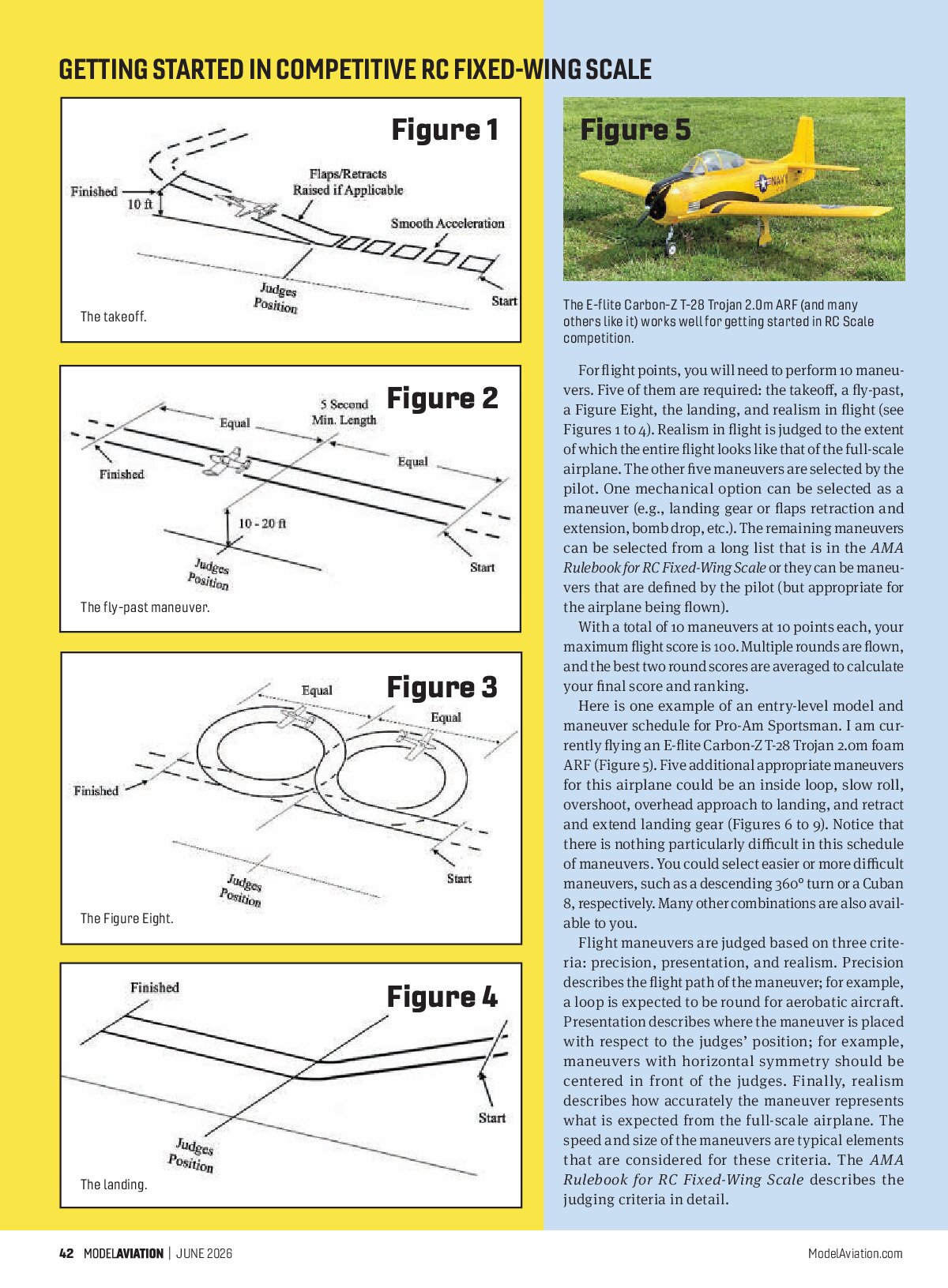
For flight points, you will need to perform 10 maneuvers. Five of them are required: the takeoff, a fly-past, a Figure Eight, the landing, and realism in flight (see Figures 1 to 4). Realism in flight is judged to the extent of which the entire flight looks like that of the full-scale airplane. The other five maneuvers are selected by the pilot. One mechanical option can be selected as a maneuver (e.g., landing gear or flaps retraction and extension, bomb drop, etc.). The remaining maneuvers can be selected from a long list that is in the AMA Rulebook for RC Fixed-Wing Scale or they can be maneuvers that are defined by the pilot (but appropriate for the airplane being flown).
With a total of 10 maneuvers at 10 points each, your maximum flight score is 100. Multiple rounds are flown, and the best two round scores are averaged to calculate your final score and ranking.
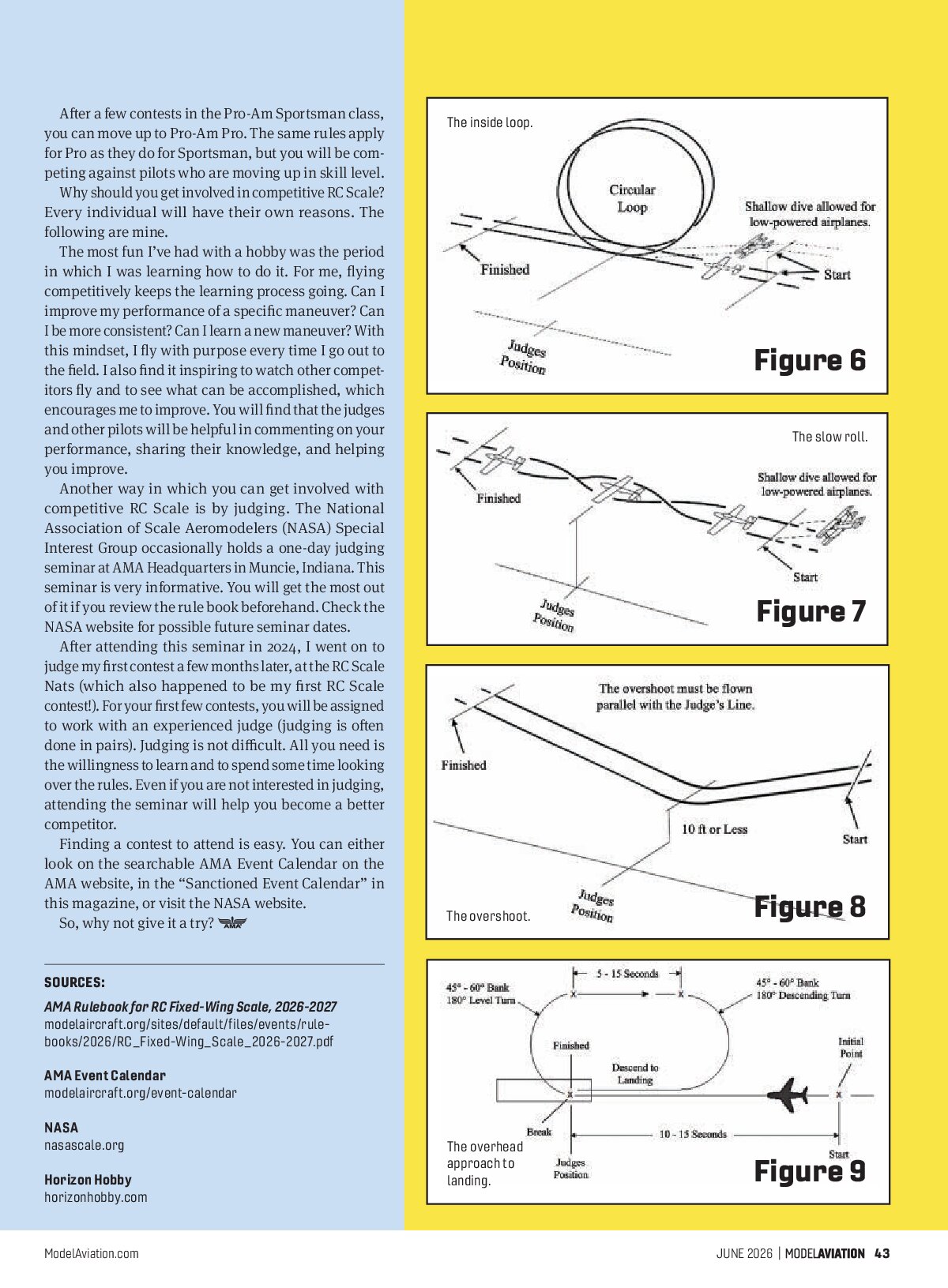
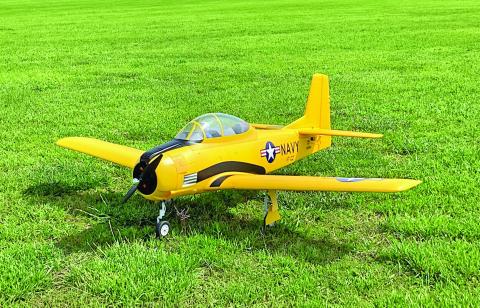
Here is one example of an entry-level model and maneuver schedule for Pro-Am Sportsman. I am currently flying an E-flite Carbon-Z T-28 Trojan 2.0m foam ARF (Figure 5). Five additional appropriate maneuvers for this airplane could be an inside loop, slow roll, overshoot, overhead approach to landing, and retract and extend landing gear (Figures 6 to 9). Notice that there is nothing particularly difficult in this schedule of maneuvers. You could select easier or more difficult maneuvers, such as a descending 360° turn or a Cuban 8, respectively. Many other combinations are also available to you.
Flight maneuvers are judged based on three criteria: precision, presentation, and realism. Precision describes the flight path of the maneuver; for example, a loop is expected to be round for aerobatic aircraft. Presentation describes where the maneuver is placed with respect to the judges’ position; for example, maneuvers with horizontal symmetry should be centered in front of the judges. Finally, realism describes how accurately the maneuver represents what is expected from the full-scale airplane. The speed and size of the maneuvers are typical elements that are considered for these criteria. The AMA Rulebook for RC Fixed-Wing Scale describes the judging criteria in detail.
After a few contests in the Pro-Am Sportsman class, you can move up to Pro-Am Pro. The same rules apply for Pro as they do for Sportsman, but you will be competing against pilots who are moving up in skill level.


Why should you get involved in competitive RC Scale? Every individual will have their own reasons. The following are mine.
The most fun I’ve had with a hobby was the period in which I was learning how to do it. For me, flying competitively keeps the learning process going. Can I improve my performance of a specific maneuver? Can I be more consistent? Can I learn a new maneuver? With this mindset, I fly with purpose every time I go out to the field. I also find it inspiring to watch other competitors fly and to see what can be accomplished, which encourages me to improve. You will find that the judges and other pilots will be helpful in commenting on your performance, sharing their knowledge, and helping you improve.
Another way in which you can get involved with competitive RC Scale is by judging. The National Association of Scale Aeromodelers (NASA) Special Interest Group occasionally holds a one-day judging seminar at AMA Headquarters in Muncie, Indiana. This seminar is very informative. You will get the most out of it if you review the rule book beforehand. Check the NASA website for possible future seminar dates.
After attending this seminar in 2024, I went on to judge my first contest a few months later, at the RC Scale Nats (which also happened to be my first RC Scale contest!). For your first few contests, you will be assigned to work with an experienced judge (judging is often done in pairs). Judging is not difficult. All you need is the willingness to learn and to spend some time looking over the rules. Even if you are not interested in judging, attending the seminar will help you become a better competitor.
Finding a contest to attend is easy. You can either look on the searchable AMA Event Calendar on the AMA website, in the “Sanctioned Event Calendar” in this magazine, or visit the NASA website.
So, why not give it a try?


SOURCES
- AMA Rulebook for RC Fixed-Wing Scale, 2026-2027
modelaircraft.org/sites/default/files/events/rule-books/2026/RC_Fixed-Wing_Scale_2026-2027.pdf - AMA Event Calendar
modelaircraft.org/event-calendar - NASA
nasascale.org - Horizon Hobby
horizonhobby.com