Interested in sharing your handiwork? Visit ModelAviation.com for submission guidelines.
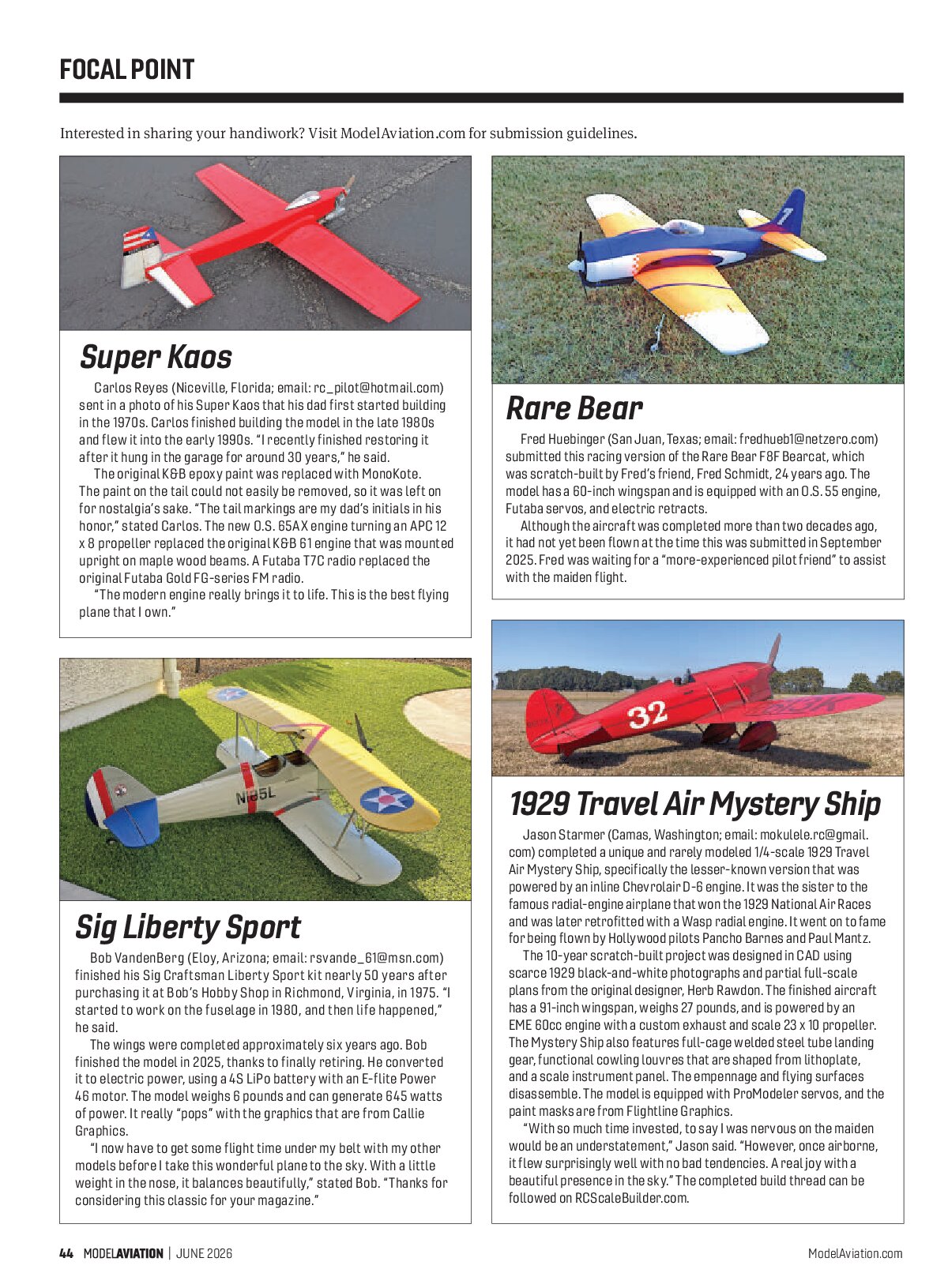
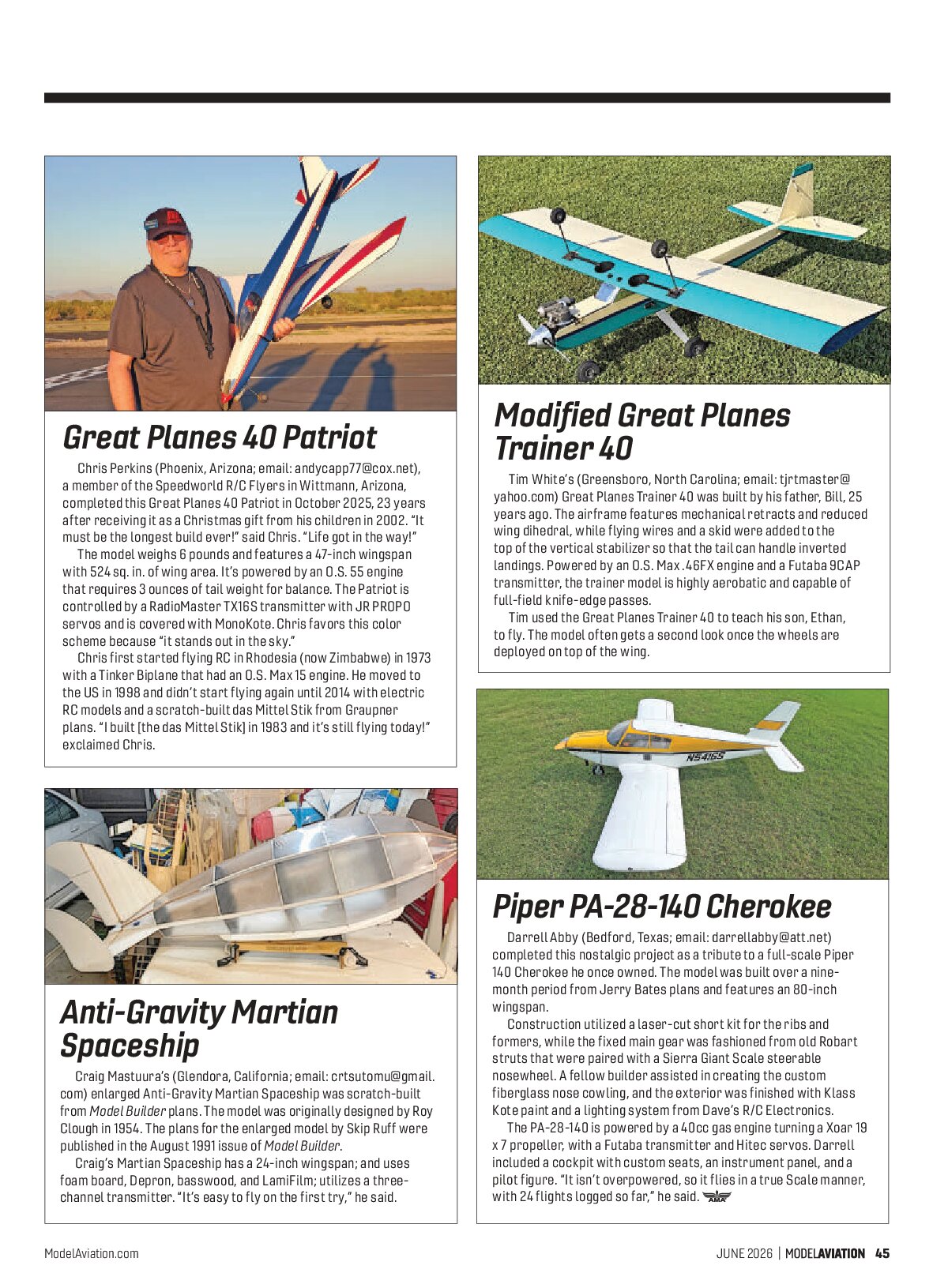
Carlos Reyes (Niceville, Florida; email: rc_pilot@hotmail.com) sent in a photo of his Super Kaos that his dad first started building in the 1970s. Carlos finished building the model in the late 1980s and flew it into the early 1990s. “I recently finished restoring it after it hung in the garage for around 30 years,” he said.
The original K&B epoxy paint was replaced with MonoKote. The paint on the tail could not easily be removed, so it was left on for nostalgia’s sake. “The tail markings are my dad’s initials in his honor,” stated Carlos. The new O.S. 65AX engine turning an APC 12 x 8 propeller replaced the original K&B 61 engine that was mounted upright on maple wood beams. A Futaba T7C radio replaced the original Futaba Gold FG-series FM radio.
“The modern engine really brings it to life. This is the best flying plane that I own.”
Fred Huebinger (San Juan, Texas; email: fredhueb1@netzero.com) submitted this racing version of the Rare Bear F8F Bearcat, which was scratch-built by Fred’s friend, Fred Schmidt, 24 years ago. The model has a 60-inch wingspan and is equipped with an O.S. 55 engine, Futaba servos, and electric retracts.
Although the aircraft was completed more than two decades ago, it had not yet been flown at the time this was submitted in September 2025. Fred was waiting for a “more-experienced pilot friend” to assist with the maiden flight.
Jason Starmer (Camas, Washington; email: mokulele.rc@gmail.com) completed a unique and rarely modeled 1/4-scale 1929 Travel Air Mystery Ship, specifically the lesser-known version that was powered by an inline Chevrolair D-6 engine. It was the sister to the famous radial-engine airplane that won the 1929 National Air Races and was later retrofitted with a Wasp radial engine. It went on to fame for being flown by Hollywood pilots Pancho Barnes and Paul Mantz.
The 10-year scratch-built project was designed in CAD using scarce 1929 black-and-white photographs and partial full-scale plans from the original designer, Herb Rawdon. The finished aircraft has a 91-inch wingspan, weighs 27 pounds, and is powered by an EME 60cc engine with a custom exhaust and scale 23 x 10 propeller. The Mystery Ship also features full-cage welded steel tube landing gear, functional cowling louvres that are shaped from lithoplate, and a scale instrument panel. The empennage and flying surfaces disassemble. The model is equipped with ProModeler servos, and the paint masks are from Flightline Graphics.
“With so much time invested, to say I was nervous on the maiden would be an understatement,” Jason said. “However, once airborne, it flew surprisingly well with no bad tendencies. A real joy with a beautiful presence in the sky.” The completed build thread can be followed on RCScaleBuilder.com.
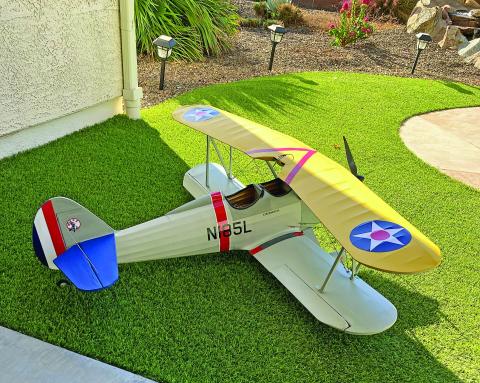
Bob VandenBerg (Eloy, Arizona; email: rsvande_61@msn.com) finished his Sig Craftsman Liberty Sport kit nearly 50 years after purchasing it at Bob’s Hobby Shop in Richmond, Virginia, in 1975. “I started to work on the fuselage in 1980, and then life happened,” he said.
The wings were completed approximately six years ago. Bob finished the model in 2025, thanks to finally retiring. He converted it to electric power, using a 4S LiPo battery with an E-flite Power 46 motor. The model weighs 6 pounds and can generate 645 watts of power. It really “pops” with the graphics that are from Callie Graphics.
“I now have to get some flight time under my belt with my other models before I take this wonderful plane to the sky. With a little weight in the nose, it balances beautifully,” stated Bob. “Thanks for considering this classic for your magazine.”


Tim White’s (Greensboro, North Carolina; email: tjrtmaster@yahoo.com) Great Planes Trainer 40 was built by his father, Bill, 25 years ago. The airframe features mechanical retracts and reduced wing dihedral, while flying wires and a skid were added to the top of the vertical stabilizer so that the tail can handle inverted landings. Powered by an O.S. Max .46FX engine and a Futaba 9CAP transmitter, the trainer model is highly aerobatic and capable of full-field knife-edge passes.
Tim used the Great Planes Trainer 40 to teach his son, Ethan, to fly. The model often gets a second look once the wheels are deployed on top of the wing.
Chris Perkins (Phoenix, Arizona; email: andycapp77@cox.net), a member of the Speedworld R/C Flyers in Wittmann, Arizona, completed this Great Planes 40 Patriot in October 2025, 23 years after receiving it as a Christmas gift from his children in 2002. “It must be the longest build ever!” said Chris. “Life got in the way!”
The model weighs 6 pounds and features a 47-inch wingspan with 524 sq. in. of wing area. It’s powered by an O.S. 55 engine that requires 3 ounces of tail weight for balance. The Patriot is controlled by a RadioMaster TX16S transmitter with JR PROPO servos and is covered with MonoKote. Chris favors this color scheme because “it stands out in the sky.”
Chris first started flying RC in Rhodesia (now Zimbabwe) in 1973 with a Tinker Biplane that had an O.S. Max 15 engine. He moved to the US in 1998 and didn’t start flying again until 2014 with electric RC models and a scratch-built das Mittel Stik from Graupner plans. “I built [the das Mittel Stik] in 1983 and it’s still flying today!” exclaimed Chris.
Darrell Abby (Bedford, Texas; email: darrellabby@att.net) completed this nostalgic project as a tribute to a full-scale Piper 140 Cherokee he once owned. The model was built over a nine-month period from Jerry Bates plans and features an 80-inch wingspan.
Construction utilized a laser-cut short kit for the ribs and formers, while the fixed main gear was fashioned from old Robart struts that were paired with a Sierra Giant Scale steerable nosewheel. A fellow builder assisted in creating the custom fiberglass nose cowling, and the exterior was finished with Klass Kote paint and a lighting system from Dave’s R/C Electronics.
The PA-28-140 is powered by a 40cc gas engine turning a Xoar 19 x 7 propeller, with a Futaba transmitter and Hitec servos. Darrell included a cockpit with custom seats, an instrument panel, and a pilot figure. “It isn’t overpowered, so it flies in a true Scale manner, with 24 flights logged so far,” he said.
Craig Mastuura’s (Glendora, California; email: crtsutomu@gmail.com) enlarged Anti-Gravity Martian Spaceship was scratch-built from Model Builder plans. The model was originally designed by Roy Clough in 1954. The plans for the enlarged model by Skip Ruff were published in the August 1991 issue of Model Builder.
Craig’s Martian Spaceship has a 24-inch wingspan; and uses foam board, Depron, basswood, and LamiFilm; utilizes a three-channel transmitter. “It’s easy to fly on the first try,” he said.